Shigeo Okumura Art

Japanese, 1937-1993

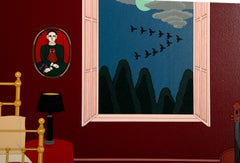
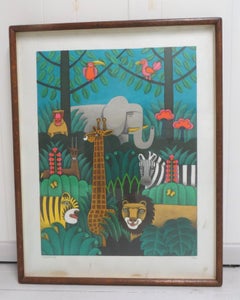
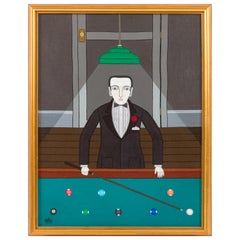
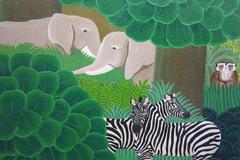
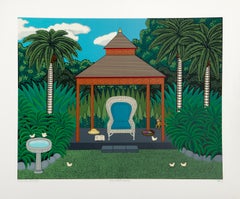
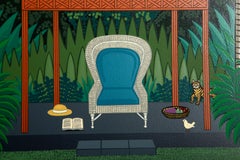
Shigeo Okumura, better known as OKU, paints with vibrant colors and crisp lines. He combines the grace of traditional Japanese art forms with the nostalgic subject matter of the West. In 1970, his work was selected for the touring exhibition "Symbols and Images," sponsored by the Whitney Museum of Art and the American Federation of the Arts.

to
6
6
5
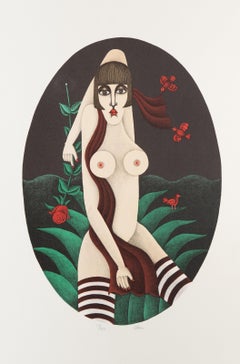
Woman with Rose, Modern Screen Print by Shigeo Okumura
By Shigeo Okumura
Located in Long Island City, NY
Shigeo Okumura, Japanese (1937 - 1993) - Woman with Rose, Medium: Screenprint on Arches, signed and numbered in pencil, Edition: 17/180, Image Size: 20 x 14 inches, Size: 30 x 22 in....
Category

Late 20th Century Modern Shigeo Okumura Art

Materials

Screen

A New Leaf, Modern Screen Print by Shigeo Okumura
By Shigeo Okumura
Located in Long Island City, NY
Shigeo Okumura, Japanese (1937 - 1993) - A New Leaf, Medium: Screenprint on Arches, signed, numbered and titled in pencil, Edition: AP, Image Size: 20 x 24.5 inches, Size: 25 x 29 in...
Category

Late 20th Century Modern Shigeo Okumura Art

Materials

Screen

Duck Dinner, Modern Screen Print by Shigeo Okumura
By Shigeo Okumura
Located in Long Island City, NY
Shigeo Okumura, Japanese (1937 - 1993) - Duck Dinner, Medium: Screenprint on Arches, signed, numbered and titled in pencil, Edition: AP, Image Size: 20 x 24 inches, Size: 24.5 x 29 i...
Category

Late 20th Century Modern Shigeo Okumura Art

Materials

Screen

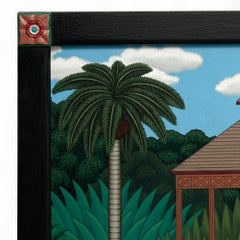
Modernist Painting of a Tropical Garden by Shigeo Okumura
By Shigeo Okumura
Located in Palm Beach, FL
Vintage oil painting on canvas of a tropical garden with palm trees, plants, birds and a pergola, executed in a distinctive modernist naive style. Signed Shigeo Okumura in the lower ...
Category

20th Century Shigeo Okumura Art

Materials

Acrylic

Lunch Break, Modern Screen Print by Shigeo Okumura
By Shigeo Okumura
Located in Long Island City, NY
Shigeo Okumura, Japanese (1937 - 1993) - Lunch Break, Medium: Screenprint on Arches, signed, numbered and titled in pencil, Edition: AP, Image Size: 20 x 25 inches, Size: 25 x 29.75 ...
Category

Late 20th Century Modern Shigeo Okumura Art

Materials

Screen
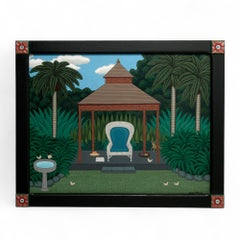
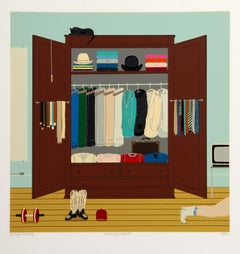
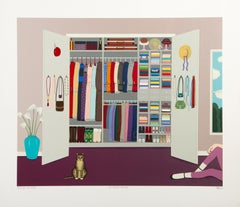
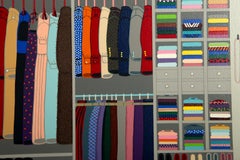
Jimmy's Closet, Modern Screen Print by Shigeo Okumura
By Shigeo Okumura
Located in Long Island City, NY
Shigeo Okumura, Japanese (1937 - 1993) - Jimmy's Closet, Medium: Screenprint on Arches, signed, numbered and titled in pencil, Edition: AP, Image Size: 20 x 20 inches, Size: 27 x 25 ...
Category

Late 20th Century Modern Shigeo Okumura Art

Materials

Screen
Related Items
Erté (Romain de Tirtoff) - Manhattan Mary IV: serigraph Broadway musical
By Erté
Located in London, GB
Erté (Romain de Tirtoff) (1892-1990) 'Manhattan Mary IV' Serigraph (Silk screen print) (Artist's Proof IL/L) Signed in pencil 70 x 56cm (sheet) 41.5 x 3...
Category

1920s Modern Shigeo Okumura Art

Materials

Screen
Color and Silence, Original Painting
Located in San Francisco, CA

Artist Comments
A solitary, weathered farmhouse stands silhouetted against a vast prairie under a vibrant sunset. A peaceful stream reflects the fiery hues, creating a mirror...

Category

21st Century and Contemporary Contemporary Shigeo Okumura Art

Materials

Acrylic

Ratfinkbonerthunk : Surrealist Rat - Original Giclee Print, Handsigned
By Kenny Scharf
Located in Paris, IDF
Kenny Scharf Ratfinkbonerthunk : Surrealist Rat, 1990 Original Giclee Print Handsigned in pencil On Arches vellum 56 x 76 cm (c. 22 x 30 in) Published by Editions Vermorel in 1990 ...
Category

1990s American Modern Shigeo Okumura Art

Materials

Giclée, Screen

Large 4-Foot Acrylic on Canvas Realist Landscape by Tom Perkinson, Framed
By Tom Perkinson
Located in Encino, CA
Untitled Landscape is an original acrylic painting on canvas by Tom Perkinson. His use of saturated violets, vivid yellows, and resplendent oranges pushes color to almost-otherworldly realms. The viewer is invited to step into the painting to explore the scene within and imagine gazing at an easel of a plein-air painter with the water-filled sky and saturated ground in full view. Here, Perkinson chose to depict the beauty and calm of the rain, with an expansive view of a lush landscape. Women are holding umbrellas in the middle ground with their young children enjoying the feeling of rain drops. A pond just creeps into view from the right and the edge of town can be seen in the distance, just over the trees. Perkinson describes his style of painting as "Romantic Realism," a technique that incorporates two iconic art movements. This style, in combination with the imagination of the artist, produces remarkable results, showcasing Perkinson's keen ability to capture emotion, nature, and life - all in a brushstroke. Both his technical talent and choice of subject matter pair perfectly with its carved, custom, antique-finish, gilt frame. This masterful work would make a great addition to an art collection and enhance most any home, perfect for those who have an affinity for landscapes, impressionism, romanticism, realism, plein-air painting, and nature. In the artist’s own words: “My color combinations aren’t in the realm of the natural world, because I don’t paint reality; I’m a painter of fiction. I try to paint a sense of place, as though this scene really does exist. I have had my collectors ask me where this scene is, and I just have to point to my head and say I made it up. Thus, I think of my work as romantic realism. I’m painting a certain reality that I’ve invented, inspired by the fascinatingly rich Southwestern landscape.” “Color gets all the credit, but it’s the values that do all the work. I don’t begin with sketches, because I want to be free to follow the painting in any direction. I start with washes of different values and tints. Then, I begin to look for a landscape. Several directions will appear to me at this time, and then I have to decide on one of them. During these first few moments, I must establish my distance from the scene. Am I a mile away or just across the river? This is one of the first steps, and I have to decide before I can continue. It’s important for working out the perspective and how things are going to relate to one another in the picture. Then, as the landscape evolves, I look for more images to add to the composition.” Artist: TOM PERKINSON (1940-) Title: UNTITLED LANDSCAPE Medium & Surface: ORIGINAL ACRYLIC PAINTING ON CANVAS (framed) Signed: HAND SIGNED AND DATED BY ARTIST LOWER RIGHT Year Created: 1983 Country of Creation: UNITED STATES Image Area Dimensions: 24 x 40 INCHES Frame Dimensions:* 28.5 x 44.75 x 1 INCHES *This work of art is being sold framed. If you would like to change the frame to better match your style or environment, please contact us for Custom Archival Framing options. Additional Info: HIGHLY COLLECTIBLE WORK BY TOM PERKINSON IN GREAT CONDITION IN A CARVED CUSTOM ANTIQUE-FINISH GILT FRAME. FRAME IS IN GREAT CONDITION CONSISTENT WITH AGE AND STYLE. Artist Info/Bio: ARTIST BIOGRAPHY DOCUMENT IS INCLUDED Documentation: CERTIFICATE OF AUTHENTICITY IS INCLUDED About the Artist: Tom Perkinson, born in Indiana in 1940, has become distinguished as a regional painter, known for his work grounded in the visually dramatic landscape of the Southwest. As a child, Perkinson discovered he had a love for the natural landscape, and a talent for art. He fostered that talent through classes at the John Herron Institute of Art in Indianapolis, and then at the Chicago Art Academy upon graduating from high school. He received a degree in art from Oklahoma Baptist University in 1964, before moving on to graduate school at the University of New Mexico. Here, among noted works of a larger scale, he continued to paint the landscape, and it was this work that began to reflect a new fascination with the Southwest. He had found what would become an infinite source of inspiration. Influenced by early painters of the southern Indiana landscape...
Category

1980s Realist Shigeo Okumura Art

Materials

Acrylic, Canvas

The Boundaries Of Our Realities Are Set By The Limits Of Our Imagination
By The Connor Brothers
Located in New York, NY
A pristine color screenprint, acrylic and oil paint and varnish over giclée on paper. Signed and dated in white ink by the Connor Brothers. Dimensions with the frame are 32 x 22 inches.
Category

2010s Modern Shigeo Okumura Art

Materials

Paper, Varnish, Oil, Acrylic, Color, Giclée, Screen

Baden Baden, Casino
By LeRoy Neiman
Located in San Francisco, CA
This artwork titled "Baden Baden, Casino" 1988 is an original color serigraph by noted American artist LeRoy Neiman, 1921-2012. It is hand signed and numbered 261/375 in pencil by the artist. The image size is 36 x 42 inches, sheet size is 42 x 48 inches. With the blind stamp of the printer Styria Studio at the lower left corner margin. It is in excellent condition, three small pieces of hanging tape remain on the back. About the artist: Mr. Neiman's kinetic, quickly executed paintings and drawings, many of them published in Playboy, offered his fans gaudily colored visual reports on heavyweight boxing matches, Super Bowl games and Olympic contests, as well as social panoramas like the horse races at Deauville, France, and the Cannes Film Festival. Quite consciously, he cast himself in the mold of French Impressionists like Toulouse-Lautrec, Renoir and Degas, chroniclers of public life who found rich social material at racetracks, dance halls and cafes. Mr. Neiman often painted or sketched on live television. With the camera recording his progress at the sketchpad or easel, he interpreted the drama of Olympic Games and Super Bowls for an audience of millions. When Bobby Fischer and Boris Spassky faced off in Reykjavik, Iceland, to decide the world chess championship, Mr. Neiman was there, sketching. He was on hand to capture Federico Fellini directing "8 ½" and the Kirov Ballet performing in the Soviet Union. In popularity, Mr. Neiman rivaled American favorites like Norman Rockwell, Grandma Moses and Andrew Wyeth. A prolific one-man industry, he generated hundreds of paintings, drawings, watercolors, limited-edition serigraph prints and coffee-table books yearly, earning gross annual revenue in the tens of millions of dollars. Although he exhibited constantly and his work was included in the collections of dozens of museums around the world, critical respect eluded him. Mainstream art critics either ignored him completely or, if forced to consider his work, dismissed it with contempt as garish and superficial — magazine illustration with pretensions. Mr. Neiman professed not to care. Maybe the critics are right," he told American Artist magazine in 1995. "But what am I supposed to do about it — stop painting, change my work completely? I go back into the studio, and there I am at the easel again. I enjoy what I'm doing and feel good working. Other thoughts are just crowded out." His image suggested an artist well beyond the reach of criticism. A dandy and bon vivant, he cut an arresting figure with his luxuriant ear-to-ear mustache, white suits, flashy hats and Cuban cigars. "He quite intentionally invented himself as a flamboyant artist not unlike Salvador Dalí, in much the same way that I became Mr. Playboy in the late '50s," Hugh Hefner told Cigar Aficionado magazine in 1995. LeRoy Runquist was born on June 8, 1921, in St. Paul. His father, a railroad worker, deserted the family when LeRoy was quite young, and the boy took the surname of his stepfather. He showed a flair for art at an early age. While attending a local Roman Catholic school, he impressed schoolmates by drawing ink tattoos on their arms during recess. As a teenager, he earned money doing illustrations for local grocery stores. "I'd sketch a turkey, a cow, a fish, with the prices," he told Cigar Aficionado. "And then I had the good sense to draw the guy who owned the store. This gave me tremendous power as a kid." After being drafted into the Army in 1942, he served as a cook in the European theater but in his spare time painted risqué murals on the walls of kitchens and mess halls. The Army's Special Services Division, recognizing his talent, put him to work painting stage sets for Red Cross shows when he was stationed in Germany after the war. On leaving the military, he studied briefly at the St. Paul School of Art (now the Minnesota Museum of American Art) before enrolling in the School of the Art Institute of Chicago, where, after four years of study, he taught figure drawing and fashion illustration throughout the 1950s. When the janitor of the apartment building next door to his threw out half-empty cans of enamel house paint, Mr. Neiman found his métier. Experimenting with the new medium, he embraced a rapid style of applying paint to canvas imposed by the free-flowing quality of the house paint. While doing freelance fashion illustration for the Carson Pirie Scott department store in Chicago in the early 1950s, he became friendly with Mr. Hefner, a copywriter there who was on the verge of publishing the first issue of a men's magazine. In 1954, after five issues of Playboy had appeared, Mr. Neiman ran into Mr. Hefner and invited him to his apartment to see his paintings of boxers, strip clubs and restaurants. Mr. Hefner, impressed, showed the work to Playboy's art director, Art Paul, who commissioned an illustration for "Black Country," a story by Charles Beaumont about a jazz musician. Thus began a relationship that endured for more than half a century and established Mr. Neiman's reputation. In 1955, when Mr. Hefner decided that the party-jokes page needed visual interest, Mr. Neiman came up with the Femlin, a curvaceous brunette who cavorted across the page in thigh-high stockings, high-heeled shoes, opera gloves and nothing else. She appeared in every issue of the magazine thereafter. Three years later, Mr. Neiman devised a running feature, "Man at His Leisure." For the next 15 years, he went on assignment to glamour spots around the world, sending back visual reports on subjects as varied as the races at Royal Ascot, the dining room of the Tour d'Argent in Paris, the nude beaches of the Dalmatian coast, the running of the bulls at Pamplona and Carnaby Street in swinging London. He later produced more than 100 paintings and 2 murals for 18 of the Playboy clubs that opened around the world. "Playboy made the good life a reality for me and made it the subject matter of my paintings — not affluence and luxury as such, but joie de vivre itself," Mr. Neiman told V.I.P. magazine in 1962. Working in the same copywriting department at Carson Pirie Scott as Mr. Hefner was Janet Byrne, a student at the Art Institute. She and Mr. Neiman married in 1957. She survives him. A prolific artist, he generated dozens of paintings each year that routinely commanded five-figure prices. When Christie's auctioned off the Playboy archives in 2003, his 1969 painting Man at His Leisure: Le Mans sold for $107,550. Sales of the signed, limited-edition print versions of his paintings, published in editions of 250 to 500, became a lucrative business in itself after Knoedler Publishing, a wholesale operation, was created in 1975 to publish and distribute his serigraphs, etchings, books and posters. Mr. Neiman's most famous images came from the world of sports. His long association with the Olympics began with the Winter Games in Squaw Valley in 1960, and he went on to cover the games, on live television, in Munich in 1972, Montreal in 1976, Lake Placid in 1980, and Sarajevo and Los Angeles in 1984, using watercolor, ink or felt-tip marker to produce images with the dispatch of a courtroom sketch artist. At the 1978 and 1979 Super Bowls, he used a computerized electronic pen to portray the action for CBS. Although he was best known for scenes filled with people and incident, he also painted many portraits. Athletes predominated, with Muhammad Ali and Joe Namath among his more famous subjects, but he also painted Leonard Bernstein, the ballet dancer Suzanne Farrell...
Category

21st Century and Contemporary American Modern Shigeo Okumura Art

Materials

Screen
Baden Baden, Casino
Baden Baden, Casino
$4,000
H 42 in W 48 in D 0.01 in
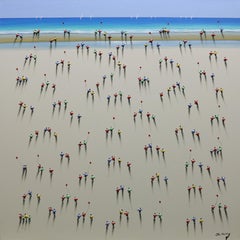
On the lake - landscape painting
By Jeroen Allart
Located in New York, NY
This beautiful figurative painting by Jeroen Allart is part of his minimalist landscape painting he did in his home country the Netherlands. A farm stands before you on the horizon....
Category

2010s Minimalist Shigeo Okumura Art

Materials

Canvas, Acrylic

On the lake - landscape painting
$5,360 Sale Price
20% Off
H 39.38 in W 47.25 in D 1.19 in
"Spring Journey" Original Acrylic Painting on Canvas by Tom Perkinson, Framed
By Tom Perkinson
Located in Encino, CA
"Spring Journey" is an original acrylic painting on canvas by Tom Perkinson. His use of saturated violets, vivid yellows, and resplendent oranges pushes color to almost-otherworldly realms. The viewer is invited to step into the painting to explore the scene within and imagine gazing at an easel of a plein-air painter with the blue sky, clouds, and terrain in full view. Here, Perkinson chose to depict a tribal group traveling during springtime with the vast sky above. Tribal members are both on foot and horseback, and comprise of men, women, and children - all trekking across the landscape beneath the foothills to a destiny unknown to us as the viewer. Perkinson describes his style of painting as "Romantic Realism," a technique that incorporates two iconic art movements. This style, in combination with the imagination of the artist, produces remarkable results, showcasing Perkinson's keen ability to capture emotion, nature, and life - all in a brushstroke. Both his technical talent and choice of subject matter pair perfectly with its original raw wood frame. The frame is by Legendwood in Sedona, Arizona, which no longer exists. Their frames are highly collectible, as they are rare, custom, and handmade. This masterful work would make a great addition to an art collection and enhance most any home, perfect for those who have an affinity for landscapes, impressionism, romanticism, realism, Southwestern Art, Native American themed art, plein-air painting, and nature. In the artist’s own words: “My color combinations aren’t in the realm of the natural world, because I don’t paint reality; I’m a painter of fiction. I try to paint a sense of place, as though this scene really does exist. I have had my collectors ask me where this scene is, and I just have to point to my head and say I made it up. Thus, I think of my work as romantic realism. I’m painting a certain reality that I’ve invented, inspired by the fascinatingly rich Southwestern landscape.” “Color gets all the credit, but it’s the values that do all the work. I don’t begin with sketches, because I want to be free to follow the painting in any direction. I start with washes of different values and tints. Then, I begin to look for a landscape. Several directions will appear to me at this time, and then I have to decide on one of them. During these first few moments, I must establish my distance from the scene. Am I a mile away or just across the river? This is one of the first steps, and I have to decide before I can continue. It’s important for working out the perspective and how things are going to relate to one another in the picture. Then, as the landscape evolves, I look for more images to add to the composition.” Artist: TOM PERKINSON (1940-) Title: SPRING JOURNEY Medium & Surface: ORIGINAL ACRYLIC PAINTING ON CANVAS (framed) Signed: HAND SIGNED BY ARTIST LOWER RIGHT Year Created: CIRCA 1979 Country of Creation: UNITED STATES Image Area Dimensions: 12 x 16 INCHES Frame Dimensions:* 19.5 x 23.625 x 2.125 INCHES *This work of art is being sold framed. If you would like to change the frame to better match your style or environment, please contact us for Custom Archival Framing options. Additional Info: HIGHLY COLLECTIBLE WORK BY TOM PERKINSON IN GREAT CONDITION IN ITS ORIGINAL UNIQUE RAW WOOD FRAME BY LEGENDWOOD, SEDONA, ARIZONA. FRAME IS IN GREAT CONDITION WITH MINOR WEAR CONSISTENT WITH AGE AND STYLE. Artist Info/Bio: ARTIST BIOGRAPHY DOCUMENT IS INCLUDED Documentation: CERTIFICATE OF AUTHENTICITY IS INCLUDED About the Artist: Tom Perkinson, born in Indiana in 1940, has become distinguished as a regional painter, known for his work grounded in the visually dramatic landscape of the Southwest. As a child, Perkinson discovered he had a love for the natural landscape, and a talent for art. He fostered that talent through classes at the John Herron Institute of Art in Indianapolis, and then at the Chicago Art Academy upon graduating from high school. He received a degree in art from Oklahoma Baptist University in 1964, before moving on to graduate school at the University of New Mexico. Here, among noted works of a larger scale, he continued to paint the landscape, and it was this work that began to reflect a new fascination with the Southwest. He had found what would become an infinite source of inspiration. Influenced by early painters of the southern Indiana landscape...
Category

1970s Realist Shigeo Okumura Art

Materials

Acrylic, Canvas

SUMMER DAYS
Located in CÓRDOBA, ES
Emerging young artist with a very personal and recognizable style. Without a doubt he will have a long journey and a great progression in her artistic career. Acrylic on canvas Ship...
Category

2010s Post-Modern Shigeo Okumura Art

Materials

Oil, Acrylic, Permanent Marker

SUMMER DAYS
SUMMER DAYS
$396
H 23.63 in W 23.63 in D 0.4 in
Left Bank Cafe, Paris
By LeRoy Neiman
Located in San Francisco, CA
This artwork titled "Left Bank Cafe, Paris" 1987 is an original color serigraph by noted American artist LeRoy Neiman, 1921-2012. It is hand signed and numbered H.C 166/175 in pencil by the artist. The image size is 26 x 38 inches, sheet size is 32.25 x 44 inches. With the blind stamp of the printer Styria Studio at the lower left corner margin. It is in excellent condition, two small pieces of hanging tape remain on the back. About the artist: Mr. Neiman's kinetic, quickly executed paintings and drawings, many of them published in Playboy, offered his fans gaudily colored visual reports on heavyweight boxing matches, Super Bowl games and Olympic contests, as well as social panoramas like the horse races at Deauville, France, and the Cannes Film Festival. Quite consciously, he cast himself in the mold of French Impressionists like Toulouse-Lautrec, Renoir and Degas, chroniclers of public life who found rich social material at racetracks, dance halls and cafes. Mr. Neiman often painted or sketched on live television. With the camera recording his progress at the sketchpad or easel, he interpreted the drama of Olympic Games and Super Bowls for an audience of millions. When Bobby Fischer and Boris Spassky faced off in Reykjavik, Iceland, to decide the world chess championship, Mr. Neiman was there, sketching. He was on hand to capture Federico Fellini directing "8 ½" and the Kirov Ballet performing in the Soviet Union. In popularity, Mr. Neiman rivaled American favorites like Norman Rockwell, Grandma Moses and Andrew Wyeth. A prolific one-man industry, he generated hundreds of paintings, drawings, watercolors, limited-edition serigraph prints and coffee-table books yearly, earning gross annual revenue in the tens of millions of dollars. Although he exhibited constantly and his work was included in the collections of dozens of museums around the world, critical respect eluded him. Mainstream art critics either ignored him completely or, if forced to consider his work, dismissed it with contempt as garish and superficial — magazine illustration with pretensions. Mr. Neiman professed not to care. Maybe the critics are right," he told American Artist magazine in 1995. "But what am I supposed to do about it — stop painting, change my work completely? I go back into the studio, and there I am at the easel again. I enjoy what I'm doing and feel good working. Other thoughts are just crowded out." His image suggested an artist well beyond the reach of criticism. A dandy and bon vivant, he cut an arresting figure with his luxuriant ear-to-ear mustache, white suits, flashy hats and Cuban cigars. "He quite intentionally invented himself as a flamboyant artist not unlike Salvador Dalí, in much the same way that I became Mr. Playboy in the late '50s," Hugh Hefner told Cigar Aficionado magazine in 1995. LeRoy Runquist was born on June 8, 1921, in St. Paul. His father, a railroad worker, deserted the family when LeRoy was quite young, and the boy took the surname of his stepfather. He showed a flair for art at an early age. While attending a local Roman Catholic school, he impressed schoolmates by drawing ink tattoos on their arms during recess. As a teenager, he earned money doing illustrations for local grocery stores. "I'd sketch a turkey, a cow, a fish, with the prices," he told Cigar Aficionado. "And then I had the good sense to draw the guy who owned the store. This gave me tremendous power as a kid." After being drafted into the Army in 1942, he served as a cook in the European theater but in his spare time painted risqué murals on the walls of kitchens and mess halls. The Army's Special Services Division, recognizing his talent, put him to work painting stage sets for Red Cross shows when he was stationed in Germany after the war. On leaving the military, he studied briefly at the St. Paul School of Art (now the Minnesota Museum of American Art) before enrolling in the School of the Art Institute of Chicago, where, after four years of study, he taught figure drawing and fashion illustration throughout the 1950s. When the janitor of the apartment building next door to his threw out half-empty cans of enamel house paint, Mr. Neiman found his métier. Experimenting with the new medium, he embraced a rapid style of applying paint to canvas imposed by the free-flowing quality of the house paint. While doing freelance fashion illustration for the Carson Pirie Scott department store in Chicago in the early 1950s, he became friendly with Mr. Hefner, a copywriter there who was on the verge of publishing the first issue of a men's magazine. In 1954, after five issues of Playboy had appeared, Mr. Neiman ran into Mr. Hefner and invited him to his apartment to see his paintings of boxers, strip clubs and restaurants. Mr. Hefner, impressed, showed the work to Playboy's art director, Art Paul, who commissioned an illustration for "Black Country," a story by Charles Beaumont about a jazz musician. Thus began a relationship that endured for more than half a century and established Mr. Neiman's reputation. In 1955, when Mr. Hefner decided that the party-jokes page needed visual interest, Mr. Neiman came up with the Femlin, a curvaceous brunette who cavorted across the page in thigh-high stockings, high-heeled shoes, opera gloves and nothing else. She appeared in every issue of the magazine thereafter. Three years later, Mr. Neiman devised a running feature, "Man at His Leisure." For the next 15 years, he went on assignment to glamour spots around the world, sending back visual reports on subjects as varied as the races at Royal Ascot, the dining room of the Tour d'Argent in Paris, the nude beaches of the Dalmatian coast, the running of the bulls at Pamplona and Carnaby Street in swinging London. He later produced more than 100 paintings and 2 murals for 18 of the Playboy clubs that opened around the world. "Playboy made the good life a reality for me and made it the subject matter of my paintings — not affluence and luxury as such, but joie de vivre itself," Mr. Neiman told V.I.P. magazine in 1962. Working in the same copywriting department at Carson Pirie Scott as Mr. Hefner was Janet Byrne, a student at the Art Institute. She and Mr. Neiman married in 1957. She survives him. A prolific artist, he generated dozens of paintings each year that routinely commanded five-figure prices. When Christie's auctioned off the Playboy archives in 2003, his 1969 painting Man at His Leisure: Le Mans sold for $107,550. Sales of the signed, limited-edition print versions of his paintings, published in editions of 250 to 500, became a lucrative business in itself after Knoedler Publishing, a wholesale operation, was created in 1975 to publish and distribute his serigraphs, etchings, books and posters. Mr. Neiman's most famous images came from the world of sports. His long association with the Olympics began with the Winter Games in Squaw Valley in 1960, and he went on to cover the games, on live television, in Munich in 1972, Montreal in 1976, Lake Placid in 1980, and Sarajevo and Los Angeles in 1984, using watercolor, ink or felt-tip marker to produce images with the dispatch of a courtroom sketch artist. At the 1978 and 1979 Super Bowls, he used a computerized electronic pen to portray the action for CBS. Although he was best known for scenes filled with people and incident, he also painted many portraits. Athletes predominated, with Muhammad Ali and Joe Namath among his more famous subjects, but he also painted Leonard Bernstein, the ballet dancer Suzanne Farrell...
Category

21st Century and Contemporary American Modern Shigeo Okumura Art

Materials

Screen
Left Bank Cafe, Paris
$7,000
H 32.25 in W 44 in D 0.01 in
Calle De La Ermita, Valencia Spain
By Guido Lopez
Located in Soquel, CA
Bright and bold screen print by Spanish artist Guido Lopez (Spain, 20th century). Signed and titled, "Guido Lopez", 12/150. Unframed. Image 22.5"H x 25"L, Mat 31"H x 34.25"L.
Category

Early 2000s Modern Shigeo Okumura Art

Materials

Screen
Calle De La Ermita, Valencia Spain
$1,020 Sale Price
20% Off
H 31 in W 34.25 in D 1 in
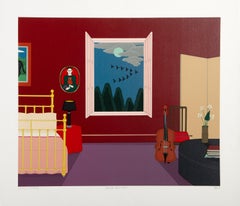
"Le Cirque Russe" Large serigraph
By Mihail Chemiakin
Located in San Francisco, CA
This artwork titled "Le Cirque Russe" c.1987, is an original colors serigraph on wove paper by renown Russian artist Mihail Chemiakin, b.1943. It is hand signed and numbered 25/195 i...
Category

Late 20th Century Modern Shigeo Okumura Art

Materials

Screen
Previously Available Items
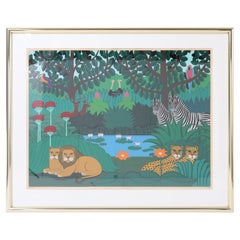
Vintage Jungle Silk Screen by Oku Shigeo Okumura
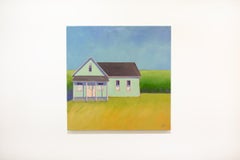
By Shigeo Okumura
Located in Palm Beach, FL
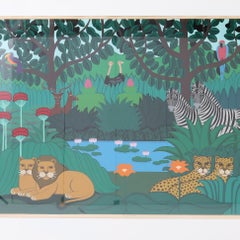
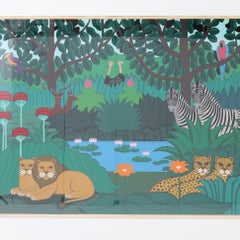
Eye catching vintage silk screen having a bold composition with pairs of African animals in a jungle setting executed in a modern naive style. Num...
Category

Late 20th Century Other Art Style Shigeo Okumura Art

Materials

Silk

Vintage Jungle Silk Screen by Oku Shigeo Okumura
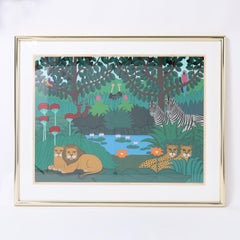
By Shigeo Okumura
Located in Palm Beach, FL
Eye catching vintage silk screen having a bold composition with pairs of African animals in a jungle setting executed in a modern naive style. Num...
Category

Late 20th Century Japanese Mid-Century Modern Shigeo Okumura Art

Materials

Aluminum

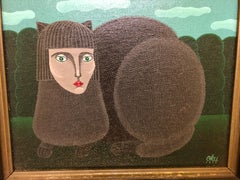
Oku Cleopatra The Cat Painting
By Shigeo Okumura
Located in San Francisco, CA
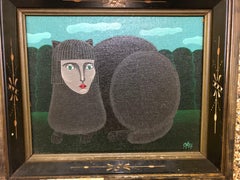
Shigeo Okumura: 1937-1993. Well listed Japanese artist who signed his paintings Oku. He has has auction records of $2,500. This small gem is an oil on masonite or board. It measures 10 inches wide by 8 high. The vintage hand carved frame...
Category

1970s Shigeo Okumura Art

Materials

Oil

Shigeo Okumura, (Japanese, 1937-1993),
By Shigeo Okumura
Located in Pasadena, CA
Shigeo Okumura, (Japanese, 1937-1993),signed OKU The “naïve” Japanese painter, Shigeo Okumura, better known as OKU, paints with vibrant colors and crisp lines. He combines the grace...
Category

1990s Contemporary Shigeo Okumura Art

Materials

Lithograph

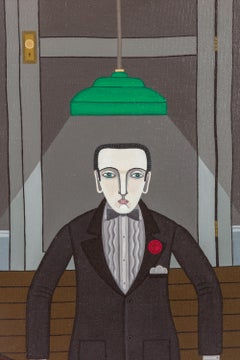
"Billiard Player" Oil on Canvas by Shigeo Okumura, Signed OKU 1976
By Shigeo Okumura
Located in New York, NY
The “naïve” Japanese painter, Shigeo Okumura, better known as OKU, paints with vibrant colors and crisp lines. He combines the grace of traditional Japanese art forms with the nostal...
Category

1970s North American Vintage Shigeo Okumura Art

Materials

Canvas

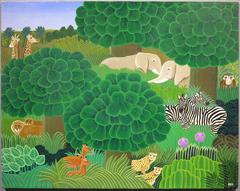
Savanna and Jungle
By Shigeo Okumura
Located in Wilton Manors, FL
Beautiful c.1970s landscape by Japanese artist, Shigeo Okumura (1937-1990). Oil on canvas measures 19 x 24 inches. Excellent condition with no damage or restoration. Signed lower rig...
Category

1970s Shigeo Okumura Art

Materials

Cotton Canvas, Oil

Shigeo Okumura art for sale on 1stDibs.

Find a wide variety of authentic Shigeo Okumura art available for sale on 1stDibs. You can also browse by medium to find art by Shigeo Okumura in fabric, silk and more. Not every interior allows for large Shigeo Okumura art, so small editions measuring 47 inches across are available. Customers who are interested in this artist might also find the work of Teppei Ikehila, Tetsuro Shimizu, and Hiro Yokose. Shigeo Okumura art prices can differ depending upon medium, time period and other attributes. On 1stDibs, the price for these items starts at $4,800 and tops out at $4,800, while the average work can sell for $4,800.

Artists Similar to Shigeo Okumura

Still Thinking About These?

All Recently Viewed