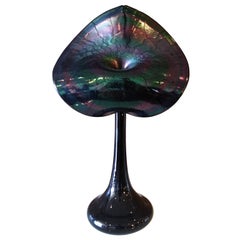
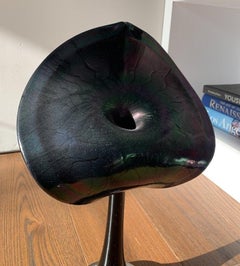
By Stuart Abelman
Located in Miami Beach, FL
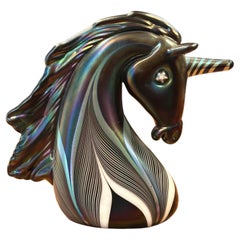
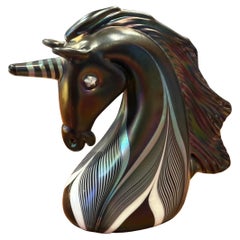
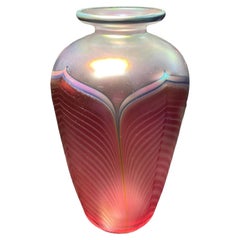
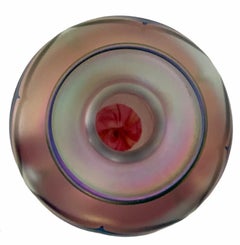
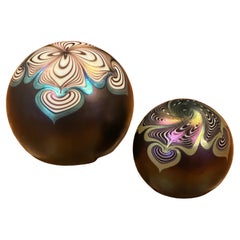
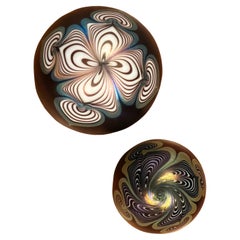
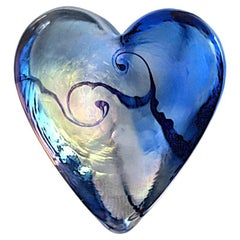
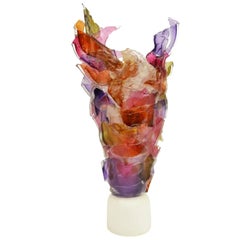
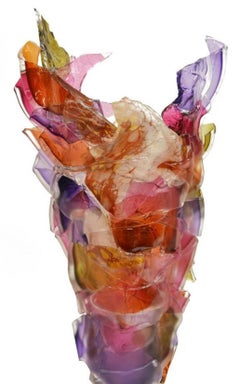
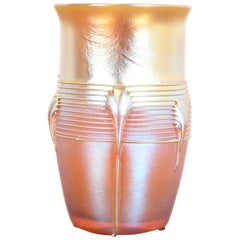
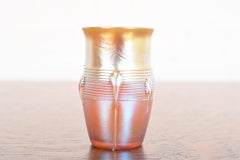
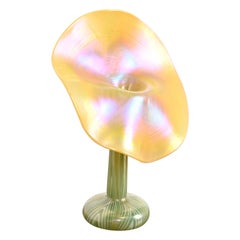
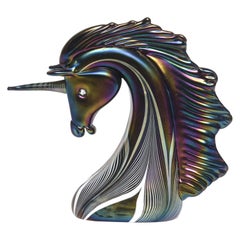
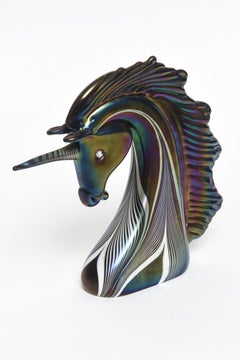
Beautiful art glass unicorn bust by Stuart Abelman featuring a pulled feather iridescent design. Signed on the bottom. Date 1985 Number 859
Artist Bio from his site:
Stuart Abelman’s artistic ability was recognized at an early age, giving him the
opportunity to study sculpture and painting as a young man. By seventeen he had quite an impressive portfolio. He was accepted to Carnegie Mellon University in Pennsylvania where he studied Fine art for four years and there received his Bachelor of Fine Arts degree.
It was in his senior year at Carnegie Mellon University that he first saw the brand new glass department. It was love at first sight. He devoted his entire senior year to glassblowing. Stuart then entered the graduate four-year Master of Fine Arts program at U.C.L.A. and proceeded to study and blow glass for four more intensive years. During this time he was a Teaching Associate at U.C.L.A. and a partner in a small two man glassblowing studio that he helped build in Inglewood California. Stuart received his Master of Fine Arts from U.C.L.A. in 1976. By this time he had already created a body of work that was finding its way into art shows and galleries.
While at U.C.L.A., El Camino College called to ask if he would run their glassblowing department. He did this as well as teaching a ceramics class and developing a flat glass program for them.
After several years as a college instructor, Stuart realized that although he loved teaching, he did not have the time to create in glass all of the ideas he found himself constantly sketching. Stuart had always drawn and doodled on any available scrap of paper, even asa very young child. As he grew older this even included drawing borders on his collegeexam papers, but now he found himself drawing ideas for glass on paper napkins in restaurants and on airplane flights. It was time to start his own studio, so in 1976 Stuartleft teaching and started Abelman Art Glass.
Stuart spent much of 1976 building his studio: Furnaces, pot furnaces, glory holes (re-heating furnaces), annealing ovens, glassblower benches, etc… and in June of 1977 thefirst furnace was lit at the Abelman Art Glass studio in Southern California.
Although glassblowing was one of Colonial America’s first industries, and enjoyed great popularity during the Art Nouveau period in the late 1800’s, hand blown art glass had allbut disappeared from the American art scene until the 1960’s. Stuart Abelman was oneof a select group of pioneering studio glass artists who saw the magic and Challenge inglass and set about starting the Studio Art Glass Movement.
Stuart uses his own formulas and the finest silica sand to ensure the purest quality glasspossible. Each piece is made entirely of hot molten glass and is worked and completed atthe furnace. All the colors and design patterns are formed from the hot glass. No paint isused. Many of the beautiful colors are made with gold, silver and other precious metals.
Stuart’s glass pieces are shown in galleries and museums around the world and have become permanent additions to museum, private and celebrity collections here and overseas. The Kobe Museum in Japan has a piece in its collection, and his piece in the permanent collection of the Corning Museum is particularly notable for its infusion of life into a figurative sculpture in glass. Stuart Abelman was the first to bring figurative sculpture to hand blown glass in the new art glass studio movement in the United States in the late 1960’s and early 1970’s. It was a hard sell back then but has become an established form of expression in the current art glass arena. Many American StudioGlass artists now express themselves through figurative sculpture.
Abelman’s early work in figurative sculpture led to his studio production of the unicorn that was chosen for the American Express Catalog in the 1980’s. Its success allowed himto expand his artistic endeavors in this area and led to his reptile and amphibian work.During these same years Stuart wanted to find another way to breathe life into glass in away that would touch everyone, glass collector or not. The result of this desire was the series of Limited Edition Clowns that are much sought after. Nancy Bingham, anAmerican authority on Murano clowns...
Category
Late 20th Century Stuart Abelman Furniture