By Takahashi Shuka
Located in Kyoto, JP
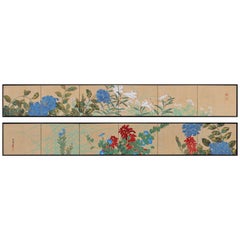
Flowers of spring and autumn
Takahashi Shuka (1877-1953)
Pair of six-fold screens. Ink, mineral pigments, gold and gofun on silk over gold leaf.
Painting inscription: Shuka hitsu
Painting seals:
Upper: Takahashi Toshi in
Lower: Shuka
Early 20th century, circa 1910-1920.
Dimensions (each):
285 cm x 40 cm (112” x 16”)
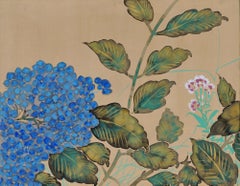
In this vivid evocation of spring and autumn, the artist successfully exploits the dimensions of the screens’ 12 horizontal panels. This unusual work rejects the well established cannon of screen painting with prominent left and right anchors and treats the space on the two screens as a unified space. The artist incorporates diagonals and verticals to create geometric designs of great drama. The screens’ flat, graphic quality and patterned motifs owe a debt to the decorative Rimpa style. The pooling together of ink and malachite green pigment in the Tarashikomi technique is similarly inspired by the Rimpa style. The flowers are characterized by the brilliant colors of their thickly applied mineral pigments; the veins of the leaves delineated in lines of gold. Representative of the affluence of the early 20th century, the scene is painted on a silk background enhanced with gold leaf applied to the entire reverse side in the Urahaku technique. The striking frontal composition features pinks, lilies, hydrangeas, amaranth, morning glories and bellflowers. Rather than following a prescribed narrative the flowers are drawn from both classical literature and varieties that were actively cultivated at the time.
Takahashi Shuka (1877-1953) was born in Okayama and originally studied nanga painting under Ishii Kinryo. He later moved to Kyoto, studying under Tsuji Kako...
Category
Early 20th Century Japanese Taisho Takahashi Shuka