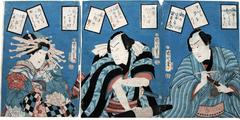
Toyoharu Kunichika Art

to
1
Overall Width
to
Overall Height
to
1
1
1
1
1
1
1
1
10,113
2,804
2,503
1,390
1
Artist: Toyoharu Kunichika
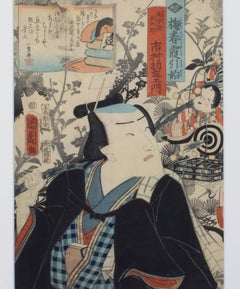
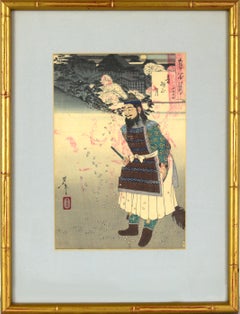
19th century color woodcut Japanese ukiyo-e print samurai figure
By Toyoharu Kunichika
Located in Milwaukee, WI
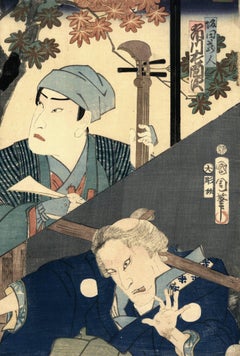
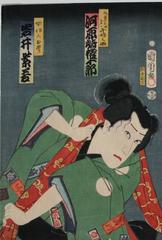
"Ichimura Hazaemon as Hatsuyumeya Mitsujiro" is a woodcut print by Toyoharu Kunichika in red, blue, and black. 14" x 9 1/2" art 20 3/4" x 16 3/4" framed From the series “First Per...
Category

1860s Edo Toyoharu Kunichika Art

Materials

Woodcut

Related Items
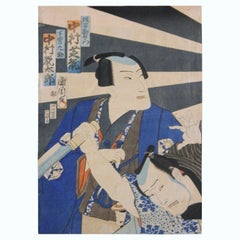
Two Kabuki Actors Japanese Woodblock Print
By Toyohara Kunichika
Located in Houston, TX
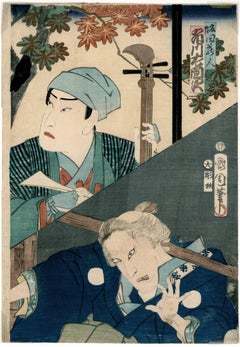
Two kabuki actors posing a samurai's. The print is printed on rice paper and is not framed. It is stamped by the artist with details about the actors in ...
Category

1860s Edo Toyoharu Kunichika Art

Materials

Woodcut

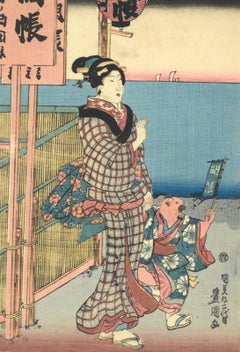
"Thirsty: the appearance of a town geisha in the Ansei era" - Woodblock on Paper
By Tsukioka Yoshitoshi
Located in Soquel, CA
"Thirsty: the appearance of a town geisha in the Ansei era" - Woodblock on Paper From the series "Thirty-two Aspects of Customs and Manners" (Fuzoku sanjuniso) Lively woodblock of a...
Category

1880s Edo Toyoharu Kunichika Art

Materials

Paper, Ink, Woodcut

Seishi Ai-oi Genji – Set of 12 Shunga works together w/astrological commentary
By Utagawa Kunisada (Toyokuni III)
Located in Middletown, NY
Set of 12 woodblock prints in colors on handmade, laid mulberry paper, 6 3/4 x 10 1/4 inches (170 x 258 mm), printed in Ka-ei 4 (1851). Each print with minor handling wear, otherwise in excellent condition with bright and fresh color, and with details printed in silver ink. The images themselves contain several illusive characters indicating the publisher which are obfuscated by figures, as intended. Presented loose, as issued. A fine set. The astrological commentary print has a large and meandering blind stamp with a bird and palm frond motif. This print lists various phrases concerning the Twelve Zodiac Animals as historically counted in Japan, and appears to include erotic commentary on the traits of people born under each of the twelve signs. These Shunga images were issued in books that paralleled (in an erotic fashion...
Category

Mid-19th Century Edo Toyoharu Kunichika Art

Materials

Ink, Handmade Paper, Woodcut

Black Horse
By Tokuriki Tomikichiro
Located in Middletown, NY
circa 1950. Woodblock print in black and gray ink on Japon laid paper, 10 1/4 x 15 3/4 inches (260 x 398 mm), full margins. With the artist's embossed chop mark in red ink in the l...
Category

Mid-20th Century Edo Toyoharu Kunichika Art

Materials

Handmade Paper, Woodcut

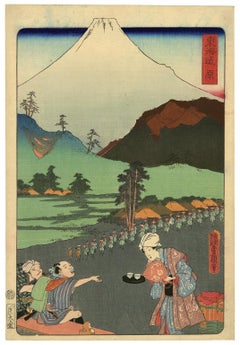
Kiyomizu Temple, Scenes of Famous Places along Tôkaidô Road - Woodblock on Paper
By Utagawa Hiroshige II
Located in Soquel, CA
Kiyomizu Temple, Scenes of Famous Places along Tôkaidô Road - Woodblock on Paper Full Title: Kyoto: Kiyomizu Temple (Kyô Kiyomizudera), from the series Scenes of Famous Places along...
Category

1860s Edo Toyoharu Kunichika Art

Materials

Ink, Rice Paper, Woodcut
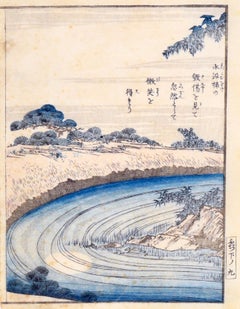
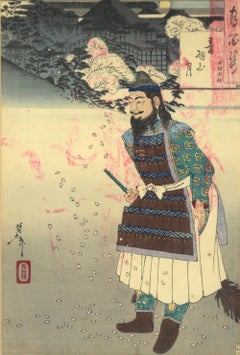
One Hundred Aspects of the Moon, Mt Otawa Moon - Bright God Tamura
By Tsukioka Yoshitoshi
Located in Soquel, CA
"Mount Otawa Moon: Bright God Tamura" - Woodblock on Paper by Tsukioka Yoshitoshi From the series "One Hundred Aspects of the Moon" This piece depicts the general Sakanoe no Tamura...
Category

1880s Edo Toyoharu Kunichika Art

Materials

Paper, Ink, Woodcut

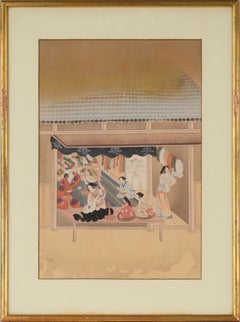
Japanese Artisans - Silk Dying -Japanese Woodblock Print
By Tosa Mitsuyoshi
Located in Soquel, CA
Japanese Artisans - Japanese Woodblock Print J Japanese woodblock depicting six women, all wearing vibrant kimonos, working on crafts by Tosa Mitsuoki (Japanese, 1617-1691). Japanese,c. 1600. Handcraft depiction (dye works).Section from a painted screen with presentations of handcraft.Kita-in, Saitama. Stamped lower left. Presented in a white mat and giltwood frame. Frame: 19"H x 14"W Mat: 18.25"H x 13.25"W Image: 14.5"H x 9.5"W Tosa Mitsuoki was a Japanese painter, reinvigorating the Yamato style of classical Japanese painting. Yamato-e originated from interest in reproducing early Tang dynasty paintings, and was later reinvented and further refined to fit Japanese cultural perceptions in the late Heian period. Yamato, sometimes referred to as wa or kazu had become synonymous with the Tosa-ha by the Muromachi period as a way for Japanese artist to distinguish their works from those of mainland Chinese paintings, kara-e. Yamato-e incorporated various visual and literary techniques for establishing narrative. Works were not always accompanied with text and may rely on heavily on period specific visual motifs, icons, and symbols to relay a story or theme. Tosa style by the time of Mitsuoki focused heavily on depicting themes of plants and nature, famous places, meisho, the four seasons, shik, bird-and-flower, kacho. Many of these popular symbols and icons from mimicking Chinese practices, treating the original Chinese masterwork as a sort of prototype to improve upon. Popular formats for Mitsuoki's pictures were wall scrolls kakemono, or handscrolls that would be read from right to left with the accompanied story, sliding doors fusuma and folding screen panels byobu that featured up to six panels. Mitsuoki's style incorporated the depth and calligraphy techniques of ink wash brushwork similar to Song dynasty and Yuan dynasty Chinese court paintings...
Category

1920s Edo Toyoharu Kunichika Art

Materials

Paper, Ink, Woodcut

Mitate of a Daimyo's Procession Crossing Ryogoku Bridge - Woodblock Print
By Keisai Eisen
Located in Soquel, CA
Mitate of a Daimyo's Procession Crossing Ryogoku Bridge - Woodblock Print Woodblock print of a procession by Keisai Eisen (Japanese, 1790–1848). Terrific triptych of a procession of...
Category

Early 19th Century Edo Toyoharu Kunichika Art

Materials

Ink, Rice Paper, Woodcut
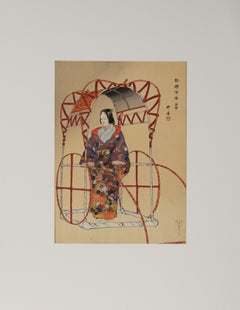
"Various Himochi" Wagashi Festival Japanese Woodblock Print by Utagawa Toyokuni
By Utagawa Toyokuni
Located in Soquel, CA
"Various Himochi" Wagashi Festival Japanese Woodblock Print by Utagawa Toyokuni Rare oversized early 19th century 5-tiered woodblock by Utagawa Ichiyosai Toyokuni, (Japan, 1769-1825), a Japanese lord and wife oversee a sekku festival of food, music, and dolls or toys. '"oshi" is the first day of “Mi (Snake)” in the third month of the lunar calendar. This day, known in modern Japan as the Girls' Festival, originated in China as a form of purification ceremony in which water and drinking peach blossom wine were used to drive away evil. Many kinds of hishi-mochi appear in this picture of hina ningyo (dolls associated with Hinamatsuri, or the Girl’s Day) from Omochae. The custom of eating special dishes at events throughout the year and at milestones in people's lives has existed since ancient times. This paragraph specifically focuses on the annual event called sekku, and life events that involve eating sweets. Joshi is the first day of “Mi (Snake)” in the third month of the lunar calendar. This day, known in modern Japan as the Girls' Festival, originated in China as a form of purification ceremony in which water and drinking peach blossom wine were used to drive away evil. According to the Keiso saijiki, in ancient China, on the third day of the third lunar month, people ate “ryuzetsuhan,” which is the juice of gogyo (Jersey cudweed) mixed with rice flour and nectar. In Japan, there is a record in the Heian period history book Nihon Montoku tenno jitsuroku [839-5] that it was an annual event to make kusamochi using gogyo on the third day of the third month of the lunar calendar, which may have been influenced by Chinese customs. The tradition of eating kusamochi on the third day of the third month of the lunar calendar continued after that. By the Edo period, however, hishimochi had come to be used as a sweet to serve on the third day of the third month. A picture of a hishimochi is included in the Morisada manko , which we mentioned in Part 1. According to it, hishimochi in the Edo period were often three layers of green-white-green instead of the now common red-white-green. However, it is possible to see from our collection that not all hishimochi were made in this way. Omochae published in 1857, is a good example. Omochae is a type of ukiyoe print...
Category

1820s Edo Toyoharu Kunichika Art

Materials

Ink, Rice Paper, Woodcut
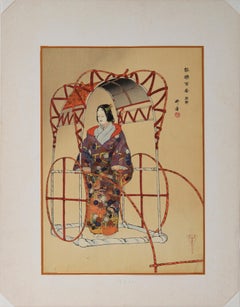
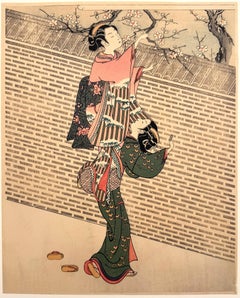
Plucking a Branch from a Neighbor's Plum Tree
By Suzuki (Hozumi) Harunobu
Located in Middletown, NY
A mischievous tableau with sexual overtones. Tokyo: Shuei-Sha, 1768. Woodblock print in colors printed on laid mulberry paper, 10 3/4 x 7 7/8 inches (273 x 200 mm), full margins. I...
Category

Mid-18th Century Edo Toyoharu Kunichika Art

Materials

Watercolor, Handmade Paper, Woodcut
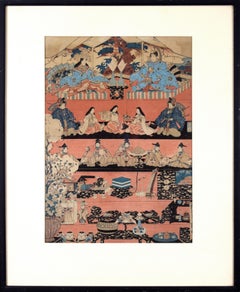
Actor as Samurai - 18th Century Japanese Woodblock Print
By Katsukawa Shunshō
Located in Soquel, CA
Actor as Samurai - 18th Century Japanese Woodblock Print Woodblock print depicting an actor, possibly Nakamura Denkuro II, as a samurai. The actor stands with his sword unsheathed a...
Category

Late 18th Century Edo Toyoharu Kunichika Art

Materials

Woodcut, Rice Paper

"Sun Saburo Matsugaya" - Mid 19th Century Figurative Japanese Woodblock Print
By Utagawa Kunisada (Toyokuni III)
Located in Soquel, CA
"Sun Saburo Matsugaya" - Mid 19th Century Figurative Japanese Woodblock Print Beautiful mid 19th century figural Japanese woodblock print of a seated man with lilies in the background by Utagawa Toyokuni III (Kunisada) (Japanese, 1786-1864/5). Artist's chop is in the lower right corner of the piece. The actor is Magosaburo Matsugaya from the play "Katakiuchi Rumors" Presented in a new grey-blue mat with foamcore backing. Mat size: 21"H x 16"W Paper size: 14"H x 9.75"W During his lifetime Kunisada Utagawa...
Category

1850s Edo Toyoharu Kunichika Art

Materials

Paper, Ink, Woodcut

Previously Available Items
Farewell at Iwahashi Village - Kabuki
By Toyoharu Kunichika
Located in Fairlawn, OH
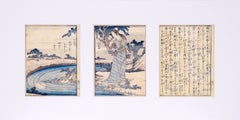
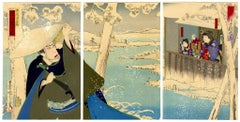
Medium: Color woodcut Date Of Execution: 1884 Dimensions: Left: 14 1/8 x 9 1/2"; Center: 14 1/8 x 9 3/8"; Right: 14 1/8 x 9 1/8" Signature: Signature: Toyohara Kunichika; Seal: Toshi...
Category

1880s Other Art Style Toyoharu Kunichika Art

Materials

Woodcut

Kabuki Actors: Ichikawa and Iwai.
By Toyoharu Kunichika
Located in Plano, TX
14 x 9 1/2 (sheet 14 x 3/4). Good color and condition. Soiling in the bottom right-hand; slight toning. Signed and sealed 'Kunichika hitsu'. Housed in a 20 x 16 inch archival mat, suitable for framng. Born in 1835, Toyohara Kunichika grew up in the Kyobashi district of Edo in the midst of merchants and artisans. In 1848, at age 13, he was accepted as an apprentice into the studio of Utagawa Kunisada I...
Category

Mid-19th Century Edo Toyoharu Kunichika Art

Materials

Color, Woodcut
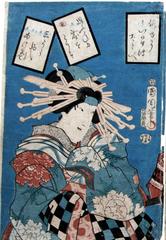
Actors in a Kabuki Play.
By Toyoharu Kunichika
Located in Plano, TX
Actors in a Kabuki Play. 1865.The actors are, left to right, Kinokuniya Bunzaemon, Suberoku, Miura Akemaki. 1865. Vertical oban. Each sheet 13 3/4 x 9 1/2 (total measurements 13 3/4 x 28 1/16). Paper losses at sheet edges, not affecting the main image. Fine color and condition. Signed and sealed 'Kunichika hitsu' Ex-collection Ulfert Wilke...
Category

1860s Edo Toyoharu Kunichika Art

Materials

Color, Woodcut
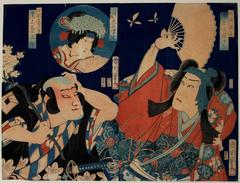
Kabuki Actors
By Toyoharu Kunichika
Located in Plano, TX
Kabuki Actors. c. 1864. Oban diptych (14 1/8 x 18 3/4). 2 small repairs in the top margin, 1 foxing spot in the right-hand actor's face; otherwise good c...
Category

Mid-19th Century Edo Toyoharu Kunichika Art

Materials

Woodcut

Kabuki Actors Iwai and Ichikawa
By Toyoharu Kunichika
Located in Plano, TX
Kabuki Actors Iwai and Ichikawa 1864. Oban diptych (14 1/8 x 19 1/4. Good color and condition. The print is not laid down. The sheets are not joined tog...
Category

Mid-19th Century Edo Toyoharu Kunichika Art

Materials

Color, Woodcut
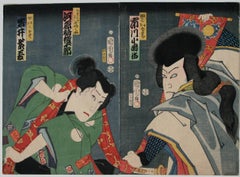
Toyoharu Kunichika art for sale on 1stDibs.

Find a wide variety of authentic Toyoharu Kunichika art available for sale on 1stDibs. You can also browse by medium to find art by Toyoharu Kunichika in woodcut print and more. Not every interior allows for large Toyoharu Kunichika art, so small editions measuring 17 inches across are available. Customers who are interested in this artist might also find the work of Utagawa Yoshitora, Utagawa Hiroshige (Ando Hiroshige), and Utagawa Kunisada (Toyokuni III). Toyoharu Kunichika art prices can differ depending upon medium, time period and other attributes. On 1stDibs, the price for these items starts at $3,000 and tops out at $3,000, while the average work can sell for $3,000.
Artists Similar to Toyoharu Kunichika