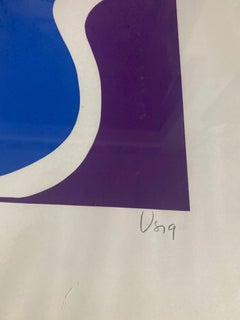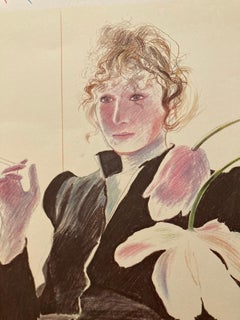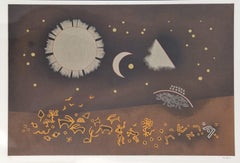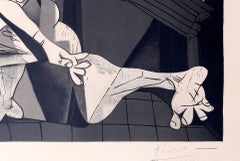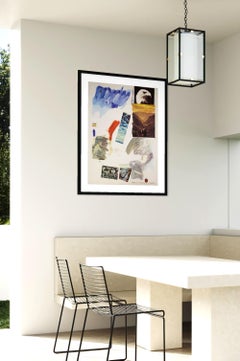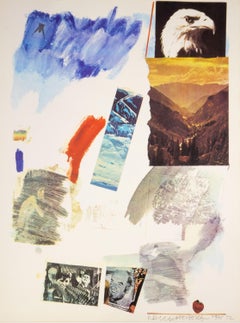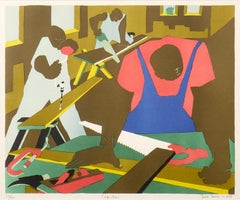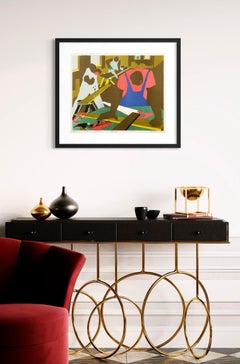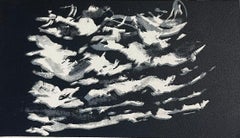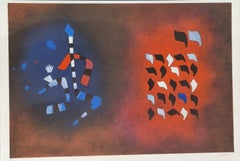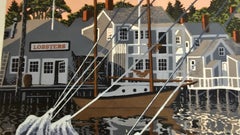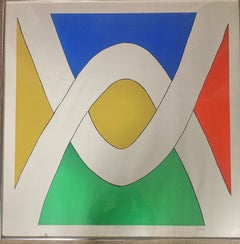
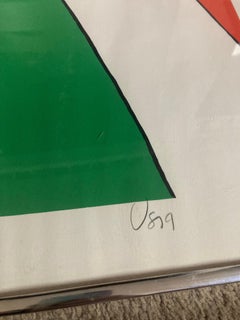
“Untitled”
By Vera Neumann
Located in Warren, NJ
Signed and numbered lithograph 100 out of 100. In good condition measures 35x35
20th Century Vera Neumann Prints and Multiples
Lithograph
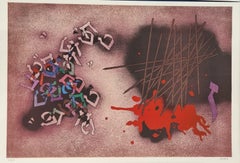
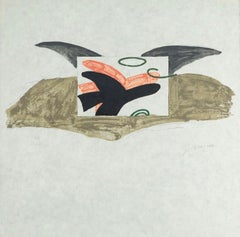
“Untitled”
By Vera Neumann
Located in Warren, NJ
Signed and numbered lithograph 100 out of 100. In good condition measures 35x35
Lithograph
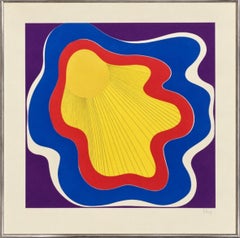
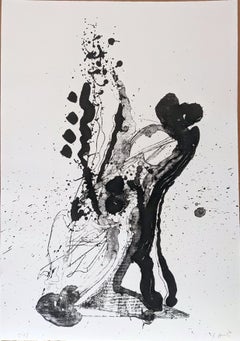
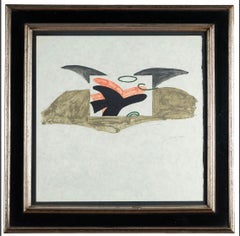
“Untitled”
By Vera Neumann
Located in Warren, NJ
This is a signed and numbered lithograph out of 100. In good condition measures 35x35. Some scratches on the plexiglass 100 Out of 100 Number
Lithograph
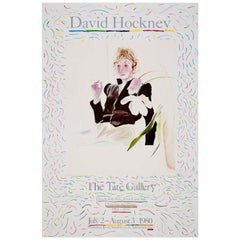
Gemini-The Twins
By Eugène Grasset
Located in Fairlawn, OH
Signed in the right center edge of the image From: Les Douze Mois de 1889 As published in Vol. 9, No. 425 of Les Hommes d'Aujourd'hui. Published by Sagot, Paris Proof before letters...
Lithograph
La Fille au Violon
By Alexandre Charpentier
Located in Fairlawn, OH
La Fille au Violon Color lithograph, gypsograph with embossed publisher's stamp Signed and numbered in ink (see photo) From: L'Estampe Originale, Paris, Vol. VII Published by Andre M...
Lithograph
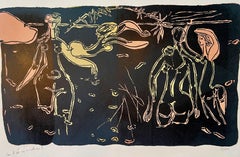
untitled (Young Woman Washing)
By Rudolf Bauer
Located in Fairlawn, OH
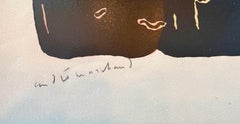
untitled (Young Woman Washing) Lithograph, c. 1910 Signed in pencil lower right; signed in the plate lower right (see photo) Image size: 11 x 5-1/8" Sheet size: 18 7/8 x 12 5/8 inches Condition: Very good Aging to the tan paper it is printed on Provenance: Estate of the Artist Borghi & Company, NYC Rudolph Bauer 1889-1953 Rudolf Bauer was born in Lindenwald near Bromberg, Silesia, in 1889 but his family moved only a few years later to Berlin. In 1905 Bauer began his studies at the Berlin Academy of Art but left the Academy only a few months later to educate himself. The upshot was paintings, caricatures and comical drawings which were published in 'Berliner Tageblatt', 'Ulk' and 'Le Figaro'. From 1912 Bauer contributed to the magazine and Gallery 'Der Sturm' founded by Herwarth Walden and pivotal to German Expressionism and the international avant-garde. In 1915 Rudolf Bauer participated for the first time in a group show at Walden's gallery. There he met Hilla von Rebay, with whom he began a relationship of many years that was crucial to Bauer's later work. By 1922 Bauer had shown work at about eight exhibitions mounted by 'Der Sturm'. From 1918 he also taught at the 'Der Sturm' art school, where Georg Muche was the director. After the war ended, Bauer was a founding member of the 'November Group' although he did not collaborate closely with the group. In 1919 Bauer joined forces with the painter and architect Otto Nebel and with Hilla von Rebay to found the artists' association 'Die Krater'. Impressionist at the outset, Bauer's early work reveals Cubist and Expressionist influences. By 1915/16 Bauer had switched to an abstract pictorial idiom, which is markedly influenced by Kandinsky. In the early 1920s Bauer was also preoccupied with Russian Constructivism as well as the Dutch de Stijl group. Bauer's decided preference for non-representational painting culminated in 1929 with the foundation of a private museum, 'Das Geistreich', which he directed as a salon for abstract art. Political developments in Germany forced Bauer to sell some of his work in America from 1932. His agent in America was Hilla von Rebay, who was by now director of the Guggenheim Collection. In 1936 she organized a touring exhibition of non-representational European art that included sixty Rudolf Bauer oil...
Lithograph
Flowering Tree -- Moonlight
By Karl Schrag
Located in Fairlawn, OH
Signed, titled, and dated in pencil by the artist; The Print Club of Cleveland stamp lower left Edition: 260 The Print Club of Cleveland Publication No. 69, 1991 Printer: Am...
Lithograph
Moto-Fuite
By Georges Meunier
Located in Fairlawn, OH
Moto-Fuite Color lithograph, c. 1902 Signed in the stone lower right (see photo) Published by Edmund Sagot (1857-1917), Paris Printed by Atelier Chaix, Paris Large edition with titl...
Lithograph
XXe Siecle
By Richard Lindner
Located in Fairlawn, OH
XXe Siecle Color lithograph, 1974 Signed in the stone on right (see photo) From: XXe Siecle, Volume 42, 1974 Published by G. di San Lazzaro for A. Maeght, Paris Printed by Mourlot, P...
Lithograph
Feast of Lights: Hanukkah
By Abraham Rattner
Located in Fairlawn, OH
Feast of Lights (Poster) Signed in the stone 17 color lithograph Published by Kennedy Galleries Edition: Unknown edition, signed in the stone There was also a pencil signed edition o...
Lithograph
The Bridge
By James Allen
Located in Fairlawn, OH
The Bridge (New York Harbor) Lithograph, 1936-7 Signed in pencil l.r., (see photo) titled lower left edge of sheet Reference: Not in Ryan Edition: Very small Note: Extremely rare. ...
Lithograph
Le Groupe
By Alexander Archipenko
Located in Fairlawn, OH
Le Groupe Lithograph, 1963 Signed and numbered in pencil, lower right Edition: 75 (68/75) see photo Publisher: Erker Presse, St. Gallen blindstamp lower left. see photo From the suit...
Lithograph
$450
H 13.63 in W 10.32 in
Cover illustration for Die Graphischen Kunste, Volume 22
By Henri Riviere
Located in Fairlawn, OH
Cover illustration for Die Graphischen Kunste, Volume 22 Color lithograph, 1899 Signed with the artist's initials lower center (see photo) From: The Graphic Arts, Volume 22, 1899 ...
Lithograph
The Trench
By James Allen
Located in Fairlawn, OH
The Trench Lithograph, 1937 Signed and annotated in pencil (see photos) Edition: 30 Provenance: Estate of the Artist Mary Ryan Gallery Frac Teck Services, Ft. Worth, TX Part of a se...
Lithograph
Buds
By Jack Beal
Located in Fairlawn, OH
Buds Color lithograph, 1980 Signed, titled, and editioned in pencil by the artist Publisher: Art Matters Printer: Bud Shark, Shark's Ink, Lyons, CO Condition: Excellent Image: 31-1/8 x 41-1/4" (79 x 104.7 cm.) "An Abstract Expressionist when he left the Art Institute of Chicago in 1956, Beal has since become a dedicated realist who sees art as a potentially powerful moral force. He has great regard for Platonic ideals of truth, beauty, and goodness, and admires both the realism of seventeenth-century Dutch painting and the compositional authority of Renaissance art. Since moving to New York in the late 1950s with his wife, painter Sondra Freckelton, Beal has painted still lifes, portraits, and landscapes, although in recent years his most ambitious undertakings have been large-scale allegories and myths. In describing his approach, Beal calls himself a "life painter" and says he is committed to human over aesthetic concerns. Yet his intricate complexes of figures and surface patterns, along with his adroit handling of space, reveal his sophisticated, accomplished sense of composition. Virginia M. Mecklenburg Biography Jack Beal (1931-2013) was born and raised in Richmond, Virginia. He briefly attended the College of William and Mary, studying biology, but dropped out after two years. A decision to take evening art classes lead to his attending the Art Institute of Chicago, where he studied from the old masters in the Institute’s collection and with Isobel Steele MacKinnon, a student of Hans Hoffman. His classmates there included Red Grooms, Richard Estes, Claes Oldenberg and Robert Barnes, and while abstract expressionism remained “the only valid way to paint,” it was a style that all would eventually reject. In 1956 Beal left the Art Institute and moved to New York with the aim of finding success as a painter, eventually becoming one of the first artists to settle in the SoHo neighborhood. A turning point came in 1962 when, spending the summer in upstate New York, Beal decided to begin painting outdoors. Dissatisfied with abstract painting, he “wanted to give Art one more try” and in working from nature “fell in love with painting all over again.” Over the next few years Beal worked toward a balance between expressionistic paint handling and realistic, narrative pictures. Clement Greenberg’s pronouncement around this time, that the figure was no longer a valid subject was taken as a challenge by many artists, Beal included. His subsequent adoption of the female nude - modeled by his wife, the artist Sondra Freckelton - was a break-through. Though the paintings retained the sensuousness of his earlier canvases, the rigorous formality of their composition and the masterful treatment of light and shadow offered a new approach to realist painting. Indeed, Beal was not alone in this transformation; friends and colleagues in New York were coming to similar conclusions and the group, who included painters such as Philip Pearlstein, Alfred Leslie, Yvonne Jacquette, Alex Katz, Jack Tworkov, Nell Blaine and Fairfield Porter, would eventually be considered the ‘New Realists.’ With the resurgence of figurative painting, Beal distinguished himself for his skillful handling of color and modeling as well as what was later described as his “pushing of representational forms to their interface with abstraction”. Through the later half of the 1960s, while his subject matter remained unchanged, his paintings were increasingly given over to wide areas of flat color. In 1969, he exhibited a series of Table Paintings which, with their hard-edge style and near complete abstraction of the form, were a radical departure for Beal. So radical in fact, he was accosted by fellow realist painters Alfred Leslie and Sidney Tillim, who berated him “for betraying realism and betraying [himself], for moving away from ‘the true path’.” The incident had its intended effect and Beal did return to a more naturalistic and humanistic style, eventually abandoning the nude in favor of increasingly allegorical portraits. In 1974, the United States General Services Administration commissioned Beal to produce a series of murals for the U.S. Department of Labor headquarters in Washington D.C. The result was The History of Labor, four, 12 x 13 foot paintings in the vein of George Caleb Bingham, each illustrating a century of American development. Following the completion of the murals in 1977, Beal continued to make use of narrative in his paintings, with portraiture and self-portraiture as a means of exploring moral and didactic themes. He and Sondra had purchased an old mill in upstate New York in 1974 and after extensive renovations, it became their permanent residence. Unsurprisingly, many of his later paintings are pastoral scenes based on his rural surroundings or still lives including flowers which they grew on the property. In 1986, Beal was commissioned by the Art in Transit Initiative to create a large-scale mural as part of the redevelopment of the Times Square Subway Station. The proposed mosaic mural, The Return of Spring, took over fifteen years to complete, with the two, 7 x 20 foot sections finally installed in 2001 and 2005. Together they update the Greek myth of Persephone with a New York setting, showing her abduction by Hades, initiating the arrival of winter, and her release, bringing the bountiful return of spring. Beal was a founder of the Artist’s Choice Museum, New York and the New York Academy of Art as well as the recipient of numerous grants and awards, including honorary degrees from the Art Institute of Boston and the Hollins College...
Lithograph