By Irene Pattinson
Located in Soquel, CA
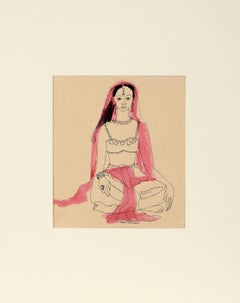
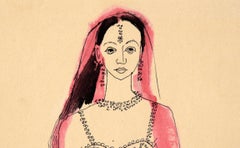
Indian Dancer - Vintage Illustration in Ink and Watercolor
A stoic, dark-haired woman in elaborate dress is sitting cross-legged in this illustration by Irene Pattinson (American, 1909-1999). Pattinson uses fine ink line detail and a vibrant pink watercolor for a splash of color.
Signed at the bottom, "Irene Pattinson."
Provenance: The Artist, Estate of Irene Pattinson: David Carlson; Estate of Larry Miller Fine Art, Robert Azensky Fine Art.
Presented in a new white mat with foam core backing.
Mat size: 16"H x 12"W
Paper size: 11.75"H x 8.5"W
Image size: 7.5"H x 6.5"W
Irene Pattinson (American, 1909-1999) studied at the California School of Fine Art (now The San Francisco Art Institute), San Francisco State College and The Marion Hartwell School of Design. She was President of the San Francisco Woman Artists Association 1955-56.
Provenance: The Artist, Estate of Irene Pattinson: David Carlson; Estate of Larry Miller Fine Art, Robert Azensky Fine Art.
Solo Exhibitions: Lucien Labaudt Gallery 1955; San Francisco Museum of Art, 1961 (39 works).
Selected Group Exhibitions: San Francisco Art Association Annual 1948, 54, 55; San Francisco Woman Artists, 1957-1960; Oakland Art Museum Annual, 1951, 58; California Palace of the Legion of Honor, 1960; Richmond Art Center, 1955, 56, 57, 58; San Francisco Art Institute 1959, 60. The Art Bank of the San Francisco Art Association, 1958, 59, 60, 62, 63; Winter Invitational, California Palace of The Legion of Honor, San Francisco, 1960; Fourth Winter Invitational, California Palace of The Legion of Honor, San Francisco, 1963.
Awards: First Place, San Francisco Woman Artists Assoc., 1957, 1959; San Francisco Art Festival 1957;Literature: San Francisco Art Institute - A catalog of the Art Ban 1962/63; San Francisco and the Second Wave: The Blair Collection
Exhibitions:
1963 The Art Bank of the San Francisco Art Association, San Francisco, CA
1963 California Palace of The Legion of Honor: Forth Winter Invitational, San Francisco, CA
1962 The Art Bank of the San Francisco Art Association, San Francisco, CA
1961 San Francisco Museum of Art, San Francisco, CA
1960 California...
Category
1950s American Modern Vincenzo Gemito Furniture
MaterialsPaper, India Ink, Watercolor, Pen