Located in Riva del Garda, IT
A follower of Peter Paul Rubens (Siegen 1577 – Antwerp 1640)
Attributed to Theodoor van Thulden (Bois-Le-Duc, 1606 – 1669)
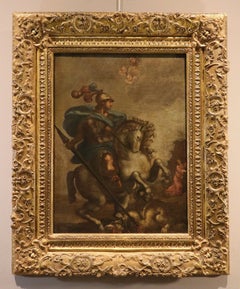
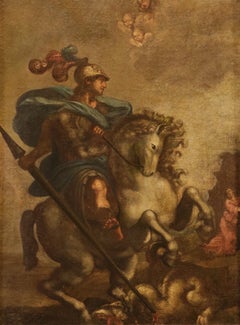
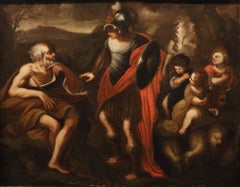
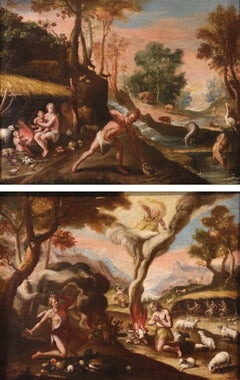
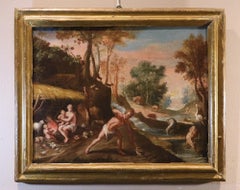
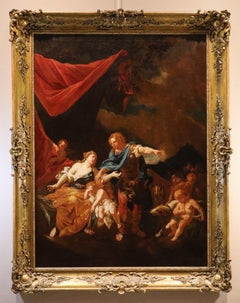
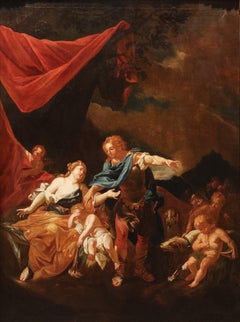
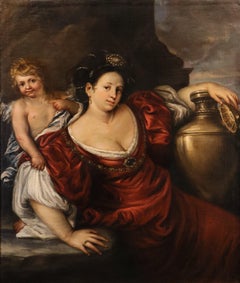
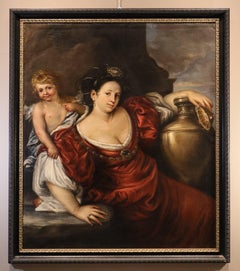
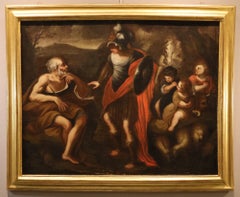
Perseus Frees Andromeda
oil on canvas, mounted on panel? 82 x 67 cm. - with frame 98 x 83 cm.
The subject of the painting, derived from Ovid’s Metamorphoses (Book IV, lines 663–752), is inspired by the myth of Princess Andromeda, daughter of King Cepheus of Ethiopia and Queen Cassiopeia, depicted here as she is freed by the Greek hero Perseus after he has defeated the sea monster that held her captive.
This cruel punishment had been imposed on her by Poseidon, god of the seas, to atone for the arrogance of her mother Cassiopeia, who had dared to compare herself and her daughter to the Nereids in beauty.
When Perseus returned home on his winged horse Pegasus after his victory over the fearsome Medusa, he saw the princess chained to a rock on the coast and, overwhelmed by her beauty, decided to save her.
The hero, clad in gleaming armour and wearing the red cloak of the victor and a crested helmet, is flanked by two small cherubs, one of whom helps him to break the chains binding Andromeda to the rock, emphasising the theme of love triumphing over danger.
This is a smaller version derived from the famous ‘Perseus Frees Andromeda’ painted by Peter Paul Rubens around 1620, now housed in the Gemäldegalerie in Berlin, from which the main scene on the right has been taken.
Rubens, who often employed sophisticated references to antiquity to emphasise the message of his paintings, modelled the figure of Andromeda and the cherub at her side, intent on loosening her chains, on the statue of the Happy Venus (Rome, Vatican Collections, which he saw during his stay in Rome.
The success of Rubens’s work led to its widespread circulation and a substantial number of copies produced by his workshop (in Vienna at the Liechtenstein Gallery, in Potsdam at the Sanssouci Gallery, the Museum of Arles, and the Museum of Lisbon).
It is our opinion that the authorship of the finely executed painting presented here is to be attributed to a Flemish artist active around the second half of the 17th century amongst Rubens’s followers...
Category
17th Century Old Masters Figurative Paintings