Darnley Fine Art

5 / 5
London, GB
THANKS!
Follow

About Darnley Fine Art

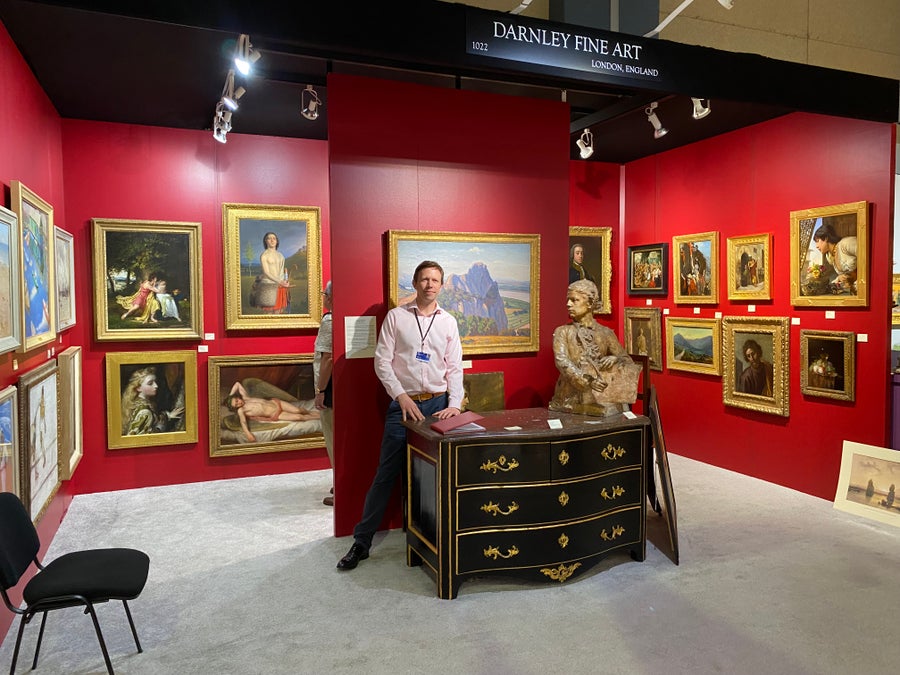
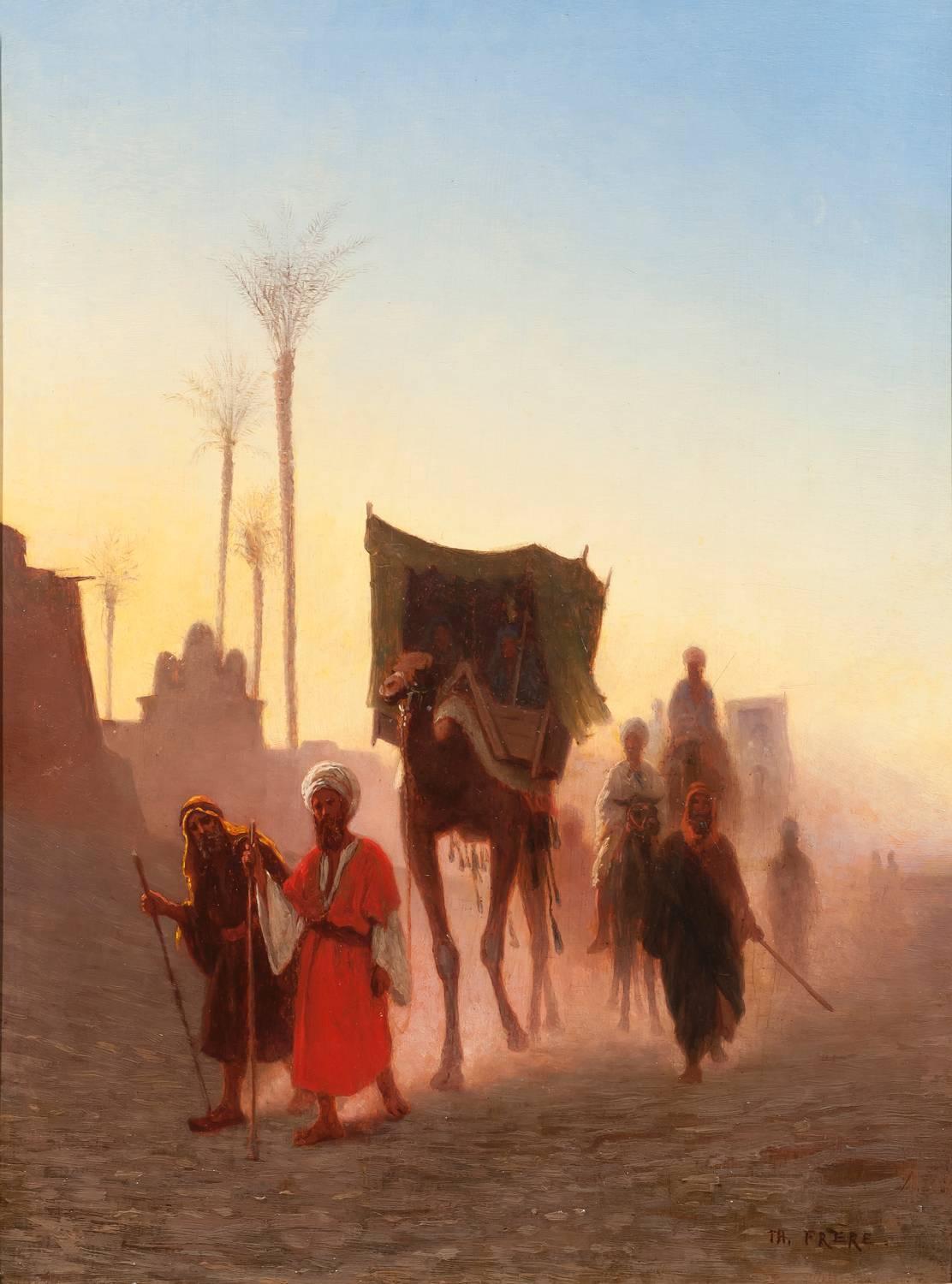
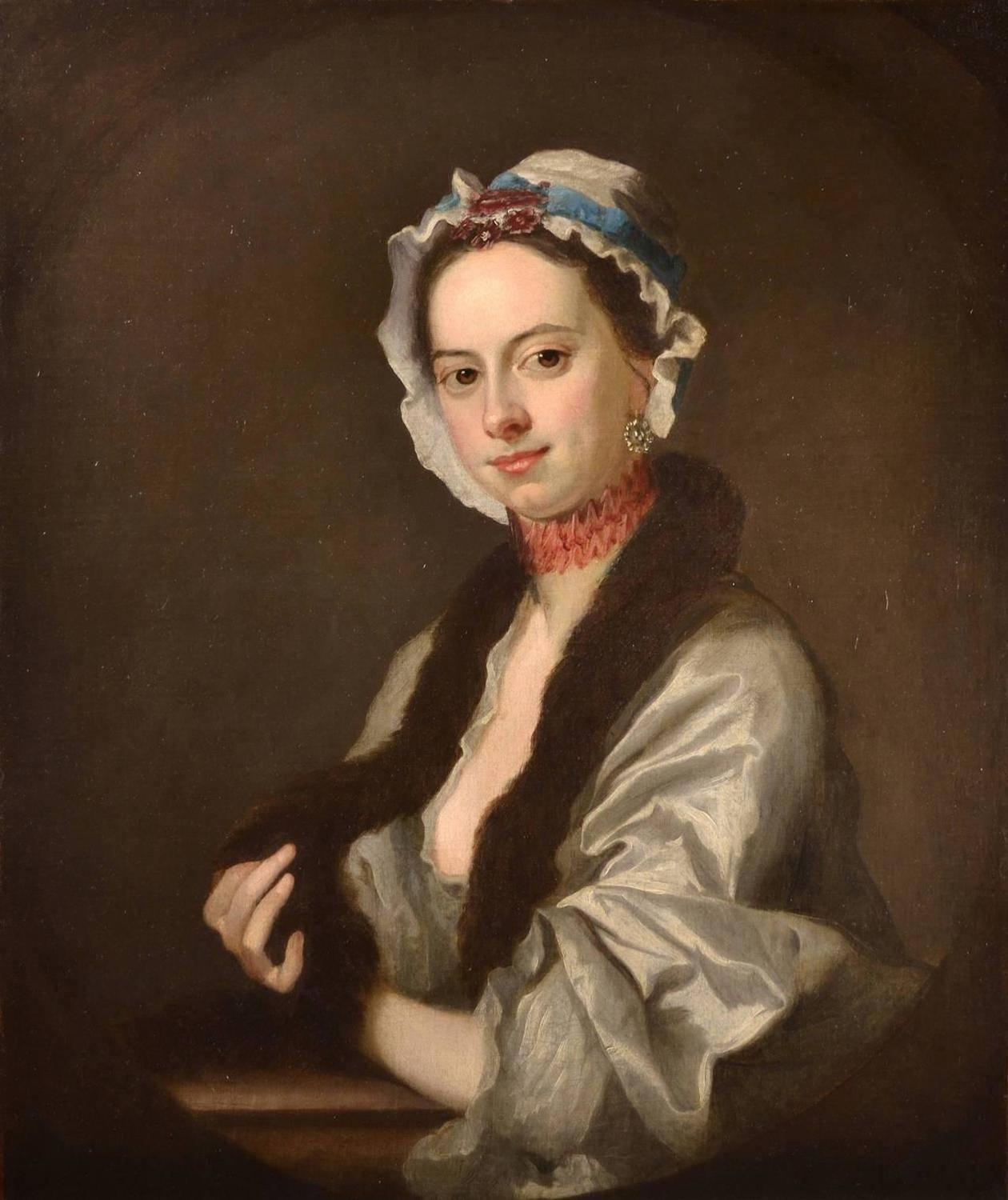
Darnley Fine Art Ltd holds an extensive range of fine paintings from the 16th to the 20th Century. We are a leading specialist in 19th Century Orientalist paintings of the Middle East, as well as in the lithographs of David Roberts. We also have a large collection of portraits from every period. Lastly, we are one of the only galleries to deal in original paintings for railway posters from the pre-war years. Our extensive knowledge and experience leaves us well placed to advise clients on starting or adding to their collection. Advice is given on other important asp...Read More

Darnley Fine Art

Established in 20071stDibs seller since 2014

VAT ID

GB926593491

Featured Pieces

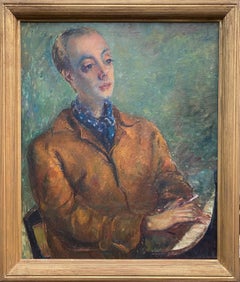
Five O'Clock
By Nicola Simbari
Located in London, GB
Oil on canvas, signed and dated (19)'58'lower right  15 1/2 x 13 3/8 inches (39.2 x 34 cm) Giltwood frame  Provenance: Exhibited at Arthur Jeffress, Catalogue 21, 1958 Bought by Ado...
Category

1950s Figurative Paintings

Materials

Canvas, Oil

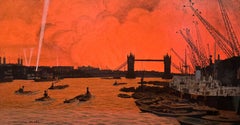
The Battle of Britiain: No. 65 Squadron
Located in London, GB
Oil on board, signed lower right  Image size: 36 x 24 inches (91.5 x 61 cm) Handmade frame  Provenance:   Sotheby's Hendon: Historic Aircraft and Aeronautica, The Royal Flying Corps...
Category

20th Century Landscape Paintings

Materials

Oil, Board

A Coffee Shop: Citadel of Cairo
By Frederick Goodall R.A.
Located in London, GB
Frederick Goodall RA A Coffee Shop: Citadel of Cairo 1822 - 1904 Oil on paper, laid down on canvas, signed with monogram and dated 'FG / 1859-70' (lower left) Image size: 13 ¾ x 21 ...
Category

19th Century Figurative Paintings

Materials

Oil, Laid Paper

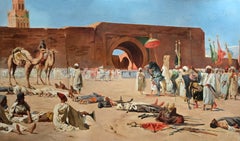
Scene of a Massacre
Located in London, GB
Jean-Joseph Benjamin-Constant Scene of a Massacre 1845 - 1902 Oil on canvas Image size: 46 1/2 x 67 inches (118.5 x 170.5 cm) The French School of Orientalists are best known for th...
Category

19th Century Figurative Paintings

Materials

Canvas, Oil

The Honoured Guest
Located in London, GB
Clemente Pujol de Gustavino The Honoured Guest 1850 - 1905 Oil on panel, signed 'C. Pujol' middle left Image size: 26 3/8 x 35 7/8 inches (67 x 90.8 cm) Handmade Orientalist frame ...
Category

19th Century Figurative Paintings

Materials

Wood Panel, Oil

Arab Horses in Desert
Located in London, GB
John Alexander Harrington Bird Arab Horses in Desert 1846–1936 Watercolour on paper, signed lower left Image size: 20 x 29 1/2 inches (60 x 75 cm) Gilt frame or thousands of years...
Category

19th Century Animal Paintings

Materials

Laid Paper, Watercolor

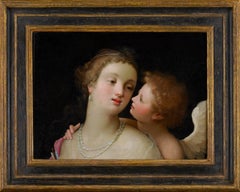
Venus and Cupid
By Cornelis van Haarlem
Located in London, GB
Circle of Cornelis van Haarlem Venus and Cupid 1562 - 1638 Oil on canvas Image size: 14 1/2 x 10 1/2 inches (49.5 x 37 cm) Contemporary-style handmade frame  This painting depicts ...
Category

16th Century Figurative Paintings

Materials

Canvas, Oil

Venus and Cupid
Free Shipping
Castle San Angelo, Rome, David Roberts, 19th Century Original Watercolour
By David Roberts
Located in London, GB
Pencil, watercolour and bodycolour heightened with white. Image size: 9 1/2 x 13 1/4 inches (24 x 34 cm) Hand made gilt frame Provenance The Fine Art Society 1981 (Label Verso) Priv...
Category

Mid-19th Century Victorian Landscape Drawings and Watercolors

Materials

Paper, Watercolor

Portrait of a Girl
Located in London, GB
Leopold Carl Muller Portrait of a Girl 1834 - 1892 Oil on wood panel, signed lower left Image size: 10 ¼ x 6½ inches (26 × 17 cm) Framed Whilst on his travels, Müller painted a se...
Category

19th Century Portrait Paintings

Materials

Oil, Wood Panel

Portrait of His Royal Highness James, Duke of York and Albany
By Mary Beale
Located in London, GB
Mary Beale Portrait of His Royal Highness James Duke of York & Albany 1633-1699 Oil on canvas, inscribed on reverse, unsigned Image size: 30 x 25 inches (76 x 63.5 cm) Contempora...
Category

17th Century Portrait Paintings

Materials

Canvas, Oil

Portrait of a Gentleman
Located in London, GB
Johan Zoffany Portrait of a Gentleman 1733 - 1810 Oil on canvas, unsigned Image size: 29 1/2 x 24 1/2 inches (75 x 62 cm) Original gilt frame Provenance: Scott & Fowles, New York ...
Category

18th Century Portrait Paintings

Materials

Canvas, Oil

Portrait of Edward VI when Prince of Wales
By English School
Located in London, GB
Studio of William Scrots Portrait of Edward VI when Prince of Wales 16th Century Oil on oak panel, unsigned Image size: 11 ½ x 11 ½ inches (29.3 x 29.3 cm) Early hand-carved gilt frame Provenance: The Hunter Blair collection, Blairquhan, Scotland By descent Christie’s London, 24th May 2007, lot 39 Mould Gallery Private Collection This striking portrait depicts Edward VI in the regalia of the Prince of Wales, shortly before he was to become the King of England. The Roman numerals on the painting indicate a creation year of 1546, meaning that Edward was only nine when this likeness was captured. It is believed that this work is a copy of a portrait held by the Met Museum of New York, completed by the Flemish portraitist William Scrots, who worked extensively with Henry VIII as the King’s Painter. Henry VIII had utilised the side-profile perspective as an artistic motif to assert the power of his Tudor dynasty. The perspective became associated with royalty, and its application in this portrait affirms Edward’s succession and future role as the English monarch. Portraits were an important way in which those in the 16th century captured likenesses of important public figures, such as the crown prince - for this reason, Edward VI is one of the most well documented Tudor monarchs, with multiple portraits capturing his childhood. This current work is exquisitely detailed, with great care taken to depict Edward’s lavish clothing. It is possible to make out the most minute of details, from the acorns on his collar to the individual barbs of the feathers on his cap. The gold chains fixing his jacket in place and the metallic aglets on his cap are also remarkable, indicating the absolute wealth and power of the Tudor dynasty. This portrait recently underwent dendrochronological analysis, which revealed that the work was painted during Edward’s lifetime. It was later altered to fit the diamond format that we see currently, which is also likely when the ‘ich dien’ (the motto of the Prince of Wales, meaning ‘I serve’) was added. King Edward VI On the 12th of October 1537, Jane Seymour gave birth to Henry VIII’s only son, who would be named Edward. As a celebration of this new heir to the throne, two thousands rounds of ammunition were shot from the Tower of London, and parties and festivities occurred all across England. Edward was baptised three days after his birth by Thomas Cranmer in a lavish ceremony before retiring to the Queen’s apartments to receive parental blessings. In a sad turn of events, Jane Seymour never recovered from the birth of her son, dying only 12 days after giving birth. Increasingly paranoid about Edward’s wellbeing as his only male heir, Henry VII ordered that he would remain at Hampton Court Palace. Edward was afforded a luxurious suite, but was initially kept in the presence chamber in a ‘cradle of state’ so that nobles and courtiers could visit the young prince. After this, Edward lived in his own bedchamber and was served by his own kitchen to avoid contamination. Once weaned, his food was tested by a servant to ensure it was safe for the prince to consume. Edward’s clothes were washed before he wore them, everything he touched had to be cleaned before he could do so, and the walls, floors and ceilings of his suite had to be scrubbed clean multiple times a day. Any visitors were forced to wash before seeing the prince, and they could not attend the chambers if they had even the smallest sign of sickness. Edward was raised by the women of the court and was known as a healthy, handsome, tall and well-fed young boy. He was shy and looked to his nurses for reassurance, and it is documented that even the most stern of nursemaids doted upon him. His elder half-sister Mary visited him regularly and showered him with lavish gifts - this makes their later divide over religion all the more heartbreaking. He was educated alongside his sister, Elizabeth, to whom he was the closest in age. Edward saw little of his father until he became an ‘adult’ at the age of six. From this point on, Edward was expected to play the heir to the throne. His female attendants were dismissed and his education became that of a prince. His suite and wardrobe were redesigned to match Henry VIII’s own. His schoolmasters noted him for his maturity, but also for his fierce temper. Edward studied humanist subjects such as classics, Latin, Greek and rhetoric, as well as gentlemanly pursuits of fencing, riding, and music. He was also educated in religion and scripture by the Archbishop Thomas Cranmer, who became somewhat of a father figure for the prince. In 1547, when Edward was nine years old, Henry VII died - his young son was crowned as King only a month later. Due to his young age, Edward was supported by a regency council, but this was quickly overpowered by the King’s uncle, Edward Seymour, who seized control as Lord Protector. Edward kept a diary during this period, whose writings characterise him as a cold and unfeeling young boy - these qualities may well have become disastrous for a monarch if he had survived. Edward is most renowned for his Protestant reforms. He introduced a new Book of Common Prayer in 1549, and again in 1552. This second Book provided the basis for worship within the Church of England for the next four hundred years. He also banned Catholic rituals such as casting of holy water, pilgrimages, and using rosaries...
Category

16th Century Portrait Paintings

Materials

Oil, Panel

More About Darnley Fine Art