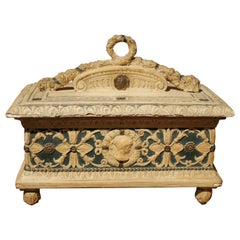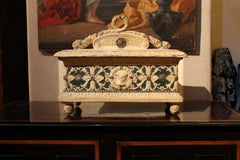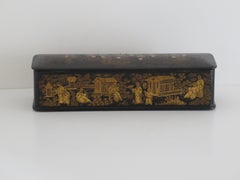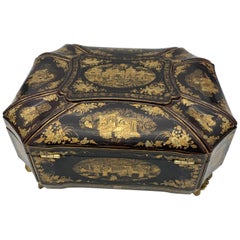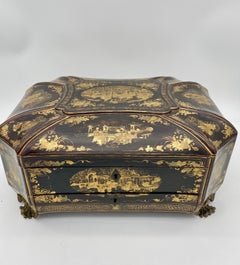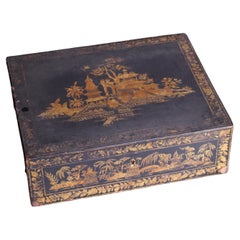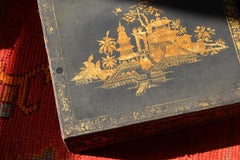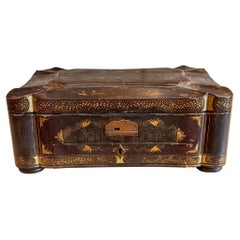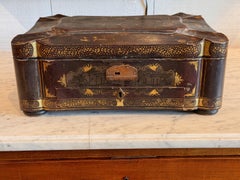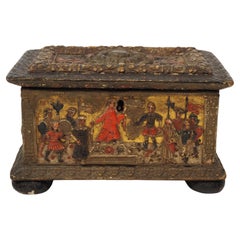
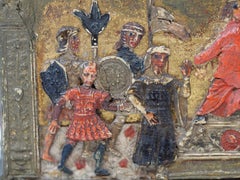
Wooden casket with polychrome and gilded "pastiglia" relief decor, Italy 15th c.
Located in Gorssel, GE
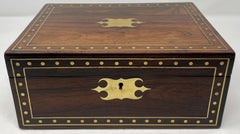
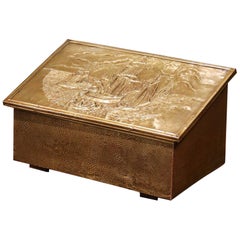
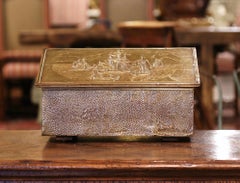
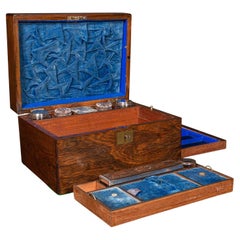
A rare wooden casket with polychrome and gilded pastiglia relief, Italy, 15th century. The box is adorned with four finely executed scenes from the life of an unknown martyr — beautifully preserved and remarkably vivid after centuries. Dimensions: 15.5 × 10.4 × 9 cm Provenance: Dutch private collection In overall good condition for its age, with minor losses to the surface and possible retouching to the polychromy. The ball feet are likely later additions. Pastiglia [paˈstiʎʎa], an Italian term meaning "pastework", is low relief decoration, normally modelled in gesso or white lead, applied to build up a surface that may then be gilded or painted, or left plain. The technique was used in a variety of ways in Italy during the Renaissance. White lead pastiglia was a north Italian speciality, produced between about 1450 and 1550. Six workshops were identified by Patrick M. De Winter, although their location remains uncertain; the Workshop of the Love and Moral Themes, whose products seem the most numerous, was possibly at Ferrara, where the painter Cosimo Tura began his career gilding caskets. Venice is also thought to have produced them. Other workshops identified by De Winter include the "Workshop of the main Berlin casket" and "Workshop of the Cleveland Casket". The subjects were typically classical, drawn from both mythology and Ancient Roman history (especially the early period covered by Livy), but biblical ones are also found. Compositions can often be shown to be borrowed from another medium, such as prints or bronze plaquettes...
15th Century and Earlier Italian Renaissance Antique Gesso Decorative Boxes
Gesso, Wood