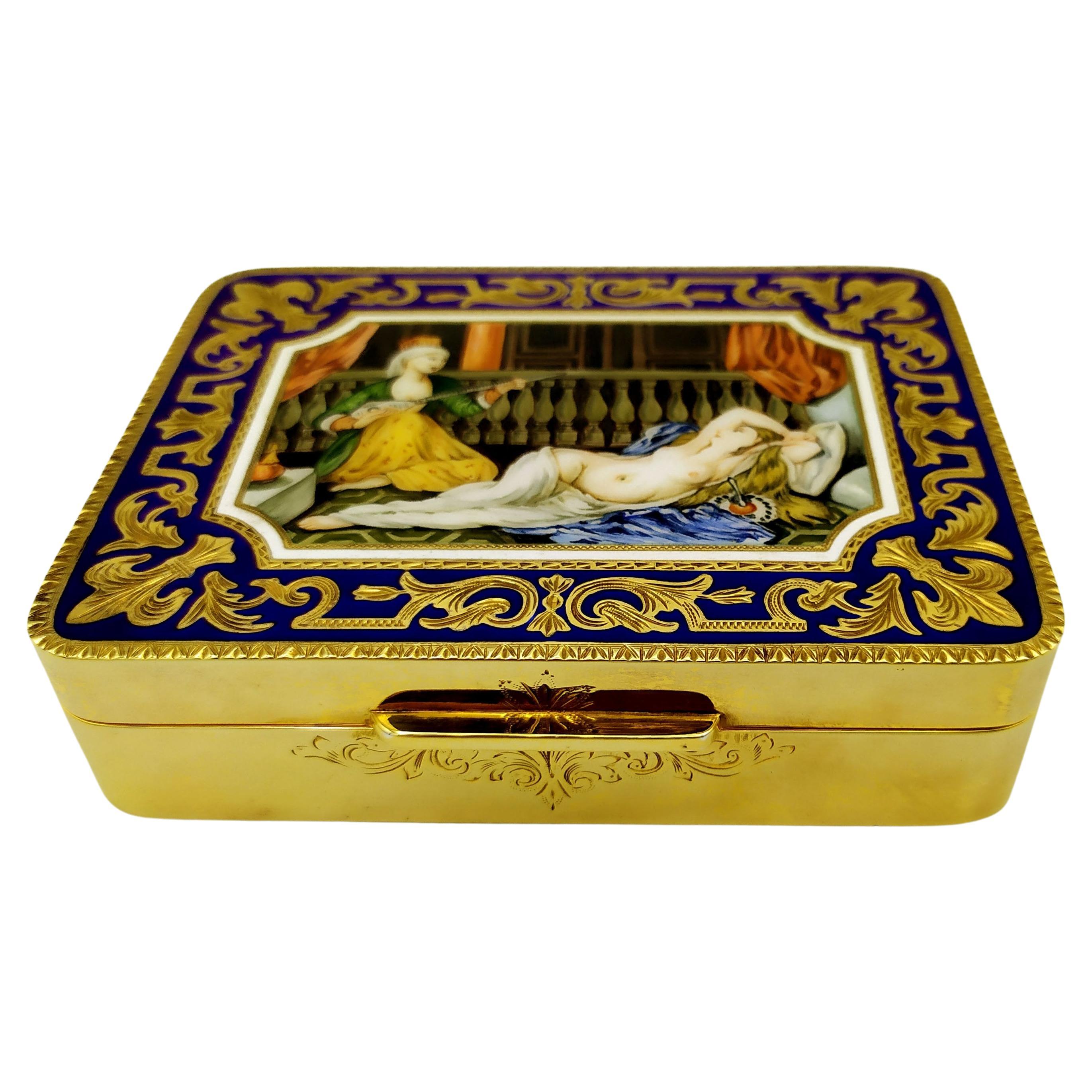
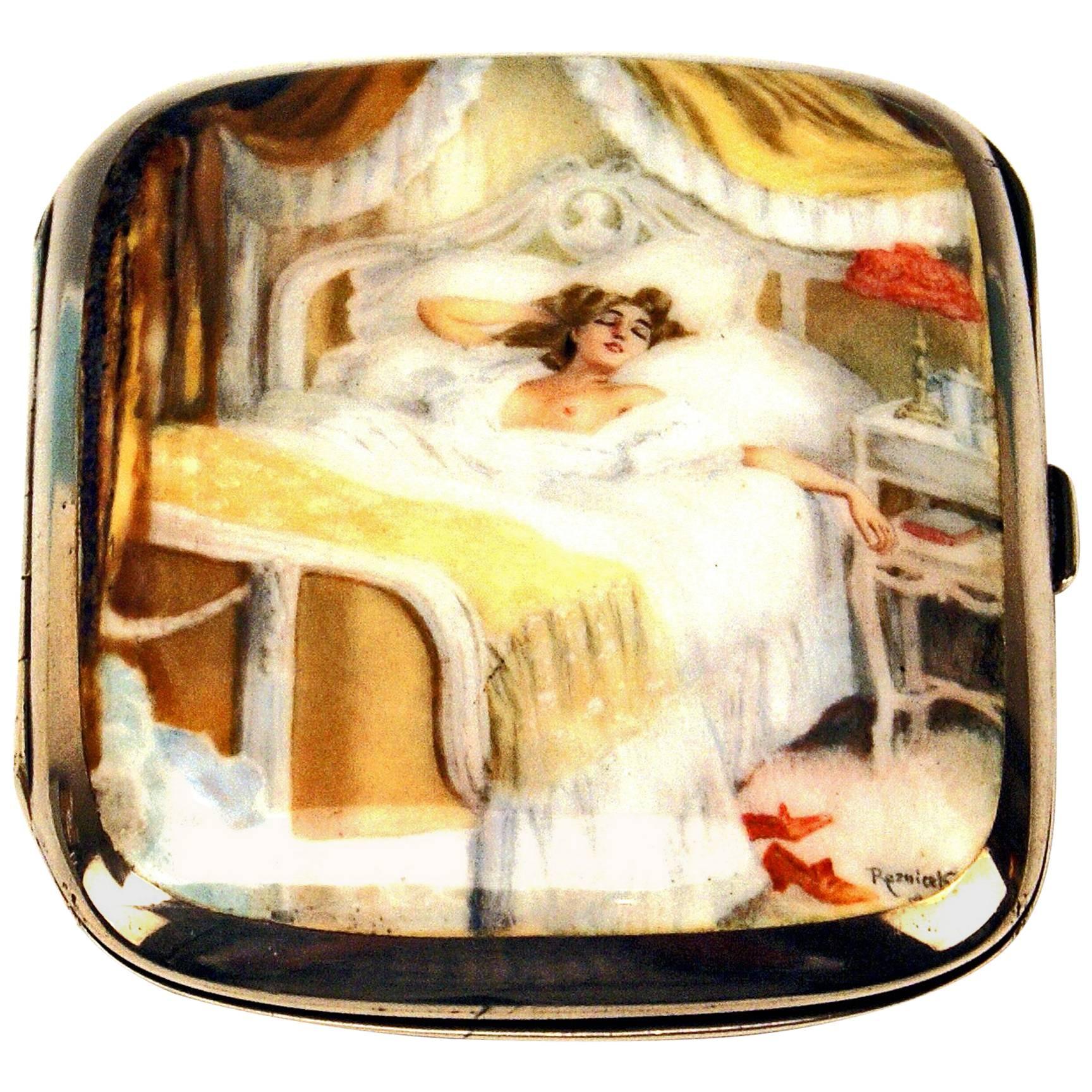
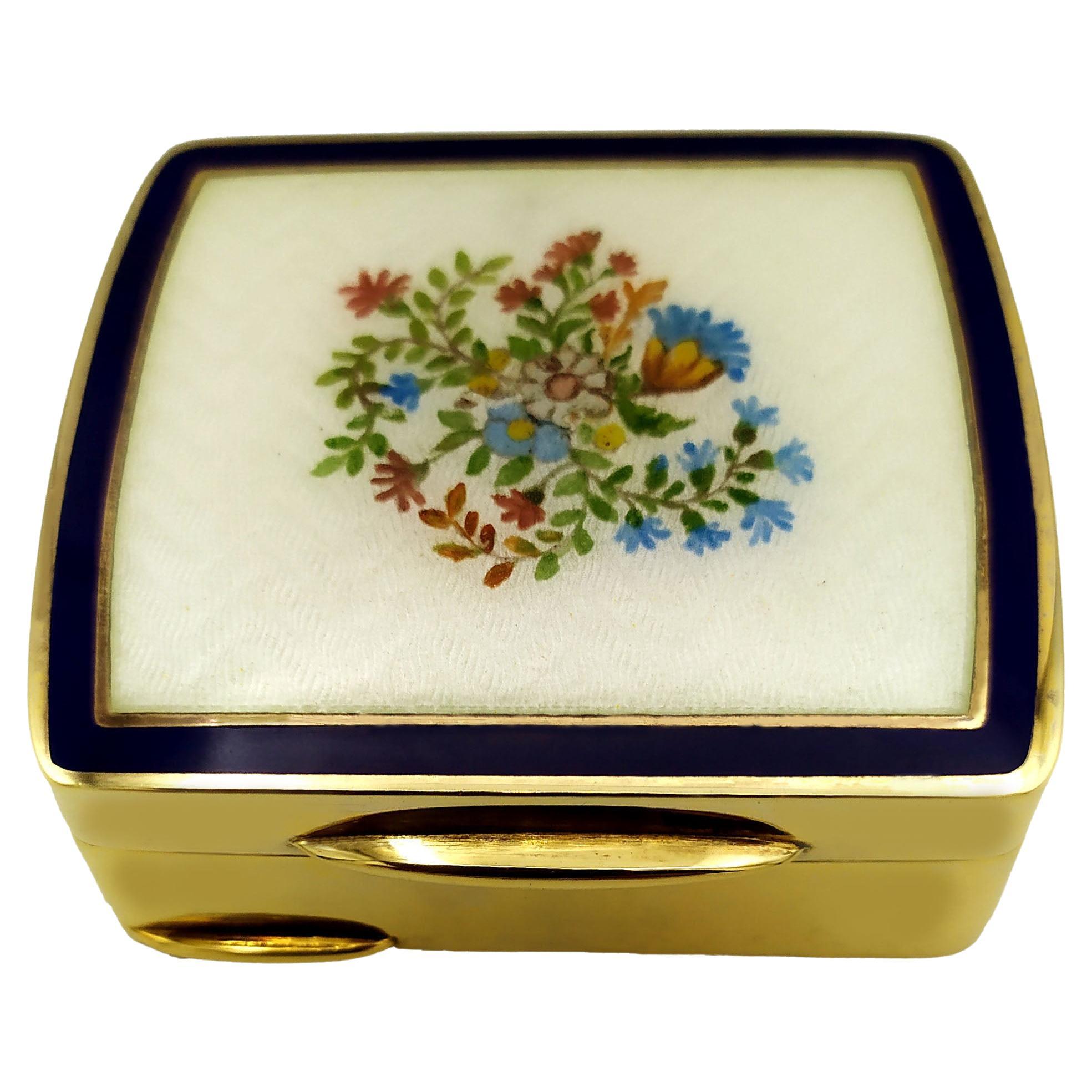
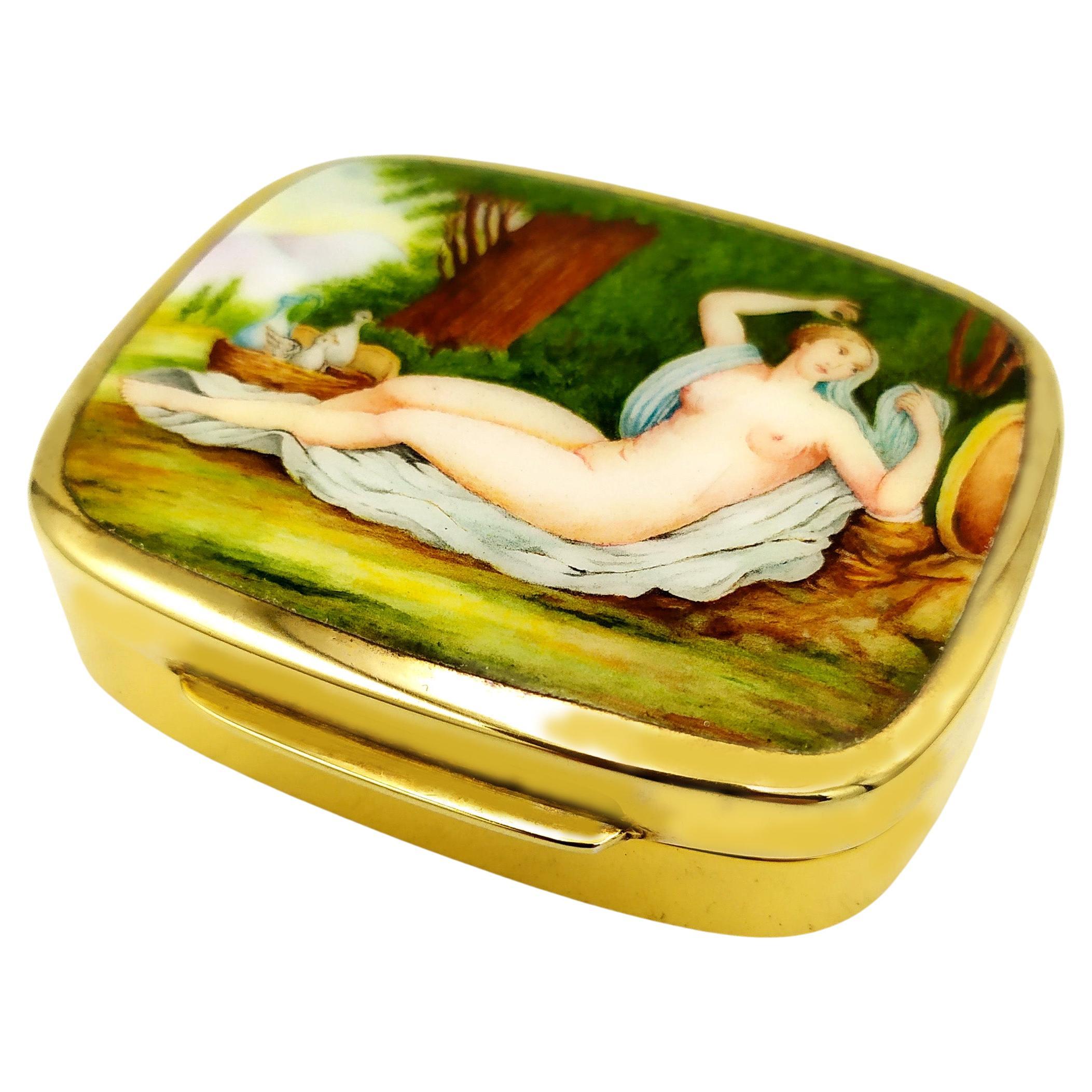
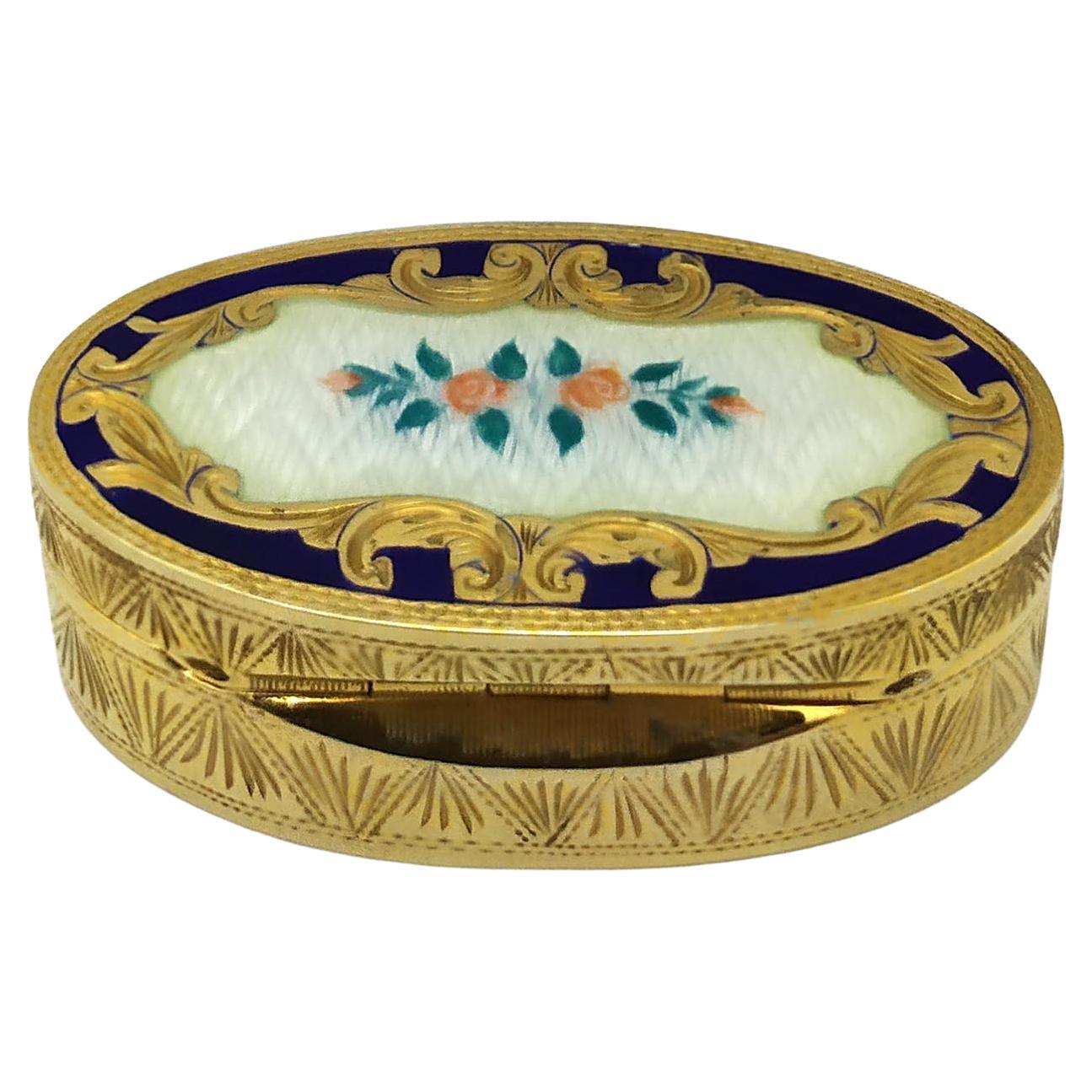
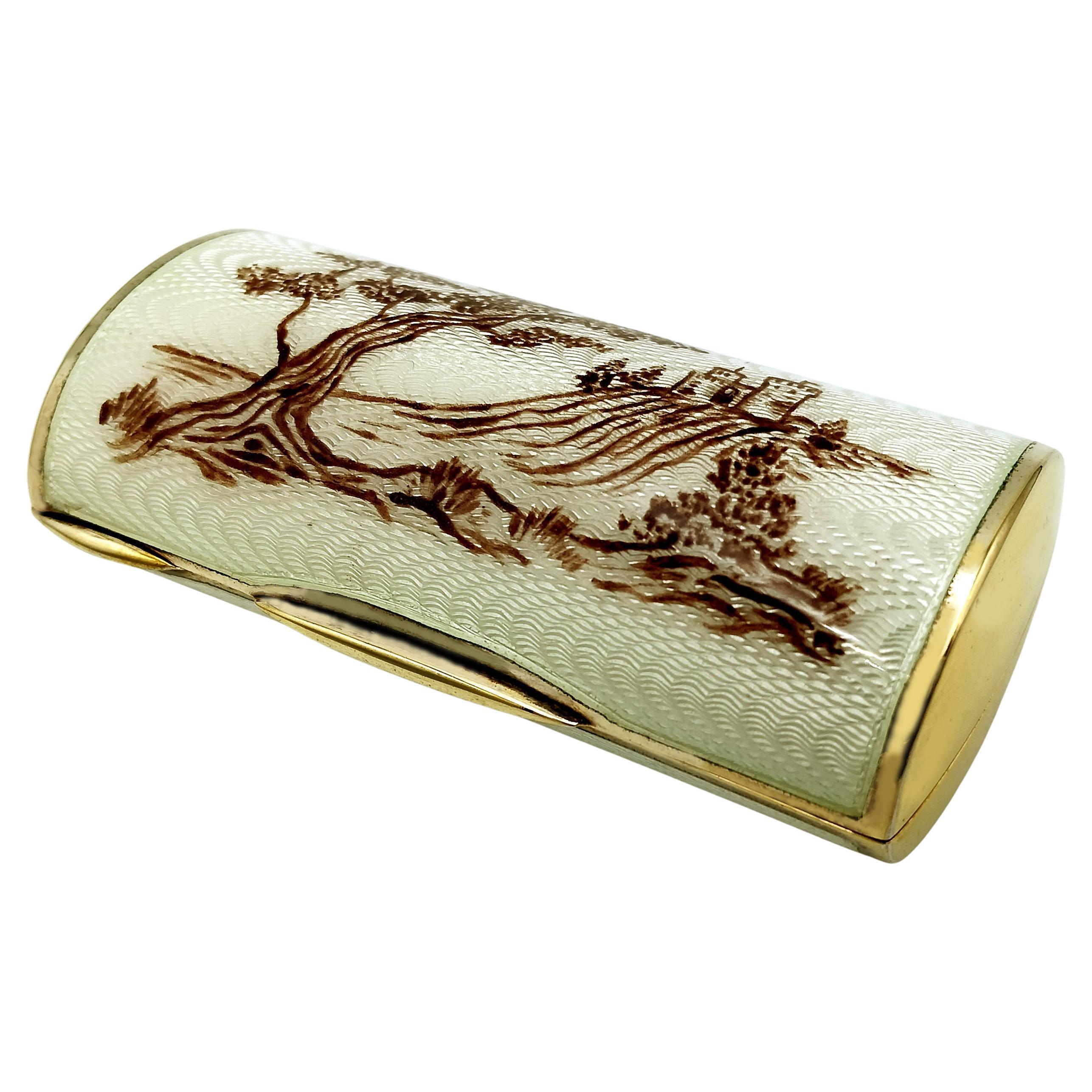
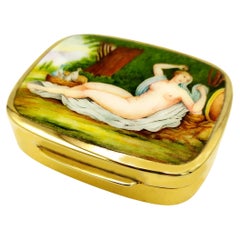
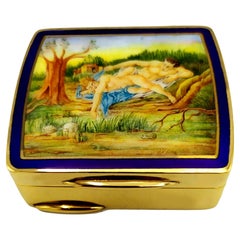
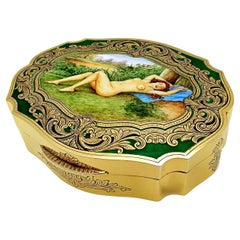
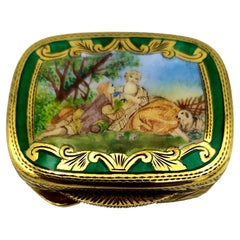
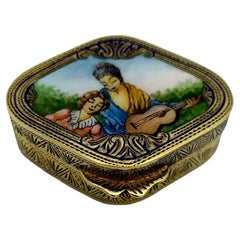
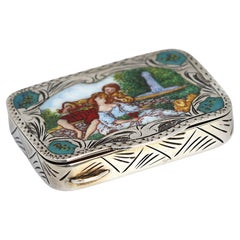
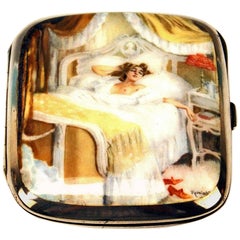
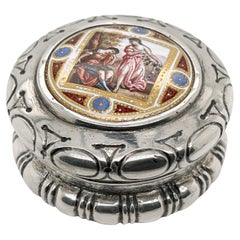
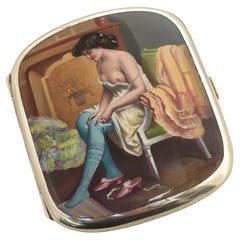
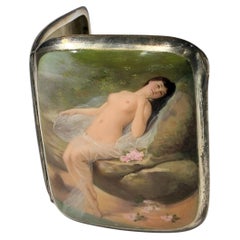
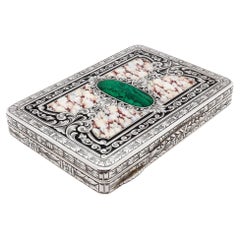
Rounded rectangular snuffbox in 925/1000 sterling silver gold plated with a miniature on the lid hand-painted with fired enamels by the painter Romano Buccioni. English Art Nouveau style, early 1900s. Measurements: 5.7 x 7.2 x 2 cm. Weight: 145 g. Designed by Giorgio Salimbeni in 1967 and manufactured in Florence in various examples but with different subjects, at the Salimbeni company headquarters, entirely handmade by artisan artists with thick sheets and large reinforcements suitable for withstanding numerous enamelling firings at high temperatures at around 800° C.
ENAMEL
English: enamel
French: smalt
German: schmelzen (to melt)
A glassy substance consisting of a mixture of silicates, potash, silica, soda, red lead, quartz, feldspars, borax, and minerals containing metallic phosphors, as well as numerous metallic oxides.
The enamel base material is prepared in melting furnaces into which the aforementioned ingredients are added. The mass is heated to temperatures varying, depending on the situation, between 1000° and 1200° C until molten glass is formed; this is followed by rapid water cooling. At this point, the material is finely ground, known as "frit."
The color of the base material is obtained by adding metallic oxides, which, in varying percentages, do not compromise its transparency. These are mixed with the "frit" and then thoroughly washed with distilled water to remove any residual impurities from the powder. The whole thing is then melted again and poured into molds to store it in blocks. Before use, it must be finely ground again and washed with distilled water. There are approximately 700 different colors of enamel, but in practice today, use is limited to about two hundred. However, layering the different colors allows for a virtually infinite range of combinations and shades, which can range, even on the same object, from darker to lighter shades and vice versa.
Hand-painted MINIATURES can be created using a variety of techniques.
The most important ones we use on our items are threefold:
those with fired enamel,
those with water tempera on ivory plates,
those painted on mother-of-pearl plates.
Fired enamel miniatures:
On a first layer of enamel, usually white, very light, or even transparent, melted at a temperature of about 750°C, the chosen subject is painted using miniature colors. These are colored crystals, ground and reduced to a very fine powder, almost impalpable like face powder. These colors are washed and purified in distilled water with the addition of small amounts of deoxidizing acids. These, diluted with essential oils (usually solder essential oil), can be mixed to form a palette of colors.
With very fine sable hair brushes, the subject is drawn, starting from the outline and then gradually adding various layers of color.
Frequent firings are necessary to ensure the colors harden and don't absorb into the underlying enamel, as the colors would spread irreparably during subsequent firings at 750°C as they liquefy. Hence the need to build up the painting piece by piece, firing it repeatedly.
Numerous touch-ups are then required, often layering different colors, a skill that only the painter's experience allows. A beautiful miniature requires 20 to over 50 firings and is finished when the painter deems no further intervention necessary.
Some colors must be darker than others because they fade when overlaid with the transparent enamel used to seal the miniature. This transparent layer, known in jargon as "fondant," must be smoothed and polished like all other translucent enamel colors.