Holly Boxes
to
4
2
2
2
1
39
6,236
4,210
2,641
1,512
4
2
2
2
Height
to
Width
to
4
4
4
Material: Holly
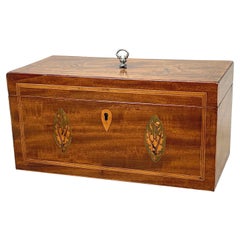
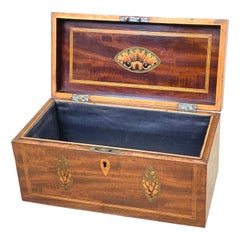
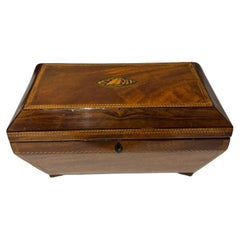
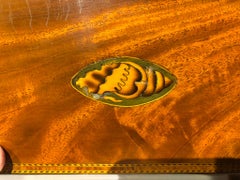
19th Century English Regency Mahogany Tea Caddy with Seashell Inlay
Located in Stamford, CT
19th century English Regency Mahogany sarcophagus form tea caddy with satinwood and holly wood seashell inlaid top. The flame mahogany top framed by twin...
Category
Early 19th Century Regency Antique Holly Boxes
Materials
Bone, Mahogany, Satinwood, Holly
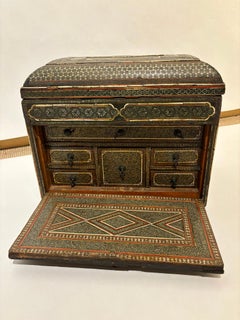
19th Century Anglo Indian Inlaid Mosaic Box With Drop Front and Drawers
Located in Stamford, CT
19th Century Anglo Indian fall front box with six drawers with metal pulls. The exterior and interior inlaid throughout with bone and various woods. Intricate geometric designs cover...
Category
Mid-19th Century Antique Holly Boxes
Materials
Bone, Fruitwood, Holly
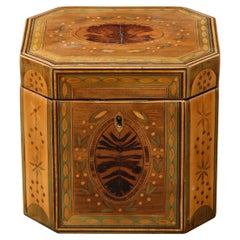
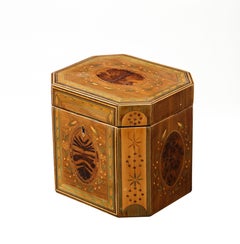
Georgian Octagonal Inlaid Tea Caddy
Located in Greenwich, CT
Fine George III octagonal tea caddy inlaid with various woods on a harewood ground, the central panels veneered with coucous wood and banded by holly stringing around a kingwood band, vines and berried...
Category
1780s English George III Antique Holly Boxes
Materials
Ebony, Kingwood, Harewood, Holly, Burl
Circa 1790 English George III Period Tea Caddy Box
Located in Chapel Hill, NC
Circa 1790 George III period tea caddy box, English. Original inlaid inner caddies & a later cut glass sugar well. Old Sheffield plate silver pull. Banded in box or holly. Classic re...
Category
1790s English George III Antique Holly Boxes
Materials
Sheffield Plate
Related Items
Large Georgian Mahogany Tea Caddy
Located in Bedfordshire, GB
A good quality Georgian 18th century mahogany rectangular tea caddy having replacement brass axe drop handle to hinged lid enclosing cavity with attractive inlaid decoration throughout.
Tea was of course a very precious commodity throughout the 18th and 19th centuries and the purpose of a tea caddy was not just to preserve the and extend the life of the precious tea leaves...
Category
Late 18th Century English Georgian Antique Holly Boxes
Materials
Mahogany
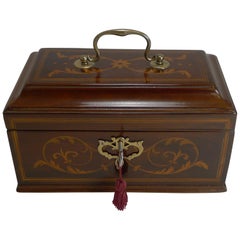
Antique English Inlaid Mahogany Tea Caddy, circa 1790
Located in Bath, GB
A very handsome George III tea caddy, made from Mahogany and beautifully inlaid with panels and highly decorative foliate marquetry to the front and top. The top has a handsome cast ...
Category
1790s English George III Antique Holly Boxes
Materials
Mahogany
$1,041 Sale Price
20% Off
H 5.5 in W 9.25 in D 5 in
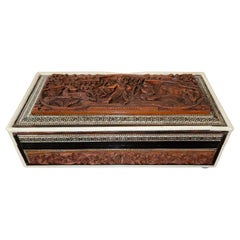
19C Anglo Indian Carved Teak Wood and Sadeli Mosaic Box
Located in Dallas, TX
PRESENTING A LOVELY 19th century Anglo-Indian Carved Teak Wood and Sadeli Mosaic Box, featuring a carving of a Hunt Scene.
Made circa 1870 in Bombay, India during the Rule of the Br...
Category
Late 19th Century Indian Anglo-Indian Antique Holly Boxes
Materials
Silver, Pewter
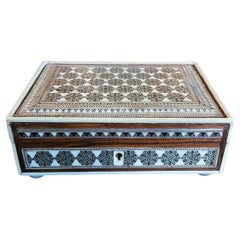
19C Anglo Indian Bombay MOP Sadeli Mosaic Trinket Box
Located in Dallas, TX
PRESENTING a LOVELY 19C Anglo Indian Bombay MOP (Mother of Pearl) Sadeli Mosaic Trinket Box from circa 1875-85.
Gorgeously detailed and hand-crafted ‘sadeli mosaic’ inlay, from the Bombay Area, with deep greens with silver, pewter, mother of pearl, bone and ebony in geometric patterns.
The box case, is made of sandalwood but completely covered in MOP, bone, faux ivory, ebony and mosaic inlay.
Edged with faux ivory and banded with a different pattern of sadeli mosaic.
Some minor damage to the top (repair is obvious in pics) and ivorine replacements to some edging, but it still a BEAUTIFUL BOX and of real QUALITY!
The mosaic work is FABULOUS!
Box opens to reveal its original blue velvet lining.
It sits on 4 (recently added) silvered button feet.
SADELI MOSAIC: “Anglo Indian boxes were made in India for the English residents from the early part of the 18th century. They were brought back or sent back to England usually by the people who had commissioned them. From the beginning of the nineteenth century they were imported more commercially, although not in any significant numbers until the middle decades. They were very highly valued, especially the early ones, to the extent that the designs were copied on late 19th and early 20th century tins.
The ancient art of Sadeli Mosaic is said to have been introduced from Shiraz in Persia via Sind to Bombay, a long time before the Anglo Indian boxes were made. It was a technique, which required a high degree of skill and patience. It was executed very lavishly, in that the frequent cuts wasted a great amount of the precious materials used. The workmanship was however more than commensurable to the value of the materials.
Ivory, silver, pewter (or other metals), wood and horn were cut into faceted rods which were bound together to form geometric patterns. When the glue has set, the rods were sliced in transverse sections. This gave the maker a number of angled circular pieces in the original pattern. Several variations of patterns could be achieved by combining the materials in different ways. The ivory was sometimes dyed green to give an extra color.
The mosaic pieces in a combination of patterns, often separated by ivory, ebony, horn or silver stringing were used to veneer sandalwood boxes. In the early boxes, which date from the turn of the 18th to the 19th century, there are large panels of mosaic covering tops and sides of boxes. It took incredible skill to cover such large areas without any shakes or wavering of the pattern. The corners and joins on these boxes are impeccably matched.
The makers (reputed to be Persian) of Sadeli mosaic made in the first two decades of the 19th century displayed a total understanding of the qualities of the different materials they used. They combined substances, which can expand and contract according to atmospheric conditions with others, which are hard and unyielding. The result was a sharp definition of the lines and patterns, which made up the whole design.
On the early boxes the designs look deceptively simple. The fact is, they emerged from a culture, which had mastered geometry and understood how to generate a pattern from a set number of points. The patterns are so harmoniously combined that their incredible complexity is not immediately apparent.
The earliest Sadeli boxes...
Category
Late 19th Century Indian Anglo-Indian Antique Holly Boxes
Materials
Silver
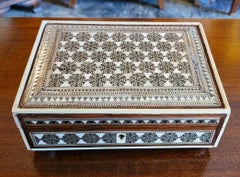
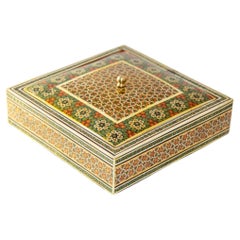
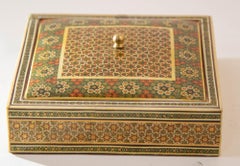
1950s Anglo Indian Micro Sadeli Mosaic Inlaid Jewelry Box
Located in Moreno Valley, CA
1950s Anglo Indian Micro Sadeli Mosaic Inlaid Jewelry Box.
DIMENSIONS: 7ʺW × 7ʺD × 2.5ʺH.
Indo Persian Moorish style micro mosaic inlaid jewelry box with lid.
Intricate inlaid Anglo ...
Category
Mid-20th Century Indian Moorish Holly Boxes
Materials
Bone, Fruitwood
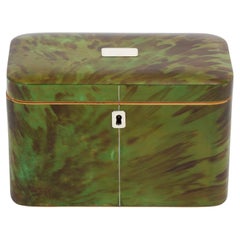
Georgian Tortoiseshell Tea Caddy
Located in Northampton, GB
Oval Tea Caddy with Silver Mounts
From our Tea Caddy collection, we are delighted to offer this Georgian Silver and Tortoiseshell Tea Caddy. The Tea Caddy is of oval shape with a Tortoiseshell exterior mounted with engraved silver stringing, a silver shield plaque below the silver escutcheon and a silver looped handle. The interior features a floating tea shelf...
Category
Early 1800s English George III Antique Holly Boxes
Materials
Silver
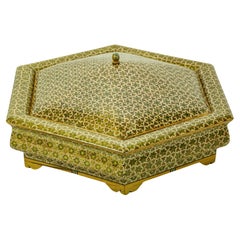
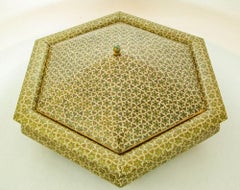
Large Anglo Indian Mosaic Inlaid Jewelry Hexagonal Box 1950s
Located in Moreno Valley, CA
Large Anglo Indian Moorish Islamic style micro mosaic inlaid jewelry box with lid.
Intricate inlaid Anglo Persian box with floral and geometric Moorish Sadeli design in an hexagonal shape form with micro mosaic marquetry, very fine artwork.
Museum collector piece like the one in Doris Duke Islamic Art Museum.
The repeating geometric patterns of Sadeli Mosaic are what give it beauty and richness.
This decorative technique is a type of micro mosaic featuring repeating geometric patterns.
Dimensions: H: 5 in : 12 in W x 12 in. D.
Circa 1950s.
Sadeli mosaic art is a highly skilled craft, it has had a long history in India and the Middle East with early examples dating back to the 16th century. In the 1800s, it became popular as a decoration on a variety of boxes, card cases, and chess boards imported from India. Since Bombay became a center of making them, they became known as Bombay boxes.
The ancient art of Sadeli Mosaic is said to have been introduced from Shiraz in Persia via Sind to Bombay, a long time before Indian boxes appeared. The designs on early boxes look deceptively simple. The fact is they emerged from a culture which had mastered geometry and understood how to generate a pattern from a set number of points. The patterns are so harmoniously combined that their incredible complexity isn’t immediately apparent to the viewer.
Will look great in a Moroccan decor...
Category
Mid-20th Century Indian Anglo-Indian Holly Boxes
Materials
Wood
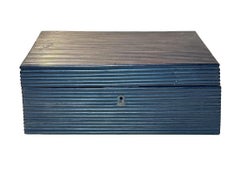
Antique Anglo-Indian Fluted Writing Box With Secret Drawers. Early 19th Century
Located in St Annes, Lancashire
Wonderful writing box made from a tropical hardwood
Fabulous shape and plain fluted carving. It gives it a modernist appearance
Probably Sri Lankan
3 secret drawers*
Replaced lea...
Category
Early 19th Century Sri Lankan Anglo-Indian Antique Holly Boxes
Materials
Wood
$650
H 5.5 in W 16 in D 9 in
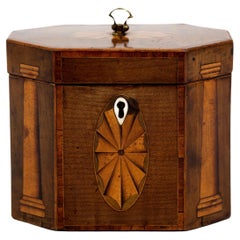
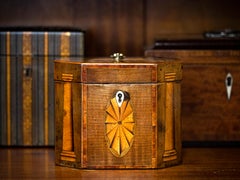
Georgian Harewood Tea Caddy
Located in Northampton, GB
With Tuscan Columns & Fan Inlay.
From our Tea Caddy collection, we are pleased to offer this Georgian Harewood Tea Caddy. The Tea Caddy of octagonal shape with a Harewood veneer...
Category
Late 18th Century English George III Antique Holly Boxes
Materials
Boxwood, Harewood
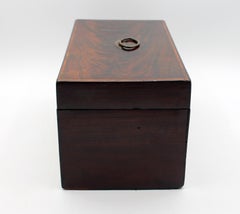
Period Georgian Tea Caddy, Circa 1790-1810
Located in High Point, NC
Circa 1790-1810 period Georgian tea caddy made from Mahogany. The tea caddy has been used well and loved over many centuries. The top has a brass ring with which to lift the lid. ...
Category
Late 18th Century English Georgian Antique Holly Boxes
Materials
Mahogany, Satinwood
Antique George III Sterling Silver Locking Tea Caddy
Located in Jesmond, Newcastle Upon Tyne
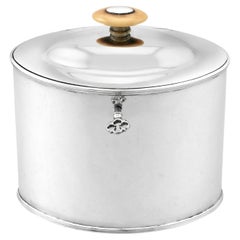
An exceptional, fine and impressive antique Georgian English sterling silver locking tea caddy; an addition to our silver teaware collection.
This exceptional antique Georgian sterling silver tea caddy has an oval form.
The surface of the tea caddy is plain and unembellished, with an applied reed decorated border to the upper and lower rims.
This antique silver tea caddy retains the original hallmarked domed flush hinged cover; the flush hinge indicates the fine quality of this piece.
The cover is surmounted with the original and exceptional silver topped oval button style finial.
This antique Georgian tea caddy...
Category
1790s British George III Antique Holly Boxes
Materials
Sterling Silver
19th Century English Regency Tea Caddy
Located in Charlottesville, VA
A large English tea caddy. It is mahogany with brass feet.
Category
19th Century British Antique Holly Boxes
Materials
Brass
Previously Available Items
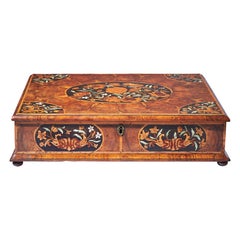
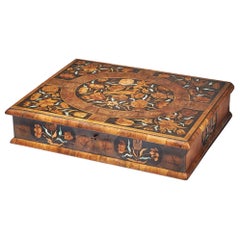
Important 17th Century Charles II Marquetry Olive Oyster Lace Box, Circa 1680
Located in Oxfordshire, United Kingdom
A fine and rare 17th century William and Mary olive oyster marquetry lace box, circa 1670-1690. England
Attributed to Gerrit Jensen.
The mould...
Category
17th Century English William and Mary Antique Holly Boxes
Materials
Bone, Boxwood, Ebony, Oak, Olive, Tulipwood, Holly
H 5.52 in W 23.04 in D 17.33 in
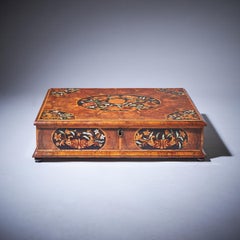
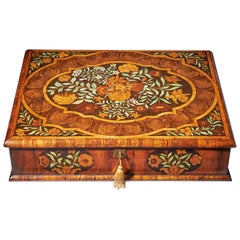
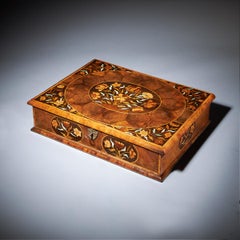
17th Century William and Mary Floral Marquetry Olive Oyster Lace Box, circa 1680
Located in Oxfordshire, United Kingdom
A fine and rare 17th century William and Mary olive oyster marquetry lace box, circa 1670-1690. England
The ovolo-moulded and holly banded top is c...
Category
17th Century English William and Mary Antique Holly Boxes
Materials
Bone, Oak, Olive, Boxwood, Ebony, Tulipwood, Holly
H 4.93 in W 21.26 in D 16.15 in
17th Century Museum Grade William and Mary Olive Oyster Marquetry Lace Box
By Thomas Pistor
Located in Oxfordshire, United Kingdom
17th century Museum Grade William and Mary Olive Oyster Marquetry Lace box, C. 1670-1690. England
The ovolo-moulded and holly banded top is centred...
Category
Late 17th Century English William and Mary Antique Holly Boxes
Materials
Bone, Boxwood, Ebony, Olive, Holly
H 4.73 in W 21.26 in D 16.15 in
Pair of George IV Regency Specimen Wood Parquetry Boxes of Sarcophagus Shape
Located in Oxfordshire, United Kingdom
An extremely rare and fine pair of George IV Regency exotic timber boxes of sarcophagus shape, decorated to all surfaces and lined in silk velvet.
The finely veneered top is deco...
Category
Early 19th Century European George IV Antique Holly Boxes
Materials
Boxwood, Ebony, Olive, Rosewood, Holly, Yew, Cocobolo
H 4.73 in W 11.03 in D 9.06 in
Unusual Welsh Early 19th Century Inlaid Tea Caddy
Located in Greenwich, CT
Unusual early 19th century welsh tea caddy of sarcophagus form, the canted top with ebony faceted boss, the front having double pinwheel inlay, the top and inner lids inlaid with dia...
Category
Early 19th Century Welsh Regency Antique Holly Boxes
Materials
Ebony, Kingwood, Walnut, Holly
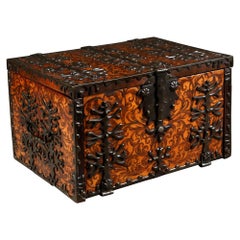
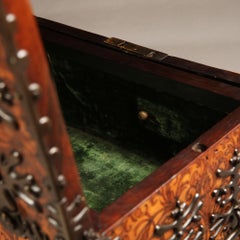
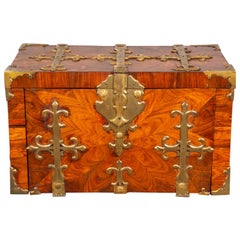
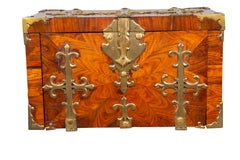
William and Mary Seaweed Marquetry Strong Box Firmly Attributed to Gerrit Jensen
By Gerrit Jensen
Located in Oxfordshire, United Kingdom
A 17th century William and Mary seaweed or arabesque marquetry strong box, with firm attribution to the royal cabinetmaker, Gerrit Jensen, circa 1680-170...
Category
17th Century British William and Mary Antique Holly Boxes
Materials
Holly
H 9.06 in W 13.78 in D 10.24 in
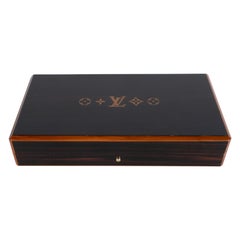
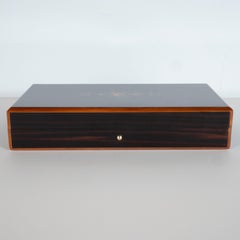
Modernist Rosewood and Cedar Monogrammed Humidor by Louis Vuitton
Located in New York, NY
This elegant humidor was realized by Louis Vuitton- one of the world's premiere luxury brands since its inception in 1854. Executed in lacquered dark rosewood with blonde holly trim ...
Category
Early 2000s French Modern Holly Boxes
Materials
Brass
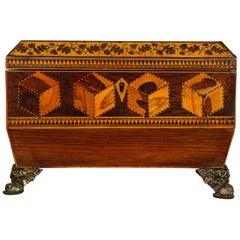
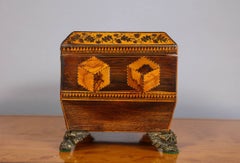
Profusely Inlaid Tunbridge Regency Tea Caddy
Located in Greenwich, CT
Fine early 19th century Tunbridge ware tea caddy, the top inlaid with geometric patterns, the canted sides with wood mosaic ivy banding over further geometric inlay, standing on gilt...
Category
Early 19th Century English Regency Antique Holly Boxes
Materials
Ebony, Olive, Walnut, Holly, Yew
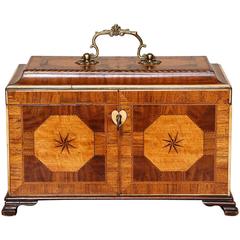
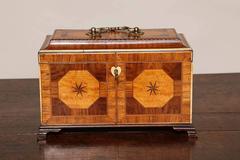
Exceptional George III Tea Caddy
Located in Greenwich, CT
George III inlaid tea caddy of the finest quality with satinwood, rosewood, holly, ebony, mahogany and Guadeloupe wood marquetry and compass star inlay, the top with two octagonal sa...
Category
1770s English Chippendale Antique Holly Boxes
Materials
Mahogany, Purpleheart, Rosewood, Satinwood, Ebony, Holly
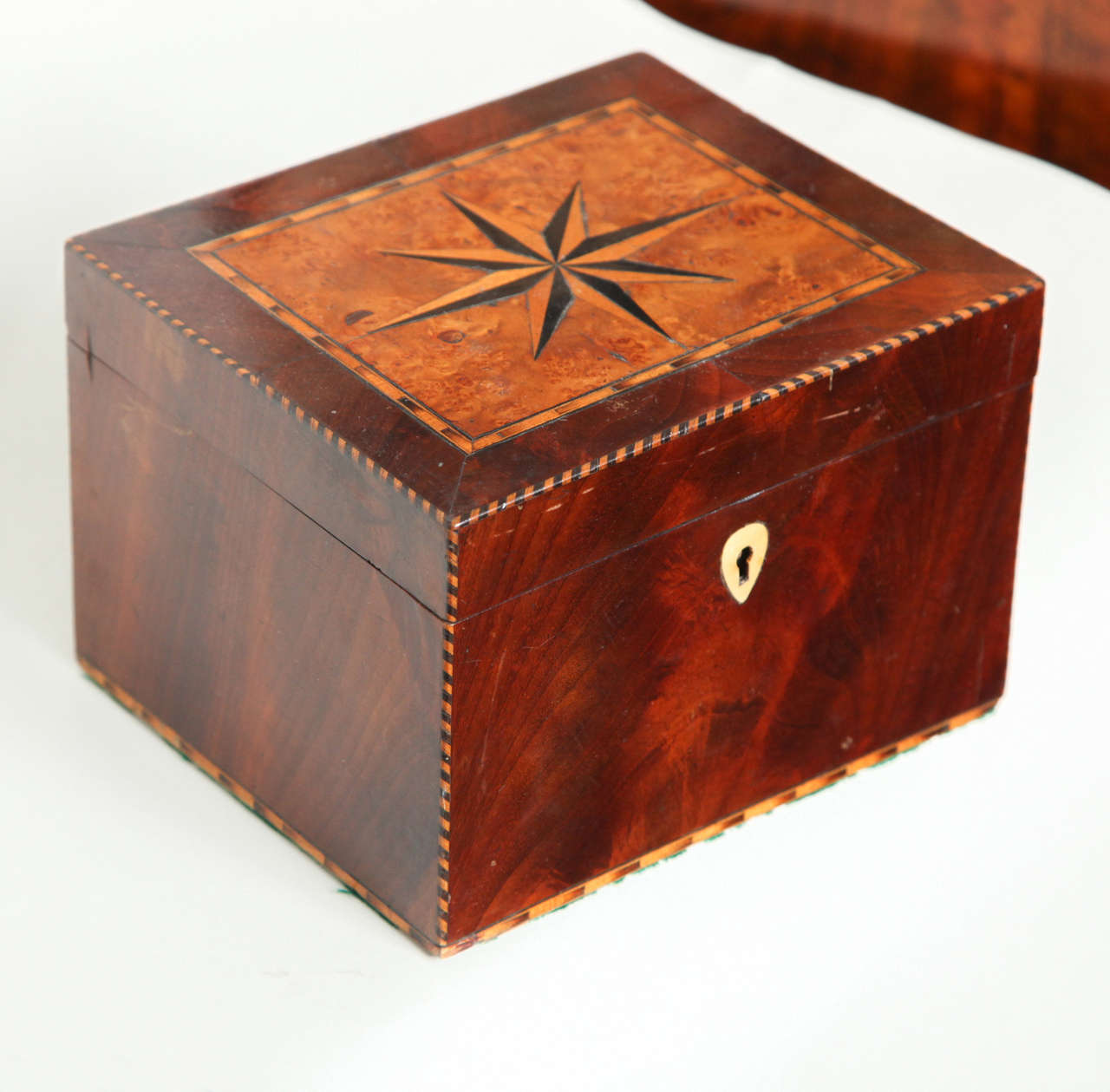
18th Century Inlaid Box
Located in Greenwich, CT
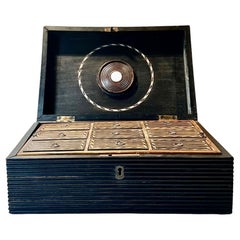
Very fine 18th century Georgian compass star inlaid box, the ebony and boxwood star inlaid on a burr oak panel surrounded by shaded string inlay on a crotch grained mahogany ground, ...
Category
1780s English Antique Holly Boxes
Materials
Ebony, Holly, Mahogany
More Ways To Browse
German Cigarette Case
Jeweled Box
Lapis Silver Box
Limoges Castel
Marble And Brass Box
Morocco Silver Box
Rose Water Bottle
Swedish Bentwood Box
Tiffany Zodiac Box
Vintage Florentine Leather
Vintage Metal Box With Lid
White Onyx Box
Wood Box With Drawers
Wood Canister
Antique Japanese Writing Box
Antique Mother Of Pearl Sewing
Antique Norwegian Box
Antique Round Wood Box