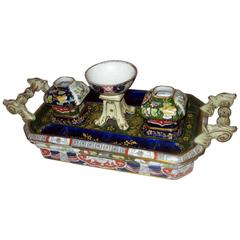
Stoneware Inkwells
to
1
1
1
8,344
847
353
219
218
1
1
1
Height
to
Width
to
1
1
1
1
Material: Stoneware
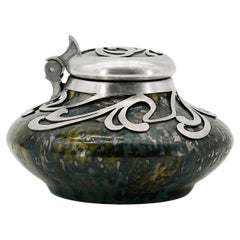
Pierre-Adrien DALPAYRAT French Art Nouveau Stoneware Inkwell, 1890
Located in Saint-Amans-des-Cots, FR
French Art Nouveau Inkwell by Pierre-Adrien Dalpayrat, France, circa 1890. A rare and exquisite Art Nouveau inkwell by renowned French ceramist Pierre-Adrien Dalpayrat (1844–1910). This finely crafted piece showcases Dalpayrat’s signature red copper-glazed stoneware, especially rich and luminous near the base. Elegantly mounted in pewter, the design exemplifies the organic flow and refined detail of the Art Nouveau period.
Dimensions: Height: 3.54 in. (9 cm) Diameter: 5.12 in. (13 cm)
Materials: Stoneware with pewter mount
Condition: Excellent+++++, museum-quality preservation
Markings: Incised signature "Dalpayrat 1500" under the base (see photo)
This inkwell is a collectible example of French ceramic art at the turn of the century—perfect for collectors of Art Nouveau, 19th-century French ceramics, or the works of Dalpayrat.
Adrien Dalpayrat (1844–1910): A Pioneer of French Ceramic Innovation
Adrien Dalpayrat was a French ceramicist and researcher who played a key role in the revival of stoneware at the end of the 19th century. Born in 1844 in Limoges, Dalpayrat studied drawing and porcelain painting in his hometown before beginning his professional career at the Jules Vieillard faience factory in Bordeaux. There, he met his wife, Marie Tallerie, with whom he had two sons—Albert and Adolphe—who would later become his primary collaborators.
Throughout his early career, Dalpayrat worked for several major ceramic manufacturers, including Ashwin (Valentine), Fouquet (Toulouse), François Blanc (Monaco), and Léon Sazerat (Limoges). In 1889, seeking greater independence, he moved to the Paris region and established his own studio in Bourg-la-Reine.
Collaborations and Artistic Evolution
Dalpayrat’s creative vision expanded through his collaboration with sculptor Alphonse Voisin-Delacroix. Together, they explored neo-Gothic and Palissy-inspired motifs, creating a remarkable ceramic bestiary. Following Voisin-Delacroix’s death in 1893, Dalpayrat partnered with Adèle Lesbros, which marked a shift in his work toward simpler, more refined vase forms influenced by Japonism.
Japanese art had been introduced to France during the 1867 Universal Exhibition, but it wasn’t until the 1878 Exhibition, particularly through the ceremonial stoneware used in the Japanese tea ceremony, that Japonism truly captivated French artists. This influence led Dalpayrat to create vessels with organic, vegetal, and animal-inspired forms.
Technical Mastery: The Secrets of Copper Red
Among all the ceramists of his time who sought to replicate the elusive Chinese “sang de boeuf” (oxblood) glaze, Adrien Dalpayrat was arguably the most successful. He didn’t simply reproduce the legendary copper red—he transformed it. By manipulating glaze thickness, firing temperature, atmosphere, and copper oxide content, he developed a unique palette of flamed and mottled red glazes that became his signature: the renowned Dalpayrat red.
He further enriched his pieces by introducing streaks and inclusions of turquoise, blue, green, and yellow—freeing the red glaze from monochromy and turning it into an expressive, living surface. His work pushed stoneware beyond function into expressive art, merging form and glaze in bold, sculptural harmony.
Beyond Ceramics: Bronze Mounts and Architectural Works
Dalpayrat also collaborated with renowned jewelers such as Ernest Cardeilhac and Keller to produce pieces mounted in gilt bronze, blending ceramics with decorative arts at the highest level.
In an effort to make his work more accessible, he opened a second faience workshop focused on simpler, more affordable pieces inspired by Nevers and Rouen ware. However, this venture faced financial difficulties and closed by 1900. The main family studio followed in 1906 as the popularity of Art Nouveau declined.
Dalpayrat then returned to Limoges, devoting his final years to painting and drawing until his death in 1910.
Legacy and Recognition
Despite financial struggles during his lifetime, Dalpayrat’s ceramics were widely acclaimed at major international exhibitions:
Bronze medal, World's Columbian Exposition, Chicago (1893)
Silver medal, Antwerp International Exhibition (1894)
Gold medal, Exposition Universelle, Paris (1900)
Today, his work is part of prestigious museum collections. In 2020, the Petit Palais in Paris acquired a large bird motif vase created in collaboration with Voisin-Delacroix, now on view in Room...
Category
1890s French Art Nouveau Antique Stoneware Inkwells
Materials
Pewter
Related Items
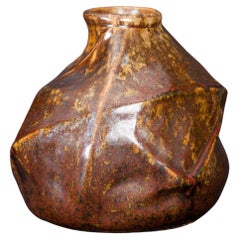
Art Nouveau Asymmetrical Vase by Pierre-Adrien Dalpayrat
Located in Palm Beach, FL
Much fuss is made about Dalpayrat’s signature red, but what many have not realized is that “Dalpayrat Red” refers not simply to a vivid red color glaze but just as often to a nuanced appearance of color resulting from the artist’s technical expertise navigating a complex play of minerals and various firing temperatures. Mossy greens, amber and chestnut tones dance together over Dalpayrat’s blood red base. The result is just as surprisingly modern as the geometric planes forming this asymmetrical vase...
Category
Early 1900s French Art Nouveau Antique Stoneware Inkwells
Materials
Stoneware

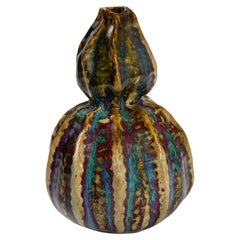
Pierre-Adrien Dalpayrat "Colocynth" Glazed Ceramic Vase
Located in New York, NY
A two tiered "Colocynth" ceramic vase by Pierre-Adrien Dalpayrat featuring his celebrated, earthen tone glazes in hues of turquoise, burgundy, moss an...
Category
Early 20th Century French Art Nouveau Stoneware Inkwells
Materials
Ceramic
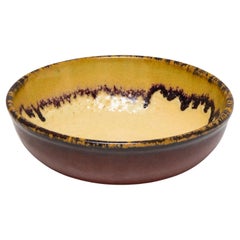
Art Nouveau Red Glaze Coupe by Pierre-Adrien Dalpayrat
Located in Greenwich, CT
Beautiful example of Pierre-Adrien Dalpayrat (1844-1910)’s celebrated ceramics and innovative superb sang-de-boeuf (oxblood) glaze or “Dalpayrat Red”.
One of the most critically acc...
Category
Early 1900s French Art Nouveau Antique Stoneware Inkwells
Materials
Ceramic
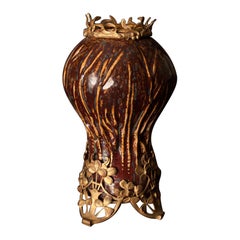
Art Nouveau Gourd Vase with Brass Mount by Pierre-Adrien Dalpayrat & Marcel Bing
By Pierre-Adrien Dalpayrat, Marcel Bing
Located in Palm Beach, FL
PIERRE-ADRIEN DALPAYRAT (1844-1910) After working nearly half his life as an itinerant faience painter and directing production for commercial porcelain manufacturers, Dalpayrat’s ey...
Category
Early 1900s Art Nouveau Antique Stoneware Inkwells
Materials
Brass
$22,000
H 12.25 in W 7 in D 7 in
Pierre-Adrien Dalpayrat Glazed Ceramic Vase
Located in New York, NY
Pierre-Adrien Dalpayrat's signature ruby-cranberry-crimson glaze is at the forefront of this exciting composition, an arresting design featuring strong c...
Category
Early 20th Century French Art Nouveau Stoneware Inkwells
Materials
Ceramic

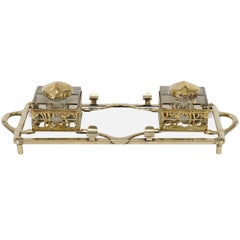
Art Nouveau Double Inkwell Brass & Solid Crystal circa 1890
Located in Great Barrington, MA
This is the perfect desk accessory for any decor but especially decorative in the Art Nouveau taste. The solid brass and crystal base supports 2 matching crystal inkwells which are s...
Category
19th Century Art Nouveau Antique Stoneware Inkwells
Materials
Brass
$1,760 Sale Price
20% Off
H 3.5 in W 16 in D 6 in
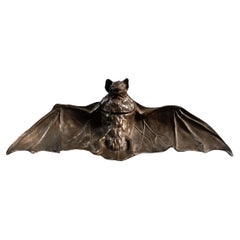
Art Nouveau Bat Inkwell by Unknown French Artist
Located in Palm Beach, FL
Little is known about the origins of this amazing piece, apart from it being from France, circa 1900.
Note: We highly recommend shipping through 1stDibs for its cost effectiveness, ...
Category
Early 1900s French Art Nouveau Antique Stoneware Inkwells
Materials
Bronze
French Art Nouveau Bronze Inkwell
Located in Queens, NY
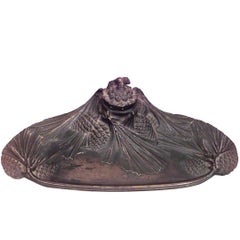
French Art Nouveau oval shaped bronze inkwell with pine cones and needles design (signed: ALBERT CHEURET)
Category
Late 19th Century French Art Nouveau Antique Stoneware Inkwells
Materials
Bronze
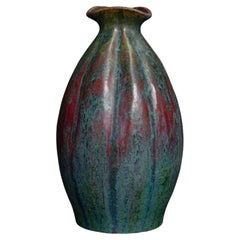
Art Nouveau Stoneware Gourd Vase Pierre-Adrien Dalpayrat
Located in Palm Beach, FL
PIERRE-ADRIEN DALPAYRAT (1844-1910) After working nearly half his life as an itinerant faience painter and directing production for commercial porcelain manufacturers, Dalpayrat’s ey...
Category
1910s French Art Nouveau Vintage Stoneware Inkwells
Materials
Stoneware
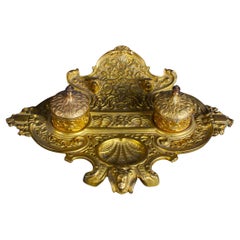
Antique Art Nouveau Inkwell, Bronze Doré, France, 1900s
Located in Greven, DE
Beautiful Art Nouveau Inkwell from France, 1900- 1920s.
This special inkwell is decorated all over with typical Art Nouveau ornaments. The attention to detail is reflected in the pen...
Category
20th Century French Art Nouveau Stoneware Inkwells
Materials
Brass, Bronze
Iridescent Art Nouveau Art Glass Inkwell
Located in San Diego, CA
Stunning early Art Nouveau threaded iridescent art glass inkwell, circa 1900s. The piece features a gorgeous array of rainbow iridescence from pinks to ...
Category
Early 20th Century Czech Art Nouveau Stoneware Inkwells
Materials
Art Glass
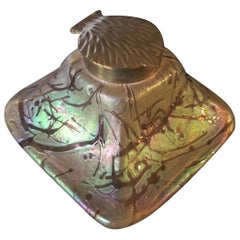
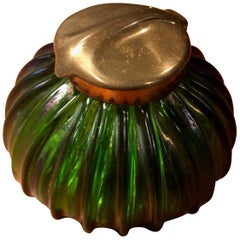
Iridescent Art Nouveau Art Glass Inkwell
Located in San Diego, CA
Stunning early Art Nouveau gourd shaped iridescent art glass inkwell, circa 1900s. The piece features a gorgeous array of rainbow iridescence from green...
Category
Early 20th Century Czech Art Nouveau Stoneware Inkwells
Materials
Art Glass
Previously Available Items
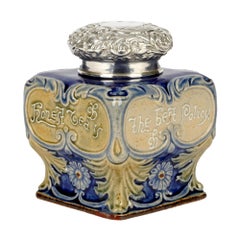
Rare Doulton Lambeth John Broad Stoneware Silver Mounted Mottoware Inkwell
Located in Bishop's Stortford, Hertfordshire
A stunning and rare Doulton Lambeth stoneware silver mounted mottoware tea caddy by renowned artist John Broad assisted by Emma A Burrows and dating from 1896. The tea caddy of squar...
Category
1890s English Aesthetic Movement Antique Stoneware Inkwells
Materials
Stoneware
H 3.75 in W 3.06 in D 3.06 in
19th Century English Mason's Ironstone Inkstand
Located in Savannah, GA
Chamfered rectangular shaped inkstand featuring gilt turned and scroll side handles, two pen trays flanking two raised urn-form inset inkwells and a central circular footed dish. In ...
Category
1820s English Chinoiserie Antique Stoneware Inkwells
Materials
Ironstone