Giovanni Domenico Molinari (1721-1793)
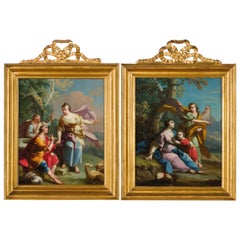
Pair of paintings, the "Hagar and Ishmael in the desert, saved by the angel"
and "Jacob and Rachel at the well"
Oil on canvas
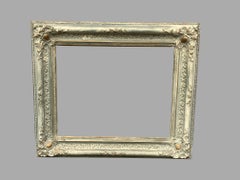
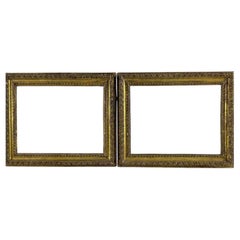
Measurements: W 38,5 x H 47,5 (with frame 49 x 68 cm) - W 35,5 x H 45,5 (with frame 46 x 66 cm)
The fine paintings presented here shows two biblical episodes: "Agar and Ishmael in the desert saved by the angel" and "Jacob and Rachel at the well". With an original frame, they’re works of Piedmontese (north of Italy) area by an artist belonging to the school of the famous Claudio Francesco Beaumont (1694-1766), first court painter. Stylistically they are attributable to the hand of his best pupil, Giovanni Domenico Molinari (1721-1793).
The paintings are part of a wider series, dispersed on the antiquarian market, coming from a prestigious italian family. On the back there’s a label of the collection of “Ill. mo sig. cav. Rambaudi Felice di Sanfrè”. Felice Rambaudi was born by Alessio Rambaudi and Luisa Pastoris and, like his father, he became a knight and commander of the SS. Maurizio and Lazzaro.
With him one of the two lines of the important Rambaudi family became extinct, the one that became the honor of distinguished public offices. The lines were created in 1706, with the death of the founder, Giovanni Guglielmo Rambaudi. The first descended from Giovanni Matteo, born of Giovanni Guglielmo in 1690. He became a master auditor of the Real Chamber, a counselor to His Majesty and Secretary of State for Foreign Affairs. Alessio, Felice's father, was born from his marriage to Teresa Maria Bogetti. Felice died unmarried, at Sanfrè, on 10 January 1872. Wishing that his noble heritage would not be lost, he adopted his cousin Tommaso with a will dated January 1872, naming him his universal heir.
Some of these works were studied by Dr. Arabella Cifani, who attributed them to Molinari. Others were recently sold at the auction house of Vercelli Meeting Art (Italy) with the same attribution. On the auction catalogue it’s indicated that some canvases of the series have a signature on the back and, in bibliographic note that were published by Polish and Martini as works of Beaumont.
If compared, the "Galanti Scenes" of the Meeting Art with the works studied, the same hand of the artist appears evident, as well as analogous frame.
Giovanni Domenico Molinari was born in Caresana (Vercelli-Italy) in 1721. Very young, he enter in the Beaumon’s studio, where he will continue to work even after the master’s death. Since 1745 him has been documented at the service of the Savoy court with the task of transferring on the cartoons the sketches made by the master for the royal tapestry. Some works belonging to the series are attributed to his hand, with the subject of the "History of Caesar", the "History of Cyrus" and the "History of Hannibal" (1745-1769), now conserved in the Museo Civico di Turin and the Palazzina di Stupinigi (Turin, Italy). In 1762 he became Prior of the Company of San Luca in Turin, and in 1766 he decorated the cabinet of the new apartment of the Duke of Chiablese, already begun by Beaumont in Stupinigi.
As part of the court tapestry, he made the cartoons with "Enea’s History", after Francesco de Mura’s sketches (1771-1785). For the parade room of the duchess Maria Teresa di Lorena Este, in the Royal Palace, in 1789 he painted the decorative panels depicting the "Facts of Sgesilao". Molinari also paints many works of religious subject: we recall the frescoes of the vault of the Chapel of the Crucifix in the church of San Lorenzo in Turin, those of the Confraternity of Saints Rocco and Carlo in Rivarolo Canavese and some altarpieces. In 1778 he becamed professor of the Royal Academy. He reached a remarkable fame also as court portraitist, but of this activity remains today a little testimony. He died in Turin in 1793. Giovanni Domenico Molinari is today considered one of the most representative painters of the second half of the eighteenth century in Piedmont (north Italy).
In recent years, many of his paintings, both sacred and profane, have re-emerged, allowing him to outline with discreet precision his stylistic evolution.
The comparison between the works of Molinari and the works in question is clear. We can observe how the treatment of human figures and landscapes, inspired by those of Cignaroli, are comparable. The chromatic choice also returns in many of his works: the characteristic use of scarlet red and blue combined with almost iridescent pink. In addition, the use of saturated and bright colors are used by Molinari for the main subjects and in the foreground, so that the landscape or the secondary decorative elements, for which it proposes a more delicate color, are in the background, increasing the depth of the compositions.
The painter in these fine paintings represents two biblical episodes.
The first is the episode of "Agar and Ismaele saved by the angel". The story, narrated in Genesis 16:21, is a page in the Old Testament of great emotional tension. Abraham, the Patriarch of Israel, received from God the promise of generating a large people, and had not yet had a son from his wife Sarah, now elderly. So Sara proposed to him to join the young Egyptian slave Agar, promising to raise her son as her own. Agar became pregnant and gave birth to Ishmael. However, the young woman began to neglect and no longer obey her mistress. God again visited Abraham, who conceived a son with Sarah named Isaac, creating further friction between the two mothers. Abraham, had to obey the will of Sarah, driving Agar and Ishmael away. He gave some food and water to Agar, gave her the child, and sent her away. Agar ran away and lost himself in the desert. Who was left without water was about to die with the child when an angel sent by God came to their rescue, pointing to her a well. The scene described in the painting is the moment when the angel reaches Agar, seated and worried, as he tries to comfort little Ismael. The angel, who seems still in flight, with the wings extended and the soft green and ochre dress...
Category
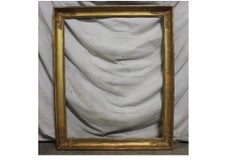
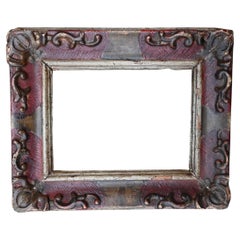
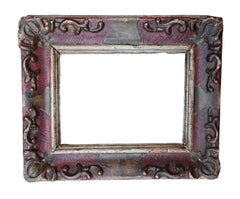
Italian Baroque Antique Mid-18th Century Picture Frames