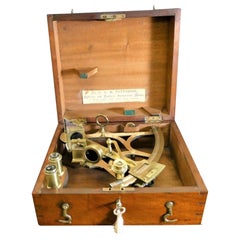
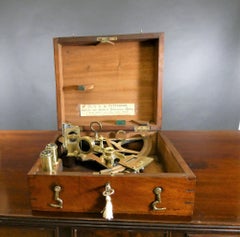
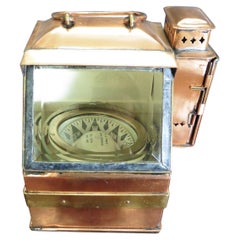
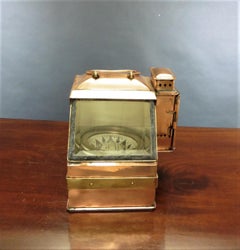
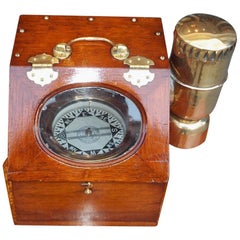
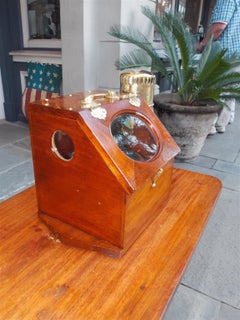
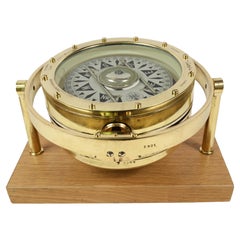
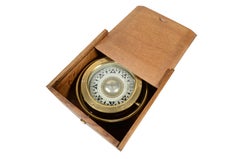
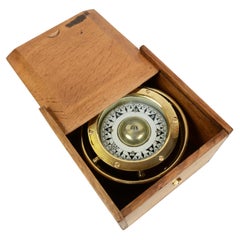
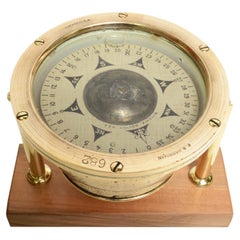
Liquid magnetic nautical compass on universal joint signed Sestrel from the 1900s, in its original oak wood box with lid. Eight wind rose complete with protractor circle.
The compass is made up of a cylindrical vessel in brass and bronze, called a mortar, on the bottom of which a hard metal stem is fixed, on which the wind rose is suitably constrained, so that the zero coincides with the magnetic polarity. To minimize friction, the mortar is filled with liquid with a low freezing point, also having the purpose of quickly dampening any oscillations of the complex and closed at the top by a sturdy protective glass. Good condition stain on lid. Measure box cm cm 19,5 x 19,5 H 13,5 – inches 7.75 x 7.75 H 5.8
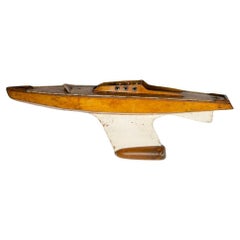
Our gift box is free (look at the last picture).
The first hints in Europe on the use of instruments using magnetic fields for orientation are dated back to the late twelfth century, especially thanks to the knowledge brought by merchants and sailors after contacts with the Arabs: we find hints in the work by Alexander Neckam "De nominibus utensilium" and in the works by Guyot de Provins, where the magnet is called "sailor's friend". Even the inventory of a Sicilian ship of 1200's, the San Nicolò, refers to the presence on board of a magnet and a "bussola di ligno", that is a wooden compass...
Category
Antique Early 1900s Nautical Objects