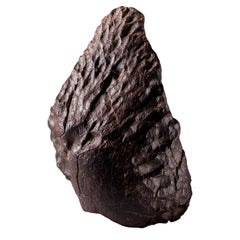
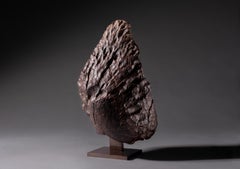
Oriented Stone Meteorite
Circa 4.5 Million y/o
Chrondrite
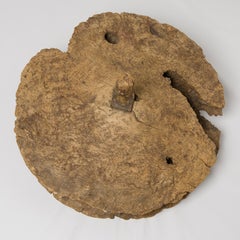
Detached from its parent body by a mighty impact, this large, oriented meteorite travelled over a hundred million miles through space before falling to Earth in the North African desert. The cone-shaped nose is covered in beautiful regmaglypts which radiate from its apex. These elongated dimples formed when streaks of superheated molten rock streamed off the meteor’s surface as it blazed through the atmosphere. The entire piece is coated in a glossy, umber-coloured fusion crust and close examination reveals remnants of encrusted, orange dirt. A faint greyish-white shadow runs across one side, indicating where it sat, partially buried in the desert sands.
Whilst most meteors tumble as they travel through the Earth’s atmosphere, oriented meteorites maintain a stable trajectory as they fall, their domed shape created by the intense heat of atmospheric entry. This phenomenon is extremely rare, with less than one percent of meteorites falling in this way.
“This is a complete individual of an unclassified chondrite found in Northwest Africa. The conical shape and flow lines of melt on the specimen show that, unlike 99% of meteorites, this piece retained a constant orientation as it plunged through the Earth’s atmosphere. The characteristic shapes of such rare oriented stones were used as models to design the reentry capsules of the Mercury, Gemini and Apollo space...
Category
15th Century and Earlier Antique Sahrawi Furniture