Want more images or videos?
Request additional images or videos from the seller
1 of 11

Study of the Biedermeier Style Genre Painting The Attic Room by Carl Spitzweg

Early 20th Century

$1,300
£989.60
€1,136.14
CA$1,835.12
A$1,880.12
CHF 1,048
MX$23,239.27
NOK 12,700.71
SEK 12,371.43
DKK 8,489.93

About the Item

Study of the Biedermeier Style Painting The Attic Room by Carl Spitzweg This painting is a study after The Attic Room by Carl Spitzweg signed "Perez" and executed in homage to Spitzweg’s celebrated Biedermeier genre scene. The scene depicts a solitary man carefully watering a window box of flowers with bird cages overhead—an action both humble and quietly profound characteristic of Spitzweg's sympathy for private rituals and overlooked lives. Below and across the roofline, a second figure appears at a small dormer window echoes the upper man’s domestic activity, surrounded by potted plants of her own. Spitzweg uses the separation of the two suggesting parallel but separate lives typical in a city. The painting demonstrates fine attention to detail and mastery of light, shadow and composition. Medium: Oil on Linen Signed "Perez" after Carl Spitzweg Condition: Good; minor craquelure consistent with age. No structural issues. Canvas size: 20"H x 16"W Presented in new gilt-toned wood frame Framed size: 25"H x 21"W. Carl Spitzweg belongs to the late Romantic Movement. Whilst the early works still show the influence of the Biedermeier, the painting style loosened up in his later work, and came close to Impressionism. The artist’s keen sense of coloring derived possibly from his training in pharmacy. In addition to landscapes, Spitzweg’s frequently depicted characters from the Biedermeier petty bourgeoisie, and satirical illustrations of quirky characters. Works by Spitzweg are on display in major collections, such as the Neue Pinakothek Munich, the Courtauld Institute of Art in London, the Germanic National Museum in Nuremberg, and the Wallraf-Richartz Museum in Cologne.
  • Creation Year:
    Early 20th Century
  • Dimensions:
    Height: 25 in (63.5 cm)Width: 21 in (53.34 cm)Depth: 1 in (2.54 cm)
  • Medium:
  • Movement & Style:
  • After:
    Carl Spitzweg (1808 - 1885, German)
  • Period:
  • Condition:
    Professionally cleaned, minor craquelure consistent with age. No structural issues. UV-resistant, non yellowing varnish applied.
  • Gallery Location:
    Soquel, CA
  • Reference Number:
    Seller: D73651stDibs: LU54217580602

More From This Seller

View All
French Impressionist Interior Scene with Desk, Doll, & Sunflowers

French Impressionist Interior Scene with Desk, Doll, & Sunflowers

Located in Soquel, CA

Charming and brightly colored French Impressionist watercolor, depicting an interior scene in great detail with an antique desk full of books, a bouquet of sunflowers, and a doll by ...

Category

Late 20th Century American Realist Interior Drawings and Watercolors

Materials

Paper, Gouache

Courtyard Interior

Courtyard Interior

Located in Soquel, CA

Skillfully executed courtyard scene by H. von der Planitz (german, 19th-20th cent ). Several trees cast dramatic shadows on the dirt floor of a courtyard, next to a colonnade that fr...

Category

Mid-20th Century Impressionist Landscape Paintings

Materials

Oil, Linen, Illustration Board

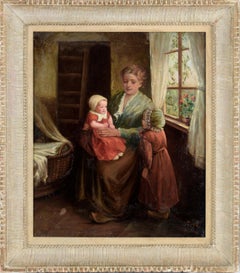
Woman with Two Children in Red - Dutch Style Interior Scene in Oil on Canvas

Woman with Two Children in Red - Dutch Style Interior Scene in Oil on Canvas

By Joseph Tomanek

Located in Soquel, CA

Woman with Two Children in Red - Interior Scene in Oil on Canvas Lovely interior scene by notable artist Joseph Tomanek (Cech-American, 1889-1974). A woman sits near a window, holding a small child dressed in bright red in her lap. Another child, somewhat older, stands next to her, looking at the young child. Soft lights spills though the window, illuminating the scene in a warm glow. A plant with red flowers sits on the windowsill, and foliage can be seen outside. Signed "Tomanek" in the lower right corner (note that the shape above the signature is a toy train) Presented in a carved wood frame with a linen liner. Frame size: 30.75"H x 26.75"W Canvas size: 24"H x 20"W Tomanek, the son of a carpenter, was born in Moravia. His family discouraged his art talent and wanted him to be a shoemaker. He studied in his homeland of Czechoslovakia at the School of Design in Prague. He emigrated to America around the turn of the century and arrived in Chicago in 1910 and worked as an interior decorator. He attended the Art Institute of Chicago and studied with Antonin Sterba. He also studied with Albert Krehbiel and K.A. Buehr. He was a member of the Bohemian Artist Club, Association of Chicago Painters, and Sculptors, and the Chicago Gallery Association. His work is included in the collection of the Vanderpoel Art Association (Chicago). He exhibited from the 1910s-40s, including exhibitions at the Art Institute of Chicago and the Georgia Museum of Art. Of the difficulty of posing nudes in Chicago, he said, "In Paris you can rent little gardens studios and pose your models there in privacy. Here, if I work out of doors, I have to pose the girls in bathing suits...

Category

1920s Romantic Figurative Paintings
Materials

Canvas, Oil

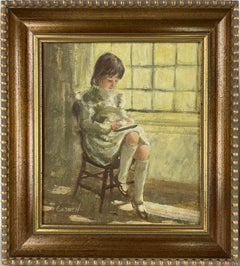
"Needle Work" Young girl by the Window original Oil on Linen

"Needle Work" Young girl by the Window original Oil on Linen

By Helen Rayburn Caswell

Located in Soquel, CA

Bright and cheery painting of a young girl by a wind by Helen Rayburn Caswell, (American, 1923 - 2018) she was born in Long Beach, California. Image, 12"H x 11"W Frame, 16"H x 15"W ...

Category

1980s Impressionist Figurative Paintings

Materials

Linen, Oil

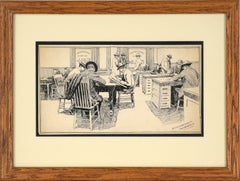
The Illustrator's Workroom at The San Francisco Call, Late 19th C. Illustration

The Illustrator's Workroom at The San Francisco Call, Late 19th C. Illustration

By Adolph Methfessel

Located in Soquel, CA

Skillful late 19th century realist drawing of illustration Newspaper artists at work at the Republican National Convention by Adolph Methfessel (American, 1876-1912)., c.1898. This p...

Category

Early 1900s American Realist Figurative Drawings and Watercolors

Materials

Paper, India Ink

You May Also Like

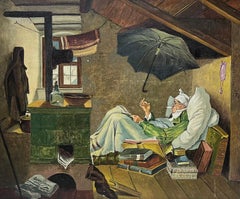
The Poor Poet Antique German Oil Painting after the famous Carl Spitzweg work

The Poor Poet Antique German Oil Painting after the famous Carl Spitzweg work

By German School

Located in Cirencester, Gloucestershire

The Poor Poet German School, early 20th century after the original painting by Carl Spitzweg (c.1839) inscribed verso oil on board, framed framed: 15.5 x 17.5 inches board: 12 x 15 i...

Category

Early 20th Century Mannerist Figurative Paintings

Materials

Oil

19th Century Interior Scene with Children on a Balcony, Oil on Panel

19th Century Interior Scene with Children on a Balcony, Oil on Panel

Located in NANTES, FR

**19th Century Interior Scene with Children on a Balcony, Oil on Panel This oil on panel is signed B. Völlme. It has been executed with fine quality and great attention to detail. ...

Category

Antique 18th Century Neoclassical Paintings

Materials

Wood, Paper

Late 19th Century Oil on Board by Johann Georg Meyer Van Bremen

Late 19th Century Oil on Board by Johann Georg Meyer Van Bremen

By Johann Georg Meyer Von Bremen

Located in Chicago, IL

This small and exquisite 19th-century oil on cardboard titled “Reading to Mother” by Johann Georg Meyer von Bremen depicts a gentle interior scene with a young boy attentively reading to a woman, presumably his mother. They are both seated at a small table, the woman rests in a chair outfitted with a large pillow and a faraway look. The painting is nested in a statement giltwood frame, with the artist’s signature on the lower right corner. The frame is a neoclassical Louis XVI-style gilt frame with bellflower trim on the top edge, guilloche detailing on the back edge, ribbon trims, and a fluted cove. Oil paintings on cardboard gained popularity in the late 19th century, offering a convenient and affordable alternative to canvas for artists and enabling greater artistic experimentation. Many renowned artists explored this medium. Oil on paper was often prepared with a layer of primer or gesso to create a stable surface for the paint and to prevent the oils from soaking directly into the paper. Johann Georg Meyer von Bremen commonly known as Meyer von Bremen (1813-1886), was a German genre painter specializing in Biblical, peasant, and family scenes. He was a pupil of the Dusseldorf Academy where he largely painted religious and historical subjects. In 1840, after traveling in Bavaria and Switzerland, he began to develop pleasant genre scenes focused on incidents from popular life, especially among the Hessian peasantry, and the portrayal of childhood and family for which he became known. He spent the remainder of his career in Berlin, becoming a Professor at the Academy in 1863. He was also a member of the Amsterdam Academy and the Order of Leopold...

Category

Antique 19th Century German Victorian Paintings

Materials

Giltwood, Paint