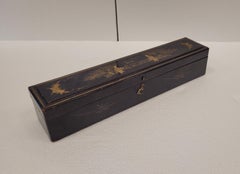
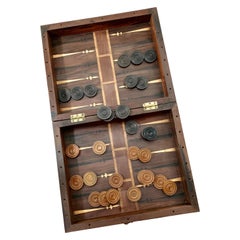
The scale of this excellent gaming box is as marvelous as its design and decoration. it measures an impressive 34.25" when opened for a game of backgammon. Incredibly, it also retains its wonderfully oversized 2.32" gaming pieces, thirty in all, a complete set for Backgammon, Nine Man's Morris and Checkers.
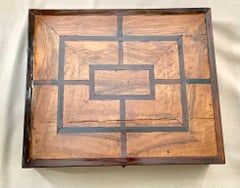
One side of the exterior is composed of a chess/checkers board of Rosewood and Walnut squares. It has developed a slight waviness during the course of its three hundred plus years, making one singularly aware of the many fun games it must have hosted. The other side inlaid in the Nine Man's Morris configuration, a game mentioned by Ovid in the 8th Century AD in Ars Amatoria and by Shakespeare in A Midsummer Night's Dream. Variants of Nine Man's Morris include Shax, Kensington, Fangqi and Luk Ssut K'i. The Walnut wood richly figured and unmistakably 17th Century shows areas of contraction, giving this piece a great sense of character. The sides are of beautifully figured Rosewood with a central metal locking mechanism. The interior reveals a fabulous inlaid wood backgammon board in Rosewood with Ebony and light Fruitwood points with Fleur-de-Lis detail. Backgammon dates back to ancient Egypt where it was known as the Royal Game of Ur. The ancient Romans played a similar game, Ludus Duodecim Scriptorum, a game of twelve lines. From the 11th Century onward, we find mention of variants of backgammon played in the Royal courts of Persia and Europe. It became a favorite game of gamblers and was prohibited by Louis IX in 1254 among his court officials and subjects. Likewise in the 16th Century, Elizabethan laws and church regulations prohibited the game, but by the 18th Century, it became a popular pastime once more. The dating, scale and craftsmanship of this gaming box suggest that it would have been created for personal use in a noble household.
Together with thick, tooled hand stitched leather dice rollers, two large wood dice...
Category
17th Century Antique Baroque Boxes and Cases