By Cartier
Located in New York, NY
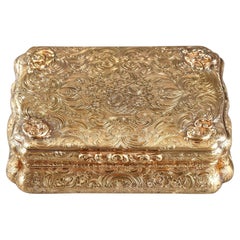
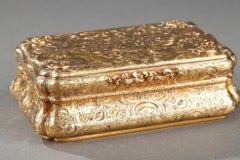
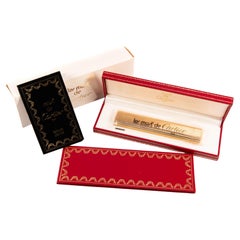
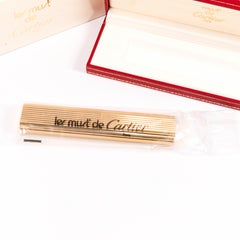
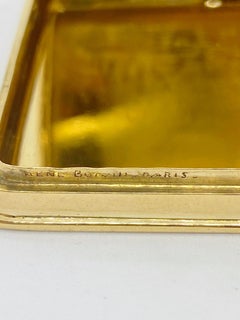
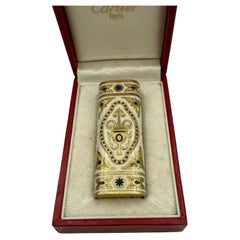
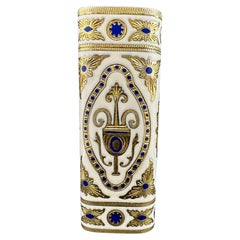
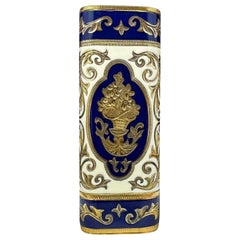
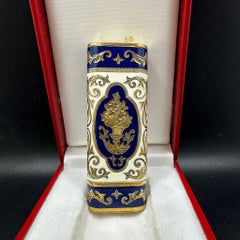
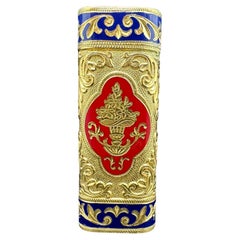
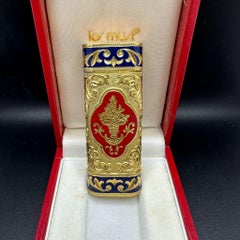
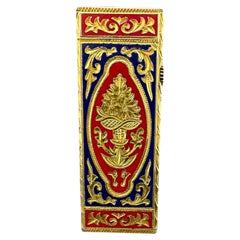
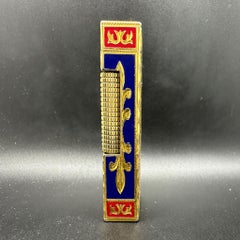
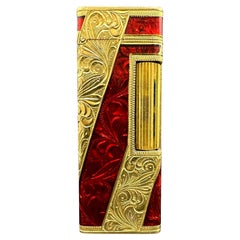
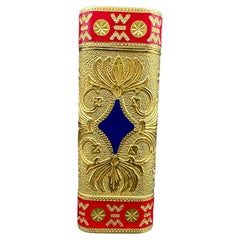
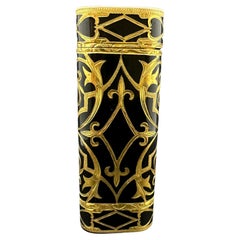
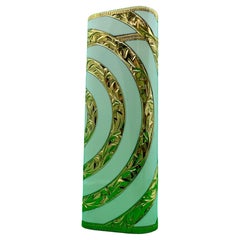
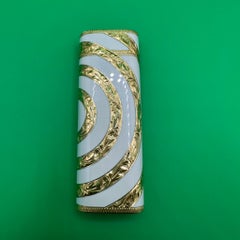
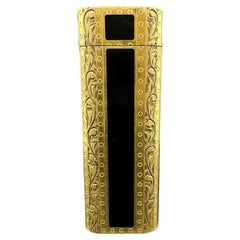
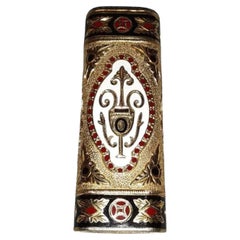
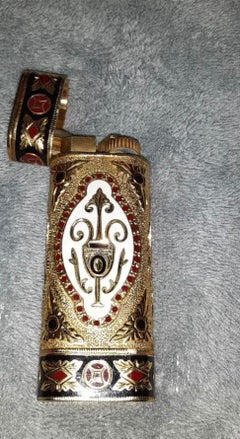
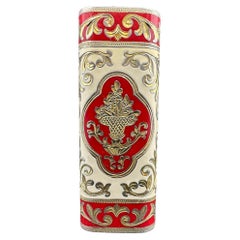
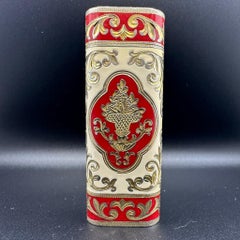
Beautiful Cartier Royking lighter.
CARTIER RoyKing Rollagas, a Unique RARE example of a ROYKING designed Cartier Rollagas lighter made circa 1970's, Gold with Baroque lacquer,
Baroque design,
mint condition,
Roy King emblem on top side part of Cartier.
ROY KING, who has died aged 87, was a leading British watch designer and jeweller, with customers ranging from Saudi princes to The Beatles and Tom Jones. King began his career at the age of 14 as an apprentice goldsmith and diamond mounter in Hatton Garden. By 21 he was foreman of a workshop, creating one-off pieces which readily found buyers (including members of the Royal Family) through Bond Street jewellers. Much of his work in the 1930s was also as an uncredited manufacturer for names such as Rolex, Cartier, Asprey and Garrard. After the war, King began to design and make watches under his own name. When restrictions on the import of Swiss watch movements were lifted in 1960, King decided to integrate these into his own designs, recognising that, whoever the manufacturer might be, people still wanted "Swiss Made" moving parts.
He signed an exclusive agency agreement with Bueche-Girod, the Swiss movement makers, which left him free to design the exterior of the pieces as he wished. He also began to make watches with straps made wholly from gold, then a novel idea. In 1961, the Roy King workshop swept the board at the British Modern Jewellery Exhibition, winning two first prizes, as well as one second and one third prize. The winning pieces are now in the permanent collection of Goldsmiths' Hall.During the 1960s, the workshop produced many designs using a variety of unconventional methods. Molten gold would be poured through tea strainers before being stretched into shapes to satisfy the most avant garde tastes. King's "bark finish" design for bracelets sparked a craze: when George Harrison married Patti Boyd in 1966, she wore one of King's bark finish wedding bands. Roy Cecil King was born in Kentish Town, London, on May 6 1913. His unmarried mother handed him as a baby to an elderly foster mother, Mrs Wells, who eventually adopted him. Mr Wells, a road sweeper, died in the great influenza outbreak of 1919 and soon afterwards young Cecil, as he was then called, found himself standing in a walk-in cupboard while his future was discussed in the cramped tenement room where he lived. At one time, it seemed as if he would have to be taken in by Dr Barnardo's, and even as a pupil at Haverstock Hill Central School he had to deliver hand-laundered shirts (at 2d a time) to help with household bills. One of his customers managed a large jewellery firm in Hatton Garden, M J Greengross, and in 1927 he was offered an apprenticeship. On his first day at the bench, King was put next to a consumptive Italian master craftsman and told to learn what he could before the man died. A tubercular cough rendered King's taskmaster highly impatient, and he would crush with a mallet any work which fell short of perfection. In the evenings, King went to classes at the Sir John Cass Art School, perfecting his skills at diamond mounting. In his spare time he performed in a jazz band as a pianist and comic master of ceremonies. During the Second World War, King worked as a planning engineer on the production line of the Hurricane, eventually heading up a 100-strong department at De Havilland. There he used machine tool...
Category
Late 20th Century French Baroque Vanity Items
MaterialsGold, Gold Plate