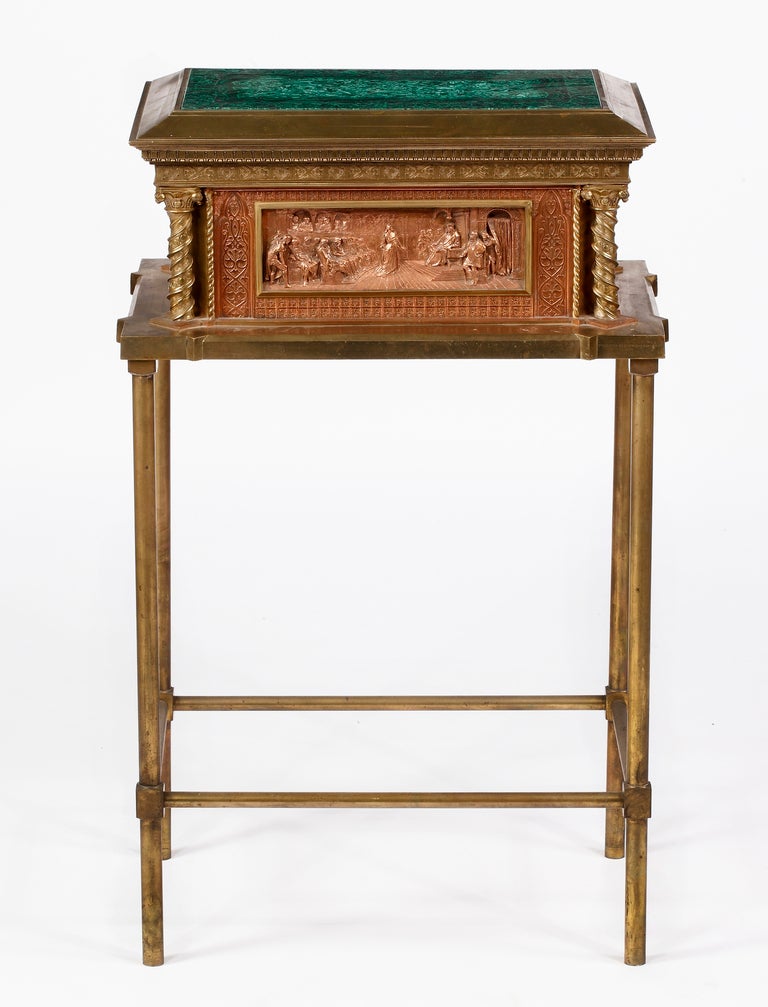
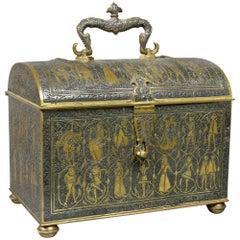
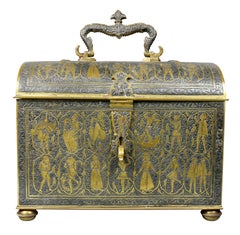
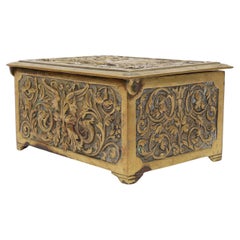
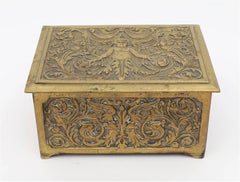
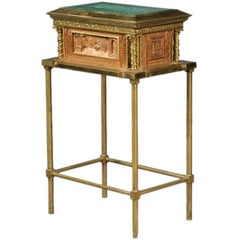
A Rare & Important Renaissance Revival
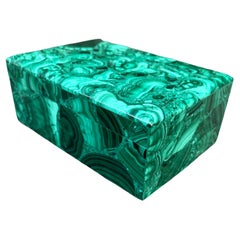
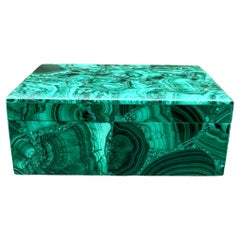
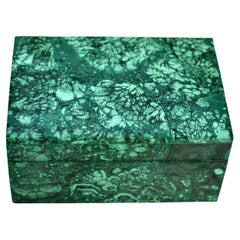
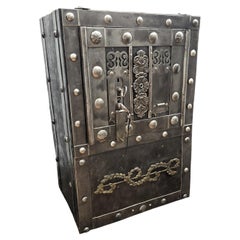
Malachite Mounted Brass & Copper Box on Stand
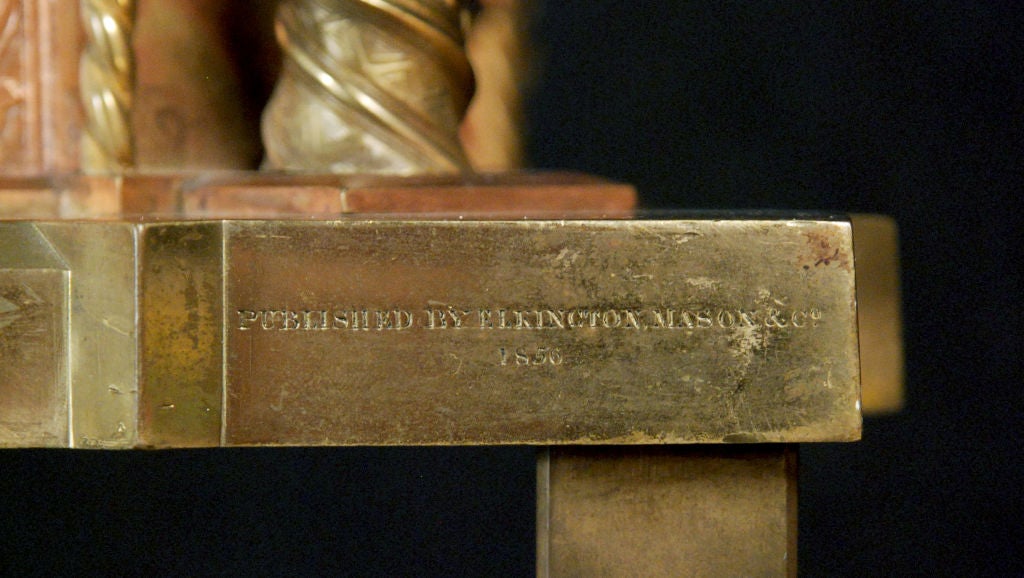
Elkington & Co., England
Dated 1856
Elkington & Co; Birmingham, England; 1854 - 1883
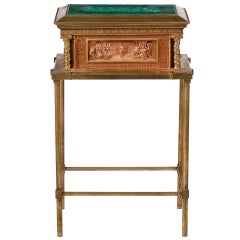
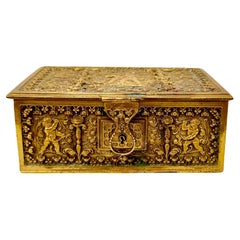
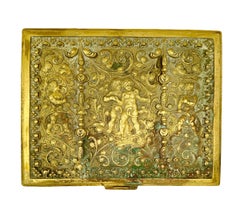
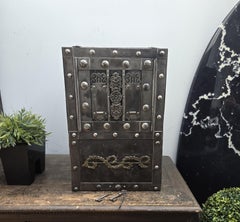
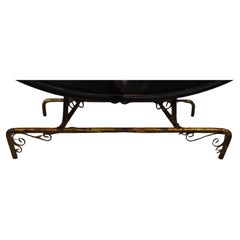
With a rectangular top and velvet-lined interior, the sides mounted with plaques depicting a court scene and armorial plaques to each side, the stand with circular turned rods and stretchers
Height 39 in. Width 24 ½ in. Depth 17 1/2 in.
Museums:
Power House Museum, England
South Kensington Museum
Victoria & Albert Museum, England
National Maritime museum
Los Angeles County Museum of Art
Museum of Fine Arts, Boston
Glasgow Museum
Elkington and Co.
The electroplating firm of Elkington and Co is of interest to these pages for its sculptural work, on the small scale, and more importantly, for full-sized bronze statues. The company was set up by two cousins, George Richards Elkington (1801-1865) and Henry Elkington (1810-1852), who along with others, were experimenting with electroplating base metals during the 1830s. By 1840 they had patented their method in Britain and France, and bought out competing patent-holders, though they later licensed the process to various firms in England and abroad. The Elkington factory was in Newhall Street, Birmingham, and they also opened premises in London. In 1842 they took on a third partner, called Josiah Mason, and the firm became Messrs Elkington, Mason and Co.
Messrs Elkington have now in constant operation a stupendous machine constructed for the application of Magneto-Electric power, .. The armature of the machine, set in motion by a small steam-engine, revolves at 500 times in a minute, at a short distance from the poles of a series of 64 permanent magnets, arranged in a circle… sufficient to deposit 50 ounces of silver per hour. This machine has been in operation almost continually day and night for six months, with scarcely any perceptible variation in its energy.
By the time of the Great Exhibition they were the leading producer of plated wares,
'...celebrated electro-plate manufactures, a branch of industrial art which has made immense strides since the patent for the various processes of gilding and plating metals by the agency of electricity was granted to this firm in 1840. Messrs Elkington alone employ about 500 work-people in their establishment, and about 30 other British manufacturers have licences to use this process, which is also extensively adopted in foreign countries...'
The process for electrotyping (duplicating) to make statues was described thus:
'...to such perfection has the process been brought that not only are silver waistcoat...
Category
19th Century English Antique Berkshires Jewelry Boxes