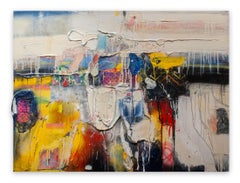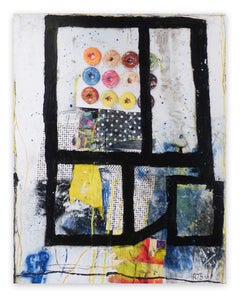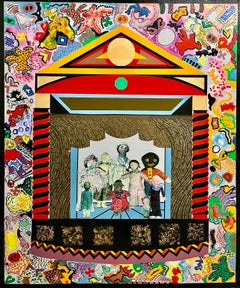
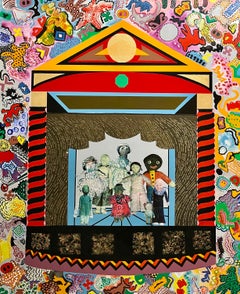
Miriam SchapiroLarge Mixed Media Collage Painting Great Jewish Feminist Artist Miriam Schapiro, 2002
$48,000
Large Mixed Media Collage Painting Great Jewish Feminist Artist Miriam Schapiro
By Miriam Schapiro
Located in Surfside, FL
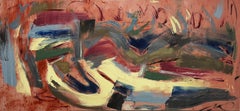
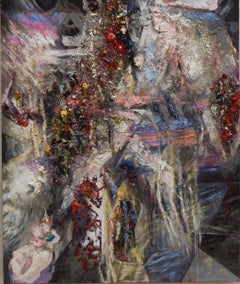
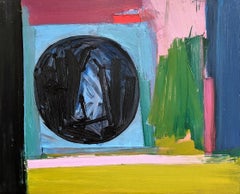
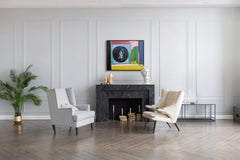
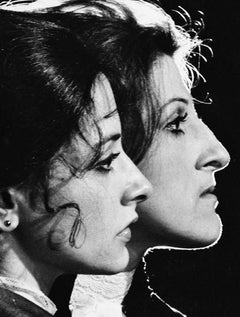
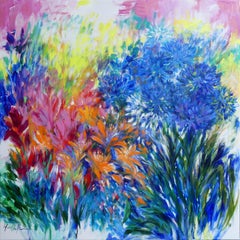
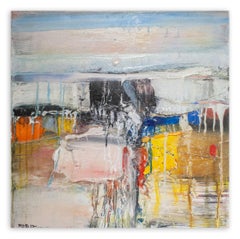
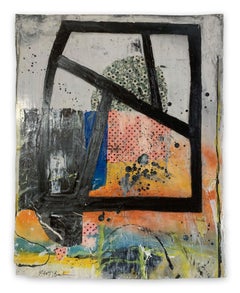
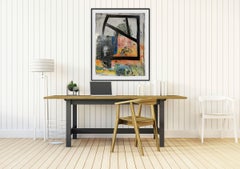
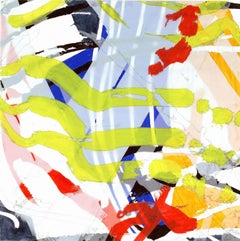
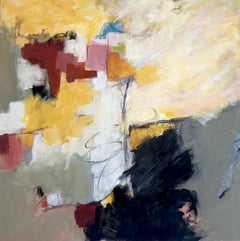
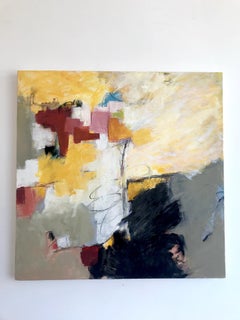
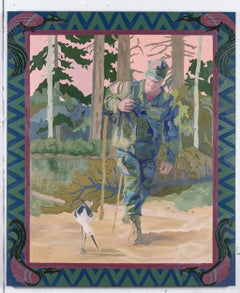
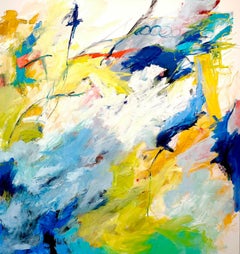
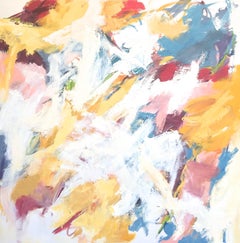
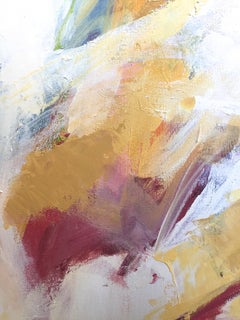
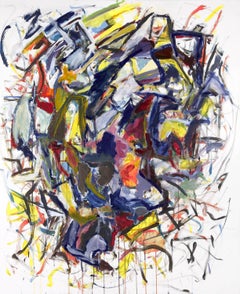
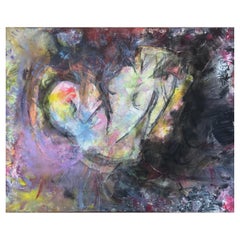
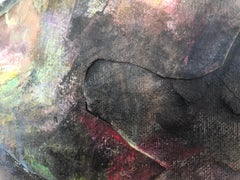
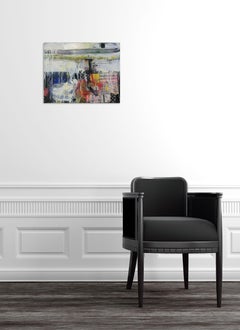
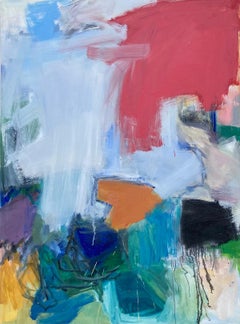
Miriam Schapiro, "Curtain Call" 2002 Hand signed, dated and titled verso and signed and dated recto. acrylic paint, digital images, glitter and textile fabric on canvas, tooling with gold leaf embossing around self edge of painting. size: 60 x 50 in Miriam Schapiro (or Mimi Schapiro) (November 15, 1923 – June 20, 2015) was a Canadian-born artist based in America. She was a painter, sculptor and printmaker. She was a pioneer of feminist art. She was also considered a leader of the Pattern and Decoration art movement. Schapiro's artwork blurs the line between fine art and craft. Her paintings contain craft elements because crafts and decoration is associated with women and femininity. She used icons that are associated with women such as hearts, floral decorations, geometric patterns and the color pink. In the 1970s she made a small woman's object, the fan, heroic by painting it six feet by twelve feet. This bears the influence of the Pattern and Decoration movement artists such as Brad Davis, Mary Grigoriadis, Joyce Kozloff, Robert Kushner, Kim MacConnel, Sonya Rapoport, Miriam Schapiro and Valerie Jaudon. Shapiro was born in Toronto, Ontario, Canada. Her father was an industrial design artist who fostered her desire to be an artist and served as her role model and mentor. Her mother was a stay at home mother who worked part-time during the depression. As a teenager, Schapiro was taught by Victor d’Amico, her first modernist teacher at the Museum of Modern Art. In the evenings she joined WPA classes for adults to study drawing from the nude model. In 1943, Schapiro entered Hunter College in New York City, but eventually transferred to the University of Iowa. At the University of Iowa, Schapiro studied painting with Stuart Edie and James Lechay. She studied printmaking under Mauricio Lasansky and was his personal assistant, which then led her to help form the Iowa Print Group. Lasanky taught his students to use several different printing techniques in their work and to study the masters' work in order to find solutions to technical problems. At the State University of Iowa she met the artist Paul Brach, whom she married in 1946.. By 1951 they moved to New York City and befriended many of the Abstract expressionist artists of the New York School, including Joan Mitchell, Larry Rivers, Knox Martin and Michael Goldberg. Schapiro worked in the style of Abstract expressionism during this time period. Shapiro and Brach lived in New York City during the 1950s and 1960s. During this period Shapiro had a successful career as an abstract expressionist painter in the hard-edge style. In December 1957, André Emmerich selected one of her paintings for the opening of his gallery. Schapiro not only honored the craft tradition in women's art, but also paid homage to women artists of the past. In the early 1970s she made paintings and collages which included photo reproductions of Mary Cassatt's and Georgia O'keefe's paintings. Early in her career, Schapiro started looking for maternal symbols to unify her own roles as a woman. Her series, Shrines (1963), was her first artistically successful attempt at compartmentalizing her life roles. Her painting, Big Ox No. 1, from 1968, references Shrines, however no longer compartmentalized. The center O takes on the symbol of the egg which exists as the window into the maternal structure with outstretched limbs. Her series, Shrines was created in 1961–63. It is one of her earliest group of work that was also an autobiography. Each section of the work show an aspect of being a woman artist. They are also symbolic of her body and soul. In 1964 Schapiro and her husband Paul both worked at the Tamarind Lithography Workshop. One of Schapiro's biggest turning points in her art career was working at the workshop and experimenting with Josef Albers' Color-Aid paper, where she began making several new shrines and created her first collages. In the 1970s, Schapiro and Brach moved to California so that both could teach in the art department at the University of California. Subsequently, she was able to establish the Feminist Art Program at the California Institute of the Arts, in Valencia with Judy Chicago. The program set out to address the problems in the arts from an institutional position. They wanted the creation of art to be less of a private, introspective adventure and more of a public process through consciousness raising sessions, personal confessions and technical training. She participated in the Womanhouse exhibition in 1972. Schapiro's smaller piece within Womanhouse, called "Dollhouse", was constructed using various scrap pieces to create all the furniture and accessories in the house. Each room signified a particular role a woman plays in society and depicted the conflicts between them. Along with Nancy Spero, Joan Snyder, Joyce Kozloff, Audrey Flack and Judy Chicago, she is from that first generation of Jewish American feminist women artists and includes Judaica in her work. Schapiro's work from the 1970s onwards consists primarily of collages assembled from fabrics, which she called "femmages". As Schapiro traveled the United States giving lectures, she would ask the women she met for a souvenir. These souvenirs would be used in her collage like paintings. Her 1977-1978 essay Waste Not Want Not: An Inquiry into What Women Saved and Assembled - FEMMAGE (written with Melissa Meyer) describes femmage as the activities of collage, assemblage, découpage and photomontage practised by women using "traditional women's techniques - sewing, piercing, hooking, cutting, appliquéing, cooking and the like..." She was involved in Abstract expressionism, Minimalism, Computer art, and Feminist art. She worked with collage, printmaking, painting, femmage [fr] – using women's craft in her artwork, and sculpture. Schapiro not only honored the craft tradition in women's art, but also paid homage to women artists of the past. In the early 1970s she made paintings and collages which included photo reproductions of past artists such as Mary Cassatt. In the mid 1980s she painted portraits of Frida Kahlo on top of her old self-portrait paintings. In the 1990s Schapiro began to include women of the Russian Avant Garde in her work. The Russian Avant Garde was an important moment in Modern Art history for Schapiro to reflect on because women were seen as equals. Schapiro also did collaborative art projects, like her series of etchings Anonymous was a Woman from 1977. She was able to produce the series with a group of nine women studio-art graduates from the University of Oregon. Each print is an impression made from an untransformed doily that was placed in soft ground on a zinc plate, then etched and printed. Her image is included in the iconic 1972 poster Some Living American Women Artists by Mary Beth Edelson...
Early 2000s Contemporary Mixed Media
Glitter, Mixed Media, Fabric, Acrylic, Digital

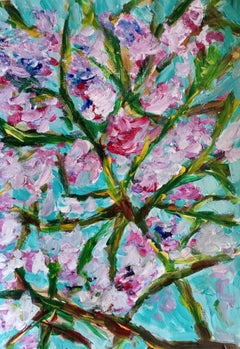
![[IN] Glorious Technicolor](https://a.1stdibscdn.com/ann-marie-auricchio-paintings-in-glorious-technicolor-for-sale/a_1102/a_181115521779921762636/Untitled_3_master.jpg?width=240)
![[IN] Glorious Technicolor](https://a.1stdibscdn.com/ann-marie-auricchio-paintings-in-glorious-technicolor-for-sale-picture-2/a_1102/a_181115521779921778163/_IN_GloriousTechnicolor_sideview2_master.jpg?width=240)