Questions & Answers
Our trusted network of 1stDibs sellers answer common questions
How many paintings did Kandinsky paint?
1 Answer
No one knows for sure how many paintings Kandinsky painted over the course of his life. Art historians estimate that he produced at least 500 oil paintings. However, there may be considerably more works that are forever lost. Because the Nazis labeled Kandinsky a degenerate, it is possible that a great number of his pieces were destroyed during the 1930s and ’40s. On 1stDibs, explore a range of Wassily Kandinsky art.
1stDibs ExpertAugust 8, 2024
Related Questions
- How many paintings did Michelangelo paint?1 Answer
- How many paintings did Modigliani paint?1 Answer
- How many paintings did Monet paint?1 Answer
- How many paintings did Matisse paint?1 Answer
- How many paintings did Raphael do?1 Answer
Shop for Wassily Kandinsky Art on 1stDibs
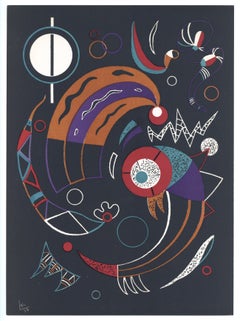
"Comets" original lithograph
By Wassily Kandinsky
Located in Henderson, NV
Medium: original lithograph. Printed in 1938 and published in Paris by Teriade for the art revue Verve (volume 1, number 2). Kandinsky was invited to contribute an original compositi...
Category
1930s Expressionist Abstract Prints
Materials
Lithograph
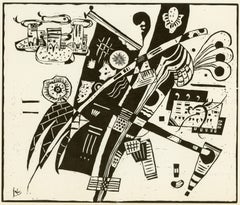
Kandinsky, Abstract Composition, c. 1935, Posthmous 1st edition, Roethel 24B
By Wassily Kandinsky
Located in Fairlawn, OH
Composition
Woodcut, c. 1935, printed 1966
Signed in the block lower left (see photo)
This is the first printing of this image. Created in 1935, it was never printed during Kandinsky's lifetime. It is a POSTHUMOUS printing.
Published by Gualtieri di San Lazzaro, Éditions XXe Siècle, Paris
Issued in XXe Siècle, nouvelle série, no. 27, December 1966, Centenaire de Kandinsky
Unsigned and unnumbered, as issued
Edition commonly reported as approximately 2,000
Condition: Excellent
Image size: 9 1/8 x 10 15/16 inches
Reference: Roethel 24b
Created in 1935 but apparently left unprinted during Kandinsky’s lifetime, Composition was first issued posthumously in December 1966 in the Kandinsky centenary number of the Parisian art review XXe Siècle. The woodcut was printed from Kandinsky’s original block rather than reproduced photographically. It is therefore properly described as an original, posthumously printed woodcut—not as a reproductive print “after” Kandinsky. Contemporary documentation identifies the composition as having been cut by the artist in 1935 and first published by Éditions XXe Siècle in 1966. Publication details and dimensions
The print belongs to Kandinsky’s final period, begun after the closing of the Bauhaus and his move from Germany to Neuilly-sur-Seine, near Paris, in 1933. Its vocabulary differs markedly from the romantic landscapes, horsemen and apocalyptic subjects of his early Munich woodcuts. The forms are now self-contained and biomorphic: circles, hooks, floating linear elements and irregular organic silhouettes coexist within an open field. Although nonrepresentational, they suggest minute organisms, astronomical bodies or signs belonging to an invented visual language.
The black-and-white medium gives the image unusual clarity. Solid forms function like sustained musical tones, while thin lines, dots and isolated marks provide accents and intervals. Areas of untouched paper are equally active, allowing the components to float without conventional gravity or horizon. Kandinsky organizes these elements through visual tension rather than perspective: large and small, dense and open, curved and angular forms establish a rhythmic equilibrium across the sheet.
The woodcut process was fundamental to Kandinsky’s development. Its demand for simplification encouraged him to reduce images to essential contrasts of shape, line and ground. Nearly two-thirds of his approximately two hundred prints were made between 1900 and 1911, and his increasingly abstract woodcuts for Klänge played a decisive role in his movement away from representation. MoMA’s Kandinsky printmaking overview In this late composition, Kandinsky returned to the medium with the more refined geometry and organic imagery of his Paris years.
The circumstances of the 1966 publication are integral to the work’s history. XXe Siècle, directed by the Italian-born critic and publisher Gualtieri di San Lazzaro, regularly included original prints by major modern artists. Issue no. 27, entitled Centenaire de Kandinsky, commemorated the hundredth anniversary of Kandinsky’s birth. It contained two original Kandinsky woodcuts...
Category
1930s Abstract Abstract Prints
Materials
Woodcut
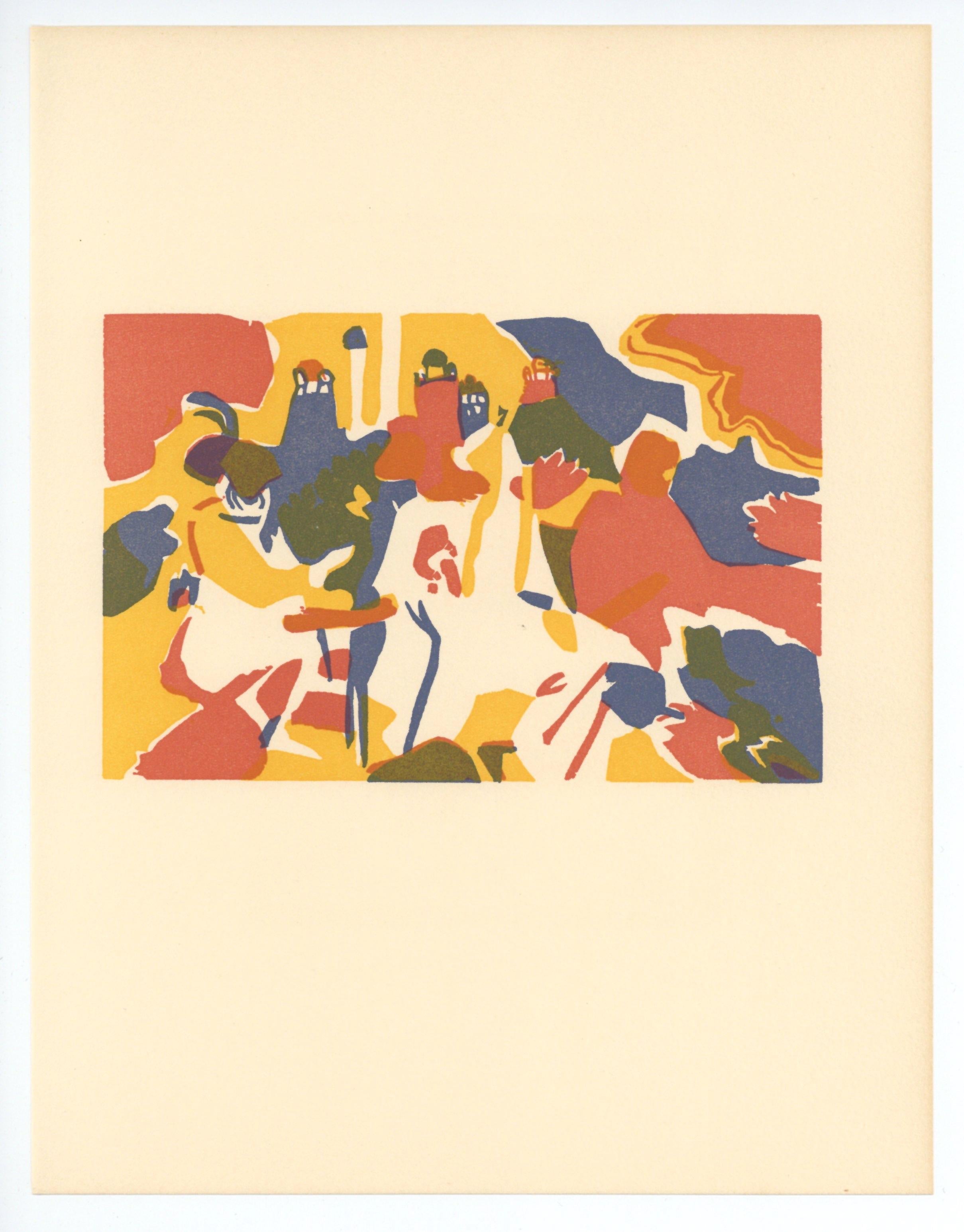
Klänge: Oriental Woodcut Print, Abstract, Framed, 118/300 Edition
By Wassily Kandinsky
Located in Milwaukee, WI
Wassily Kandinsky
Woodcut in color on Dutch laid paper
Cut from the folio Klänge, conceived 1911-1912, published in 1913
Published by R. Piper, Munich
Printed by F. Bruckmann A.G., ...
Category
1910s Abstract Abstract Prints
Materials
Woodcut
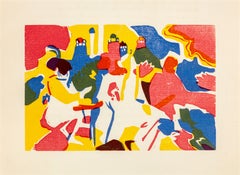
Klänge: Lyrisches, Framed 1913 Woodcut Print on Dutch Laid Paper
By Wassily Kandinsky
Located in Milwaukee, WI
Wassily Kandinsky
Woodcut in color on Dutch laid paper
Cut from the folio Klänge, conceived 1911-1912, published in 1913
Kandinsky monograph lower right in plate
Published by R. Pip...
Category
1910s Abstract Abstract Prints
Materials
Woodcut
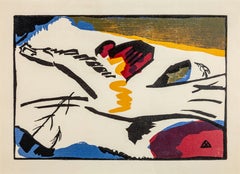
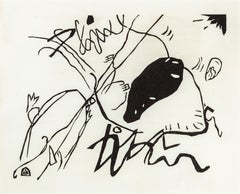
"Schwartzer Fleck" original woodcut
By Wassily Kandinsky
Located in Henderson, NV
Medium: original woodcut. Catalogue reference Roethel 145. Printed in Paris in 1938 for the art revue XXe Siecle (issue number 3). Image size: 7 x 8 1/2 inches (170 x 218 mm). Sheet ...
Category
1930s Expressionist Figurative Prints
Materials
Woodcut
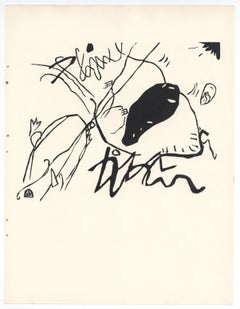
Klänge: Schwarzer Fleck (Black Spot), Roethel #145, (118/300)
By Wassily Kandinsky
Located in Milwaukee, WI
Wassily Kandinsky
Woodcut in black on Dutch laid paper
Cut from the folio Klänge, conceived 1911-1912, published in 1913
Published by R. Piper, Munich
Book is signed and edition to ...
Category
1910s Abstract Abstract Prints
Materials
Woodcut