Questions & Answers
Our trusted network of 1stDibs sellers answer common questions
Where did tapestry originate?
1 Answer
Historians are not completely sure where tapestries originated. Ancient literature from Rome, Greece and other civilizations does not specifically mention tapestries, but that doesn't mean that they didn't exist. We do know that the Ancient Egyptians did produce and utilize tapestries, as examples have been discovered in the tombs of Thutmose IV and Tutankhamen. The word tapestry wasn't coined until the 15th century, and it originated in England. Find a wide variety of tapestries on 1stDibs.
1stDibs ExpertFebruary 13, 2024
Related Questions
- What is a tapestry?1 Answer
- Can you frame a tapestry?1 Answer
- What is a tapestry used for?1 Answer
- What is embroidered tapestry?1 Answer
- What is Flemish tapestry?1 Answer
Shop for Tapestries on 1stDibs
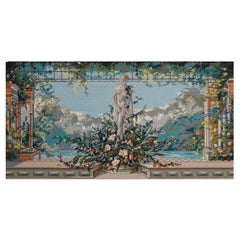
The Verdant Court of Virtue: A Chinese Aubusson Masterpiece of Flemish Grandeur
Located in Dallas, TX
79487 Vintage Chinese Aubusson Tapestry, 05'08 x 05'01. This handwoven wool vintage Chinese Aubusson tapestry is a lush homage to the legendary Flemish Feuilles de Choux verdure trad...
Category
Mid-20th Century Chinese Aubusson Western European Rugs
Materials
Wool
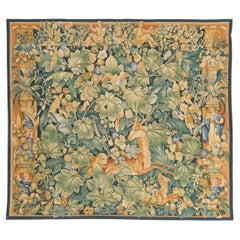
Rosemary Pipkin Jackson (American 20th C.), Classical Scene, Needlework Frame
Located in Germantown, MD
Rosemary Pipkin Jackson (American 20th Century), Classical Scene, Needlework panel, Framed., Signed
Measures 50" in width and 29" in height.
Category
Late 20th Century American American Classical Tapestries
Materials
Wood, Wool, Cotton
The Regal Convergence: A French Tapestry Masterpiece of Courtly Grandeur
Located in Dallas, TX
79397 Antique French Tapestry, 07'08 x 08'11. This exceptional handwoven wool tapestry transports you straight into the rarefied world of Renaissance pageantry—an era where nobility,...
Category
Early 20th Century French Louis XIV Western European Rugs
Materials
Wool
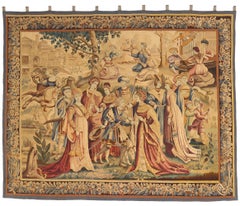
20th Century Tapisserie d'Halluin France Aubusson Style Tapestry
Located in Germantown, MD
A 20th Century Tapisserie d'Halluin France Aubusson Style Tapestry featuring King Louis XIV in Versailles, France.
Measures 74" in width and 52" in height.
Category
Mid-20th Century American Aubusson Tapestries
Materials
Tapestry
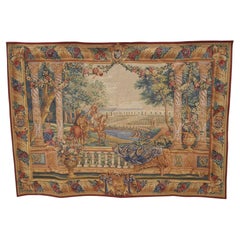
Antique Japanese Ink Painting Curtain/Wabi-Sabi Tapestry/1868-1920
Located in Sammu-shi, Chiba
This is an old Japanese noren curtain. It is believed to be made from a traditional Japanese fabric called asa or basho, made from banana leaf fibers. Noren curtains were originally hung at the entrances of shops and homes, gently blocking outside views and breezes while also conveying a sense of the presence of people and the changing seasons, a presence born from Japan's unique lifestyle and culture. More than simply a room divider, noren curtains also quietly convey the aesthetic sense of the people and businesses that inhabit them.
The greatest appeal of this work lies in the ink paintings executed on the fabric. The moon, bamboo grass, rocks, and flowing river are depicted, making ample use of the white space, creating a tranquil worldview reminiscent of Chinese and Japanese landscape paintings. However, the depiction is by no means verbose; the bamboo grass is depicted with minimal, omitted lines, and the river is not depicted in full, leaving it to the viewer's imagination. In the center, a full moon is depicted only as an outline, and its understated depiction evokes a sense of transience and lingering beauty.
A two-character signature can be seen in the corner of the painting, but details about the artist are unknown. However, noren curtains painted directly onto them in ink like this are extremely rare, and I have only seen them a few times before. I think it is particularly noteworthy that such poetic, highly refined pictorial expression has been applied to a noren curtain, which is supposed to be a practical item.
Over the years, the entire fabric has taken on a slight brownish tinge, taking on the depth and tranquility that only comes with aging. This color blends with the pale ink colors of the ink, quietly blending into the space without making a strong statement. It pairs particularly well with white walls, and I highly recommend using it not only as a noren curtain, but also hanging it on the wall like a tapestry for viewing. I believe that just hanging one in a space will bring a sense of dignified space and the depth of time.
Size & Specifications
Cloth Width: Approx. 87.5 cm
Height: Approx. 150.5 cm
Cloth Thickness: Very thin (approx. 0.05 mm; exact measurements not taken)
Top Bamboo Rod Length: Approx. 98.5 cm
Item Number
OB314
It's impossible to say when we'll ever be able to find another antique noren...
Category
Antique Late 19th Century Japanese Meiji Tapestries
Materials
Hemp

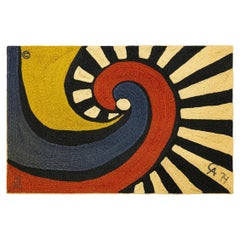
Alexander Calder Jute Tapestry, 1974 Guatemala
Located in Los Angeles, CA
Extremely rare Alexander Calder 'Swirl' jute tapestry. Swirl pattern. Made in Guatemala in 1974. Calder contributed 14 designs to be made in limited editions by weavers in Guatemala ...
Category
Vintage 1970s American Tapestries
Materials
Jute