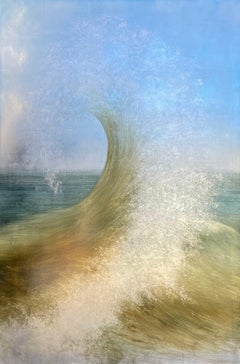
By Ann Aspinwall
Located in New York, NY
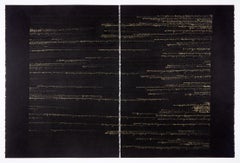
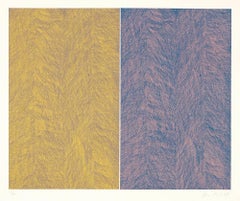
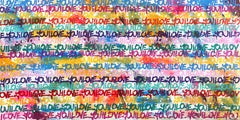
Printmaker Ann Aspinwall made this etching in 1999, while living in Venice. During those years she did several etchings that adhered to a certain principle. She drew a freehand line, as straight as possible; and beneath that line drew another, following as closely as possible the one above. Each successive line followed the line directly above, imitating all the curves and shakes. These imperfections, or deviations from the original line, became more and more prominent, each line being an interpretation of what came before it.
Around that time, Aspinwall discovered the writing of John Dewey on the subject of rhythm in his Art as Experience (1934):
Rhythm, writes Dewey, is an “ordered variation of changes.” There is no rhythm “when there is a uniformly even flow, with no variations of intensity or speed,” when “variations of pulse and rest do not occur.” “Variations of intensity are relative to the subject matter directly experienced. Each beat, in differentiating a part within the whole, adds to the force of what went before while creating a suspense that is a demand for something to come. It is not a variation in a single feature but a modulation of the entire pervasive and unifying qualitative substratum.”
Ten years later Aspinwall returned to this plate. Looking at it again after a long time she perceived the strong influence of Venice; the texture calls to mind water and fabric. The artist was unable to decide on one color for an edition, so after printing many color proofs, she chose ten combinations of colored lines on colored Japanese papers. The prints evoke the light and surfaces of Venice. The title of the series, Tessuto Veneziano, means Venetian textile...
Category
2010s Contemporary Art by Medium: ABS
MaterialsArchival Paper, ABS, Etching