By Peter Paul Rubens
Located in PARIS, FR
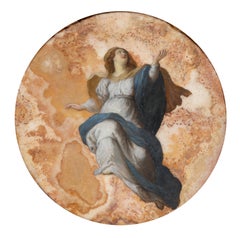
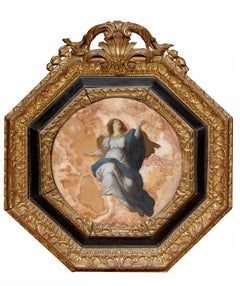
This beautiful composition on stone is still an enigma, despite our research. The representation of the Assumption of the Virgin Mary is directly inspired by an engraving by Schelte Adams Bolswert (ca. 1586 - 1659), after an altarpiece by Peter Paul Rubens (1577-1640), completed in 1621. The presence of a label on the back indicating that this panel was brought from Rome, suggests that it is a Roman work, however, at this stage, it has not been possible to establish the exact name of the artist. The French framing makes it a true European work of art, testifying both to the circulation of forms between Flanders and Italy thanks to the spread of engravings, but also to the circulation of works of art between Italy and France.
Oil on alabaster panel, probably of antique origin
9 7/16” (24 cm) diameter; 18 ½” x 16 ½” (47 x 42 cm) framed
French frame from the Louis XIV period in a mixture of gilded and carved wood and ebony marquetry inlaid with pewter fillets.
1. A well identified source of inspiration: the altarpiece of the Assumption by Rubens
The Assumption of the Virgin is based on a large altarpiece designed by Rubens between 1611/14 and 1621. This altarpiece was originally executed for the cathedral of Antwerp but was exhibited from 1621 to 1776 in the Marian chapel of the Jesuit church in that city. It is now in the Kunsthistorisches Museum in Vienna (Austria) .
The figure of the Virgin in Rubens' altarpiece is reversed on our panel, and the colors of the Virgin's garments are different. These two elements show that the real source of inspiration for the painter of our panel is probably the engraving made from this altarpiece by Schelte Adams Bolswert (ca. 1586 - 1659) for the printer Martinus van den Enden (1605 - after 1654).
A comparison between the engraving made after Rubens' work and our work shows that the treatment of the Virgin and her drapery are very similar.
2. A panel probably of Roman origin
Stone painting appeared in Rome around 1530, and then spread to other Italian artistic centres (Florence, Venice, Genoa, Milan and Verona) as well as outside the peninsula, particularly to Antwerp. It is interesting to note the role of Rubens in the spread of this pictorial tradition on stone in Flanders. Rubens had in fact learned this technique while working in Rome between 1606 and 1608 on a triptych on slate for the church of Santa Maria in Vallicella. It was after his return to Flanders that certain painters discovered stone painting in their turn.
It seems however, that, despite the Rubenian inspiration, our panel is a Roman work. A label on the back indicates that the panel was brought from Rome. This inscription, made partially illegible by the addition of a suspension hook, reads as follows
"This table [...]
is painted by * (*The Correggio) on oriental alabaster
of a choice (particularly ?) [...] perfectly imitating
a glory all the more [...] as the lights come
from above; which has (decided?) the skilful painter to compose his
figure to take advantage [...] of the contrasts (of ?) lights
accidental - so that the composition has been so
studied that it could not be otherwise flawless.
[...] belongs to Mr. Henri François Bernard
who [...] from someone who had it [...] from Rome. "
Beyond the erroneous nature of the attribution to Correggio, typical of an era in which knowledge of the great artists was in its infancy, this label leads us to believe that this painting was indeed purchased in Rome, unframed, allowing it to be transported more easily, and then brought back and framed in France - we will come back to this.
The very high quality of the alabaster used...
Category
Mid-17th Century Old Masters Alabaster Figurative Paintings