Located in Sitges, Barcelona
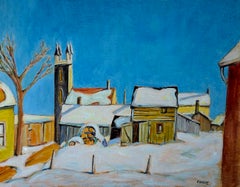
Mediterranean Church Square with Figures Spanish Impressionist Oil Painting
Artist: Joan Roig i Soler (Barcelona, 1852–1909)
Title: Mediterranean Church Square with Figures
Medium: Oil on canvas
Dimensions: 36 × 32 cm / 14.2 × 12.6 in
Framing: Unframed
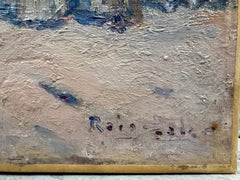
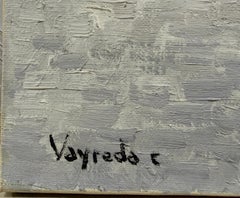
Signature: Signed lower right
Period: Late 19th to early 20th century
Country of origin: Spain
Style: Catalan Luminism, Impressionism, Mediterranean painting
Subject: Church square, village architecture, figures, religious procession
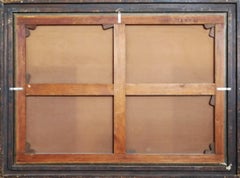
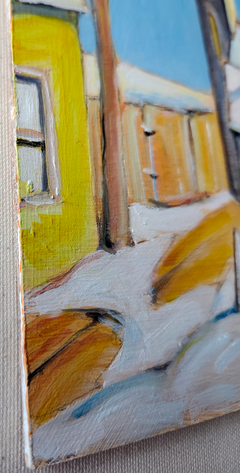
Condition: Good antique condition, with age-related wear and surface texture consistent with its period. Please examine the photographs carefully, as they form an integral part of the condition description.
Description
An exceptionally atmospheric Mediterranean village scene by Joan Roig i Soler, one of the founders and leading representatives of the Sitges Luminist School.
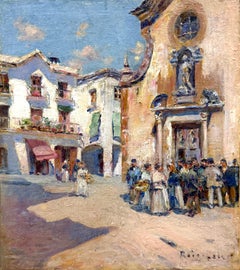
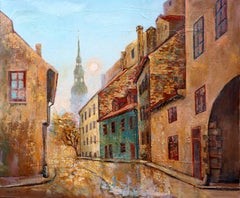
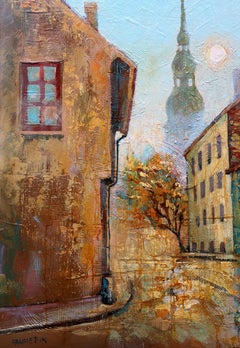
The composition depicts a sunlit church square animated by a gathering of villagers dressed in traditional clothing. Several figures appear to carry baskets or offerings, suggesting a local religious celebration, market day or procession taking place outside the church. Whitewashed houses, balconies, green shutters and warm ochre façades frame the scene, creating an evocative image of everyday life in a historic Spanish coastal town.
Roig i Soler constructs the view through loose, confident brushwork and a luminous palette of pale blues, creams, rose, ochre and muted green. The broad foreground and diagonal shadows guide the eye towards the group assembled beside the church entrance, while the vivid Mediterranean sky gives the entire painting a radiant, open-air atmosphere.
The contrast between the sunlit architecture and the compact crowd demonstrates the artist’s ability to combine landscape, urban architecture and costumbrista figure painting. Rather than describing every individual in detail, Roig i Soler uses rapid touches of colour to create movement, light and social energy. The result is spontaneous and highly decorative, yet also historically evocative.
Works showing populated streets and village squares are especially desirable within Roig i Soler’s production, as they unite his celebrated treatment of Mediterranean light with a vivid record of Catalan and Spanish daily life. Its intimate format also makes the painting particularly suitable for a salon wall, study, library or carefully assembled collection of European Impressionist art.
Artist biography
Joan Roig i Soler was born in Barcelona in 1852 and became one of the most important Catalan landscape painters of the late 19th century. He studied at the Escola de la Llotja in Barcelona and trained under Modest Urgell, one of the leading Spanish landscape painters of his generation.
After travelling through France and Italy, Roig i Soler settled for extended periods in Sitges, where he worked alongside Arcadi Mas i Fondevila. Together they became central figures in the development of the Sitges Luminist School, a pioneering movement devoted to plein-air painting, Mediterranean light and direct observation of nature.
The Sitges Luminists moved away from academic historical painting and focused instead on beaches, ports, village streets, churches and everyday life. Their experiments with natural light anticipated important aspects of Catalan Modernism and helped establish Sitges as one of the principal artistic centres of Spain.
Roig i Soler painted throughout Catalonia and the Balearic Islands, including Sitges, Barcelona, Blanes, Tossa de Mar, Cadaqués, Camprodon and Mallorca. His work is admired for its luminous colour, animated brushwork and sensitive depiction of Mediterranean architecture and coastal atmosphere.
He participated in major exhibitions in Barcelona, Madrid, Zaragoza and Paris and served as a jury member at the 1888 Barcelona Universal Exposition. His paintings are represented in important public collections, including the Museu Nacional d’Art de Catalunya and the museums of Sitges.
Artistic inspiration
The luminous treatment of architecture and atmosphere recalls the Mediterranean clarity of Joaquín Sorolla, while the lively arrangement of figures and spontaneous plein-air brushwork evokes Pierre-Auguste Renoir and Camille Pissarro. The elegant observation of everyday urban life also connects the work with John Singer Sargent and the Venetian street scenes of Maurice Prendergast, filtered through the distinctive light and vernacular architecture of Catalonia.
Joan Roig i Soler, Spanish Impressionist painting, Catalan Luminist painting, Mediterranean village painting, Spanish church painting...
Category
1890s Impressionist Figurative Paintings