Tapestry Paintings

to
1
Overall Width
to
Overall Height
to
1
1
1
1
1
1
1
1
1
1
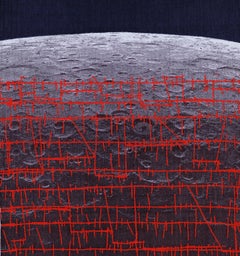
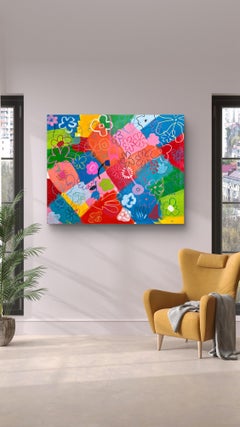
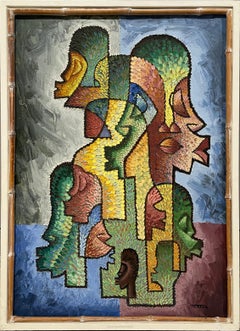
Medium: Tapestry
Artist: Annette Cords
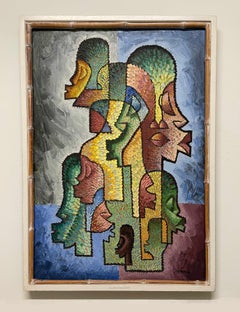
Annette Cords, Crosstalk, 2013, Tapestry

Annette Cords, Crosstalk, 2013, Tapestry

By Annette Cords

Located in Darien, CT

Jacquard weaving is at once simple and complex. The language used to set up weave structures is straightforward and binary: the warp is either up or down. With the Jacquard loom, h...

Category

21st Century and Contemporary American Modern Tapestry Paintings

Materials

Tapestry

Related Items
Divided By Time, Large Modern Abstract Painting

Divided By Time, Large Modern Abstract Painting

Located in Grand Rapids, MI

Robert Sealock (American, 20th Century) Signed: RWS 93 (Canvas Verso) " Divided By Time ", 1993 Oil on Canvas 48 1/4" x 40" This large modern painting is in nice original condi...

Category

Late 20th Century American Modern Tapestry Paintings

Materials

Canvas, Oil

The Day Bangkok Stopped for a Giant Cat

The Day Bangkok Stopped for a Giant Cat

Located in Zofingen, AG

Massive cat blocking traffic Bangkok Thailand acrylic artwork Acrylic Painting on canvas One of a kind artwork Size: 80 × 100 × 3 cm (unframed) The artwork is titled and signed on ...

Category

2010s American Modern Tapestry Paintings

Materials

Canvas, Acrylic

"Cubist Landscape" Albert Heckman, American Modernist, Fractured Landscape

"Cubist Landscape" Albert Heckman, American Modernist, Fractured Landscape

By Albert Heckman

Located in New York, NY

Albert Heckman Cubist Landscape Signed lower right Oil on canvas 21 3/4 x 30 inches Albert Heckman was born in Meadville, Western Pennsylvania, 1893. He went to New York City to tr...

Category

1940s American Modern Tapestry Paintings

Materials

Canvas, Oil

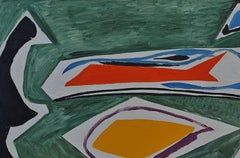
Mid-20th Century Abstract Canvas Painting with Curved Lines

Mid-20th Century Abstract Canvas Painting with Curved Lines

By Jean Xceron

Located in New York, NY

Jean Xceron (Greek-American, 1890 – 1967) Mid-20th Century Abstract Painting Oil on canvas 41.7 x 43.5 inches Signed lower left Jean Xceron (1890 – 1967) is a modernist artist who...

Category

Mid-20th Century American Modern Tapestry Paintings

Materials

Canvas, Oil

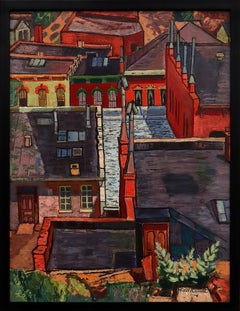
WPA American Scene Modernism 20th Century NYC Industrial "Cellar with Horseshoe"

WPA American Scene Modernism 20th Century NYC Industrial "Cellar with Horseshoe"

By Joseph Solman

Located in New York, NY

"Cellar with Horseshoe" WPA American Scene Modernism 20th Century NYC Industrial Joseph Solman (1909-2008) "Cellar with Horseshoe" 16 x 20 inches, c. 1938 Oil on canvas Initialed "...

Category

1930s American Modern Tapestry Paintings

Materials

Canvas, Oil

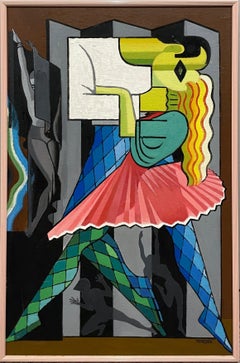
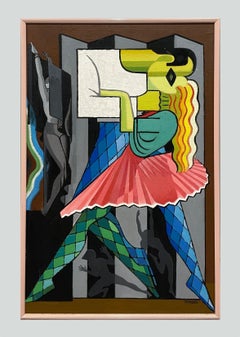
Figurative Cubist Surrealist Abstraction Mid 20th Century American Modern Large

Figurative Cubist Surrealist Abstraction Mid 20th Century American Modern Large

By O. Louis Guglielmi

Located in New York, NY

Figurative Cubist Surrealist Abstraction Mid 20th Century American Modern Large O. Louis Guglielmi (1906 - 1956) OBSESSIVE THEME 44 x 33 inches Oil on canvas Signed and dated '48 lo...

Category

1940s American Modern Tapestry Paintings

Materials

Canvas, Oil

Untitled
Untitled

James KoenigUntitled, 1944

$2,000

H 14 in W 20 in

Untitled

By James Koenig

Located in Buffalo, NY

An original oil on canvas painting by American artist James Koenig created in 1944.

Category

1940s American Modern Tapestry Paintings

Materials

Canvas, Oil

"Untitled" Albert Heckman, 1950s Modernist Abstracted Still Life Painting

"Untitled" Albert Heckman, 1950s Modernist Abstracted Still Life Painting

By Albert Heckman

Located in New York, NY

Albert Heckman Untitled, circa 1950 Signed lower right Oil on canvas 21 1/4 x 29 inches Albert Heckman was born in Meadville, Western Pennsylvania, 1893. He went to New York City to try his hand at the art world in 1915 after graduating from high school and landing a job at the Meadville Post Office. In 1917, at the age of 24, Heckman enrolled part-time in Teachers' College, Columbia University's Fine Arts Department to begin his formal art education. He worked as a freelance ceramic and textile designer and occasionally as a lecturer at the Metropolitan Museum of Art. In the early 1920s, at the age of almost 30, he graduated with a Bachelor of Arts degree from Columbia Teachers College. He was especially impacted by his instructor at Columbia, Arthur Wesley Dow. After graduating, he was hired by the Teachers' College as a Fine Arts instructor. He stayed with Columbia Teachers' College until 1929, when he left to attend the Leipzig Institute of Graphic Arts in Leipzig, Germany. Isami Doi (1903-1965), who was born in Hawaii, was arguably his most impressive student at Columbia. Doi is now regarded as one of the most prominent artists hailing from Hawaii. Heckman became an active member and officer of the Keramic Society and Design Guild of New York in the 1920s as part of his early commercial art career. The Society's mission was to share knowledge and showcase textile and ceramic design exhibits. In 1922, Heckman married Florence Hardman, a concert violinist. Mrs. Heckman's concert schedule during the 1920s kept Albert and Florence Heckman apart for a significant portion of the time, but they spent what little time they had together designing and building their Woodstock, New York, summer house and grounds. A small house and an acre of surrounding land on Overlook Mountain, just behind the village of Woodstock, were purchased by Albert and Florence Heckman at the time of their marriage. Their Woodstock home, with its connections, friendships, and memories, became a central part of their lives over the years, even though they had an apartment in New York City. Heckman's main artistic focus shifted to the house on Overlook Mountain and the nearby towns and villages, Kingston, Eddyville, and Glasco. After returning from the Leipzig Institute of Graphic Arts in 1930, Mr. Heckman joined Hunter College as an assistant professor of art. He worked there for almost thirty years, retiring in 1956. Throughout his tenure at Hunter, Mr. Heckman and his spouse spent the summers at their Woodstock residence and the winters in New York City. They were regular and well-known guests at the opera and art galleries in New York. Following his retirement in 1956, the Heckmans settled in Woodstock permanently, with occasional trips to Florida or Europe during the fall and winter. Mr. Heckman's close friends and artistic career were always connected to Woodstock or New York City. He joined the Woodstock art group early on and was greatly influenced by artists like Paul and Caroline Rohland, Emil Ganso, Yasuo Kuniyoshi, Andre Ruellan, and her husband, Jack Taylor. Heckman operated a summer art school in Woodstock for several years in the 1930s with support from Columbia University, where these and other Woodstock artists gave guest lectures. The Potter's Shop in New York City hosted Mr. Heckman's first art show in December 1928. The exhibit received some positive reviews from critics. The American Institute of Graphic Arts chose the plate of "Wehlen, Saxony" as one of the "Fifty Prints of the Year in 1929." There were sixteen etchings displayed. The remaining plates depicted scenes in Saxony, Germany, while five of the plates were based on scenes in Rondout, New York. Heckman started switching from etching to black and white lithography by the early 1930s. A lifelong admirer of Heckman's artwork, Mr. Gustave von Groschwitz organized a significant exhibition of Heckman etchings and lithographs at the Ferargil Gallery in New York City in 1933. The exhibition traveled to the Stendahl Galleries in Los Angeles (May 1933), the Charles Lessler Gallery in Philadelphia (May 1933), J.L. Hudson in Detroit (June 1933), and Gumps in San Francisco (July 1933). Together with his early etchings, the exhibition featured brand-new black and white lithographs depicting scenes in and around Woodstock as well as "A View from Tudor City...

Category

1950s American Modern Tapestry Paintings

Materials

Canvas, Oil

Excavation
Excavation

Excavation

By Charles Houghton Howard

Located in New York, NY

Charles Houghton Howard was born in Montclair, New Jersey, the third of five children in a cultured and educated family with roots going back to the Massachusetts Bay colony. His father, John Galen Howard, was an architect who had trained at M.I.T. and the École des Beaux Arts in Paris, and apprenticed in Boston with H. H. Richardson. In New York, the elder Howard worked for McKim, Mead and White before establishing a successful private practice. Mary Robertson Bradbury, Charles’s mother, had studied art before her marriage. John Galen Howard moved his household to California in 1902 to assume the position of supervising architect of the new University of California campus at Berkeley and to serve as Professor of Architecture and the first Dean of the School of Architecture (established in 1903). The four Howard boys grew up to be artists and all married artists, leaving a combined family legacy of art making in the San Francisco Bay area that endures to this day, most notably in design, murals and reliefs at the Coit Tower and in buildings on the Berkeley campus. Charles Howard graduated from the University of California at Berkeley in 1921 as a journalism major, and pursued graduate studies in English at Harvard and Columbia Universities before embarking on a two-year trip to Europe. Howard went to Europe as a would-be writer. But a near-religious experience, seeing a picture by Giorgione in a remote town outside of Venice, proved a life-altering epiphany. In his own words, “I cut the tour at once and hurried immediately back to Paris, to begin painting. I have been painting whenever I could ever since” (Charles Howard, “What Concerns Me,” Magazine of Art 39, no. 2 [February 1946], p. 63). Giorgione’s achievement, in utilizing a structured and rational visual language of art to convey high emotion on canvas, instantly convinced Howard that painting, and not literature, offered the best vehicle to express what he wanted to say. Howard returned to the United States in 1925, confirmed in his intent to become an artist. Howard settled in New York and supported himself as a painter in the decorating workshop of Louis Bouché and Rudolph Guertler, where he specialized in mural painting. Devoting spare time to his own work, he lived in Greenwich Village and immersed himself in the downtown avant-garde cultural milieu. The late 1920s and early 1930s were the years of Howard’s art apprenticeship. He never pursued formal art instruction, but his keen eye, depth of feeling, and intense commitment to the process of art making, allowed him to assimilate elements of painting intuitively from the wide variety of art that interested him. He found inspiration in the modernist movements of the day, both for their adherence to abstract formal qualities and for the cosmopolitan, international nature of the movements themselves. Influenced deeply by Surrealism, Howard was part of a group of American and European Surrealists clustered around Julien Levy. Levy opened his eponymously-named gallery in 1931, and rose to fame in January 1932, when he organized and hosted Surrealisme, the first ever exhibition of Surrealism in America, which included one work by Howard. Levy remained the preeminent force in advocating for Surrealism in America until he closed his gallery in 1949. Howard’s association with Levy in the early 1930s confirms the artist’s place among the avant-garde community in New York at that time. In 1933, Howard left New York for London. It is likely that among the factors that led to the move were Howard’s desire to be a part of an international art community, as well as his marriage to English artist, Madge Knight...

Category

20th Century American Modern Tapestry Paintings

Materials

Canvas, Oil

1994 "Eye on the Pie II" Abstract Oil Painting Illustrator Bill Shields

1994 "Eye on the Pie II" Abstract Oil Painting Illustrator Bill Shields

Located in Arp, TX

William Stephens Shields, Jr., 1925 - 2010 "Eye on the Pie II" 1994 Oil on canvas 48"x36" artist framed Signed lower right William Stephens Shields, Jr., 1925 - 2010 He was born in san Francisco, in 1931, Bill moved to Texas, where he grew up. Moved to New York in 1940 and later joined the Naval Air Corps at the age of 18. He served as an Aviation Cadet in the U.S. Navy from 1943 to 1945. At the end of WWII, Bill returned to Texas. At 21, Bill re-focused his energy and enrolled in the Chicago Academy of Fine Art as an Illustration major. What followed was a whirlwind of success, great friendships and a sense of belonging he had never before experienced. Art was his calling and the art-world could not have been less prepared for the likes of Bill Shields. He took them by storm, first Houston, then San Francisco, followed by New York in the late 60's. For 35 years, Bill produced some of the country's best illustrations: fresh, playful, loose and innovative. His illustrations were coveted by such clients as Bantam Books, Time Life, MacMillan Publishing Co., and were awarded numerous gold medals by the Societies of Illustrators in New York, San Francisco and Los Angeles, and the Houston Artists Guild. Later, following inspirational trips to Mexico and France, Bill shifted his attention to the self-directed world of fine art. After years of sculpting, making assemblages, painting nudes and landscapes, he settled on the exploration of large abstract oil paintings. His paintings have been exhibited in galleries in San Francisco, Connecticut and New York. CV EDUCATION: Chicago Academy Of Fine Art San Antonio Art Institute MAJOR FIELDS OF PROFESSIONAL ENDEAVOR: Freelance graphic design and illustration Instructor of painting and illustration Landscape, figurative and abstract painting ART RELATED EMPLOYMENT: (Professor of Art) California College of Arts and Crafts, Oakland, CA Academy of Art College, San Francisco, CA San Francisco Art Institute San Jose State University AWARDS FOR ILLUSTRATION, Gold Medals: New York Society of Illustrators Los Angeles Society of Illustrators San Francisco Society of Illustrators Dallas-Fort Worth Art Director's Club Houston Artist's Guild BIBLIOGRAPHY: Feature articles in: American Artist, Communication Arts, Print, North Light...

Category

Late 20th Century American Modern Tapestry Paintings

Materials

Canvas, Oil

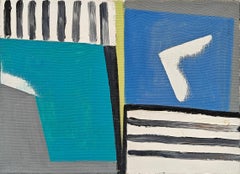
"Untitled" Edward Zutrau, Modernist, Mid-Century, Abstract, Blue, White, Gray

"Untitled" Edward Zutrau, Modernist, Mid-Century, Abstract, Blue, White, Gray

Located in New York, NY

Edward Zutrau Untitled, 1960 Signed and dated "11/60" on the reverse Oil on canvas 9 3/4 x 13 1/4 inches Edward Zutrau (1922–1993) was an American painter whose career spanned from...

Category

1960s American Modern Tapestry Paintings

Materials

Canvas, Oil

Tapestry paintings for sale on 1stDibs.

Find a wide variety of authentic Tapestry paintings available on 1stDibs. While artists have worked in this medium across a range of time periods, art made with this material during the 21st Century is especially popular. If you’re looking to add paintings created with this material to introduce a provocative pop of color and texture to an otherwise neutral space in your home, the works available on 1stDibs include elements of pink, purple, red and other colors. There are many well-known artists whose body of work includes ceramic sculptures. Popular artists on 1stDibs associated with pieces like this include Mary Tooley Parker, Fernandez Arman, Lia Cook, and Annette Cords. Frequently made by artists working in the Contemporary, Modern, all of these pieces for sale are unique and many will draw the attention of guests in your home. Not every interior allows for large Tapestry paintings, so small editions measuring 0.1 inches across are also available