Old Masters Art

OLD MASTERS

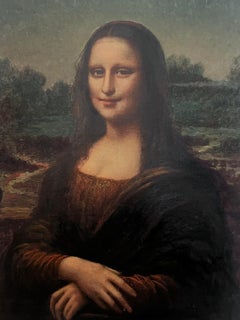
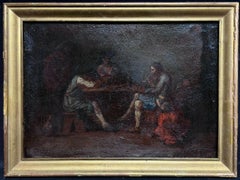
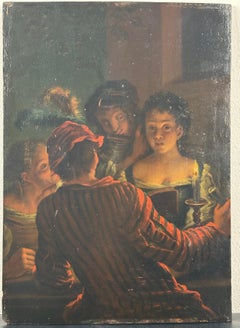
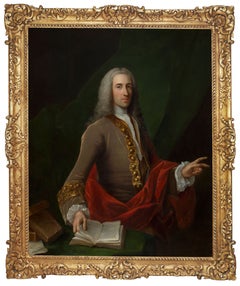
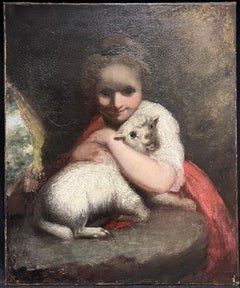
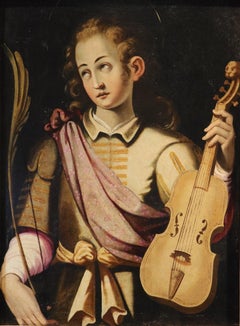
Encompassing centuries of change in Europe between 1300 and 1800, from booms of prosperity to bloody revolutions, Old Masters describes a wide range of artists. The informal term was derived from the title of an artist who trained in a guild long enough to become a master, such as Leonardo da Vinci, who studied in a Florence painters’ guild. However, Old Masters paintings, prints and other art is now used to refer to work made by any artist with a high level of skill in painting, drawing, sculpture or printmaking who worked during this era.

The 15th century’s expansive trade and commerce spread culture across borders. A vibrant period of art emerged, bolstered by studies of anatomy and nature that influenced a new visual realism. From Raphael and Michelangelo in the Renaissance to Rembrandt van Rijn and Johannes Vermeer in the Dutch Golden Age, artists expressed emotion, naturalism, color and light in new ways. El Greco and Paolo Veronese were leaders in the dramatic style of Mannerism, while Caravaggio and Peter Paul Rubens demonstrated the movement and meticulous detail of Baroque art.

Historically, most attention was concentrated on male artists, but recent research and exhibitions have elevated the impactful work of women such as Rachel Ruysch and Artemisia Gentileschi. In late-18th-century France, female artists like Adélaïde Labille-Guiard and Élisabeth Vigée Le Brun were prominent names. Nevertheless, access to the academies and guilds was highly restricted for women, and even those able to establish practices were expected to adhere to portraits and still lifes rather than the grand history paintings being created by men.

Find a collection of Old Masters prints, paintings, drawings and watercolors and other art on 1stDibs.

to
679
2,393
779
338
305
365
Overall Width
to
Overall Height
to
3,129
841
97
126
11
6
6
2
1
6
2
11
2
4
2,287
114,428
65,088
54,972
27,063
14,922
9,370
6,542
5,779
3,054
2,582
2,327
2,251
719
2,014
1,733
385
2,855
1,501
961
937
903
475
431
316
274
273
226
207
194
166
110
103
99
91
91
86
2,330
1,270
1,127
390
384
108
98
93
88
67
1,205
2,196
2,443
744
Style: Old Masters
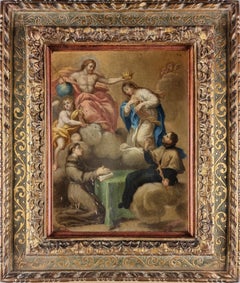
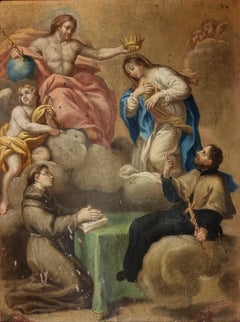
San Joaquín, Santa Ana y la Virgen niña - óleo sobre cobre.
Located in Sant Celoni, ES
Escuela española; siglo XVIII. San Joaquín, Santa Ana y la Virgen Niña. Es un Óleo sobre cobre anónimo y buena calidad pictórica. Medidas de la obra: 69 x 87 cm. Medidas del marc...
Category

18th Century Old Masters Art

Materials

Oil

18th/19th Century French Old Master Oil Christ entering Jerusalem
Located in Cirencester, Gloucestershire
18th/19th Century School 'A scene of Christ entering Jerusalem' Medium: oil on canvas, framed Size of painting: 21.5" x 18.25" inches condition: overa...
Category

18th Century Old Masters Art

Materials

Oil

Very Large Antique French Classical Romantic Oil Painting Ancient Ruin Landscape
Located in Cirencester, Gloucestershire
Artist/ School: French School, 19th century Title: Classical Landscape with figures amongst ancient ruins. Medium: oil painting on canvas, unframed. canvas: 24.5 x 36 inches P...
Category

19th Century Old Masters Art

Materials

Oil

The Beheading of St. John the Baptist - Etching by Rembrandt - 1640
Located in Roma, IT
Beautiful proof of I state on III before the white space under the sword is covered. Without Margins. Very good condition. Ref. Bartsch 92; Biörklund 40-B; Hollstein (White and Bo...
Category

1640s Old Masters Art

Materials

Etching

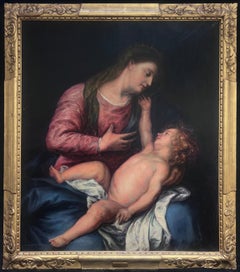
Madonna Child Maria Sassoferrato Paint Oil on canvas 17th Century Old master Art
Located in Riva del Garda, IT
Giovan Battista Salvi known as 'il Sassoferrato' (1609 - 1685) circle/ workshop Madonna with sleeping child Oil on canvas 84 x 66 cm - Framed (19th century) 112 x 95 cm The paintin...
Category

17th Century Old Masters Art

Materials

Oil

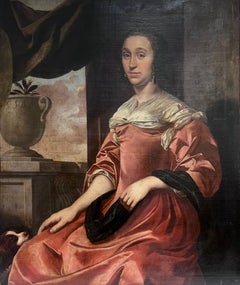
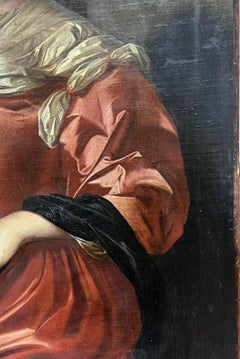
Portrait of Lady in red Dress - British Old Master art female oil painting
Located in Hagley, England
This superb British Old Master portrait oil painting is attributed to circle of noted artist Michael Dahl. Although born in Sweden, Dahl lived and worked most of his life in England ...
Category

1690s Old Masters Art

Materials

Oil

Shepherd with Sheep, Cows and a Goat in a Landscape by Jan Frans Soolmaker
Located in Stockholm, SE
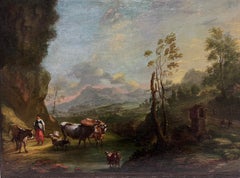
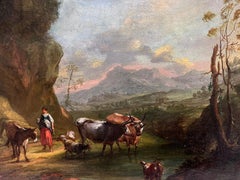
This painting depicts a pastoral scene that is attributed to the artist Jan Frans Soolmaker, an artist known for his Italianate landscapes and scenes that often feature equestrian and Arcadian elements. The painting is not signed but is attributed to Soolmaker, relating it to a known signed work by the artist that was sold at Sotheby’s London in 1999. The scene is suffused with the warm glow of a setting or rising sun, casting a soft light that is characteristic of Soolmaker’s landscapes. It shows a shepherd guiding a group of cattle across a shallow stream, with the animals taking center stage in the composition. The animals are rendered with careful attention to their forms and the play of light on their bodies, which is a hallmark of Soolmaker's work. The landscape is composed of a rocky terrain with trees and shrubbery, creating a sense of depth and natural beauty that invites the viewer to explore the scene further. The background suggests a vast, open landscape with distant mountains, which adds to the Italianate feel of the painting. The sky is dramatic, with clouds catching the light of the sun, contributing to the overall serene yet dynamic atmosphere of the work. The provenance of the painting is notable, having been in the possession of significant historical figures such as Swedish Prince Fredrik Adolf, and later The collection of Pär Ulmgren, The collection of Gösta Stenman, and Engineer and politician Gustaf Henry Hansson. Potential buyers have the option of choosing between a newly made gold frame or an older brown frame, which allows for personalization in how the work is presented. Soolmaker’s work is often compared to that of Dutch painter Nicolaes Berchem, whose style he emulated. Soolmaker's landscapes reflect a similar sensitivity to light and composition, making his works sought after for their beauty and historical significance. Despite the smaller body of work left by Soolmaker, due to his short career, his paintings are valued for their craftsmanship and the legacy of the artist’s brief but impactful contribution to the Dutch Italianate landscape genre. Information: Jan Frans Soolmaker (Flanders 1635‑1685) Shepherd with Sheep...
Category

17th Century Old Masters Art

Materials

Canvas, Oil

Oedipus before the Temple of the Furies at Colonus
Located in London, GB
Terracotta 19 x 25 ½ inches; 480 x 650 mm Signed and dated: ‘W Tyler Excu. 1765’ Collections: Cyril Humphris, London; Humphris sale, Sotheby's, New York, 10-11 January 1995, lot 74...
Category

18th Century Old Masters Art

Materials

Terracotta

Christ on the Cold Stone – After Jan Gossaert (Mabuse)
Located in Stockholm, SE
This striking devotional image, painted by a follower of Jan Gossaert, represents one of the most influential compositions of the Northern Renaissance: Christ on the Cold Stone, or C...
Category

16th Century Old Masters Art
Materials

Oil, Wood Panel

Portrait of a Lady with Pink Bow - British c 1820 Old Master art oil painting
By Sir Thomas Lawrence
Located in Hagley, England
This lovely British Old Master portrait oil painting is attributed to circle of Sir Thomas Lawrence. Painted circa 1820 it is a seated half length portrait of a beautiful lady in a b...
Category

1820s Old Masters Art

Materials

Oil

18th century antique portrait Edmund Hoyle Circle of James Latham, Edmund Hoyle
Located in York, GB
18th century Bust portrait of a gentleman in a blue coat with gold buttons (Said to be Edmund Hoyle, inventor of Whist) oil on canvas circle of James Latham. Housed in a gilt frame the size overall is 71 x 84 cm (28 x 33 inches approx) whilst the painting is 56 x 69 cm ( 22 x 27 inches approx) unsigned The overall condition is very good having had some restoration. The painting has been relined, cleaned and re varnished. There has been some strengthening/overpainting. There is a Rectangular patch repair along lower edge, centre, reverse approximately 5 x 7cm with associated retouching to front,all essentially done sympathetically. some fine stable craquelure throughout. Some minor self coloured losses to frame. None of the above detracting from a very attractive portrait. Edmond Hoyle Edmond Hoyle English card game authority, "the Father of whist" Born 1672 England Died 29 August 1769 (aged 96–97) London, England Edmond Hoyle (1672 – 29 August 1769)[1] was a writer best known for his works on the rules and play of card games. The phrase "according to Hoyle" came into the language as a reflection of his generally perceived authority on the subject James Latham James Latham was born in Thurles, County Tipperary, Ireland and possibly related to the family of Lathams of Meldrum and Ballysheehan. After some practice of his art, Latham studied for an academic year in Antwerp (1724–25) where he became a Master of the Guild of St Luke. He returned to Dublin by 1725, and may have visited England in the 1740s, as the influence of Joseph Highmore, as well as Charles Jervas and William Hogarth, is evident in his work of this period. Anthony Pasquin memorably dubbed Latham "Ireland's Van Dyck". Latham died in Dublin on 26 January 1747. Several of James Latham's portraits are in the National Gallery of Ireland collection in Dublin; one is of the famous MP Charles Tottenham (1694–1758) of New Ross, Co. Wexford, "Tottenham in his Boots" (Cat. No.411) and a second is a portrait of Bishop...
Category

Mid-18th Century Old Masters Art

Materials

Oil

J. Clays (British painter) - 19th century Still Life painting - Fruits
Located in Varmo, IT
J. Clays (British, 19th-20th century) - Still life with fruit basket. 61 x 51 cm without frame, 67.5 x 58 cm with frame. Antique oil painting on canvas, in a gilded wooden frame. ...
Category

Late 19th Century Old Masters Art

Materials

Canvas, Oil

La Dune Christian Wilhelm Ernst Dietrich (cercle) 1712 - 1774
Located in GOUVIEUX, FR
Tableau ancien – Paysage nocturne animé Attribué au cercle de Christian Wilhelm Ernst Dietrich (1712–1774) Huile sur toile – Dimensions : 63 x 48 cm Cadre en bois doré d’époque, rich...
Category

Late 18th Century Old Masters Art

Materials

Oil

17th Century Italian Old Master Oil Painting Moses Striking Water from the Rock
By Pier (Pietro) Dandini
Located in Cirencester, Gloucestershire
Moses Striking Water from the Rock; Circle of Pietro Dandini, Italian 1646-1712 Italian School, late 17th century oil on canvas, framed framed: 3...
Category

Early 18th Century Old Masters Art

Materials

Canvas, Oil

Fete Champetre - Garden Party - French 18thC figurative landscape oil painting
Located in Hagley, England
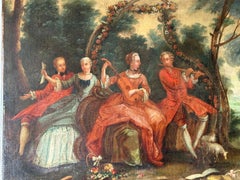
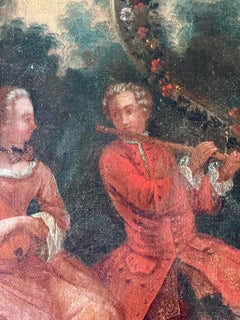
This charming 18th century French Old Master oil painting is attributed to circle of Joseph Frans Nollekens. Painted circa 1740 it is described as a fete champetre - a form of entertainment in the 18th century, taking the form of a garden party. They were often elegant affairs and became very popular in 18th French paintings. Antoine Watteau invented the genre, from around 1710 and they were also included as a category in the French Academy. In this painting, several well dressed figures are sat in the foreground by a fountain and statue, being entertained by a musician. Beyond, a wide avenue of trees leads towards a very grand country house with countryside beyond. There is superb detail in the figures and their colourful clothing. The brushwork in the trees and sky is also superb. This is a charming example of an 18th century fete champetre and of a French Old Master oil painting. Provenance. Gloucester estate. Condition. Oil on canvas. Image size 49 inches by 30 inches and in good condition. Frame. Housed in a fine gilt frame, 56 inches by 37 inches and in good condition. Josef Frans Nollekens or Joseph Frans Nollekens (1702–1748)[2] was a Flemish painter who was principally active in England where he is often referred to as "Old Nollekens" to distinguish him from his famous son, the sculptor Joseph Nollekens. He painted conversation pieces, galant companies and fêtes champêtres in the style of Watteau, genre scenes as well as portraits. He was also active as a picture restorer. A fête champêtre was a form of entertainment in the 18th century, taking the form of a garden party. This form of entertainment was particularly practised by the French court, where in the Gardens of Versailles and elsewhere areas of the park were landscaped with follies, pavilions, and temples to accommodate such festivities. The term is a French expression, very literally translating as "party in the fields", meaning a "pastoral festival" or "country feast" and in theory was a simple form of entertainment, perhaps little more than a picnic or informal open air dancing. In practice, especially in the 18th century, the simplicity of the event was often contrived. A fête champêtre was often a very elegant form of entertainment involving on occasions whole orchestras hidden in trees, with guests sometimes in fancy dress. Such events became a popular subject in French 18th-century painting, representing a glamourized aristocratic form of pastoral, with "scenes of well dressed dalliance in a park setting". Antoine Watteau invented the genre, from around 1710, and is its best exponent, imitated by others such as Nicolas Lancret and Jean-Baptiste Pater...
Category

1740s Old Masters Art

Materials

Oil

Christ Cross Religious Van Dyck 17th Century Paint Oil on canvas Old master
By Anthoon van Dyck (Antwerp 1599 - London 1641)
Located in Riva del Garda, IT
Anthoon van Dyck (Antwerp 1599 - London 1641) workshop Christ Carrying the Cross - 17th century Oil on canvas (120 x 94 cm - framed 140 x 112 cm). This remarkable canvas, depic...
Category

17th Century Old Masters Art

Materials

Oil

Holy Family Piola Paint Oil on canvas Old master 17th Century Maria Religious
Located in Riva del Garda, IT
Genoese school of the second half of the seventeenth century Circle of Domenico Piola (Genoa 1627-1703) The Holy Family Oil painting on canvas 83 x 68 cm. - in an antique frame 99 x...
Category

17th Century Old Masters Art

Materials

Oil

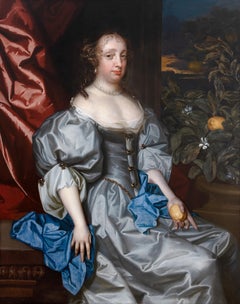
Portrait of a lady in blue dress ”Countess of Peterborough”
Located in Stockholm, SE
This exquisite portrait, with its new attribution to Theodore Russel, is believed to depict Lady Penelope O'Brien, daughter of Barnabas O'Brien, the sixth Earl of Thomond, and wife of the Earl of Peterborough, whom she married in 1644. The painting thus belongs to a historically significant period, capturing the refined elegance of the time. The portrait has a prestigious provenance from Elleholms Hofgård, a historic estate in Mörrums socken, Blekinge, Sweden. Elleholms Hofgård, whose two-story, timber-framed main building was constructed in 1730 and expanded in 1804, has changed ownership several times since the 17th century. The ancestors of the present owners acquired the estate in 1915, and from the 20th century until 2023, this painting was prominently displayed in the estate’s main building, making it an integral part of the estate’s history. Theodore Russel, an English portrait artist born in 1614, studied under the renowned Sir Anthony van Dyck, whose influence can be seen in Russel’s meticulous style. Russel often painted on cabinet-sized panels, such as this one, which measures approximately 39 x 31 cm. This preference for panels is a notable characteristic that sets him apart from contemporary artists like Sir Peter Lely, who exclusively used canvas. The size of the panel is a key reason for the reattribution to Russel from Peter lely, as Lely never used panels for his works. This distinctive format, along with Russel’s characteristic style, strongly supports the new attribution. Russel, the son of Nicasius Rousseel, a goldsmith and jeweler to James I and Charles I, refined his skills under the mentorship of his uncle, the famous portrait painter Cornelis Janssen. He also worked as an assistant and copyist for van Dyck, further honing his artistic style. This captivating portrait exemplifies Russel’s craftsmanship, reflecting the elegance of the period’s fashion and the artist's refined techniques. oil on wood panel with indistinct inscription Countess of Peter[...] upper left. with inscription on the reverse: ”Countess of Peterborough. P. Lely 1670. S Beatty Picture Restorer [...] Warwick”. unframed 39 x 31 cm = 15.35 x 12.2 inches framed 52 x 41.5 cm = 20.47 x 16.34 inches Condition: The portrait has just been restored by a professional art conservator in Stockholm and is now in a very good condition. The colors are vivid, and the skin tones appear more natural than before. It is a very fine painting. The frame is newly made and included. Provenance: Elleholms Hofgård, Mörrums socken, Blekinge, Sweden **; Stockholms Auktionsverk, Fine Art & Antiques Autumn...
Category

17th Century Old Masters Art

Materials

Oil, Wood Panel

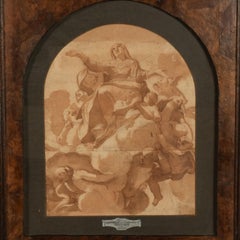
Fine 1700's Italian Old Master Ink & Wash Drawing Roman Allegorical India
Located in Cirencester, Gloucestershire
'India' Italian School, 18th century ink and wash drawing on paper, framed within a light oak wood frame (behind glass) image size: 10.5 x 7 inches overall framed: 17 x 13 inches con...
Category

18th Century Old Masters Art

Materials

Ink, Watercolor, Archival Paper

Portrait of a Gentleman with his Dog - Possibly Abraham Tucker. Oil on Canvas
Located in St. Albans, GB
Enoch Seeman - 1894 - 1744 An excellent example of Seeman's work. It is typically unsigned as was the case of many portraits of that time. A three quarter length portrait showing a r...
Category

1730s Old Masters Art

Materials

Oil

17th-Century Flemish School, Portrait Of A Gentleman In A Justaucorps, Oil
Located in Cheltenham, GB
This fine late 17th-century Flemish portrait depicts a distinguished gentleman dressed in the elaborate fashions of the 1670s. He wears a long, collarless coat known as a justaucorps...
Category

1670s Old Masters Art

Materials

Canvas, Oil

Madonna Scarsella Paint Oil on canvas Old master 16/17th Century Raffaello Art
Located in Riva del Garda, IT
Ippolito Scarsella, known as Lo Scarsellino (Ferrara, around 1550 - 1620) workshop Altarpiece depicting the Madonna and Child, St. James the Greater and the donor in armour Technique: oil on panel Measurements: 93 x 72 cm./with frame 109 x 86 cm. Provenance: Prato, Farsetti, auction of 28.10.2016, lot 261 (link) A majestic Madonna in Glory occupies the upper register of the canvas, seated on a blanket of iridescent clouds surrounded by angels, flanked by a cherub who scatters flowers contained in a cornucopia towards the infant Christ as a sign of abundance, naked and supported with both hands from the mother. In the lower part of the composition stands the figure of San Giacomo Maggiore, one of the twelve apostles, standing on the right side of the altarpiece, represented dressed in a humble tunic; one arm holds the open Gospel book, while the other holds a cross pilgrimage staff. A particular aspect of the table is the presence in the central part, to indicate its importance, of the figure of the donor, kneeling on a cushion, with his hands joined in prayer and his face observing the Virgin in an attitude of devotion, while on the opposite lectern is placed a prayer book; depicted with the features of a young leader in armor, with a sword and a rich iridescent red cloak, elements which, combined with his authoritarian composure, enhance his ennoblement. Unlike the medieval altarpieces, the knight is here included in the space of the painting and has proportionate dimensions to those of the other characters, returning to all intents and purposes in the sacred scene, with a pose that cannot but evoke the detail of the 'Montefeltro altarpiece' made by Piero della Francesca for Federico da Montefeltro, kneeling in front of the sacred group in the guise of a leader. On the right, the view recedes into depth highlighting the background of an urban landscape set on a hill behind which a mountain range stands out, with the peculiarity of the arched aqueduct that runs along the entire landscape. Presumably among these expanses were the donor's own possessions and his hometown. It is a quality table, imbued with the late Mannerist style still resistant in the second half of the 16th century, characterized by a 'sweet and affable religiosity, rendered through a manner of studied simplicity and grace', which highlights the unmistakable stylistic and chromatic connotations of the produced...
Category

16th Century Old Masters Art
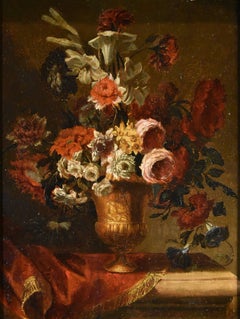
Materials

Oil

Studio of Sir Peter Lely, Portrait of Lady Anne (later Queen Anne)
Located in Oxford, GB
Studio of Sir Peter Lely (1618-1680) Portrait of Lady Anne (1665–1714), later Queen Oil on canvas 20⅞ x 16¾ in. c.1678 Provenance Capt. H. A. N. Forte of Polock, West Somerset; Chri...
Category

17th Century Old Masters Art

Materials

Oil

Allegory Music Trémolières Paint 18th Century Oil on canvas Old master France
Located in Riva del Garda, IT
Pierre Charles Trémolières (Cholet, 1703 - Paris, 1739) Allegory of Music (the Muse Euterpe) Oil on canvas (112 x 86 cm. - In original lacquered frame 122 x 95 cm.) Work acco...
Category

18th Century Old Masters Art

Materials

Oil

Annunciation Bonini Paint Oil in canvas Old master 17th Century Leonardo Italy
Located in Riva del Garda, IT
Girolamo Bonini, called Anconitano (Ancona, circa 1600 - Bologna 1680) Annunciation (or Madonna of the Beautiful Angel) Oil on canvas (115 x 91 cm. - Framed 134 x 108 cm.) Work accompanied by the expertise of Prof. Emilio Negro The work, undoubtedly commissioned as an object of private devotion, shows the Annunciation to the Virgin Mary, a Gospel episode here set on the two figures portrayed in the foreground, the Archangel Gabriel with outstretched wings, a portrait of supernatural beauty, and the Virgin; We see her here absorbed in reading a prayer book with her eyes turned humbly downwards as a sign of devotion, while a small cherub hands her white lilies, a symbol of purity and chastity.   In the upper part of the composition is the austere image of God the Father, with the dove radiating with light, emblem of the Holy Spirit, surrounded by a flock of angels fluttering in the clouds charged with intense glow and play of light, in full Baroque style. It should also be noted that the image of the Saviour's mother in a delicately pious attitude, with her yellow veil, her broad blue mantle and her usual modest red dress from which the edges of her white blouse protrude, is to be interpreted as a kind of tender allegory of sacred love. The painting in question is an interesting replica with variants of the composition commissioned from Francesco Albani for the Fioravanti chapel in the ancient church...
Category

17th Century Old Masters Art

Materials

Oil

Portrait of Bartholomeus Spranger with an Allegory on the Death of his Wife
Located in Middletown, NY
Sadeler, Aegidius II, after Bartholomeus Spranger Portrait of Bartholomeus Spranger with an Allegory on the Death of his Wife, Christina Muller Engraving on hand made laid paper wit...
Category

Early 17th Century Old Masters Art

Materials

Handmade Paper, Laid Paper, Engraving

Fine 18th Century Italianate Landscape Garden Classical Ornaments and Figures
Located in Cirencester, Gloucestershire
Italianate landscape garden with classical ornament, including Giambologna's Sabine women and a classical urn, view to a bay beyond Coplestone War...
Category

Mid-18th Century Old Masters Art

Materials

Oil

Manor House with Cottages - British 18thC Old Master art oil painting VG prov.
Located in Hagley, England
This stunning British Old Master landscape oil painting, with excellent provenance, is by George Lambert. Lambert was a pioneer of British landscape in art for its own sake. Painted in 1744, the painting is entitled View of a Manor House and Cottages in Elizabeth Einberg's 63rd volume of the Walpole Society 2001 and is described as follows: In the foreground a road emerges from a wood to cross a ford and then leads up the hill to the right, towards a manor house seemingly built into the remains of a medieval or Tudor edifice. The main track, crowded with sheep and rustic figures, passes the massive square gateposts lower down the hill on the left. Further to the left is a thatched cottage with smoke coming out the chimney. In the distance is a wide coastal view. The main buildings, which are in the dead centre of the composition, represent almost certainly an as yet unidentified English view. The colouring and detail in the trees and foliage are superb. This is an excellent Old Master oil painting by one of the all time great British landscape artists with extensive provenance. Signed and dated 1744 lower left on rock in black. Provenance. Elizabeth Einberg, “Catalogue Raisonnè of the works of George Lambert” The Annual Volume of the Walpole Society, 2001 Vol. 63, page 149 no P1744, fig.71. Antonacci Efrati Antichità Rome Gallery. Burden sale, Parke Bernet, New York, 20-21, April 1938 (376 repr.) Robert E. Peters, Sotheby Parke Bernet, New York, March 1975 (41 repr.) Lit. Schnackenburg 1995, pp 83-84, cat. no.14 fig 13. Condition. Oil on canvas, 54 inches by 52 inches and in good condition. Frame. Housed in an ornate gilt frame, 64 inches by 62 inches and in good condition. George Lambert (1700-1765) was an English landscape artist and theatre scene painter. With Richard Wilson he is recognised as a pioneer of British landscape in art, for its own sake. Lambert was born in Kent and studied art under Warner Hassells and John Wootton, soon attracting attention by the quality of his landscape painting. He painted many large and fine landscapes in the style of Gaspar Poussin and Salvator Rosa. Many of his landscapes were finely engraved by François Vivares, James Mason (1710–1785), and others, including a set of views of Plymouth and Mount Edgcumbe (painted conjointly with Samuel Scott), a view of Saltwood Castle in Kent, another of Dover, and a landscape presented to the Foundling Hospital in London. Lambert also obtained a great reputation as a scene-painter, working at first for the Lincoln's Inn Fields Theatre, in London, under John Rich. When Rich moved to Covent Garden Theatre, Lambert secured the assistance of Amigoni, and together they produced scenery of far higher quality than any previously executed. Lambert was a man of jovial temperament and shrewd wit, and frequently spent his evenings at work in his painting-loft at Covent Garden Theatre, to which men of note in the fashionable or theatrical world resorted to share his supper of a beef-steak, freshly cooked on the spot. Out of these meetings arose the well-known "Beefsteak Club" which long maintained a high social reputation. Most of Lambert's scene-paintings unfortunately perished when Covent Garden Theatre was destroyed by fire in 1808. Lambert was a friend of William Hogarth and a member of the jovial society that met at 'Old Slaughter's' Tavern in St Martin's Lane. In 1755 he was one of the committee of artists who proposed a royal academy of arts in London. He was a member of the Society of Artists of Great Britain, exhibited with them in 1761 and the three following years, and during the same period contributed to the Academy exhibitions. In 1765 he and other members seceded and formed the Incorporated Society of Artists of Great Britain, of which he was elected the first president. In conjunction with Samuel Scott, Lambert painted a series of Indian views for the old East India House in Leadenhall Street. He also etched two prints after Salvator Rosa. Lambert was associated in 1735 with George Vertue, Hogarth, and John Pine (engraver, 1660–1756) in obtaining a bill from parliament securing artists a copyright on their works. Lambert's portraits were painted by Thomas Hudson, John Vanderbank (engraved in mezzotint by John Faber the younger in 1727, and in line by H. Robinson and others), and Hogarth. Lambert's most famous painting is "A view of Box Hill, Surrey" (1733) which depicts a well-known beauty spot south of London. Hogarth considered Lambert a rival to the famous French landscape painter Claude Lorrain (1600–1682) with respect to his use of soft light to unify the scene in this painting. Though he never visited Italy he was inspired by the classical tradition of landscape painting. Lambert died on 30 November 1765 at his home on the Piazza in Covent Garden. His pupils included John Inigo Richards...
Category

Mid-18th Century Old Masters Art

Materials

Oil

19th century oil Devon coastal scene William Shayer Snr (Circle of)
Located in York, GB
19th century oil Devon coastal scene William Shayer Snr (Circle of) A very attractive oil on canvas of cockle gatherers on the Devon coast The painting depicts a busy scene with people gathering their cockles with horses/donkeys laden with baskets ready to take to market. The painting Bears signature, also inscribed and dated 1833 (lower right) The size overall is 95 x 130cm whilst the image is 64 x 104cm (25 x 40¾ in.) Housed in the original heavy gilt frame Provenance: The property of a lady and gentleman , removed from a Cheshire country house William Shayer (1787–1879) was an English landscape painter and figure painter who became prominent during the Victorian era. A self-taught artist, who began by painting decorations on rush-bottom chairs. He moved on to painting carriages in the town of Guildford, after which he started doing heraldic painting...
Category

19th Century Old Masters Art

Materials

Oil

Antique Sculpture Female Moor Venice 19th Century Gold Italy
Located in Riva del Garda, IT
Antique sculpture of a female Moor with flowering cornucopia Venice, 19th century Carved, lacquered and gilded/silvered wood Total height 202 cm (column base 82 cm, figure 120 cm) ...
Category

19th Century Old Masters Art

Materials

Gold

The peace of your nights descends into their thoughts
Located in Genève, GE
Work on paper mounted on wood 35.5 x 45.5 x 2 cm
Category

Late 18th Century Old Masters Art

Materials

Oil

Saint Jerome De Somer Paint Oil on canvas 17th Century Old master Flemish Art
Located in Riva del Garda, IT
Hendrick de Somer, known as Enrico Fiammingo (Lokeren 1602 - Naples 1655) Saint Jerome penitent in the cave oil on canvas 103 x 130 cm. - In original period frame 123 x 152 cm. Th...
Category

17th Century Old Masters Art

Materials

Oil

17th Century Memento Mori Vanitas Skull Old Master Oil Ex-Christie’s
Located in Yardley, PA
This wonderful 17th-century French School vanitas painting is a meditation on mortality and the transience of earthly pleasures. The composition centers on a finely rendered human sk...
Category

17th Century Old Masters Art

Materials

Canvas, Oil

Landscapes Couple Ricci Paint 18th Century Oil on canvas Old master Italy
Located in Riva del Garda, IT
Marco Ricci (Belluno 1676 – Venice 1730) Circle of Pair of Arcadian landscapes with figures Oil on canvas 56 x 72 cm. - Framed 77 x 93 cm. This pair of charming landscapes, ex...
Category

18th Century Old Masters Art

Materials

Oil

Portrait Noble Man Ceresa Paint Oil on canvas Old master 17th Century Italy Art
Located in Riva del Garda, IT
Carlo Ceresa (San Giovanni Bianco 1609 - Bergamo 1679) attributable Full-length portrait of Giacomo Pesenti Oil on canvas (206 x 121 cm - in frame 212 x 133 cm.) This fascinating portrait, portraying a full-length gentleman and datable to the 17th century, illustrates the stylistic and compositional details typical of the pictorial production of the Lombardy area, Bergamo in particular. This reference is reflected in elements such as the natural light, the sober and austere setting and, above all, the subtle psychological characterisation of the face. We are inclined to identify the hand of portrait painter Carlo Ceresa, one of the most illustrious Bergamasque figure painters of the 17th century, capable of developing a style of intense realism and acute psychological investigation. In his works, and our portrait perfectly reflects his canons, an extraordinary naturalistic imprint, great realism and remarkable essentiality are evident. Those traits of severity, moral rigour and austerity typical of his portraiture find a perfect balance here: never courtly or rhetorical, his portraits are profoundly linked to the concept of counter-reform. Immortalising the main personalities of the time, he established himself as a point of reference for the Bergamasque aristocracy, from the Vertova to the Pesenti to the Secco Suardo. The subject of the portrait is Giacomo Pesenti, here immortalised life-size in a rigorous black suit, his left hand resting on a table, on which is placed the necessities for writing and a manuscript, and his right hand, with a sealed ring on his little finger, abandoned along his side while he holds his gloves. He wears a suit of incredible rigour, dressed as befits a man of his high social standing, while the sharp light focuses on his face, with an intensity that seems to be accentuated by the reflection of the white collar, with its sharp profile. For Ceresa, it is not the richness of the garment that gives value to the person portrayed, it is the need to give feeling and bring out the character of the person, and this he succeeds in marvellously, aided by his ability to capture the essence of the person and return it to us in painting through the face and light used as a strong expressive element. In fact, the image highlights that 'counter-reformed' composure typical of the portraiture of painters active in this area and era, adhering to a verism...
Category

17th Century Old Masters Art

Materials

Oil

Cattle watering in an open landscape
Located in Stoke, Hampshire
Joshua Shaw (Billingborough 1776-1860 New Jersey) An open landscape with cattle watering signed and dated 'J. Shaw. 1810' lower right Oil on canvas Canvas Size 36 x 51 in Framed Siz...
Category

18th Century Old Masters Art

Materials

Oil

St. John the Baptist in the wilderness , Ecce Agnus Dei (Behold the Lamb of God)
By Giovanni Francesco Barbieri (Il Guercino)
Located in Middletown, NY
Pen and sepia ink and wash on vellum, 8 7/8 x 10 1/2 inches (225 x 267 mm). In very good condition with some modern notations in pencil on the verso, minor cockling, and a 1-inch hor...
Category

Mid-17th Century Old Masters Art

Materials

Ink, Watercolor, Vellum, Pencil

Fine 18th Century Italian Old Master Oil Painting Berghers with Animals Sunset
Located in Cirencester, Gloucestershire
The Close of Day Italian School, early 18th century oil on canvas, unframed canvas: 17 x 22.5 inches provenance: private collection, France condition: very good and sound condition
Category

18th Century Old Masters Art

Materials

Oil, Canvas

Letter of the Alphabet A - Etching by Luigi Vanvitelli - 18th Century
Located in Roma, IT
Letter of the Alphabet A from the series "Antiquities of Herculaneum", is an etching on paper realized by Luigi Vanvitelli in the 18th century. Signed on the plate. Good condition...
Category

Late 18th Century Old Masters Art

Materials

Etching

Very Large Marine Shipping Scene Impressive Statement Piece
Located in Cirencester, Gloucestershire
Large Marine Scene Dutch or Flemish, 20th century color print on canvas, framed framed: 27 x 34 inches canvas: 20 x 27.5 inches provenance: private collection, UK condition: very goo...
Category

20th Century Old Masters Art

Materials

Color

17th Century French Old Master Oil Painting Classical Robed Semi Nude Figures
Located in Cirencester, Gloucestershire
17th century French School circle of Nicolas Poussin (French 1594-1665) "Figures in Arcadia" oil on canvas, unframed canvas: 16 x 20 inches provenance: private collection, England condition: very good and sound condition Nicolas Poussin was a renowned French painter of the 17th century. He is considered one of the greatest figures of classical French Baroque art...
Category

17th Century Old Masters Art

Materials

Oil, Canvas

The Triumph of Constantine the Great
Located in Chicago, IL
Inscribed on the verso: EE 27/10
Category

16th Century Old Masters Art
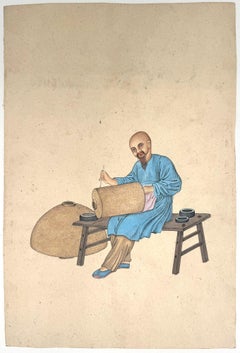
Materials

Chalk, Ink, Pen

1600’s Flemish Old Master Ink Wash Drawing Biblical Figures Group on paper
Located in Cirencester, Gloucestershire
Figure Studies Attriubted to Cornelis Schut (1597 - 1655) Flemish ink drawing on paper, inscribed on mount size: 4.75 x 7 inches private collection, France The painting is in overa...
Category

Early 17th Century Old Masters Art

Materials

Ink, Watercolor

18th-Century Spanish Baroque Oil Painting, The Divine Shepherdess, Virgin Mary
Located in Cheltenham, GB
This tender mid-18th-century Sevillian oil painting depicts the Virgin Mary as La Divina Pastora, the Divine Shepherdess. Attired in a straw hat, decorated with flora, she rests in...
Category

Mid-18th Century Old Masters Art

Materials

Canvas, Oil

Four Framed Hogarth Engravings "Four Times of the Day"
Located in Alamo, CA
The four plates in this "Four Times of the Day" set were created utilizing both engraving and etching techniques by William Hogarth in 1738. Hogarth's original copper plates were refurbished where needed by James Heath and these engravings were republished in London in 1822 by Braddock, Cradock & Joy. This was the last time Hogarth's original copper plates were used for printing. Most were melted down during World War I for the construction of bombs. Printed upon early nineteenth century wove paper and with large, full margins as published by William Heath in 1822. The inscription below each print reads "Invented Painted & Engraved by Wm. Hogarth & Publish'd March 25. 1738 according to Act of Parliament". These large folio sized "Four Times of the Day" engravings/etchings are presented in complex gold-colored wood frames with black bands and scalloped gold inner trim. A majority of each thick impressive frame is covered with glass applied near the outer edge. Each frame measures 25.75" high, 22.25" wide and 1.88" deep. There are a few small dents in the edge of these frames, which are otherwise in very good condition. "Morning" has two focal areas of discoloration in the upper margin and some discoloration in the right margin, a short tear in the left margin and a short tear or crease in the right margin. "Noon" has a spot in the upper margin that extends into the upper image, but it is otherwise in very good condition. "Evening" has a faint spot in the upper margin, but it is otherwise in very good condition. "Night" is in excellent condition. The "Four Times of the Day" series is in the collection of many major museums, including: The British Museum, The Metropolitan Museum of Art, The Tate Museum, The Chicago Art Institute and The Victoria and Albert Museum. Through this series Hogarth is portraying early 18th century London street life at "Four Times of the Day". His characters are exhibiting their personalities, quircks, strange activities, but he also wants to draw attention the disparities between the wealthy aristocracy and the common working class. Plate 1, "Morning" depicts morning in Covent Garden in the winter in front of Tom King...
Category

Mid-18th Century Old Masters Art

Materials

Engraving, Etching

William sidney cooper, Cows by a river 19th century landscape oil
Located in York, GB
A fine framed oil on canvas painting by the renowned artist William Sidney coope.Signed and dated 91 lower left. This painting depicts 3 cows resting by a river, a village with hous...
Category

19th Century Old Masters Art

Materials

Oil

Naval Battle Engagement at Sea Large Busy Battle Scene Many Ships, Signed Oil
Located in Cirencester, Gloucestershire
English School, early 20th century signed oil painting on canvas, unframed canvas: 17 x 24 inches provenance: private collection, Eng;and condition: good and sound condition, minor ...
Category

Early 20th Century Old Masters Art

Materials

Oil, Canvas

Pastoral Landscape - British 18th century Old Master art oil painting
Located in Hagley, England
This superb Old Master 18th century figurative landscape oil painting is by noted French born artist Philip James Loutherbourg. who settled in England in 1771. The painting has good ...
Category

1770s Old Masters Art

Materials

Oil

Allegory Poetry Trémolières Paint 18th Century OIl on canvas Old master France
Located in Riva del Garda, IT
Pierre Charles Trémolières (Cholet, 1703 - Paris, 1739) Allegory of Poetry (the Muse Calliope) Oil on canvas (86 x 112 cm - In original lacquered frames 122 x 95 cm.) Work ac...
Category

18th Century Old Masters Art

Materials

Oil

18th century Dutch, with figures goats and sheep outside in a barn yard or farm
Located in Woodbury, CT
Unknown Artist (Dutch School, late 18th century) Pastoral Scene with Goatherds, ca. 1780–1800 Oil on canvas In this lively pastoral composition, a group of figures reclines in rusti...
Category

1790s Old Masters Art

Materials

Oil, Wood Panel

Huge I1600's Italian Old Master Oil on Canvas Jesus at House of Mary & Martha
Located in Cirencester, Gloucestershire
Jesus at the House of Mary & Martha Italian artist, 1600's oil on canvas, unframed Canvas: 32.5 x 56.5 inches Provenance: Private collection, England Condition: for a work of such mo...
Category

17th Century Old Masters Art

Materials

Oil, Canvas

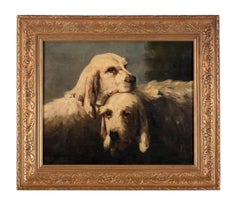
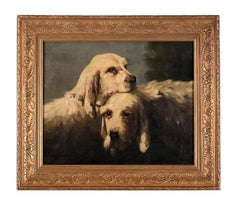
18th century portrait of a Spaniel dog with fruit in a wooded landscape.
By Tobias Stranover
Located in Woodbury, CT
Outstanding early 18th-century portrait of a seated Spaniel dog in a landscape with an array of fruits. Attributed to the work of Tobias Stranover. ...
Category

1730s Old Masters Art

Materials

Oil

Column of Trajan in Rome: A Framed Original 19th C. Etching by Luigi Rossini
Located in Alamo, CA
This early 19th century etching entitled "Veduta dello scavo del Foro Trajano" was created by Luigi Rossini and included in his publication "Le Antichita Romane" (The Rome of Antiquity), published in Rome in 1823. It depicts the historical victory column of Trajan standing amidst the rubble of broken columns that remain around it. The etching is presented in a black wood frame with a light brown outer mat and a dark brown inner mat. There are several frame abrasions. The print and mats are in very good condition. The frame measures 27" high, 29.07" wide and 0.5" deep. The print is framed and matted in the identical style as the another etching of an ancient Roman landmark, the Piazza Navona, which is also listed on 1stdibs, see item # LU117326144172. The pair would make an attractive display grouping of Roman architecture. A discount is available for purchase of the pair of prints. Luigi Rossini (1790-1857) like his predecessors, Giovanni Piranesi (1720–1778) and Giuseppi Vasi (1710-1782), was an architect and artist. Like Piranesi and Vasi, he wanted to glorify the architecture of ancient Rome, which he felt was deteriorating and needed to be documented. Several of the ruins he illustrated have, in fact, since disappeared leaving only his images as a record of their appearance. His images of the grand edifices of the city dramatically depict the power and glory...
Category

1820s Old Masters Art

Materials

Etching

Battle Scene - Original Etching Hand Watercolored After Antonio Simonini - 1760
By Luigi Guidotti
Located in Roma, IT
Scena di Battaglia (Battle Scene) is a wonderful hand-watered etching, made in 1760 by Luigi Guidotti ( Bologna, 1751 -1800 c.a), after Francesco Antonio Simonini. On lower margin u...
Category

1760s Old Masters Art

Materials

Watercolor, Etching

Portrait of Lady in Silver Dress - Dutch Old Master art portrait oil painting
By Willem Wissing
Located in Hagley, England
This lovely Dutch Old Master portrait oil painting is attributed to circle of Willem Wissing. Wissing settled in England and emerged as Peter Lely's most important pupil after his de...
Category

17th Century Old Masters Art

Materials

Oil

HERCULES FIGHTS ADRAGON center, ACHELOUS CARRYING OFF DEIANEIRA left
Located in Santa Monica, CA
GIULIO BONASONE (Italian 1500/10-1574) HERCULES FiGHTS ADRAGON center, ACHELOUS CARRYING OFF DEIANEIRA left 1531–76 (Bartsch XV.157.178; Massari 1983, no.230) Engraving. Lettered in roundel held by putto at right: 'Iulio / Bonasone' Sheet 10 5/8 x 16 7/8 inches. Thread margins outside border line. A fair impression. Early annotations lower left verso, as well aa a collectors stamp: Lugt 2773 - A. Freiherr von...
Category

16th Century Old Masters Art
Materials

Engraving

Madonna & Child with Saint Heavenly Cherubs Fine 17th Century Old Master Oil
Located in Cirencester, Gloucestershire
Madonna and Child with a Saint and Heavenly Cherubs 17th Century Italian School, unsigned oil on canvas, framed framed: 20 x 18 inches canvas : 13 x 10 inches Provenance: private col...
Category

17th Century Old Masters Art
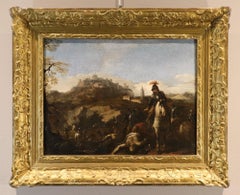
Materials

Oil

Shipping in Stormy Waters, Attributed to Italian Artist Francesco Guardi
By Francesco Guardi
Located in Stockholm, SE
The splendour of the tragic sea Francesco Guardi and maritime painting in Venetian art No Venetian painter was a stranger to the sea. After all, Venice was not only one of the most prominent ports of the Mediterranean, but indeed a city literally submerged in the ocean from time to time. Curiously however, the famous Venetian school of painting showed little interest in maritime motifs, favouring scenes from the iconic architecture of the city rather than seascapes. That is why this painting is a particularly interesting window into not only the painter Francesco Guardi himself – but to the significance of the element of water in art history, in absence as well as in the centre of attention. Whether it be calm, sunny days with stunning views of the palaces alongside the canals of Venice or – more rarely – stormy shipwrecking tragedies at sea, water as a unifying element is integral to the works of painter Francesco Guardi (1712–1793). During his lifetime, Venetian art saw many of its greatest triumphs with names like Tiepolo or Canaletto gaining international recognition and firmly establishing Venice as one of the most vibrant artistic communities of Europe. While the city itself already in the 18th century was something of an early tourist spot where aristocrats and high society visited on their grand tour or travels, the artists too contributed to the fame and their work spread the image of Venice as the city of romance and leisure to an international audience, many of whom could never visit in person. Still today, the iconic image of Venice with its whimsical array of palaces, churches and other historic buildings is much influenced by these artists, many of whom have stood the test of time like very well and remain some of the most beloved in all of art history. It was not primarily subtility, intellectual meanings or moral ideals that the Venetian art tried to capture; instead it was the sheer vibrancy of life and the fast-paced city with crumbling palaces and festive people that made this atmosphere so special. Of course, Venice could count painters in most genres among its residents, from portraiture to religious motifs, history painting and much else. Still, it is the Vedutas and views of the city that seems to have etched itself into our memory more than anything else, not least in the tradition of Canaletto who was perhaps the undisputed master of all Venetian painters. Born into his profession, Francesco lived and breathed painting all his life. His father, the painter Domenico Guardi (1678–1716) died when Francesco was just a small child, yet both he and his brothers Niccolò and Gian Antonio continued in their fathers’ footsteps. The Guardi family belonged to the nobility and originated from the mountainous area of Trentino, not far from the Alps. The brothers worked together on more challenging commissions and supported each other in the manner typical of family workshops or networks of artists. Their sister Maria Cecilia married no other than the artist Giovanni Battista Tiepolo himself, linking the family to the most renowned Venetian name of the time. During almost a decade, Guardi worked in the studio of Michele Giovanni Marieschi, sometimes simply known as Michiel, a painted similar in both style and motif. Canaletto is, however, the artist Guardi is most often compared to since they shared a mutual fascination for depicting the architecture and cityscape of Venice. During the course of his career, Guardi tried his hand in many different genres. He was as swift in painting landscapes, Vedutas of Venice, sacred motifs, interiors and architectural compositions as he was in a number of other motifs. His style is typical of the Venetian school but also distinct and personal once we look a little closer. There is an absolute certainty in the composition, the choice of which sometimes feels like that of a carefully calculated photograph – yet it is also very painterly, in the best sense of the word: fluid, bold, sensitive and full of character. The brushwork is rapid, intense, seemingly careless and extraordinarily minute at the same time; fresh and planned in a very enjoyable mixture. His interiors often capture the breath-taking spacious glamour of the palaces and all their exquisite decor. He usually constructed the motif through remarkably simple, almost spontaneous yet intuitively precise strokes and shapes. The result was a festive, high-spirited atmospheric quality, far away from the sterile and exact likeness that other painters fell victim to when trying to copy Canaletto. The painting here has nothing of the city of Venice in it. On the contrary, we seem to be transported far away into the solitary ocean, with no architecture, nothing to hold on to – only the roaring sea and the dangerous cliffs upon which the ships are just moments away from being crushed upon. It is a maritime composition evoking both Flemish and Italian precursors, in the proud tradition of maritime painting that for centuries formed a crucial part of our visual culture. This genre of painting is today curiously overlooked, compared to how esteemed and meaningful it was when our relationship to the sea was far more natural than it is today. When both people and goods travelled by water, and many nations and cities – Venice among them – depended entirely on sea fare, the existential connection to the ocean was much more natural and integrated into the imagination. The schools and traditions of maritime art are as manifold as there are countries connected to the sea, and all reflect the need to process the dangers and wonders of the ocean. It could symbolize opportunity, the exciting prospects of a new countries and adventures, prospering trade, beautiful scenery as well as war and tragedy, loss of life, danger and doom. To say that water is ambivalent in nature is an understatement, and these many layers were something that artists explored in the most wondrous ways. Perhaps it takes a bit more time for the modern eye to identify the different nuances and qualities of historic maritime paintings, they may on first impression seem hard to differentiate from each other. But when allowing these motifs to unfold and tell stories of the sea in both fiction and reality – or somewhere in between – we are awarded with an understanding of how the oceans truly built our world. In Guardi’s interpretation, we see an almost theatrically arranged shipwrecking scene. No less than five ships are depicted right in the moment of utter disaster. Caught in a violent storm, the waves have driven them to a shore of sharp cliffs and if not swallowed by the waves, crushing against the cliffs seems to be the only outcome. The large wooden ships are impressively decorated with elaborate sculpture, and in fact relics already during Guardi’s lifetime. They are in fact typical of Dutch and Flemish 17th century ships, giving us a clue to where he got the inspiration from. Guardi must have seen examples of Flemish maritime art, that made him curious about these particular motifs. One is reminded of Flemish painters like Willem van de Velde and Ludolf Backhuysen, and this very painting has indeed been mistakenly attributed to Matthieu van Plattenberg...
Category

18th Century Old Masters Art
Materials

Oil, Canvas

Peasants in a Cornfield (Boer in het veld) by David Teniers the Younger
By David Teniers the Younger
Located in Stockholm, SE
Remembering the magic of everyday life moments in the art of David Teniers: The art of David Teniers the Younger (1610–1690) coincided with the heyday of the Flemish Baroque and cap...
Category

Late 17th Century Old Masters Art

Materials

Canvas, Oil

Fine 18th Century French Old Master Ink Wash Drawing Cain & Abel Fighting
Located in Cirencester, Gloucestershire
'Cain et Abel' Circle of Franois Devosge (1732-1811) French pencil drawing with watercolour wash on paper size: 12.25 x 9 inches private collection, France The painting is in overall...
Category

18th Century Old Masters Art
Materials

Washi Paper, Color Pencil

Old Masters art for sale on 1stDibs.
Find a wide variety of authentic Old Masters art available for sale on 1stDibs. Works in this style were very popular during the 21st Century and Contemporary, but contemporary artists have continued to produce works inspired by this movement. If you’re looking to add art created in this style to introduce contrast in an otherwise neutral space in your home, the works available on 1stDibs include elements of orange, yellow, blue and other colors. Many Pop art paintings were created by popular artists on 1stDibs, including Charles Amand Durand, Giuseppe Vasi, Thomas Holloway, and Vincenzo Campana. Frequently made by artists working with Etching, and Paint and other materials, all of these pieces for sale are unique and have attracted attention over the years. Not every interior allows for large Old Masters art, so small editions measuring 0.4 inches across are also available. Prices for art made by famous or emerging artists can differ depending on medium, time period and other attributes. On 1stDibs, the price for these items starts at $11 and tops out at $1,495,000, while the average work sells for $546.
Still Thinking About These?

All Recently Viewed