Old Masters Art

OLD MASTERS

Encompassing centuries of change in Europe between 1300 and 1800, from booms of prosperity to bloody revolutions, Old Masters describes a wide range of artists. The informal term was derived from the title of an artist who trained in a guild long enough to become a master, such as Leonardo da Vinci, who studied in a Florence painters’ guild. However, Old Masters paintings, prints and other art is now used to refer to work made by any artist with a high level of skill in painting, drawing, sculpture or printmaking who worked during this era.

The 15th century’s expansive trade and commerce spread culture across borders. A vibrant period of art emerged, bolstered by studies of anatomy and nature that influenced a new visual realism. From Raphael and Michelangelo in the Renaissance to Rembrandt van Rijn and Johannes Vermeer in the Dutch Golden Age, artists expressed emotion, naturalism, color and light in new ways. El Greco and Paolo Veronese were leaders in the dramatic style of Mannerism, while Caravaggio and Peter Paul Rubens demonstrated the movement and meticulous detail of Baroque art.

Historically, most attention was concentrated on male artists, but recent research and exhibitions have elevated the impactful work of women such as Rachel Ruysch and Artemisia Gentileschi. In late-18th-century France, female artists like Adélaïde Labille-Guiard and Élisabeth Vigée Le Brun were prominent names. Nevertheless, access to the academies and guilds was highly restricted for women, and even those able to establish practices were expected to adhere to portraits and still lifes rather than the grand history paintings being created by men.

Find a collection of Old Masters prints, paintings, drawings and watercolors and other art on 1stDibs.

to
1,012
2,396
767
334
306
361
Overall Width
to
Overall Height
to
3,114
837
102
124
10
6
7
2
2
7
3
11
2
4
2,268
115,052
63,492
57,542
26,916
14,702
9,378
6,471
5,608
3,023
2,482
2,375
2,249
648
1,988
1,743
386
2,826
1,479
950
922
897
477
429
315
274
270
224
197
194
168
109
105
102
93
92
86
2,322
1,255
1,111
385
379
107
97
93
88
67
1,184
2,191
2,430
749
Style: Old Masters
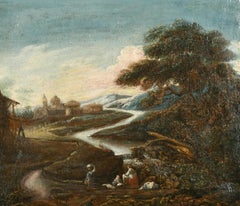
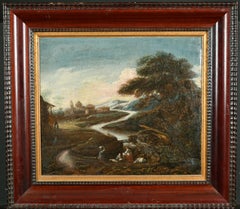
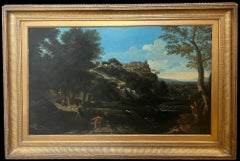
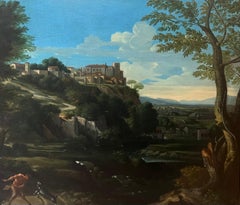
Manor House with Cottages - British 18thC Old Master art oil painting VG prov.
Located in Hagley, England
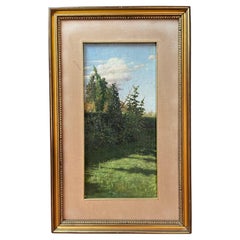
This stunning British Old Master landscape oil painting, with excellent provenance, is by George Lambert. Lambert was a pioneer of British landscape in art for its own sake. Painted in 1744, the painting is entitled View of a Manor House and Cottages in Elizabeth Einberg's 63rd volume of the Walpole Society 2001 and is described as follows: In the foreground a road emerges from a wood to cross a ford and then leads up the hill to the right, towards a manor house seemingly built into the remains of a medieval or Tudor edifice. The main track, crowded with sheep and rustic figures, passes the massive square gateposts lower down the hill on the left. Further to the left is a thatched cottage with smoke coming out the chimney. In the distance is a wide coastal view. The main buildings, which are in the dead centre of the composition, represent almost certainly an as yet unidentified English view. The colouring and detail in the trees and foliage are superb. This is an excellent Old Master oil painting by one of the all time great British landscape artists with extensive provenance. Signed and dated 1744 lower left on rock in black. Provenance. Elizabeth Einberg, “Catalogue Raisonnè of the works of George Lambert” The Annual Volume of the Walpole Society, 2001 Vol. 63, page 149 no P1744, fig.71. Antonacci Efrati Antichità Rome Gallery. Burden sale, Parke Bernet, New York, 20-21, April 1938 (376 repr.) Robert E. Peters, Sotheby Parke Bernet, New York, March 1975 (41 repr.) Lit. Schnackenburg 1995, pp 83-84, cat. no.14 fig 13. Condition. Oil on canvas, 54 inches by 52 inches and in good condition. Frame. Housed in an ornate gilt frame, 64 inches by 62 inches and in good condition. George Lambert (1700-1765) was an English landscape artist and theatre scene painter. With Richard Wilson he is recognised as a pioneer of British landscape in art, for its own sake. Lambert was born in Kent and studied art under Warner Hassells and John Wootton, soon attracting attention by the quality of his landscape painting. He painted many large and fine landscapes in the style of Gaspar Poussin and Salvator Rosa. Many of his landscapes were finely engraved by François Vivares, James Mason (1710–1785), and others, including a set of views of Plymouth and Mount Edgcumbe (painted conjointly with Samuel Scott), a view of Saltwood Castle in Kent, another of Dover, and a landscape presented to the Foundling Hospital in London. Lambert also obtained a great reputation as a scene-painter, working at first for the Lincoln's Inn Fields Theatre, in London, under John Rich. When Rich moved to Covent Garden Theatre, Lambert secured the assistance of Amigoni, and together they produced scenery of far higher quality than any previously executed. Lambert was a man of jovial temperament and shrewd wit, and frequently spent his evenings at work in his painting-loft at Covent Garden Theatre, to which men of note in the fashionable or theatrical world resorted to share his supper of a beef-steak, freshly cooked on the spot. Out of these meetings arose the well-known "Beefsteak Club" which long maintained a high social reputation. Most of Lambert's scene-paintings unfortunately perished when Covent Garden Theatre was destroyed by fire in 1808. Lambert was a friend of William Hogarth and a member of the jovial society that met at 'Old Slaughter's' Tavern in St Martin's Lane. In 1755 he was one of the committee of artists who proposed a royal academy of arts in London. He was a member of the Society of Artists of Great Britain, exhibited with them in 1761 and the three following years, and during the same period contributed to the Academy exhibitions. In 1765 he and other members seceded and formed the Incorporated Society of Artists of Great Britain, of which he was elected the first president. In conjunction with Samuel Scott, Lambert painted a series of Indian views for the old East India House in Leadenhall Street. He also etched two prints after Salvator Rosa. Lambert was associated in 1735 with George Vertue, Hogarth, and John Pine (engraver, 1660–1756) in obtaining a bill from parliament securing artists a copyright on their works. Lambert's portraits were painted by Thomas Hudson, John Vanderbank (engraved in mezzotint by John Faber the younger in 1727, and in line by H. Robinson and others), and Hogarth. Lambert's most famous painting is "A view of Box Hill, Surrey" (1733) which depicts a well-known beauty spot south of London. Hogarth considered Lambert a rival to the famous French landscape painter Claude Lorrain (1600–1682) with respect to his use of soft light to unify the scene in this painting. Though he never visited Italy he was inspired by the classical tradition of landscape painting. Lambert died on 30 November 1765 at his home on the Piazza in Covent Garden. His pupils included John Inigo Richards...
Category

Mid-18th Century Old Masters Art

Materials

Oil

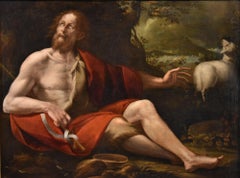
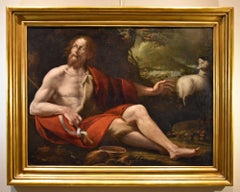
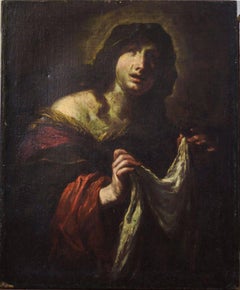
Saint John Baptist 16/17th Century Paint OIl on canvas Old master Tuscany school
Located in Riva del Garda, IT
Florentine painter, 16th-17th century Saint John the Baptist Oil on canvas 67 x 56 cm - In frame 98 x 83 cm In bringing out the sculptural figure of this young Saint John the...
Category

17th Century Old Masters Art

Materials

Oil

Saint Michael Angels Roman School 17/18th Century Paint Oil on canvas Old master
Located in Riva del Garda, IT
Saint Michael the Archangel expels the rebellious angels from paradise (probably a preparatory sketch) Roman school, 17th/18th century Oil on canvas 99 x 73 cm Framed 119 x 94 ...
Category

17th Century Old Masters Art

Materials

Oil

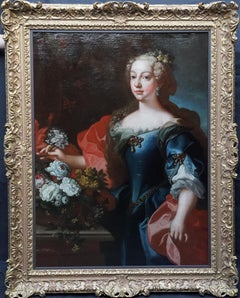
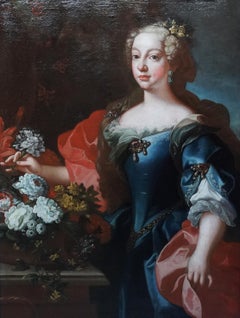
Portrait of Maria Vittoria Queen of Portugal - Italian Old Master oil painting
Located in Hagley, England
This lovely Italian Old Master portrait oil painting is by Domenico Maria Sani. Painted circa 1732 the sitter is of Maria Anna Vittoria (1718 - 1788), daughter of Philip V and Elisabetta Farnese, who in 1729 married Joseph prince of Brazil and king of Portugal...
Category

Mid-18th Century Old Masters Art

Materials

Oil

La Dune Christian Wilhelm Ernst Dietrich (cercle) 1712 - 1774
Located in GOUVIEUX, FR
Tableau ancien – Paysage nocturne animé Attribué au cercle de Christian Wilhelm Ernst Dietrich (1712–1774) Huile sur toile – Dimensions : 63 x 48 cm Cadre en bois doré d’époque, rich...
Category

Late 18th Century Old Masters Art

Materials

Oil

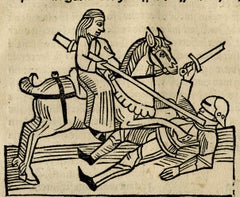
Mythological combat scene with Roman soldiers on horseback.
By Virgil Solis
Located in Middletown, NY
Pen and brownish black ink on grayish-cream laid paper, 6 1/2 x 8 inches (165 x 175 mm), irregular hexagonal sheet with margins. Some archival repairs along the top sheet edge, scatt...
Category

16th Century Old Masters Art

Materials

Ink, Laid Paper, Pen

1800's Italian Grand Tour Oil Painting Theseus Temple Athens in Landscape
Located in Cirencester, Gloucestershire
Theseus Temple, Athens early 1800's Italian artist oil on canvas laid over board, framed framed: 9 x 12.75 inches board: 6.75 x 10.75 inches provenance: private collection, UK condit...
Category

Early 19th Century Old Masters Art

Materials

Oil

Escuela española - Personajes - 100 x 80 cm.
Located in Sant Celoni, ES
La obra va firmada por el artista en la parte inferior (L. CABOT) y fechada del año 1983 Se presenta enmarcada la pintura (el marco presenta algunas leves faltas y signos de uso) E...
Category

1980s Old Masters Art

Materials

Oil

Pasquariello Truonno and Meo Squaquara - Etching by Jacques Callot - 1621/22
Located in Roma, IT
Etching on paper. A lively etching from Jacques Callot’s celebrated series Balli di Sfessania, depicting two grotesque comic figures engaged in an exaggerated dance or mock duel. Id...
Category

1620s Old Masters Art

Materials

Etching

Portrait Noble Man Ceresa Paint Oil on canvas Old master 17th Century Italy Art
Located in Riva del Garda, IT
Carlo Ceresa (San Giovanni Bianco 1609 - Bergamo 1679) attributable Full-length portrait of Giacomo Pesenti Oil on canvas (206 x 121 cm - in frame 212 x 133 cm.) This fascinating portrait, portraying a full-length gentleman and datable to the 17th century, illustrates the stylistic and compositional details typical of the pictorial production of the Lombardy area, Bergamo in particular. This reference is reflected in elements such as the natural light, the sober and austere setting and, above all, the subtle psychological characterisation of the face. We are inclined to identify the hand of portrait painter Carlo Ceresa, one of the most illustrious Bergamasque figure painters of the 17th century, capable of developing a style of intense realism and acute psychological investigation. In his works, and our portrait perfectly reflects his canons, an extraordinary naturalistic imprint, great realism and remarkable essentiality are evident. Those traits of severity, moral rigour and austerity typical of his portraiture find a perfect balance here: never courtly or rhetorical, his portraits are profoundly linked to the concept of counter-reform. Immortalising the main personalities of the time, he established himself as a point of reference for the Bergamasque aristocracy, from the Vertova to the Pesenti to the Secco Suardo. The subject of the portrait is Giacomo Pesenti, here immortalised life-size in a rigorous black suit, his left hand resting on a table, on which is placed the necessities for writing and a manuscript, and his right hand, with a sealed ring on his little finger, abandoned along his side while he holds his gloves. He wears a suit of incredible rigour, dressed as befits a man of his high social standing, while the sharp light focuses on his face, with an intensity that seems to be accentuated by the reflection of the white collar, with its sharp profile. For Ceresa, it is not the richness of the garment that gives value to the person portrayed, it is the need to give feeling and bring out the character of the person, and this he succeeds in marvellously, aided by his ability to capture the essence of the person and return it to us in painting through the face and light used as a strong expressive element. In fact, the image highlights that 'counter-reformed' composure typical of the portraiture of painters active in this area and era, adhering to a verism...
Category

17th Century Old Masters Art

Materials

Oil

Annunciation Tuscan School 17th Century Paint Oil on canvas Old master Religious
Located in Riva del Garda, IT
Tuscan school,17th century The Annunciation Oil on canvas 55 x 73 cm In antique lacquered frame 73 x 92 cm NB: The darker strip at the top of the canvas is the shadow of the ...
Category

17th Century Old Masters Art

Materials

Oil

Van Bloemen Landscape Rome Paint 17/18th Century Oil on canvas Old master Italy
Located in Riva del Garda, IT
Antichità Castelbarco SRLS is proud to present: Painting depicting "View of Rome with countryside scene with ancient ruins, with the Palatine from via dei Cerchi", work of high qual...
Category

17th Century Old Masters Art

Materials

Oil

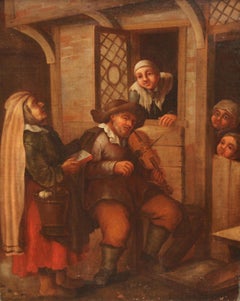
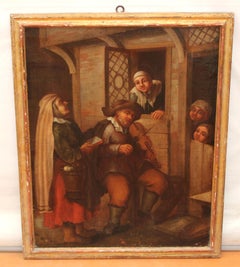
Singer by Candlelight (Dutch School Old Master Genre Scene)
Located in Wilton Manors, FL
Beautiful Dutch School painting dating from 17th century. Oil on wood panel measuring 10 3/8 x 14 7/16 inches. Unsigned. No inpainting or conservation. Depicted is a scene with a beautiful young woman singing...
Category

17th Century Old Masters Art

Materials

Oil, Wood Panel

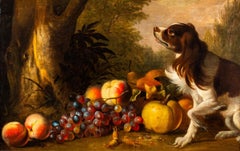
William Albert Clark, clumber spaniel, dog, oil painting.
By William Albert Clark
Located in York, GB
study of a seated clumber spaniel, oil on canvas, signed and dated 1929 lower left. Housed in a new gilt frame. Paintings of these beautiful dogs are...
Category

1920s Old Masters Art

Materials

Oil

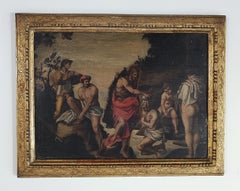
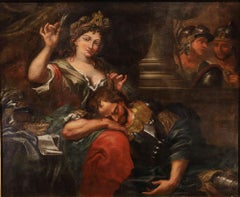
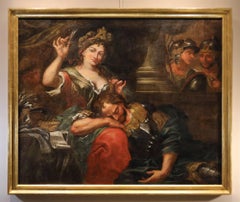
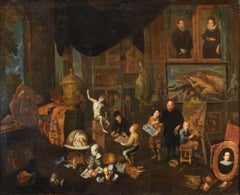
Animated biblical scene
Located in Genève, GE
Work on canvas Work re-lined Plaster and gilded wood frame 86 x 105 x 7 cm
Category

Late 18th Century Old Masters Art

Materials

Oil

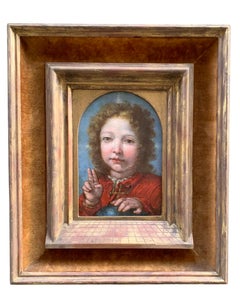
Animated biblical scene
$4,098 Sale Price
20% Off
Equestrian Portrait Florentine Painter 17/18th Century Paint Oil on canvas Italy
Located in Riva del Garda, IT
Florentine painter, 17th-18th century Equestrian portrait of Pietro Strozzi (Florence, 1511 - Thionville, 1558) Oil on canvas 79 x 115 cm. - Framed cm. 92 x 127 A valiant knight, p...
Category

17th Century Old Masters Art

Materials

Oil

Correccion - Etching and Aquatint by Francisco Goya - 1868
Located in Roma, IT
Correccion is an original artwork realized by Francisco Goya and published for the first time in 1799. Etching on wove paper. This artwork belongs to the Third Edition published in...
Category

1860s Old Masters Art

Materials

Etching, Aquatint

Four Framed Hogarth Engravings "Four Times of the Day"
Located in Alamo, CA
The four plates in this "Four Times of the Day" set were created utilizing both engraving and etching techniques by William Hogarth in 1738. Hogarth's original copper plates were refurbished where needed by James Heath and these engravings were republished in London in 1822 by Braddock, Cradock & Joy. This was the last time Hogarth's original copper plates were used for printing. Most were melted down during World War I for the construction of bombs. Printed upon early nineteenth century wove paper and with large, full margins as published by William Heath in 1822. The inscription below each print reads "Invented Painted & Engraved by Wm. Hogarth & Publish'd March 25. 1738 according to Act of Parliament". These large folio sized "Four Times of the Day" engravings/etchings are presented in complex gold-colored wood frames with black bands and scalloped gold inner trim. A majority of each thick impressive frame is covered with glass applied near the outer edge. Each frame measures 25.75" high, 22.25" wide and 1.88" deep. There are a few small dents in the edge of these frames, which are otherwise in very good condition. "Morning" has two focal areas of discoloration in the upper margin and some discoloration in the right margin, a short tear in the left margin and a short tear or crease in the right margin. "Noon" has a spot in the upper margin that extends into the upper image, but it is otherwise in very good condition. "Evening" has a faint spot in the upper margin, but it is otherwise in very good condition. "Night" is in excellent condition. The "Four Times of the Day" series is in the collection of many major museums, including: The British Museum, The Metropolitan Museum of Art, The Tate Museum, The Chicago Art Institute and The Victoria and Albert Museum. Through this series Hogarth is portraying early 18th century London street life at "Four Times of the Day". His characters are exhibiting their personalities, quircks, strange activities, but he also wants to draw attention the disparities between the wealthy aristocracy and the common working class. Plate 1, "Morning" depicts morning in Covent Garden in the winter in front of Tom King...
Category

Mid-18th Century Old Masters Art

Materials

Engraving, Etching

View Venice Landscape Tironi 18th Century Paint Oil on canvas Old master Italy
Located in Riva del Garda, IT
Francesco Tironi (Venice, circa 1745 - 1797) View of Venice with the entrance to Cannaregio oil on canvas 59 x 75 cm with frame 72 x 88 cm Work accompanied by a descriptive n...
Category

18th Century Old Masters Art

Materials

Oil

Portrait Man Pourbus 16/17th Century Paint Oil on canvas Old master Flemish
Located in Riva del Garda, IT
Frans Pourbus (Bruges, 1545 - Antwerp, 1581) circle Portrait of a gentleman in Renaissance dress with a black doublet and ruff Late 16th century Oil on canvas 46 x 32 cm. - 65 x 53...
Category

16th Century Old Masters Art

Materials

Oil

Madonna Correggio Paint Oil on table 16th Century Old master Italian Religious
Located in Riva del Garda, IT
School of Antonio Allegri, known as Correggio (Correggio c. 1489 - 1534) Attributable to Pomponio Allegri (Correggio, 1522 - Parma, 1593) Madonna and Child, Two Angels and John the B...
Category

16th Century Old Masters Art

Materials

Oil

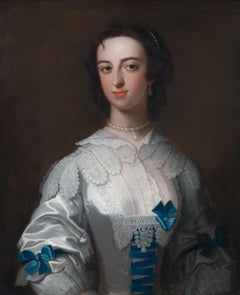
Portrait of Mary Hooper née Davie, Blue Dress, Seated in a Parkland, Provenance
By Jonathan Richardson the Elder
Located in London, GB
Portrait of Mary Hooper (née Davie) in a Blue Dress & Seated in a Parkland c. 1715–1725 Jonathan Richardson the Elder (1667–1745) This portrait, presented by Titan Fine Art, is of p...
Category

18th Century Old Masters Art

Materials

Canvas, Oil

Studies of a kneeling female figure, an arm, a hand, and a head in profile
Located in Paris, Île-de-France
Studio of Carlo Maratti (or Maratta) Camerano 1625 – Rome 1713 Studies of a kneeling female figure, an arm, a hand, and a head in profile Red chalk on paper 43.4 x 26.6 cm Unsigne...
Category

Late 17th Century Old Masters Art

Materials

Chalk

Fine 18th Century Italianate Landscape Garden Classical Ornaments and Figures
Located in Cirencester, Gloucestershire
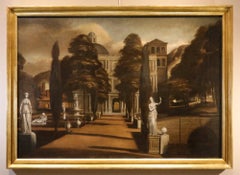
Italianate landscape garden with classical ornament, including Giambologna's Sabine women and a classical urn, view to a bay beyond Coplestone War...
Category

Mid-18th Century Old Masters Art

Materials

Oil

Large Antique Oil Still Life with Hunting Dogs & Game Classic Sporting Scene
Located in Cirencester, Gloucestershire
Italian artist, 19th century Still Life with Hunting Dogs indistinctly signed oil on canvas, unframed Canvas: 14.25 x 24 inches Provenance: private collection, UK Condition: very goo...
Category

19th Century Old Masters Art

Materials

Oil

Northern Italy: A 16th Century Hand-colored Map by Abraham Ortelius
Located in Alamo, CA
This is a framed 16th century hand-colored copperplate map of northern Italy entitled "Veronae Urbis Territorium a Bernardo Bragnolo Descriptium" by Abraham Ortelius from his atlas "Theatrum Orbis Terrarum", which was the first modern atlas of the world, with the first volume published in 1570. This map was part of a subsequent volume, published in Antwerp in 1584. It was based on an earlier map by Bernardo Brognoli. This beautiful map of northern Italy is focussed on Verona and its environs, including Mantua. Lake Garda and the South Tyrol mountains are prominently depicted. There is a very large striking cartouche in the upper left and a decorative distance scale in the lower right. This striking hand-colored map of northern Italy is presented in a gold-colored wood frame and an olive green-colored mat. It is glazed with UV conservation glass. All mounting materials used are archival. The frame measures 21.5" high by 28" wide by 0.75" deep. There is a central vertical fold, as issued, with slight separation of the lower portion of the fold. There are faint spots in the upper and right margins, but the map is otherwise in very good condition. Abraham Ortelius (also known as Ortels, Orthellius, and Wortels) (1527-1598) was a Dutch cartographer, geographer, and cosmographer. He began his career as a map colorist. In 1547 he entered the Antwerp guild of St Luke as an "illuminator of maps". He had an affinity for business from an early age and most of his journeys before 1560, were for business. He was a dealer in antiques, coins, maps, and books. 
His business income allowed him to acquire an extensive collection of medals, coins, and antiques, as well as a large library of books...
Category

16th Century Old Masters Art

Materials

Engraving

Interno della Basilica della Fortuna Prenestina - by L. Rossini - 1826
Located in Roma, IT
Interno della Basilica della Fortuna Prenestina Image dimensions: 40x53 cm. From the collection “Le antichità de’ contorni di Roma (...)”, published in Rome, 1826 an artist's proof w...
Category

1820s Old Masters Art

Materials

Etching

Escuela española (XIX) - La sagrada familia
Located in Sant Celoni, ES
La obra no va firmada Se presenta sin enmarcar la obra El estado de la pintura es aceptable Medidas de la obra: 117 cm. de altura x 88 cm. de ancho
Category

Mid-19th Century Old Masters Art

Materials

Oil

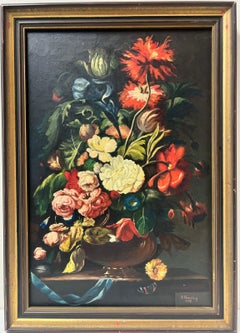
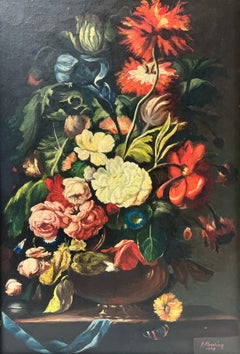
Still Life of Flowers in vase on Ledge - Dutch 17thC Old Master art oil painting
Located in Hagley, England
This stunning 17th century Dutch Old Master Golden Age floral oil painting is by noted Dutch artist Simon Pietersz Verelst. The full attribution...
Category

1670s Old Masters Art

Materials

Oil

Portrait of Lady, Barbara Herbert, Countess of Pembroke c.1708, Large Painting
Located in London, GB
Portrait of Barbara Herbert, Countess of Pembroke c.1708 Charles d’Agar (1669-1723) This magnificent large-scale portrait, presented by Titan Fine Art, depicts the British court of...
Category

17th Century Old Masters Art

Materials

Cotton Canvas, Oil

Paint Oil on canvas 17th Century Italy Mediterranean Landscapes Marina Flandre
Located in Riva del Garda, IT
We present this pair of fascinating coastal views, the fruit of the author's imagination, executed with an elegant descriptive taste and conceived with the scenographic sensitivity typical of the Flemish landscape tradition of the late seventeenth century. The canvases, in particular, fully reflect the pictorial style of the Flemish Peter van den Velde the Elder (Antwerp 1634-1707), a famous painter specialized in marine views with port cities and fortresses. Pair of paintings with fancy coastal views Circle of Peter Van de Velde the Elder (Antwerp 1634 -1714) Oil on canvas, cm. 43 x 64 With framens cm. 70 x 89 They respectively represent a port city and a fortress perched overlooking the sea, both animated small characters, which at first sight evoke the coasts of the Mediterranean, even if the mixes with Northern European elements are inevitable, including a small mill...
Category

17th Century Old Masters Art

Materials

Oil

19thC. Figures Hunting Classical Ruins Mountainous Sunset Landscape North Africa
Located in Cirencester, Gloucestershire
Continental, 19th Century oil on canvas, framed Monogrammed 'WM' and dated '1868' lower right framed: 34 x 48.5 inches canvas : 29.5 x 44 inches Provenance: private collection, UK Co...
Category

19th Century Old Masters Art

Materials

Oil

Study of a Seated Satyr, Seen from Behind
Located in Paris, Île-de-France
Domenico Maria Canuti (1625–1684) Study of a Seated Satyr, Seen from Behind Red chalk on laid paper with watermark 39 × 26 cm Unsigned Provenance: Private Collection, France Note...
Category

Late 17th Century Old Masters Art

Materials

Chalk

Pair Landscape Horses Duplessis Paint Oil on table 18th Century Old master
Located in Riva del Garda, IT
Claude Michel Hamon Duplessis (active in Versailles from 1791 to 1799) Signed one lower right, the other lower left “M. h. Duplessis” Pair of paintings ...
Category

18th Century Old Masters Art

Materials

Oil

Bermuda: An Early 17th Century Hand-colored Map by Henricus Hondius
By Henricus Hondius
Located in Alamo, CA
This attractive and interesting map of Bermuda by Henricus Hondius in 1633 is entitled "Mappa Aestivarum Insularum, Alias Barmudas". It is based on a ...
Category

Early 17th Century Old Masters Art

Materials

Engraving

'Prime Minister' with jockey John Shepherd up, and owner Sir Mark Sykes
By Henry Bernard Chalon
Located in Stoke, Hampshire
Henry Bernard Chalon (London 1770-1849) 'Prime Minister' with jockey John Shepherd up, and owner Sir Mark Sykes Signed and dated 'H.B. Chalon pinxit 181...
Category

Early 19th Century Old Masters Art

Materials

Oil

Elegant Georgian Young Ladies Woodland Park Antique English Oil Painting
Located in Cirencester, Gloucestershire
'Morning Amusement' English School, circa 1800's after the painting by Sir Joshua Reynolds, British 1723-1792 oil painting on canvas, unframed please...
Category

Early 19th Century Old Masters Art

Materials

Oil

Fine 19th Century French Oil Painting Classical Roman Figures Interior Scene
Located in Cirencester, Gloucestershire
Attributed to Antoine Felix Boisselier (19th Century) French (unsigned) 'Classical figures in a bed chamber Medium: oil on canvas, with inscription verso S...
Category

19th Century Old Masters Art

Materials

Oil

Portrait of a Gentleman in a Red Coat and Periwig, c.1715-1725; Godfrey Kneller
Located in London, GB
Portrait of a Gentleman in a Red Coat and Periwig, c.1715-1725 Studio of Sir Godfrey Kneller (1646–1723) This portrait of a gentleman, presented by Titan Fine Art, is a fine and wel...
Category

18th Century Old Masters Art

Materials

Canvas, Oil

Sir Charles Frederick
Located in London, GB
Oil on canvas 50 x 40 inches; 127 x 101.6 cm Framed dimensions: 151.5 x 127 cm Inscribed on plinth: ‘VOTIS X ET XX’ Not signed Painted c.1748 Collections: Christie’s London, 23rd December 1954, lot.272; J. Singer; Somerville & Simpson Ltd, London, by 1985; The Matthiesen Gallery, London; Richard Feigen, New York; Matthew Rutenberg, New York to 2019; Lowell Libson and Jonny Yarker Ltd. Literature: Stella Rudolph, La Pittura del’ 700 a Roma, Milan, 1983, reproduced pl.133; Jacob Simon, Handel, a celebration of his life and times 1685-1759, exh. cat. London, (National Portrait Gallery), 1985, no.196; Catherine Whistler, Baroque & Later Paintings in the Ashmolean Museum, London, 2016, pp.102-105, reproduced p.104 Exhibited: London, National Portrait Gallery, Handel, a celebration of his life and times 1685-1759, 1985-86, no.196, reproduced p.198 This powerful portrait of the antiquarian and courtier Sir Charles Frederick was completed in 1748 by the Roman painter Andrea Casali. Frederick, as comptroller of the royal laboratory, one of the ‘great officers’ of the Board of Ordinance at Woolwich, had just been responsible for the famed pyrotechnic display celebrating the Peace of Aix-la-Chapelle: the so-called ‘Royal Fireworks’ for which George Frederick Handel composed music. Casali’s portrait pays tribute to Frederick’s role as comptroller of the royal laboratory, showing him with a firing diagram and mortar, it also points to Frederick’s interests as an antiquarian with the inclusion of antique relief. Casali had first met Frederick in Rome in 1738, where he had painted his portrait, Frederick subsequently encouraged Casali to travel to London. This probably accounts for the unusual format; rather than a modern man of science, Casali casts Frederick as an alchemist bent on some mystic discovery, as such, it is one of the most unusual portraits of the period. Andrea Casali was a pupil of Sebastiano Conca and then of Francesco Trevisani, who recommended him to the Spanish court in 1736. He enjoyed some success in Rome as a painter of frescoes and altarpieces, notably a large cycle of Scenes from the Life of St Dominic at the cloister of S. Sisto Vecchio, for which he was made a Knight of the Golden Spur in 1729. Casali began painting Grand Tourist portraits in Rome around 1738. His first portrait of Sir Charles Frederick is dated that year Ashmolean Museum, Oxford), it casts Frederick as a focused scholar, showing him seated at an elaborately carved console table, hard at work. In common with other Grand Tour portraiture of the period, Casali includes a famous Roman landmark in the background, in this case the façade of the Pantheon. Horace Walpole noted that it was thanks to the encouragement of ‘Mr Frederick and his Friends at Rome’ that Casali travelled to London in 1741. Charles Frederick was a fascinating Augustan polymath. Born at Fort St George, Madras, where his father, Sir Thomas Frederick, was governor, he successively matriculated at New College, Oxford (1725), was called to the Middle Temple (1728), became a Fellow of the Royal Society (1731) and Director of the Society of Antiquaries (1735). His interests were wide ranging. Frederick was an amateur architect, he designed the monument to Lucy, Lady Lyttleton, in Hagley Church and the monument to Thomas Miller, bishop of Waterford, in Highclere church, Hampshire. He was a numismatist and collector of antiquities, as well as an amateur scientist. It was in the last capacity that he was appointed comptroller of the royal laboratory at Woolwich and clerk of the deliveries in 1746, this was the most junior of the ‘great officers’ who made up the membership of the royal Board of Ordnance. This appointment came through the good offices of the master-general of the Ordnance, a fellow antiquarian, John, 2nd Duke of Montagu. As comptroller, Frederick was responsible for the fireworks celebration of the treaty of Aix-la-Chapelle, for which Handel composed his celebrated music. As Horace Walpole wrote to his cousin, Henry Seymour Conway: ‘Charles Frederick has turned all his virtu into fireworks, and, by his influence with the Ordnance has prepared such a spectacle for the proclamation of Peace as is to surpass all its predecessors of bouncing memory. It is to open with a concert of fifteen hundred hands, and conclude with so many thousand crackers all set to music, that all the men killed in the war are to be wakened with a crash, as if it was the day of judgement, and fall a-dancing, like the troops in the Rehearsal. I wish you could see him making squibs of his papillotes, and bronzed over with a patina of gunpowder, and talking himself still hoarser on the superiority that his fireworks will have over the Roman naumachia.’ Performed in Green Park, the fireworks were mounted on a temporary structure designed by the architect Giovanni Niccolò Servandoni decorated by Adrea Soldi and Casali. Casali’s second portrait of Frederick was completed following the success of the firework display. In this remarkable image, we discover Frederick at work, dressed in almost monastic garb, pouring over an impossibly large tome propped on an antique altar. The altar is identifiable as a Roman relief depicting Victory writing on a shield, the original is at Villa Medici in Rome, but was engraved by Pietro Santi Bartoli...
Category

18th Century Old Masters Art

Materials

Canvas, Oil

Antique Sculpture Female Moor Venice 19th Century Gold Italy
Located in Riva del Garda, IT
Antique sculpture of a female Moor with flowering cornucopia Venice, 19th century Carved, lacquered and gilded/silvered wood Total height 202 cm (column base 82 cm, figure 120 cm) ...
Category

19th Century Old Masters Art

Materials

Gold

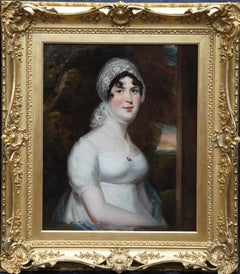
Fine 18th Century British Portrait of an Aristocratic Lady, Large oil painting
Located in Cirencester, Gloucestershire
Circle of Thomas Hudson (1701-1779) British. 18th Century Bust Portrait of a Lady, Oil on Canvas, Inscribed on a label verso, canvas: 30" x 25" (76.2 x 63.5cm). frame: 30 x 25 in...
Category

Mid-18th Century Old Masters Art

Materials

Canvas, Oil

The Pump House, Notre Dame, Paris
Located in Plano, TX
La Pompe Notre Dame. (The Pumphouse, Notre Dame). Schneiderman catalog 26.x. 1861. Etching. Image 6 3/4 x 10. Edition of 30 in this state. Series: Eaux-Fortes sur Paris . Initial...
Category

Mid-19th Century Old Masters Art

Materials

Etching

Portrait of a Bewigged Gentleman, Oil on Canvas, Early 18th Century
Located in St. Albans, GB
Enoch Seeman Canvas Size: 30 x 25" (76 x 62cm) Outside Frame Size: 37 x 32" (92 x 80cm) 1694-1744 He was born in Danzig, now Gdansk, Poland, around 1694. His father, also Enoch...
Category

Early 18th Century Old Masters Art

Materials

Oil

Cap. Cardoni and Maramao - Etching by Jacques Callot - 1621/22
Located in Roma, IT
This etching is part of Balli di Sfessania, Jacques Callot’s celebrated series depicting grotesque dancers inspired by the Neapolitan commedia dell’arte tradition. The figures Capita...
Category

1620s Old Masters Art

Materials

Etching

Landscape With Pan and Syrinx, Flemish School From the 1600s, Oil on Copper
Located in Stockholm, SE
Flemish School, 1600s Landscape With Pan and Syrinx painted around the 1600s oil on copper 19 x 23.5 cm frame 29 x 34 cm Hand-made oak frame by Swedish frame maker Christer Björkma...
Category

17th Century Old Masters Art

Materials

Copper

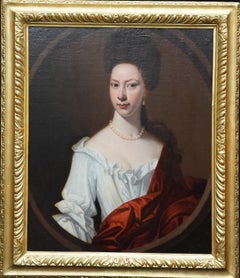
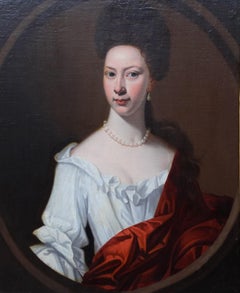
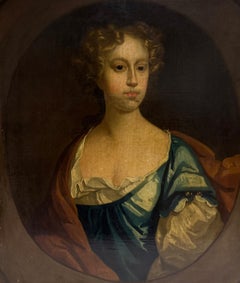
Fine 18th Century English Aristocratic Portrait of a Lady Oval Canvas Gilt Frame
Located in Cirencester, Gloucestershire
Artist/ School: English School, circa 1740's Title: Portrait of a Lady, traditionally identified as 'Anne of Chesterfield'. Medium: oil painting on canvas, framed Size: painting: ...
Category

Early 18th Century Old Masters Art

Materials

Canvas, Oil

Still Life Animals Fruit De Gryef Signed Paint 17th Century Oil on canvad Art
Located in Riva del Garda, IT
Adriaen de Gryef (Leiden 1657 - Brussels 1722) Signed ‘A Gryeff f’(ecit) - centre left Peasant in the courtyard with still life of animals and fruit Oil on canvas Dimensions (cm): ...
Category

17th Century Old Masters Art

Materials

Oil

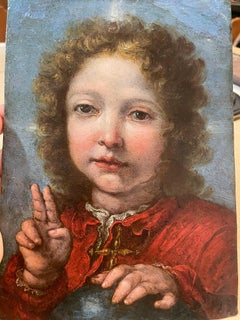
CHILD - Alfonso Grassi Pastel on paper Portrait italian Painting
Located in Napoli, IT
CHILD - Pastel on paper cm.51x41 signed lower right by Alfonso Grassi, Italy. Wooden frame with passeportout cm.94x73
Category

Late 20th Century Old Masters Art

Materials

Paper, Pastel

Period Marine Landscape Credited to Warren Sheppard
Located in Roma, IT
This beautiful painting, due to its very high quality of execution, style and era, can be referred to the great artist Warren Sheppard, who specialized in seascapes. Of great evocati...
Category

19th Century Old Masters Art

Materials

Oil, Canvas

17th-Century Flemish School, Portrait Of A Gentleman In A Justaucorps, Oil
Located in Cheltenham, GB
This fine late 17th-century Flemish portrait depicts a distinguished gentleman dressed in the elaborate fashions of the 1670s. He wears a long, collarless coat known as a justaucorps...
Category

1670s Old Masters Art

Materials

Canvas, Oil

Fishing at Dawn Old Trading Port with Many Figures Large Oil Painting
Located in Cirencester, Gloucestershire
Fishing at Dawn English artist after an earlier work (see inscription verso) signed oil painting on canvas, framed inscribed verso framed: 23 x 31 inches canvas: 18 x 26inches proven...
Category

Late 20th Century Old Masters Art

Materials

Canvas, Oil

18th Century Old Master pencil study of cows by French artist Jean Baptiste Huet
Located in Petworth, West Sussex
A rare and charming study of cows by 18th Century French painter, engraver and designer Jean-Baptiste Huet. The details are: Jean Baptiste Huet (French, 1745 – 1811) Study of cows P...
Category

18th Century Old Masters Art

Materials

Pencil

Fine 17th Century Flemish Old Master Oil Painting Travellers Country Landscape
Located in Cirencester, Gloucestershire
Travellers in a Country Landscape circle of Jacques d'Arthois (Flemish 1613-1686) oil on canvas, framed frame: 13.5 x 18.5 inches canvas: 11 x 16 inches provenance: private collectio...
Category

17th Century Old Masters Art

Materials

Oil

Freshwater fish, an eel and a frog, on a table
Located in Stoke, Hampshire
Isaac Van Duynen (Dordrecht 1628-1679 The Hague) Freshwater fish, an eel and a frog, on a table Oil on canvas Canvas size 37 x 51 in Framed size 44 x 58 in Provenance with Simon Dic...
Category

17th Century Old Masters Art

Materials

Oil

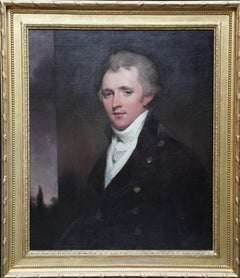
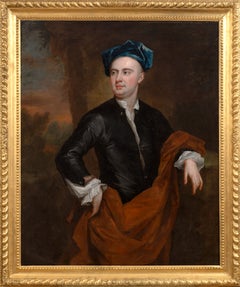
Old Master Portrait of a Gentleman - British 18th century oil painting
By Michael Dahl
Located in Hagley, England
This stunning 18th century Old Master portrait oil painting is attributed to Swedish born, England based artist Michael Dahl. Painted circa 1690 it is a sumptuous half length portrai...
Category

17th Century Old Masters Art

Materials

Oil

The Lady in the Park, Oil on Canvas Signed Arnaldo De Lisio
Located in Napoli, IT
Oil painting on canvas, framed in a rich gilt frame decorated with acanthus leaf motifs. The work depicts an elegantly dressed female figure, portrayed in profile in a lush formal ga...
Category

1910s Old Masters Art

Materials

Oil

Antique French Miniature Portrait of Lady Biographical details with painting
Located in Cirencester, Gloucestershire
Miniature Portrait French School, late 18th/ early 19th century framed: 5.5 x 5.5 inches board: 2 x 2 inches provenance: private collection, France condition: very good and sound c...
Category

Late 18th Century Old Masters Art

Materials

Watercolor

Shipping in Stormy Waters, Attributed to Italian Artist Francesco Guardi
By Francesco Guardi
Located in Stockholm, SE
The splendour of the tragic sea Francesco Guardi and maritime painting in Venetian art No Venetian painter was a stranger to the sea. After all, Venice was not only one of the most prominent ports of the Mediterranean, but indeed a city literally submerged in the ocean from time to time. Curiously however, the famous Venetian school of painting showed little interest in maritime motifs, favouring scenes from the iconic architecture of the city rather than seascapes. That is why this painting is a particularly interesting window into not only the painter Francesco Guardi himself – but to the significance of the element of water in art history, in absence as well as in the centre of attention. Whether it be calm, sunny days with stunning views of the palaces alongside the canals of Venice or – more rarely – stormy shipwrecking tragedies at sea, water as a unifying element is integral to the works of painter Francesco Guardi (1712–1793). During his lifetime, Venetian art saw many of its greatest triumphs with names like Tiepolo or Canaletto gaining international recognition and firmly establishing Venice as one of the most vibrant artistic communities of Europe. While the city itself already in the 18th century was something of an early tourist spot where aristocrats and high society visited on their grand tour or travels, the artists too contributed to the fame and their work spread the image of Venice as the city of romance and leisure to an international audience, many of whom could never visit in person. Still today, the iconic image of Venice with its whimsical array of palaces, churches and other historic buildings is much influenced by these artists, many of whom have stood the test of time like very well and remain some of the most beloved in all of art history. It was not primarily subtility, intellectual meanings or moral ideals that the Venetian art tried to capture; instead it was the sheer vibrancy of life and the fast-paced city with crumbling palaces and festive people that made this atmosphere so special. Of course, Venice could count painters in most genres among its residents, from portraiture to religious motifs, history painting and much else. Still, it is the Vedutas and views of the city that seems to have etched itself into our memory more than anything else, not least in the tradition of Canaletto who was perhaps the undisputed master of all Venetian painters. Born into his profession, Francesco lived and breathed painting all his life. His father, the painter Domenico Guardi (1678–1716) died when Francesco was just a small child, yet both he and his brothers Niccolò and Gian Antonio continued in their fathers’ footsteps. The Guardi family belonged to the nobility and originated from the mountainous area of Trentino, not far from the Alps. The brothers worked together on more challenging commissions and supported each other in the manner typical of family workshops or networks of artists. Their sister Maria Cecilia married no other than the artist Giovanni Battista Tiepolo himself, linking the family to the most renowned Venetian name of the time. During almost a decade, Guardi worked in the studio of Michele Giovanni Marieschi, sometimes simply known as Michiel, a painted similar in both style and motif. Canaletto is, however, the artist Guardi is most often compared to since they shared a mutual fascination for depicting the architecture and cityscape of Venice. During the course of his career, Guardi tried his hand in many different genres. He was as swift in painting landscapes, Vedutas of Venice, sacred motifs, interiors and architectural compositions as he was in a number of other motifs. His style is typical of the Venetian school but also distinct and personal once we look a little closer. There is an absolute certainty in the composition, the choice of which sometimes feels like that of a carefully calculated photograph – yet it is also very painterly, in the best sense of the word: fluid, bold, sensitive and full of character. The brushwork is rapid, intense, seemingly careless and extraordinarily minute at the same time; fresh and planned in a very enjoyable mixture. His interiors often capture the breath-taking spacious glamour of the palaces and all their exquisite decor. He usually constructed the motif through remarkably simple, almost spontaneous yet intuitively precise strokes and shapes. The result was a festive, high-spirited atmospheric quality, far away from the sterile and exact likeness that other painters fell victim to when trying to copy Canaletto. The painting here has nothing of the city of Venice in it. On the contrary, we seem to be transported far away into the solitary ocean, with no architecture, nothing to hold on to – only the roaring sea and the dangerous cliffs upon which the ships are just moments away from being crushed upon. It is a maritime composition evoking both Flemish and Italian precursors, in the proud tradition of maritime painting that for centuries formed a crucial part of our visual culture. This genre of painting is today curiously overlooked, compared to how esteemed and meaningful it was when our relationship to the sea was far more natural than it is today. When both people and goods travelled by water, and many nations and cities – Venice among them – depended entirely on sea fare, the existential connection to the ocean was much more natural and integrated into the imagination. The schools and traditions of maritime art are as manifold as there are countries connected to the sea, and all reflect the need to process the dangers and wonders of the ocean. It could symbolize opportunity, the exciting prospects of a new countries and adventures, prospering trade, beautiful scenery as well as war and tragedy, loss of life, danger and doom. To say that water is ambivalent in nature is an understatement, and these many layers were something that artists explored in the most wondrous ways. Perhaps it takes a bit more time for the modern eye to identify the different nuances and qualities of historic maritime paintings, they may on first impression seem hard to differentiate from each other. But when allowing these motifs to unfold and tell stories of the sea in both fiction and reality – or somewhere in between – we are awarded with an understanding of how the oceans truly built our world. In Guardi’s interpretation, we see an almost theatrically arranged shipwrecking scene. No less than five ships are depicted right in the moment of utter disaster. Caught in a violent storm, the waves have driven them to a shore of sharp cliffs and if not swallowed by the waves, crushing against the cliffs seems to be the only outcome. The large wooden ships are impressively decorated with elaborate sculpture, and in fact relics already during Guardi’s lifetime. They are in fact typical of Dutch and Flemish 17th century ships, giving us a clue to where he got the inspiration from. Guardi must have seen examples of Flemish maritime art, that made him curious about these particular motifs. One is reminded of Flemish painters like Willem van de Velde and Ludolf Backhuysen, and this very painting has indeed been mistakenly attributed to Matthieu van Plattenberg...
Category

18th Century Old Masters Art

Materials

Canvas, Oil

The Triumph of Constantine the Great
Located in Chicago, IL
Inscribed on the verso: EE 27/10
Category

16th Century Old Masters Art

Materials

Chalk, Ink, Pen

Old Masters art for sale on 1stDibs.

Find a wide variety of authentic Old Masters art available for sale on 1stDibs. Works in this style were very popular during the 21st Century and Contemporary, but contemporary artists have continued to produce works inspired by this movement. If you’re looking to add art created in this style to introduce contrast in an otherwise neutral space in your home, the works available on 1stDibs include elements of orange, yellow, blue and other colors. Many Pop art paintings were created by popular artists on 1stDibs, including Charles Amand Durand, Giuseppe Vasi, Thomas Holloway, and Vincenzo Campana. Frequently made by artists working with Etching, and Paint and other materials, all of these pieces for sale are unique and have attracted attention over the years. Not every interior allows for large Old Masters art, so small editions measuring 0.4 inches across are also available. Prices for art made by famous or emerging artists can differ depending on medium, time period and other attributes. On 1stDibs, the price for these items starts at $11 and tops out at $1,495,000, while the average work sells for $546.