Items Similar to Two Arcadic Landscapes - J.F. Van Bloemen (follower of) - Oil on Canvas
Want more images or videos?
Request additional images or videos from the seller
1 of 8
Jan Frans van Bloemen (Orizzonte)Two Arcadic Landscapes - J.F. Van Bloemen (follower of) - Oil on Canvas18th Century
18th Century
$19,768.79
£14,501.38
€16,500
CA$26,985.88
A$30,353.14
CHF 15,743.51
MX$368,205.65
NOK 199,618.37
SEK 187,852.06
DKK 125,556.60
Shipping
Retrieving quote...The 1stDibs Promise:
Authenticity Guarantee,
Money-Back Guarantee,
24-Hour Cancellation
About the Item
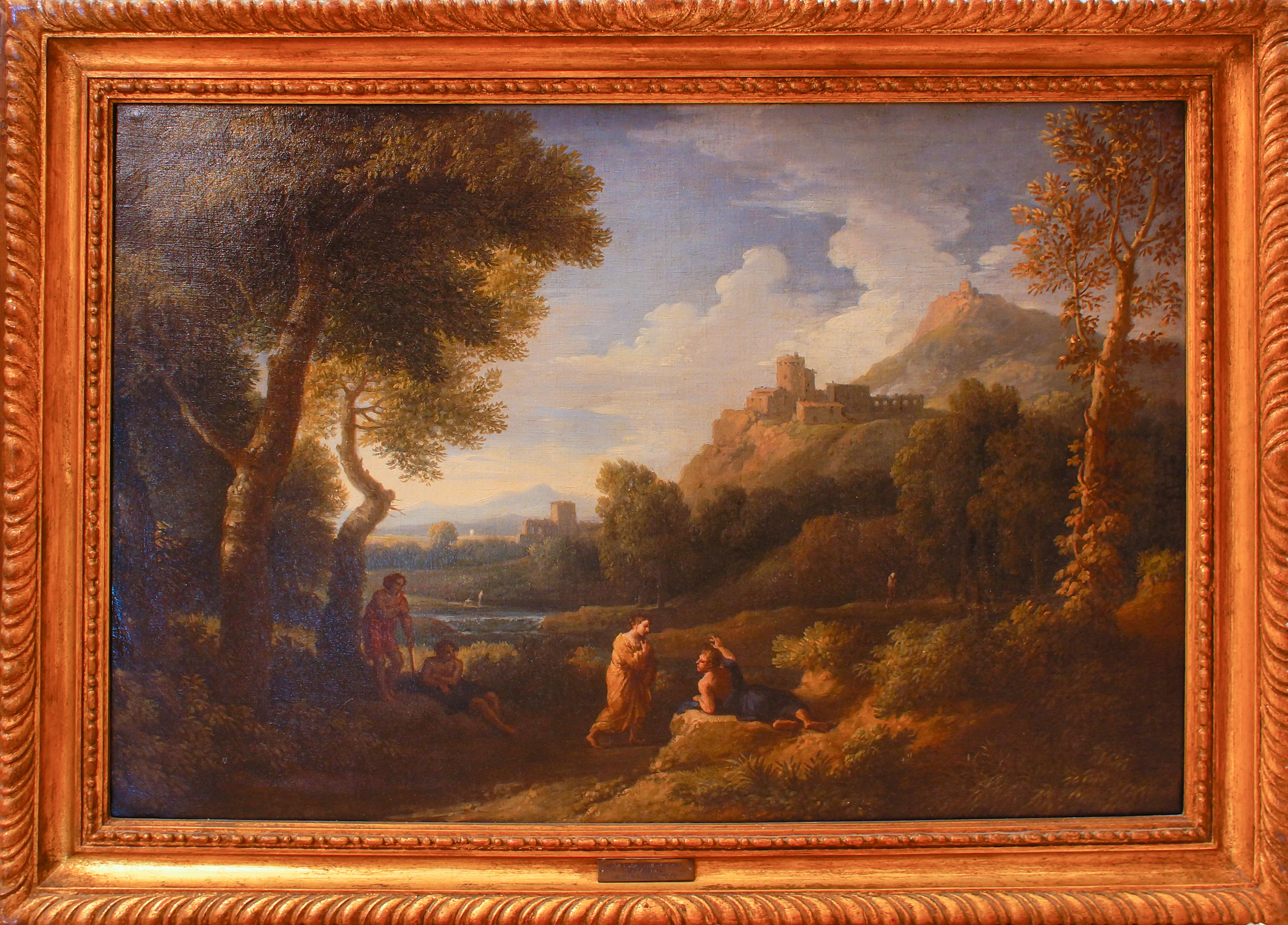

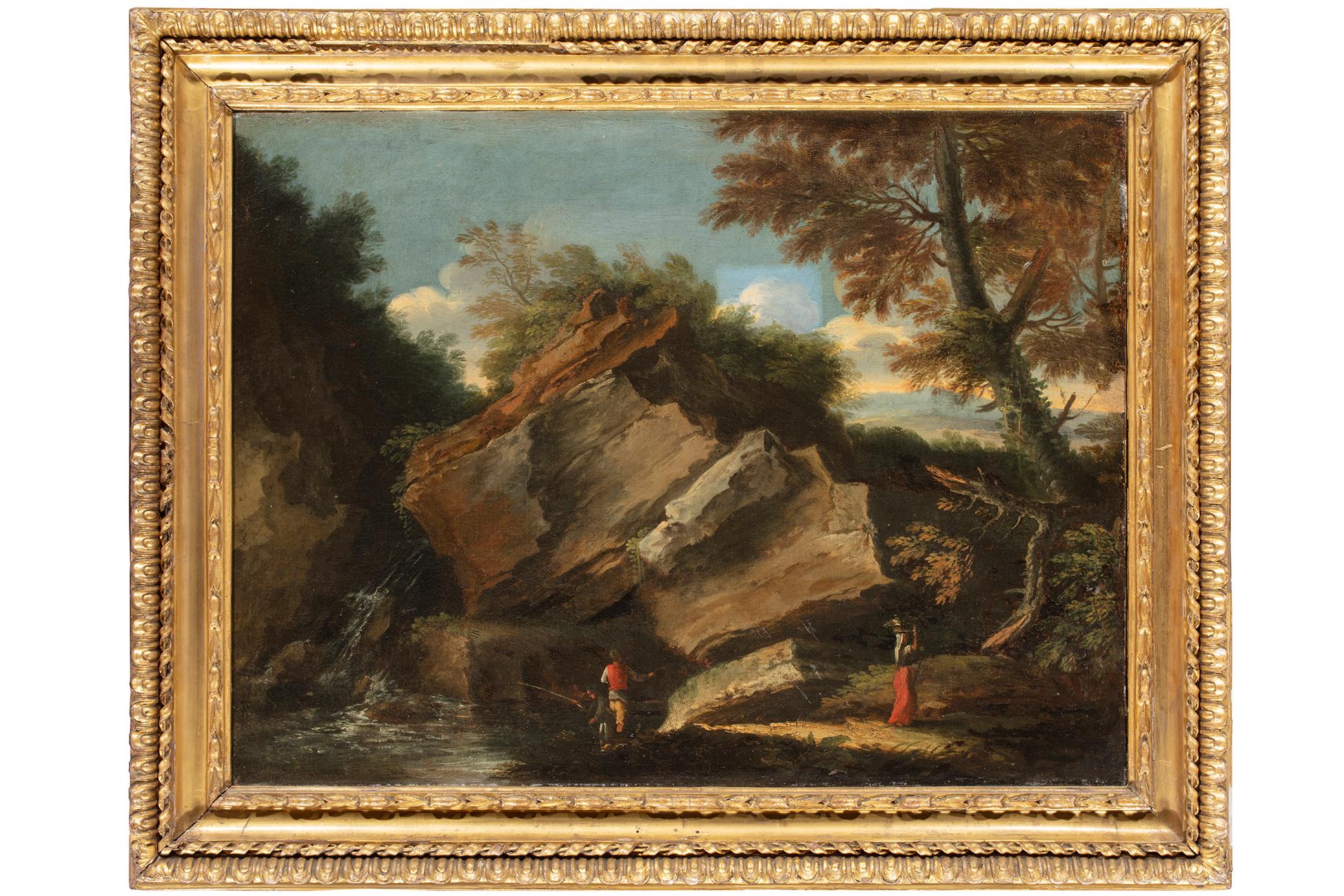
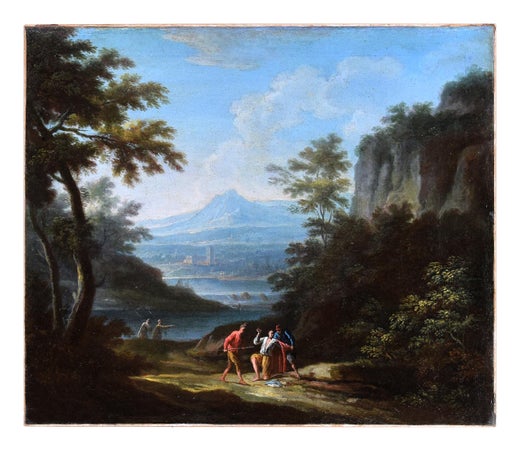
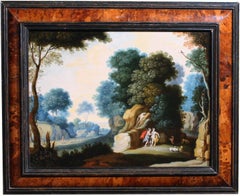
Two Arcadic Landscapes are a couple of original oil paintings by a follower of the Flemish artist, Jan Frans Van Bloemen (1662-1749).
These old master's original paintings representing a pastoral scene, and a brigandage scene set in a wonderful natural landscape are in a very good conditions, except for some signs of time and some color peeling on the pictorial surface. With a Flemish attention to detail, and a superb representation of atmosphere and to blues and demonstrating an incredible draftmanship these artworks trasmit peace and harmony, are absolutely to collect!
Jan Frans van Bloemen, or Blommen or Bloms, called L'Orizzonte or Orizonte (Antwerp, 1662 - Rome, 1749)
The Flemish painter and engraver came from a family of Flemish painters and designers, also active in Italy and France. He then became a pupil of Antoine Goubau, and after a brief stay in France with his brother, he moved to Rome, and Turin. From 1686-1687 they lived in Rome, where they became part of the Schildersbent, Pieter with the nickname of Standaart or Stendardo, probably for the banners he painted in the battle scenes, while Jan Frans with the nickname of Horizon, for the ease with which he painted landscapes.
In 1714 it was included among the Virtuosi al Pantheon [3].
Despite having patrons of aristocratic Roman families, van Bloemen's artistic career was hampered by the prolonged clash with the Accademia di San Luca. Among his patrons and collectors we remember the Pallavicini and Rospigliosi families, Luigi Bonaparte, Humphry Morice and Pope Benedetto XIV because he was considered one of the best classical landscape painters in Rome in the first half of the XVIII century with Arcadian-Rococo style.
- Creator:Jan Frans van Bloemen (Orizzonte) (1662-1749, Flemish)
- Creation Year:18th Century
- Dimensions:Height: 18.51 in (47 cm)Width: 21.66 in (55 cm)Depth: 0.48 in (1.2 cm)
- Medium:
- Movement & Style:
- Period:
- Framing:Framing Options Available
- Condition:Insurance may be requested by customers as additional service, contact us for more information.
- Gallery Location:Roma, IT
- Reference Number:Seller: M-1020371stDibs: LU65034615062
Jan Frans van Bloemen (Orizzonte)
Jan Frans van Bloemen (baptized 12 May 1662 - buried 13 June 1749) was a Flemish landscape painter mainly active in Rome. Here he was able to establish himself as the leading painter of views (vedute) of the Roman countryside depicted in the aesthetic of the classical landscape tradition. Van Bloemen predominantly painted classical landscapes, taking his inspiration from the Roman Campagna. His landscapes, with their recession through a series of planes, soft, warm lightning and classical and religious subject matter, drew on the examples of artists such as Claude Lorrain and Gaspard Dughet. His paintings are exquisitely imbued with that "difficult-to-define pastoral ambience" which helped to make him such a great painter in the eyes of his contemporaries. The technique and subjects of the work of Jan Frans van Bloemen are also related to painters such as Jan Asselijn, Thomas Wyck, Willem Romeyn and Willem Schellinks. His painted vedute fall into the category of the vedute that combine reality with imaginary elements. His landscapes have an Arcadian lushness, with mountains, streams, distant hamlets, and small inhabitants painted with imprecise pittura di tocco ('painting of touch') using small dotting and spirited brush-strokes. Unlike van Wittel, van Bloemen did not generally depict views of areas distant from Rome such as the Tiber valley or the Alban hills. His subjects were limited to views in the immediate vicinity of Rome, an outline of which was typically visible in his compositions. Van Bloemen was in particular known for his 'estate views' representing the estates of the nobility in the Roman Campagna. His views aim to associate the modern estate view with the classical arcadian landscape. Rather than offering the wide panoramic views, distant horizon and atmospheric effects associated with topographical landscapes, van Bloemen's estate views emphasize minute observation of reality and a limited viewpoint. The estates are thus made to appear as immutable features of the local landscape. He worked together with other painters who painted the figures in his landscapes such as Carlo Maratti, Placido Costanzi and Pompeo Batoni. However, he only relied on such collaboration with figure painters in the last decades of his life when he produced his most ambitious classicising compositions. Even then he only relied on these figure specialists for the most prominent figures in the foreground while he took care of the minor characters. In fact, van Bloemen was an accomplished staffage painter and he was very skilled at quickly learning to imitate the style of his collaborators. As a result, many of the figures in his paintings that are attributed to prestigious contemporaries were actually by his own hand. His landscape drawings, which often depict imaginary ruins, have been confused with those of his brother Pieter, who is better known for his drawings of figures and animals. Jan Frans van Bloemen also made pen drawings of buildings in and around Rome.
About the Seller
4.9
Platinum Seller
Premium sellers with a 4.7+ rating and 24-hour response times
1stDibs seller since 2017
7,584 sales on 1stDibs
Typical response time: 2 hours
- ShippingRetrieving quote...Shipping from: Monaco, Monaco
- Return Policy
Authenticity Guarantee
In the unlikely event there’s an issue with an item’s authenticity, contact us within 1 year for a full refund. DetailsMoney-Back Guarantee
If your item is not as described, is damaged in transit, or does not arrive, contact us within 7 days for a full refund. Details24-Hour Cancellation
You have a 24-hour grace period in which to reconsider your purchase, with no questions asked.Vetted Professional Sellers
Our world-class sellers must adhere to strict standards for service and quality, maintaining the integrity of our listings.Price-Match Guarantee
If you find that a seller listed the same item for a lower price elsewhere, we’ll match it.Trusted Global Delivery
Our best-in-class carrier network provides specialized shipping options worldwide, including custom delivery.More From This Seller
View AllPair of Roman Landscapes - by J.F. Van Bloemen - 18th Century
By Jan Frans van Bloemen (Orizzonte)
Located in Roma, IT
Beautiful couple of Roman Landscape by J. F. Van Bloemen, in very good conditions and with later wooden frames.
Bibliography and Exhibitions:
Old Master Exhibition, H.Terry-Engell, ...
Category
Early 18th Century Landscape Paintings
Materials
Oil, Canvas

Wooden Landscape with Shepherds, Fountain and Flock - by Jan Frans van Bloemen
By Jan Frans van Bloemen (Orizzonte)
Located in Roma, IT
Bibliography:
A.Busiri Vici, Jan Frans Van Bloemen Orizzonte e l’origine del paesaggio romano settecentesco, Ugo Bozzi Editore, Roma 1974, n.41
This artwork is shipped from Italy. U...
Category
18th Century Old Masters Landscape Paintings
Materials
Canvas, Oil

Landscape with figures - Original Oil Paint On Canvas - 18th Century
Located in Roma, IT
Landscape with figures is an original oil on canvas realized in the XVIII Century by a Venetian School Master.
Original oil painting on Canvas.
The painting represents a beautiful...
Category
18th Century Modern Landscape Paintings
Materials
Canvas, Oil
Landscape with Figures and Herd - Original Oil On Canvas - 18th Century
Located in Roma, IT
Landscape with figures and herd is an original oil on canvas realized in the 18th Century by a School Master of Central Italian School.
Original oil painting on Canvas.
The painti...
Category
18th Century Modern Landscape Paintings
Materials
Canvas, Oil
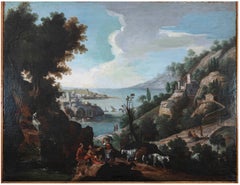
Pair of Landscapes with Views of Ancient Rome - Oil on Canvas - Mid 19th century
Located in Roma, IT
Landscapes with Views of Ancient Rome is an original pair of oil on canvas realized in the Second Half 19th Century.
Mixed colored oil on canvas, mounted on panel.
Minor damage to ...
Category
Mid-19th Century Modern Figurative Paintings
Materials
Canvas, Oil
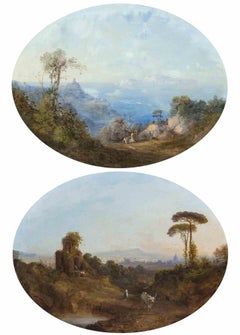
Landscape with Stream - Oil on Canvas - 18th Century
Located in Roma, IT
Original Oil on Canvas, probably of Dutch School, of the mid-18th Century. Wood Lable attributing the work to E. Williams Senior.
Small restoration, otherwise very good condition.
Category
18th Century Modern Figurative Paintings
Materials
Canvas, Oil
You May Also Like
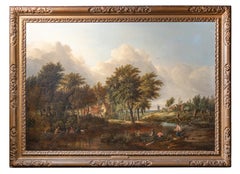
17th Century by Jacob de Heusch Pair of Landscapes Oil on Canvas
Located in Milano, Lombardia
Jacob De Heusch (Utrecht, Netherlands, 1657 – Amsterdam, Netherlands, 1701)
Title: Pair of Landscapes
Medium: Oil on canvas
Dimensions: without frame 50 x 8...
Category
17th Century Old Masters Landscape Paintings
Materials
Oil, Canvas
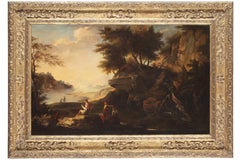
Italian Landscape - Dutch Old Master art Grand Tour landscape oil painting
Located in London, GB
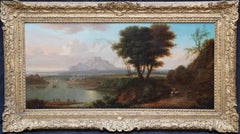
This simply stunning large Old Master landscape oil painting is attributed to noted Dutch artist Adriaen van Diest. Painted circa 1700 this Mediterranean Italian landscape painting has everything; A really interesting landscape with land, river, sea and mountains, interesting figures and cattle and a wonderful sky with fading light. The details and the capturing of the light make this a really fantastic Dutch Old Master country house Grand Tour oil painting. Irresistible.
Provenance. Dorset estate.
Condition. Oil on canvas, 42 inches by 20 inches and in good condition.
Frame. Housed in an English carved giltwood frame, 50 inches by 28 inches framed and in good condition.
Adriaen van Diest (1655-1704) was born in the Hague in the Netherlands. Like his father and his brother, he pursued a career as a marine painter, that is, a painter of seascapes and sailing ships. In 1673, attracted by the thriving English market for portraits and marine paintings, he joined the exodus of Dutch artists leaving to work in England. It is thought that his master was Willem van de Velde the Younger...
Category
Early 1700s Old Masters Landscape Paintings
Materials
Oil
$21,691 Sale Price
20% Off
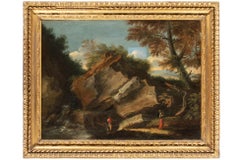
17th Century by Pietro Montanini Landscape Oil on Canvas
Located in Milano, Lombardia
PIETRO MONTANINI (Perugia, Italy, 1619 - 1689)
Title: Landscape
Medium: Oil on canvas
Dimensions: without frame 50 x 65 cm - with frame 64 x 79 cm
An...
Category
17th Century Old Masters Landscape Paintings
Materials
Canvas, Cotton Canvas, Oil
$10,159 Sale Price
22% Off
Wooded Figurative River Landscape - Dutch 17thC Golden Age art oil painting
Located in London, GB
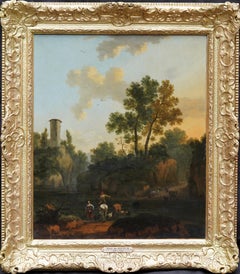
This superb 17th century Dutch Golden Age oil painting has been more recently reattributed to Abraham Begeyn by Dr Marijke C. de Kinkelder formerly of the RKD - Netherlands Institute for Art History. Painted circa 1640 it is an Italianate wooded river landscape with drovers and their herd crossing a river with a watchtower beyond. Begeyn was one of the many 17th-century Dutch and Flemish painters to embrace the Italianate style, populating their decidedly non-Dutch, mountainous landscapes with rustic travellers and picturesque ruins bathed in warm, Mediterranean light. It has Begeyn's characteristic brightly lit cattle and grouping of figures, similar to a comparable painting in the Lichtenstein Princely Collections. The brushwork and details are superb. One can see the influence of his teacher Nicholaes Berchem (1620-1683) and the typical golden glow of the Golden Age painters. This is a stunning 17th century Golden Age oil painting and an excellent example of Begeyn's work.
Provenance: With Koetser Gallery, Zurich. Private Collection (Rhine region). Anon. sale, Dorotheum, Vienna, 22 June 2010, lot 357, as by Jacob de Heusch (€18,600).
Anon. sale, Christie's South Kensington,18 November 2015, lot 432, as 'Follower of Nicolaes Berchem'; where purchased by the present owner.
Note: Begeyn was one of the many 17th-century Dutch and Flemish painters to embrace the Italianate style, populating their decidedly non-Dutch, mountainous landscapes with rustic travellers and picturesque ruins bathed in warm, Mediterranean light.
He is thought to have studied under Nicolaes Berchem (1620-1683), a pioneer of this genre of landscape painting, and travelled extensively to Italy, London and later to Germany in 1688, where he lived out his days as court painter to Frederick III, Elector of Brandenburg (later Frederick I, King of Prussia).
The present work was previously thought to be the work of Jacob de Heusch (1656-1701), but has been more recently reattributed to Abraham Begeyn by Dr Marijke C. de Kinkelder formerly of the RKD - Netherlands Institute for Art History.
A comparable scene, which also includes Begeyn's characteristic brightly lit cattle and a similar figure group, was sold at Christie's Amsterdam, 18 November 2015, lot 110. Another can be found in the Liechtenstein Princely Collections (no.GE 290).
Condition. Oil on canvas, image size 21 inches by 18 inches and in good condition.
Frame. Housed in a beautiful gilt frame, 28 inches by 25 inches and in good condition.
Abraham Begeyn (c. 1637 Leiden - 11 June 1697 Berlin), was a Dutch Golden Age painter. Begeyn was born in Leiden. Though perhaps known mostly for his Italianate landscapes and cattle in the manner of Nicolaes Pietersz Berchem, Begyn was a highly skilled painter active in many genres, who travelled widely. According to the RKD, Begeyn's earliest known work is from 1653, though he was first accepted into the Guild of St. Luke in Leiden in 1655. He stopped paying dues in 1667, because he set off for a trip to Italy. He is registered in Rome and Naples from 1659–1660. In the rampjaar or disaster year, of 1672, he is registered in Amsterdam, and after that he lived in London, where he painted at Ham House, Surrey, together with Willem van de Velde the Younger (1633–1707) and Dirck van Bergen...
Category
1640s Old Masters Landscape Paintings
Materials
Oil
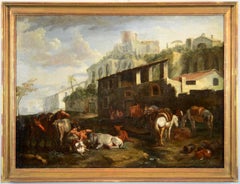
Van Bloemen Landscape Rome Paint 17/18th Century Oil on canvas Old master Italy
Located in Riva del Garda, IT
Antichità Castelbarco SRLS is proud to present:
Painting depicting "View of Rome with countryside scene with ancient ruins, with the Palatine from via dei Cerchi", work of high qual...
Category
17th Century Old Masters Paintings
Materials
Oil
$8,597 Sale Price
20% Off
Landscape with figures, workshop of Paul Bril, Italian school 17th Century
By Paul Bril
Located in PARIS, FR
Idyllic landscape with myhological story of Cephalus and Procris
Early 17th century Italian school
Workshop Of Paul Bril (Antwerp, 1554 - Roma, 1626)
Oil on poplar panel: H. 28 cm (1...
Category
Early 17th Century Old Masters Landscape Paintings
Materials
Poplar, Oil
More Ways To Browse
18th Century French Landscape
18th Century French Rococo Painting
Flemish 18th Century Oil Painting
Antique Hampers
Pieter Van Bloemen
Rob Browning Painting
Russian Doll
Ruth Hiller
Sam Smith
Tom Hayward
Victorian Oil Paintings Of Sheep
Vintage Eagle Oiler
Charles Rogers
Charlie Chaplin Vintage
Finger Lakes Painting
Laimdots Murnieks
Luce Maximilien
Oil Painting Bahamas