Located in Moreno Valley, CA
A striking mid-20th-century Indian torque necklace traditionally known as a hansli, hansuli or hasli, attributed to the jewelry traditions of the Banjara—also known regionally as Lambadi, Lambani or Sugali—communities of India.
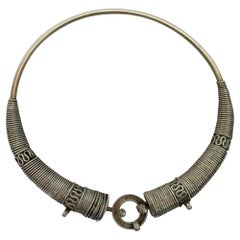
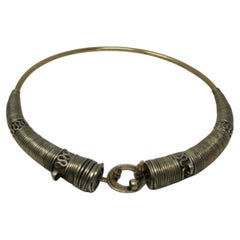
Substantial and highly sculptural, the rigid circular collar is fashioned from silver-alloy or silver-colored white metal. A smooth rounded band forms the upper portion, while the lower sections are dramatically wrapped with closely spaced coils of thick wire. Undulating applied motifs divide the coiled decoration into three graduated sections on either side, giving the necklace a strong architectural rhythm.
The collar opens at the center front and is secured by a distinctive circular loop-and-screw fitting. This functional closure becomes part of the necklace’s decorative composition, balancing the symmetrical coiled elements surrounding it. The hand-worked construction, subtle irregularities and naturally developed surface patina contribute to its authentic character.
Indian tribal jewelry frequently served purposes extending beyond personal decoration. Neck ornaments could communicate community identity, marital status, prosperity and participation in ceremonial life. Academic documentation of Lambadi adornment records several types of rigid silver neck ornaments, including the kante and hasla. Because closely related torque forms circulated among nomadic and neighboring communities across several Indian regions, the most responsible attribution is Banjara or Lambadi tradition, India, rather than assigning it definitively to one state without supporting documentation.
Although rooted in traditional ceremonial dress, the necklace has a remarkably modern presence. Its clean circular silhouette and repetitive wirework give it the appearance of a modernist studio-jewelry sculpture. It may be worn as a dramatic collar over a simple black dress, silk blouse or tailored jacket, or displayed on a jewelry stand as a collectible example of Indian ethnographic metalwork.
The necklace measures approximately 8 inches in outer diameter and approximately 1 inch at its deepest decorated section. Because of its rigid construction, prospective wearers should rely on the interior opening measurement rather than the exterior diameter when determining fit.
Provenance: Private European collection.
Origin: India; attributed to the Banjara/Lambadi cultural tradition.
Date: Circa 1950.
Period: Mid-20th century.
Materials: Silver alloy or silver-colored white metal; unmarked and untested.
Techniques: Hand-formed, coiled, applied and assembled metalwork.
Condition: Good vintage condition with oxidation, rubbing, darkened recesses, surface marks and naturally developed patina consistent with age and traditional use. The metal has not been tested for silver content.
Indian hansli necklace, Banjara torque necklace, Lambadi tribal jewelry, Sugali silver necklace, Indian silver-alloy choker, Rajasthan tribal jewelry, Andhra Pradesh...
Category
Mid-20th Century Indian Miscellaneous