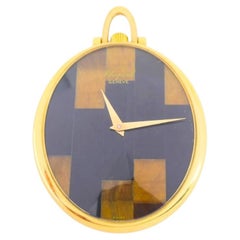
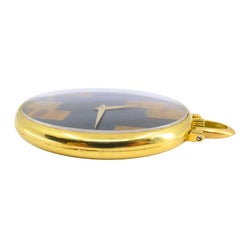
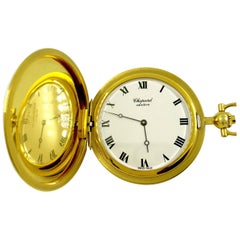
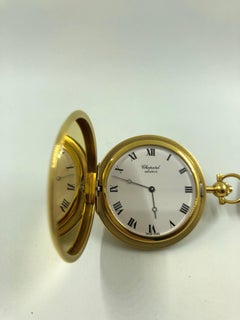
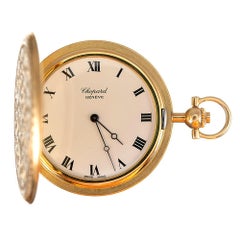
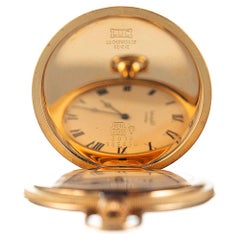
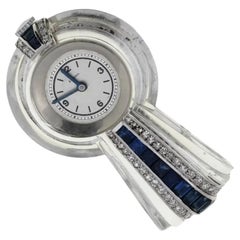
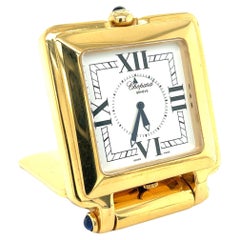
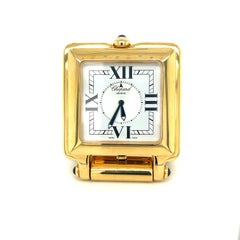
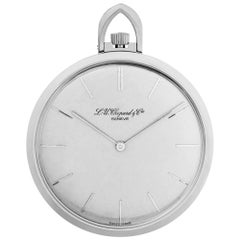
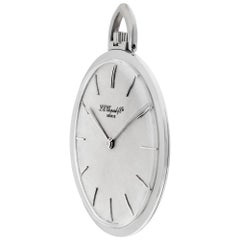
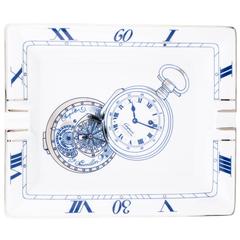
In 1860, a 24-year-old son of a farmer, Louis-Ulysse Chopard (1836–1915), established the L.U.C. company — now known simply as Chopard, rather than by the founder’s initials — in Sonvilier, Switzerland. His initial work evolved from making mechanical movements to building the watches themselves, concentrating on making the pocket watch slimmer to carry for everyday use while also ensuring it was precise and reliable.
Early successes for Chopard included providing watches for the punctuality needs of the Swiss Railway Company. Recognizing the international market for Swiss watchmaking, Chopard traveled across Europe and Russia, with Czar Nicholas II becoming a client in 1912.
Chopard’s son, Paul-Louis, took over after Louis-Ulysse’s death in 1915 and expanded the business to La Chaux-de-Fonds. In 1937, the company relocated to the watchmaking center of Geneva, where they could mark their work with the prestigious Geneva Seal. (Paul-Louis’s son, Paul-André, took the reins in 1943.) Business thinned in the postwar years, and Paul-André’s sons declined the opportunity to take over for their father.
In 1963, Chopard was acquired by German goldsmith and watchmaker Karl Scheufele III and his wife, Karin. Under their ownership, Chopard added jewelry to its offerings. The popular Happy Diamonds wristwatch debuted in 1976 — it launched a collection, which now features bracelets, rings and other items. The distinctive watch sees dozens of glittering diamonds, loosed from their settings, moving freely around the dial.
The story goes that the in-house designer Ronald Kurowski was inspired by the kinetic glimmers of sunlight on a waterfall in the Black Forest. He would then develop the innovative system for the Happy Diamonds timepiece that he hoped would essentially mimic his experience in the woods.
A young Caroline Scheufele — Karl and Karin’s daughter, who would later become copresident and artistic director — led the introduction of a Happy Diamonds jewelry line in 1985, with her design for a playful clown pendant with a belly full of jittering precious stones. Subsequent lines and accessories such as the Happy Dreams bracelet, Happy Hearts collection and the Happy Sport watches further enhanced Chopard’s range of dynamic adornment.
The Scheufele family-run company continues to be synonymous with excellence in timepieces, such as its role as the official timekeeper for the Grand Prix de Monaco Historique, creating all of its movements in-house. And Chopard is constantly developing its wares, from sunglasses and fragrances to recent introductions of high-end handbags.
Find a wide range of vintage Chopard wristwatches, necklaces, rings and other jewelry on 1stDibs.
Can you pull off a vintage pocket watch? Of course you can. With a suit and a waistcoat, a pocket watch can be a refreshing alternative to a wristwatch.
The earliest pocket watches were luxury items, and, owing to cost, they weren’t commonplace until the 19th century. Artfully crafted pocket watches were a symbol of wealth, and manufacturers such as Vacheron Constantin and Patek Philippe became known for theirs. (Today, they’re among the most sought after by collectors and enthusiasts.)
At the onset, pocket watches resembled small round table clocks, and pulling your small round table clock — perhaps of the silver variety — out of your breast pocket in front of someone else demonstrated unequivocally that you cared about punctuality. For collectors, pocket watches are big, and that means a larger canvas provided for functions without crowding the dial. For example, the Marius Lecoultre pocket watch — made circa 1890 — does everything but uncork your wine.
In the late 1800s, the open-face pocket watch became a staple on the American railroad. It was a requirement for railway workers to wear a pocket watch, as the timepieces were responsible for keeping conductors on schedule. This was a boon to the watchmaking industry, with companies like Hamilton, the Elgin National Watch Company and the Waltham Watch Company producing high-grade and workingman’s watches.
By the 1930s, wristwatches comprised the bulk of watch manufacturing in America, superseding the pocket watch. Suddenly, if you wanted to know the time, you merely glanced at your wrist. But given their vintage charm and our general appetite for good design, pocket watches are a piece of statement-making jewelry and today can prove complementary to your formal attire in a manner that is stylish and unconventional.
Let time take its course — browse a vast selection of antique and vintage pocket watches available on 1stDibs designed by legendary brands such as IWC, Cartier and more.