By Felice Clerici
Located in Milano, IT
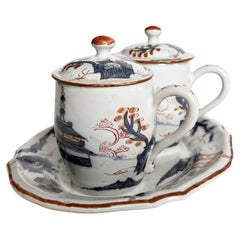
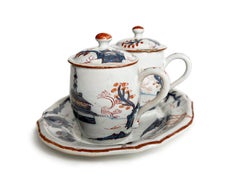
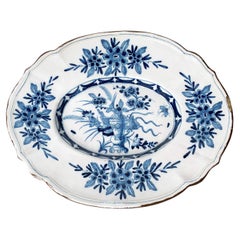
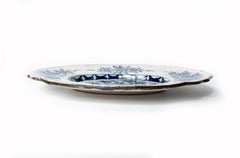
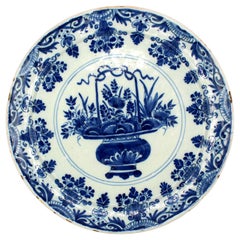
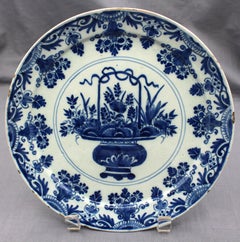
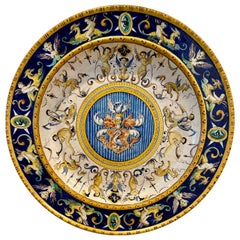
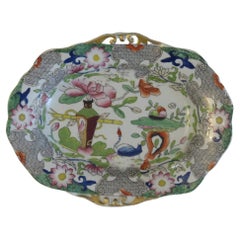
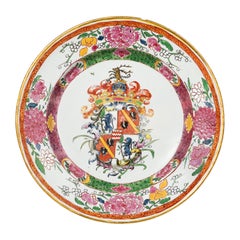
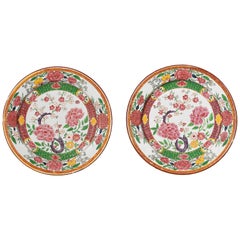
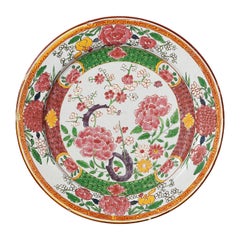
Two maiolica dishes, "Famille Rose" decoration
Felice Clerici Factory
Milan, 1770-1780
9.13 in (23.2 cm) each in diameter
lb 1.32 (kg 0.6)
State of conservation: perfect, except for slight chipping at the edges
The dishes are rare examples of a service produced by the factory of Felice Clerici (1710-1780) in Milan.
Felice Clerici had opened his own factory in Milan in 1745, inserting himself into the new European stylistic trend which saw maiolica becoming a fine product like porcelain. The Milanese entrepreneur worked in the early period with high fire furnaces, declaring only in 1759 that he had purchased "the secrets of the paintings by force of money," by which he meant he now could obtain colors with a greater chromatic range with a low fire.
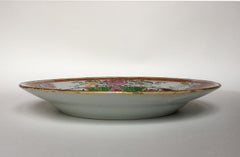
The two dishes are funds with lightly blue glaze. Smooth barely detectable rim and ring foot. Along the edge there is a thin orange band with a chain of small spirals whereas along the brim there is a typical oriental decoration with peonies and chrysanthemums and minor florets. The flounce hosts a motif "in reserves" centered inside alternating flower and trellis motifs on pink and green backgrounds. In the center an oriental floral ornament is developed around a sturdy branch.
On the back the "fraction" brand by Felice Clerici in black.
Raffella Ausenda, while cataloging a maiolica in the same model as ours, conserved in the collections of the Museo di Arti Applicate del Castello in Milan (to which we refer for comparison), highlights that the ornamentation is directly inspired by Chinese porcelain from the Kang'hsi period known as "Famille Rose". The Clerici manufacture had in fact such a technical command of colors that it could perfectly imitate the oriental models even thanks to the aid of painters such as Giuseppe Sormani and Giacomo Facchetti who “painted with enamel in gold and silver colors. They imitate and accompany porcelain".
The recent publication, edited by the same scholar (R. Ausenda in J.V.G. Mallet and E.P. Sani, a cura di, Maiolica in Italy and Beyond. pp. 124-140), underlines how the rebirth of maiolica in northern Italy also sprang from the experiences of the Milanese factory of Pasquale Rubati. This factory, established in 1756, obtained very high quality products, even considered among the best of the time. In the study she remarks how the pieces produced in the factory so closely matched Chinese...
Category
1770s Italian Rococo Antique Felice Clerici Ceramics