Kiyoshi Hasegawa Art
Japanese, 1891-1980
Kiyoshi Hasegawa was a Japanese artist and engraver who spent most of his life in France and whose work is featured at the Yokohama Museum of Art. Born in present-day Yokohama, he moved to France in 1919 (via the United States) to learn copperplate printing, and never returned to Japan.
to
1
1
1
Overall Width
to
Overall Height
to
2
1
1
2
2
1
1
1
1
1
1
1
1
1
1
2
10,442
2,791
2,504
1,384
2
Artist: Kiyoshi Hasegawa
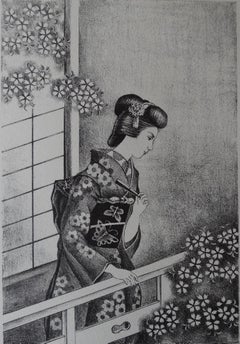
Japanese Woman with Fan - Stone lithograph, 1930 (Catalog Akio Uozu #522)
By Kiyoshi Hasegawa
Located in Paris, IDF
Kiyoshi HASEGAWA
Japanese Woman with Fan, 1930
Original stone lithograph
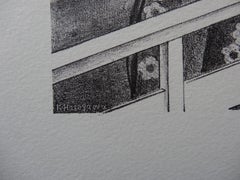
Printed signature in the plate
On Arches vellum 28 x 22 cm (c. 11 x 9 inch)
REFERENCES : Catalog raisonne (...
Category
1930s Modern Kiyoshi Hasegawa Art
Materials
Lithograph
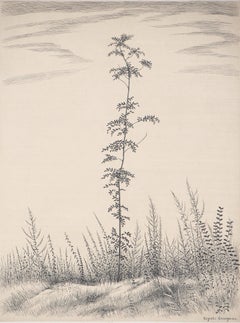
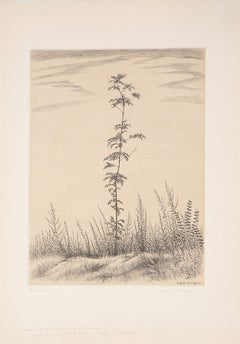
A Young Tree - Original handsigned etching, Limited to 50 copies, 1953
By Kiyoshi Hasegawa
Located in Paris, IDF
Kiyoshi HASEGAWA
A young tree
Original etching on vellum
Handsigned in pencil on the bottom right
Signed again with a dedication in the bottom margin
Justified artist proof (from a ...
Category
1950s Modern Kiyoshi Hasegawa Art
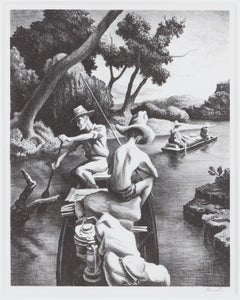
Materials
Etching
Related Items
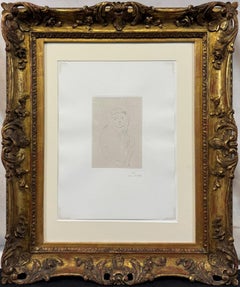
L'inspiré Self Portrait Marc Chagall Valentina Vava Lithograph 1963 Mourlot 398
By Marc Chagall
Located in Eversholt, Bedfordshire
Inspiration or L'inspiré - The artist and his wife, self-portrait.
This is a self-portrait of the great artist, depicting him as lost in thought before one of his paintings, which is apparently related to his home country Russia, as suggested by the small figure in the lower right of the work. Chagall’s wife Valentina (“Vava”), who was also from Russia, is looking over his shoulder, full of longing. The small surreal elements that are characteristic of Chagall’s paintings are also present here: the silhouettes of the houses that seems to stick out of the painting and a figure with a flute or trombone standing on its head.
Chagall Lithographe, Volume II of the catalogue raisonné of Chagall's lithographic work, see Mourlot 398, 1957-1962, Paris 1963, imprinted by Imprimerie Mourlot for the publisher André Sauret. A lithographic plate from the catalog that was published in 10,000 copies.
Condition : Excellent
Set inside a cream mount bearing brass cartellino
Visible sheet size length 23cm, Height 31.50cm
In a carved and gilded frame
Frame size Length 44cm, Height 55.5cm
The reverse with a paper label in Japanese
Provenance : Private Collection, purchased with Lovers in Grey
Category
1960s Modern Kiyoshi Hasegawa Art
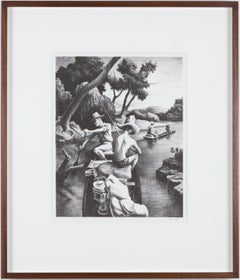
Materials
Lithograph
$1,393
H 21.86 in W 17.33 in D 1.19 in
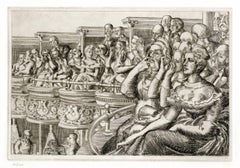
Jean Dubuffet - original lithograph from XXe Siecle magazine
By Jean Dubuffet
Located in Collonge Bellerive, Geneve, CH
Jean Dubuffet - Original Lithograph from XXe Siecle magazine
1958
Dimensions: 32 x 25 cm
Edition: G. di San Lazzaro.
Unsigned and unumbered as issued
Category
1960s Modern Kiyoshi Hasegawa Art
Materials
Lithograph
$2,903
H 12.6 in W 9.85 in D 0.04 in
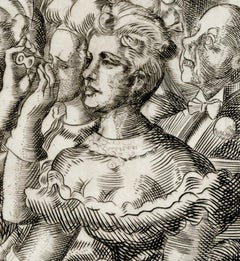
Pablo Picasso - Les Banderillas - Original Lithograph
By Pablo Picasso
Located in Collonge Bellerive, Geneve, CH
Original Lithograph by Picasso
Atelier Mourlot.
Paper: Vélin.
Dimensions : 9 5/8 x 12 7/16 inches
Bloch 1017; Cramer 113; Mourlot 350
Category
1960s Modern Kiyoshi Hasegawa Art
Materials
Lithograph
$1,633
H 10.24 in W 12.6 in D 0.04 in
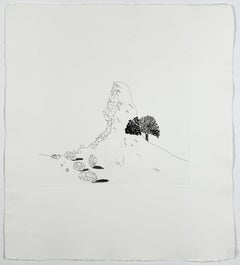
Memnon - after Georges Braque - Lithograph - 1988 - Figurative Print
By (after) Georges Braque
Located in Sint-Truiden, BE
Color lithograph after a gouache by Georges Braque from the edition of 398 published by Armand & Georges Israel in 1988. Printed signature.
Artwork entirely made in France: from th...
Category
1980s Modern Kiyoshi Hasegawa Art
Materials
Lithograph
$423
H 17.72 in W 22.84 in
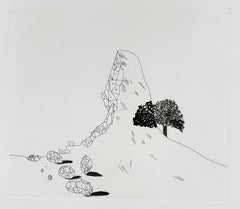
Grotta della Ninfa Egeria - Original Etching on Paper by Gili - 1804
Located in Roma, IT
Grotta della Ninfa Egeria is an original black and white etching on paper, realized by Florent-Constant Bourgeois in 1804..
It represents the Nymphaeum of Egeria, also known as the G...
Category
Early 19th Century Modern Kiyoshi Hasegawa Art
Materials
Etching
Florent-Constant BourgeoisGrotta della Ninfa Egeria - Original Etching on Paper by Gili - 1804, 1804
$241
H 13.39 in W 19.3 in D 0.04 in
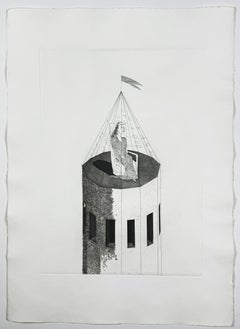
Revelations de Nozdriov
By Marc Chagall
Located in San Francisco, CA
This artwork titled "Revelations de Nozdriov" from the suite "Nicholas Gogol, Les Ames Mortes" created 1923-1937, published 1948, is an etching on paper by renown Russian/French arti...
Category
Early 20th Century Modern Kiyoshi Hasegawa Art
Materials
Etching
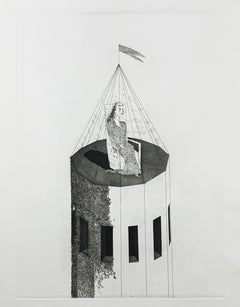
Leonor Fini - Original Lithograph
By Leonor Fini
Located in Collonge Bellerive, Geneve, CH
Leonor Fini - Original Lithograph
The Flowers of Evil
1964
Conditions: excellent
Edition: 500
Dimensions: 46 x 34 cm
Editions: Le Cercle du Livre Précieux, Paris
Unsigned and unumb...
Category
1960s Modern Kiyoshi Hasegawa Art
Materials
Lithograph
Jean Cocteau - Portrait - Original Lithograph
By Jean Cocteau
Located in Collonge Bellerive, Geneve, CH
Original Lithograph by Jean Cocteau
Title: Taureaux
Signed in the plate
Dimensions: 40 x 30 cm
Edition: 200
Luxury print edition from the portfolio of Trinckvel
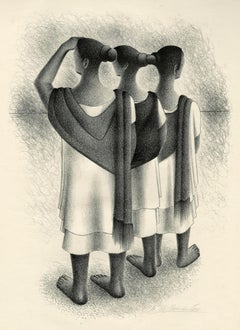
1965
Jean Cocteau
W...
Category
1960s Modern Kiyoshi Hasegawa Art
Materials
Lithograph
$1,451
H 15.75 in W 11.82 in D 0.04 in
Marc Chagall - Bateau Mouche au bouquet - Original Lithograph
By Marc Chagall
Located in Collonge Bellerive, Geneve, CH
Marc Chagall
Original Lithograph
Title: Bateau Mouche au bouquet
1963
Dimensions: 39 x 30 cm
Edition: 180
Unsigned as issued.
From Regards sur Paris
Published by André Sauret
Condit...
Category
1960s Modern Kiyoshi Hasegawa Art
Materials
Lithograph
$2,419
H 15.36 in W 11.82 in D 0.04 in
Giorgio de Chirico 1960s Original Signed Lithography
By Giorgio De Chirico
Located in Roma, IT
Giorgio de Chirico 1960s Original Signed Lithography
Lithograph with golden yellow background
Signed in pencil lower left ‘P d A’ Artist's proof
Signed in pencil lower right ‘G. De ...
Category
1950s Modern Kiyoshi Hasegawa Art
Materials
Paper, Lithograph
$2,177
H 27.56 in W 19.69 in D 0.79 in
Marc Chagall - Moses - Original Lithograph
By Marc Chagall
Located in Collonge Bellerive, Geneve, CH
Marc Chagall, Original Lithograph depicting an instant of the Bible.
Technique: Original lithograph in colours
Year: 1956
Sizes: 35,5 x 26 cm / 14" x 10.2" (sheet)
Published by: Éditions de la Revue Verve, Tériade, Paris
Printed by: Atelier Mourlot, Paris
Documentation / References: Mourlot, F., Chagall Lithograph [II] 1957-1962, A. Sauret, Monte Carlo 1963, nos. 234 and 257
Marc Chagall (born in 1887)
Marc Chagall was born in Belarus in 1887 and developed an early interest in art. After studying painting, in 1907 he left Russia for Paris, where he lived in an artist colony on the city’s outskirts. Fusing his own personal, dreamlike imagery with hints of the fauvism and cubism popular in France at the time, Chagall created his most lasting work—including I and the Village (1911)—some of which would be featured in the Salon des Indépendants exhibitions. After returning to Vitebsk for a visit in 1914, the outbreak of WWI trapped Chagall in Russia. He returned to France in 1923 but was forced to flee the country and Nazi persecution during WWII. Finding asylum in the U.S., Chagall became involved in set and costume design before returning to France in 1948. In his later years, he experimented with new art forms and was commissioned to produce numerous large-scale works. Chagall died in St.-Paul-de-Vence in 1985.
The Village
Marc Chagall was born in a small Hassidic community on the outskirts of Vitebsk, Belarus, on July 7, 1887. His father was a fishmonger, and his mother ran a small sundries shop in the village. As a child, Chagall attended the Jewish elementary school, where he studied Hebrew and the Bible, before later attending the Russian public school. He began to learn the fundamentals of drawing during this time, but perhaps more importantly, he absorbed the world around him, storing away the imagery and themes that would feature largely in most of his later work.
At age 19 Chagall enrolled at a private, all-Jewish art school and began his formal education in painting, studying briefly with portrait artist Yehuda Pen. However, he left the school after several months, moving to St. Petersburg in 1907 to study at the Imperial Society for the Protection of Fine Arts. The following year, he enrolled at the Svanseva School, studying with set designer Léon Bakst, whose work had been featured in Sergei Diaghilev's Ballets Russes. This early experience would prove important to Chagall’s later career as well.
Despite this formal instruction, and the widespread popularity of realism in Russia at the time, Chagall was already establishing his own personal style, which featured a more dreamlike unreality and the people, places and imagery that were close to his heart. Some examples from this period are his Window Vitebsk (1908) and My Fianceé with Black Gloves (1909), which pictured Bella Rosenfeld, to whom he had recently become engaged.
The Beehive
Despite his romance with Bella, in 1911 an allowance from Russian parliament member and art patron Maxim Binaver enabled Chagall to move to Paris, France. After settling briefly in the Montparnasse neighborhood, Chagall moved further afield to an artist colony known as La Ruche (“The Beehive”), where he began to work side by side with abstract painters such as Amedeo Modigliani and Fernand Léger as well as the avant-garde poet Guillaume Apollinaire. At their urging, and under the influence of the wildly popular fauvism and cubism, Chagall lightened his palette and pushed his style ever further from reality. I and the Village (1911) and Homage to Apollinaire (1912) are among his early Parisian works, widely considered to be his most successful and representative period.
Though his work stood stylistically apart from his cubist contemporaries, from 1912 to 1914 Chagall exhibited several paintings at the annual Salon des Indépendants exhibition, where works by the likes of Juan Gris, Marcel Duchamp and Robert Delaunay were causing a stir in the Paris art world. Chagall’s popularity began to spread beyond La Ruche, and in May 1914 he traveled to Berlin to help organize his first solo exhibition, at Der Sturm Gallery. Chagall remained in the city until the highly acclaimed show opened that June. He then returned to Vitebsk, unaware of the fateful events to come.
War, Peace and Revolution
In August 1914 the outbreak of World War I precluded Chagall’s plans to return to Paris. The conflict did little to stem the flow of his creative output, however, instead merely giving him direct access to the childhood scenes so essential to his work, as seen in paintings such as Jew in Green (1914) and Over Vitebsk (1914). His paintings from this period also occasionally featured images of the war’s impact on the region, as with Wounded Soldier (1914) and Marching (1915). But despite the hardships of life during wartime, this would also prove to be a joyful period for Chagall. In July 1915 he married Bella, and she gave birth to a daughter, Ida, the following year. Their appearance in works such as Birthday (1915), Bella and Ida by the Window (1917) and several of his “Lovers” paintings give a glimpse of the island of domestic bliss that was Chagall’s amidst the chaos.
To avoid military service and stay with his new family, Chagall took a position as a clerk in the Ministry of War Economy in St. Petersburg. While there he began work on his autobiography and also immersed himself in the local art scene, befriending novelist Boris Pasternak, among others. He also exhibited his work in the city and soon gained considerable recognition. That notoriety would prove important in the aftermath of the 1917 Russian Revolution when he was appointed as the Commissar of Fine Arts in Vitebsk. In his new post, Chagall undertook various projects in the region, including the 1919 founding of the Academy of the Arts. Despite these endeavors, differences among his colleagues eventually disillusioned Chagall. In 1920 he relinquished his position and moved his family to Moscow, the post-revolution capital of Russia.
In Moscow, Chagall was soon commissioned to create sets and costumes for various productions at the Moscow State Yiddish...
Category
1950s Modern Kiyoshi Hasegawa Art
Materials
Lithograph
Engraving #1 by Ernst Fuchs: KABBALAH (SEFER YETSIRA and 32 PATHS OF WISDOM)
By Ernst Fuchs
Located in Cliffside Park, NJ
Original engraving #7 by Ernst FUCHS from Kabbalah (THIRTY-TWO PATHS OF WISDOM by SEFER YETZIRA), 1978
Etching signed and numbered 16/30 E.A.
Page size - 30 ...
Category
1970s Modern Kiyoshi Hasegawa Art
Materials
Paper, Etching
Previously Available Items
Afternoon of a Faun
By Kiyoshi Hasegawa
Located in Saint Augustine, FL
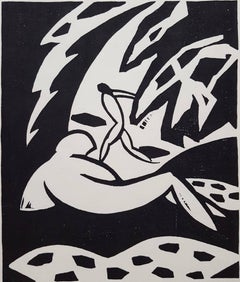
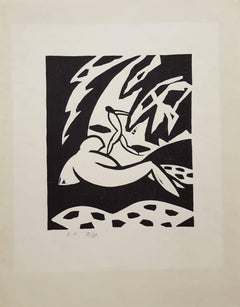
An original woodblock engraving on Japon paper after Japanese artist Kiyoshi Hasegawa (1891-1980) titled "Afternoon of a Faun", c, 1983. Hand pencil numbered lower left. Limited edition: III/XV (3/15). This is a later edition authorized by the artist's estate after the original print from 1915. Blindstamp/chopmark upper left and lower right. The image is based off a poem called "Pastoral" written by Stephen Mallarme. Provenance: private collection Los Angeles, CA; Icking, Germany estate; Artelino Art Auctions - Icking, Germany. Sheet size: 15" x 12". Image size: 8.5" x 7.25". Minimal mat burn at far outer margin not affecting the image. The woodblock printed artwork is in excellent condition.
Kiyoshi Hasegawa (長谷川潔 Hasegawa Kiyoshi...
Category
1980s Expressionist Kiyoshi Hasegawa Art
Materials
Intaglio, Woodcut
Kiyoshi Hasegawa art for sale on 1stDibs.
Find a wide variety of authentic Kiyoshi Hasegawa art available for sale on 1stDibs. You can also browse by medium to find art by Kiyoshi Hasegawa in etching, lithograph and more. Much of the original work by this artist or collective was created during the 20th century and is mostly associated with the modern style. Not every interior allows for large Kiyoshi Hasegawa art, so small editions measuring 9 inches across are available. Customers who are interested in this artist might also find the work of Kiyoshi Saitō, Sadao Watanabe., and Utagawa Yoshitora. Kiyoshi Hasegawa art prices can differ depending upon medium, time period and other attributes. On 1stDibs, the price for these items starts at $404 and tops out at $2,695, while the average work can sell for $1,550.