Utagawa Toyokuni Art

Japanese, 1769-1825
Utagawa Toyokuni[a] (歌川 豊国; 1769 – 24 February 1825), also often referred to as Toyokuni I, to distinguish him from the members of his school who took over his gō (art-name) after he died, was a great master of ukiyo-e, known in particular for his kabuki actor prints. He was the second head of the renowned Utagawa school of Japanese woodblock artists, and was the artist who elevated it to the position of great fame and power it occupied for the rest of the nineteenth century. He was born, the son of Kurahashi Gorobei, a carver of dolls and puppets, including replicas of kabuki actors. At around 14, Toyokuni was apprenticed to the first head of the Utagawa house, Utagawa Toyoharu, whom his father knew well and who lived nearby. One of his fellow pupils under Toyoharu was Toyohiro, whose pupil was the great landscape artist Hiroshige. In recognition of his artistic ability, Toyokuni later took the name Utagawa Toyokuni, following the common practice of using one syllable of his master's name. Toyokuni seems not to have been an "intuitive genius"determined to forge a new path; rather, he seems to have studied intently those who came before him, particularly Utamaro, Chōbunsai Eishi and Eishōsai Chōki and through a great deal of hard work produced first a mastery, and then a synthesis of their styles, to create a style of his own. He was known mostly for his prints related to the kabuki theatre, in particular his yakusha-e actor portraits, a field which he took to new heights. He also, however, produced other genres such as musha-e warrior prints, shunga erotica, and most notably bijin-ga. In his actor prints, like Sharaku, one sees the real subject; but his prints merely portrayed what he saw, unlike Sharaku who exaggerated those aspects he saw as the most key. It is said of Toyokuni's prints that they recreate exactly what one would see on stage; they show actors acting, not merely just pictures of actors. Together, these characteristics made Toyokuni's prints far more popular among theatre-goers than Sharaku's, although history has come to judge Sharaku the keener observer and greater artist. His popularity and prolific output may in part have been his undoing, though. From 1803 through 1817, his work became more static, even as it became more popular. He continued to produce large quantities of prints, but the quality as a rule did not match that of his earlier days. Occasional prints from this period, however, show his old brilliance
to
2
7
4
1
Overall Width
to
Overall Height
to
12
6
1
1
11
1
11
7
7
7
5
4
3
3
2
2
1
1
1
11
5
3
3
3
14
11,519
2,870
2,492
1,536
5
5
8
4
Artist: Utagawa Toyokuni
Set of Eight Period Japanese Colored Woodblock Print

Set of Eight Period Japanese Colored Woodblock Print

By Utagawa Toyokuni

Located in Roma, IT

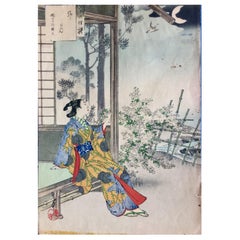
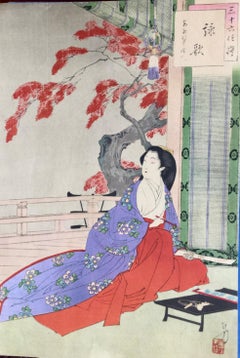
Important series of eight colorful Japanese woodblock prints featuring iconic scenes of Japanese life. They are the work of great artists including: Mizuno Toshikata (1866-1908) Utagawa Toyokuni (Japanese: ?; 1769 in Edo – 24 February 1825 in Edo) This series of woodblock prints, never before on the market, comes from a private collection. Utagawa Toyokuni[a] (歌川 豊国; 1769 – 24 February 1825), also often referred to as Toyokuni I, to distinguish him from the members of his school who took over his gō (art-name) after he died, was a great master of ukiyo-e, known in particular for his kabuki actor prints. He was the second head of the renowned Utagawa school of Japanese woodblock artists, and was the artist who elevated it to the position of great fame and power it occupied for the rest of the nineteenth century. He was born, the son of Kurahashi Gorobei, a carver of dolls and puppets...

Category

Late 19th Century Old Masters Utagawa Toyokuni Art

Materials

Paper, Lithograph

Kabuki Actor with Pine-Patterned Robe - Japanese Woodblock Print

Kabuki Actor with Pine-Patterned Robe - Japanese Woodblock Print

By Utagawa Toyokuni

Located in Soquel, CA

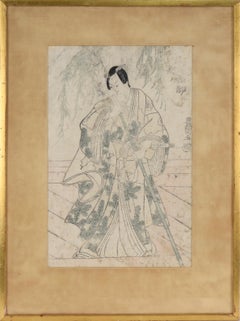
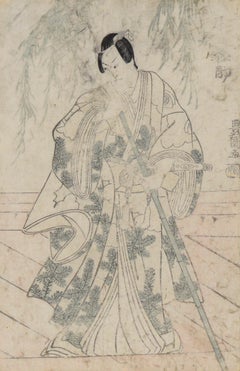
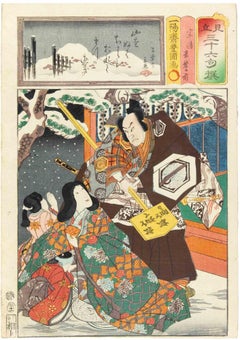
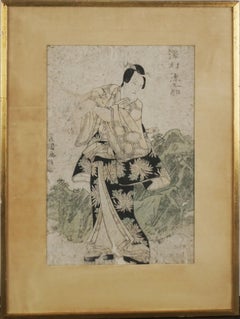
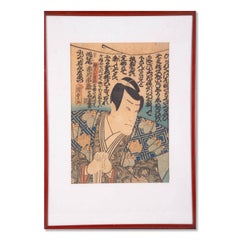
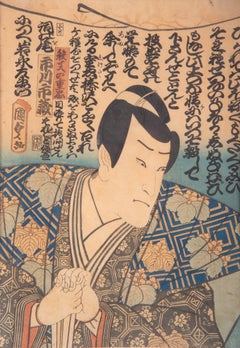
Kabuki Actor with Pine-Patterned Robe - Japanese Woodblock Print Finely detailed woodblock by Utagawa Toyokuni (Japanese, 1769-1825). A kabuki actor is standing on a wooden deck, wearing a robe with a pine-needle pattern. He is holding a sword and a staff. In the background, tree branches hang down from out of frame. Presented in a gold colored frame with a silk mat. Frame size: 20"H x 14.25"W Image size: 14"H x 8.5"W Utagawa Toyokuni (Japanese, 1769-1825) was born in Edo, the son of Kurahashi Gorobei, a carver of dolls and puppets...

Category

Early 19th Century Impressionist Utagawa Toyokuni Art

Materials

Ink, Rice Paper, Woodcut
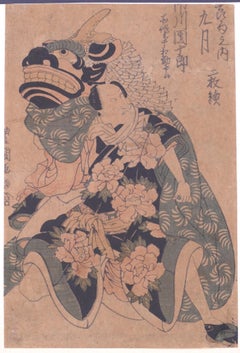
Actor Print - Woodcut by Utagawa Toyokuni - 19th Century

Actor Print - Woodcut by Utagawa Toyokuni - 19th Century

By Utagawa Toyokuni

Located in Roma, IT

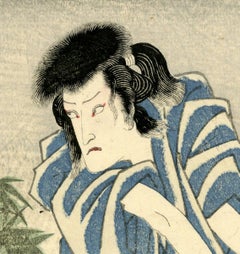
Polychrome woodblock print (nishiki-e) on paper Japan, Edo period, mid-19th century. A finely executed nishiki-e woodblock print depicting a dramatic scene from the Japanese theatri...

Category

19th Century Modern Utagawa Toyokuni Art

Materials

Woodcut

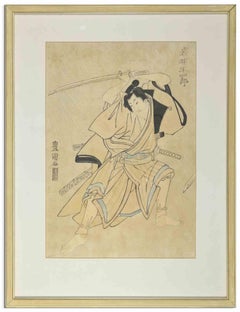
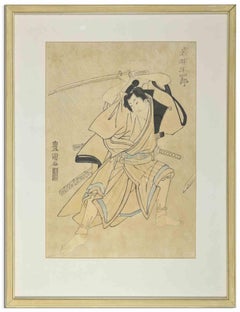
Kabuki Actor in Water Lily Robe with Samurai Sword - Japanese Woodblock Print

Kabuki Actor in Water Lily Robe with Samurai Sword - Japanese Woodblock Print

By Utagawa Toyokuni

Located in Soquel, CA

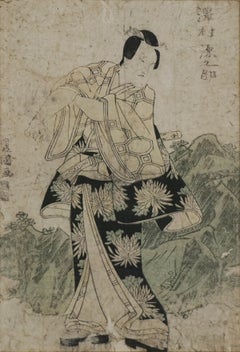
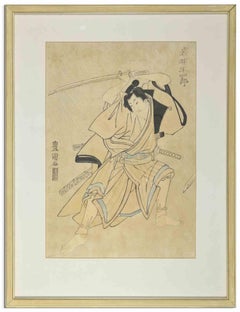
Kabuki Actor in Water Lily Robe with Samurai Sword- Japanese Woodblock Print Finely detailed woodblock by Utagawa Toyokuni (Japanese, 1769-1825). A kabuki actor ("Master Haranyuki Sawamura") is standing on stage with mountainous backdrop, wearing a robe in a water lily pattern. He is wearing a samurai sword. Presented in a gold colored frame with a silk mat. Frame size: 20"H x 14.25"W Image size: 14"H x 9"W Utagawa Toyokuni (Japanese, 1769-1825) was born in Edo, the son of Kurahashi Gorobei, a carver of dolls and puppets...

Category

Early 19th Century Edo Utagawa Toyokuni Art

Materials

Ink, Rice Paper, Woodcut
"Various Himochi" Wagashi Festival Japanese Woodblock Print by Utagawa Toyokuni

"Various Himochi" Wagashi Festival Japanese Woodblock Print by Utagawa Toyokuni

By Utagawa Toyokuni

Located in Soquel, CA

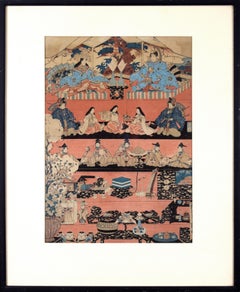
"Various Himochi" Wagashi Festival Japanese Woodblock Print by Utagawa Toyokuni Rare oversized early 19th century 5-tiered woodblock by Utagawa Ichiyosai Toyokuni, (Japan, 1769-1825), a Japanese lord and wife oversee a sekku festival of food, music, and dolls or toys. '"oshi" is the first day of “Mi (Snake)” in the third month of the lunar calendar. This day, known in modern Japan as the Girls' Festival, originated in China as a form of purification ceremony in which water and drinking peach blossom wine were used to drive away evil. Many kinds of hishi-mochi appear in this picture of hina ningyo (dolls associated with Hinamatsuri, or the Girl’s Day) from Omochae. The custom of eating special dishes at events throughout the year and at milestones in people's lives has existed since ancient times. This paragraph specifically focuses on the annual event called sekku, and life events that involve eating sweets. Joshi is the first day of “Mi (Snake)” in the third month of the lunar calendar. This day, known in modern Japan as the Girls' Festival, originated in China as a form of purification ceremony in which water and drinking peach blossom wine were used to drive away evil. According to the Keiso saijiki, in ancient China, on the third day of the third lunar month, people ate “ryuzetsuhan,” which is the juice of gogyo (Jersey cudweed) mixed with rice flour and nectar. In Japan, there is a record in the Heian period history book Nihon Montoku tenno jitsuroku [839-5] that it was an annual event to make kusamochi using gogyo on the third day of the third month of the lunar calendar, which may have been influenced by Chinese customs. The tradition of eating kusamochi on the third day of the third month of the lunar calendar continued after that. By the Edo period, however, hishimochi had come to be used as a sweet to serve on the third day of the third month. A picture of a hishimochi is included in the Morisada manko , which we mentioned in Part 1. According to it, hishimochi in the Edo period were often three layers of green-white-green instead of the now common red-white-green. However, it is possible to see from our collection that not all hishimochi were made in this way. Omochae published in 1857, is a good example. Omochae is a type of ukiyoe print...

Category

1820s Edo Utagawa Toyokuni Art

Materials

Ink, Rice Paper, Woodcut
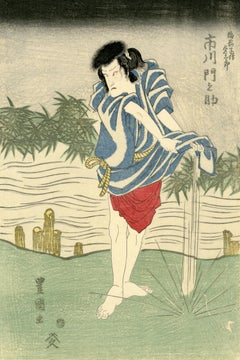
Inari Kozo Tasaburo- Kabuki

Inari Kozo Tasaburo- Kabuki

By Utagawa Toyokuni

Located in Fairlawn, OH

Inari Kozo Tasaburo- Kabuki Color woodcut, c. 1820 Signed: ‘Toyokuni’ Publisher: ‘Yamamoto Heikichi’ Censor: Hama and Magome Very good impression and color Sheet/Image size: 15 1/2 x...

Category

1820s Other Art Style Utagawa Toyokuni Art

Materials

Woodcut

Oriental Scene - Woodcut Print by Utagawa Toyokuni  - 1820s

Oriental Scene - Woodcut Print by Utagawa Toyokuni - 1820s

By Utagawa Toyokuni

Located in Roma, IT

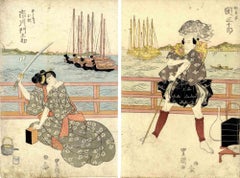
Oriental scene is an original modern artwork realized by Toyoukuni I in 1820-30. Woodcut Print Oban Format Scene on the veranda of a restaurant overlooking a bay with ships. Seki S...

Category

19th Century Modern Utagawa Toyokuni Art

Materials

Woodcut

Ichikawa Danjuro in the Role of Chobei - Woodcut by Utagawa Toyokuni  - 1810s

Ichikawa Danjuro in the Role of Chobei - Woodcut by Utagawa Toyokuni - 1810s

By Utagawa Toyokuni

Located in Roma, IT

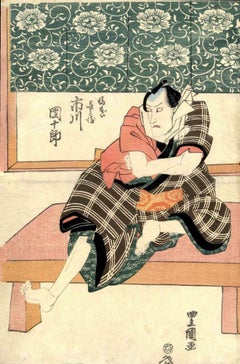
Ichikawa Danjuro in the role of Chobei is an original modern artwork realized by Utagawa Toyokuni (Edo, 1769 – Edo, 1825). Original Woodcut Print. Oban from a Triptych, around 1810. The actor Ichikawa Danjuro sitting on a bench and fretting, behind him a green curtain with peony motif. Signed: Toyokuni ga. Publisher: Yamamotoya Heikichi. Excellent impression, cut, centrefold, a little bit rubbed and soiled. Utagawa Toyokuni (Edo, 1769 – Edo, 1825), also often referred to as Toyokuni I...

Category

1810s Modern Utagawa Toyokuni Art

Materials

Woodcut

Related Items
Seishi Ai-oi Genji – Set of 12 Shunga works together w/astrological commentary

Seishi Ai-oi Genji – Set of 12 Shunga works together w/astrological commentary

By Utagawa Kunisada (Toyokuni III)

Located in Middletown, NY

Set of 12 woodblock prints in colors on handmade, laid mulberry paper, 6 3/4 x 10 1/4 inches (170 x 258 mm), printed in Ka-ei 4 (1851). Each print with minor handling wear, otherwise in excellent condition with bright and fresh color, and with details printed in silver ink. The images themselves contain several illusive characters indicating the publisher which are obfuscated by figures, as intended. Presented loose, as issued. A fine set. The astrological commentary print has a large and meandering blind stamp with a bird and palm frond motif. This print lists various phrases concerning the Twelve Zodiac Animals as historically counted in Japan, and appears to include erotic commentary on the traits of people born under each of the twelve signs. These Shunga images were issued in books that paralleled (in an erotic fashion...

Category

Mid-19th Century Edo Utagawa Toyokuni Art

Materials

Ink, Handmade Paper, Woodcut
Black Horse
Black Horse

Black Horse

By Tokuriki Tomikichiro

Located in Middletown, NY

circa 1950. Woodblock print in black and gray ink on Japon laid paper, 10 1/4 x 15 3/4 inches (260 x 398 mm), full margins. With the artist's embossed chop mark in red ink in the l...

Category

Mid-20th Century Edo Utagawa Toyokuni Art

Materials

Handmade Paper, Woodcut
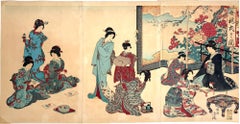
Plucking a Branch from a Neighbor's Plum Tree

Plucking a Branch from a Neighbor's Plum Tree

By Suzuki (Hozumi) Harunobu

Located in Middletown, NY

A mischievous tableau with sexual overtones. Tokyo: Shuei-Sha, 1768. Woodblock print in colors printed on laid mulberry paper, 10 3/4 x 7 7/8 inches (273 x 200 mm), full margins. I...

Category

Mid-18th Century Edo Utagawa Toyokuni Art

Materials

Watercolor, Handmade Paper, Woodcut
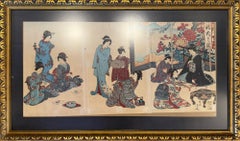
Apollo, plate 11 from the series of The Gods in Niches

Apollo, plate 11 from the series of The Gods in Niches

Located in Middletown, NY

by Jacopo Caraglio (after Rosso Fiorentino) Rome: Carlo Losi, 1526. Engraving on cream laid paper, 8 1/2 x 4 3/8 inches, 215 x 110 mm), thread margins. In very good condition with a...

Category

17th Century Old Masters Utagawa Toyokuni Art

Materials

Laid Paper, Handmade Paper, Engraving

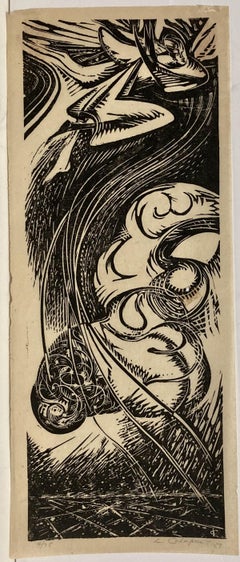
Modern American Industrial Landscape

Modern American Industrial Landscape

Located in Buffalo, NY

An original woodblock print dated 1965, titled "Our Town" but signed illegibly.

Category

1960s American Modern Utagawa Toyokuni Art

Materials

Paper, Woodcut
La Reine Marie d'Angleterre (Queen Mary of England) /// Old Masters Royal Family

La Reine Marie d'Angleterre (Queen Mary of England) /// Old Masters Royal Family

By Georges Henri Manesse

Located in Saint Augustine, FL

Artist: Georges Henri Manesse (French, 1854-1940) Title: "La Reine Marie d'Angleterre (Queen Mary of England)" Portfolio: Gazette des Beaux-Arts Year: 1893 Medium: Original Etching on cream laid paper Limited edition: approx. 1,500 Printer: Chardon Wittman, Paris, France Publisher: Gazette des Beaux-Arts, Paris, France Sheet size: 10.69" x 7.13" Image size: 7" x 5.25" Reference: Sanchez/Seydoux 1893-7 Condition: Light discoloration at edges. It is otherwise a strong impression in excellent condition Notes: This etching is after a painting from 1554 by Dutch artist Anthonis Mor (c. 1517-1577). Comes with its original tissue cover sleeve. This etching was published by Gazette des Beaux-Arts. The Gazette des Beaux-Arts was a French art review, found in 1859 by Édouard Houssaye, with Charles Blanc as its first chief editor. Assia Visson Rubinstein was chief editor under the direction of George Wildenstein from 1928 until 1960. Her papers, which include all editions of the Gazette from this period, are intact at the Cantonal and University Library of Lausanne in Dorigny. The Gazette was a world reference work on art history for nearly 100 years - one other editor in chief, from 1955 to 1987, was Jean Adhémar. It was bought in 1928 by the Wildenstein family, whose last representative was Daniel Wildenstein, its director from 1963 until his death in 2001. The review closed in 2002. Mary I...

Category

1890s Old Masters Utagawa Toyokuni Art

Materials

Laid Paper, Etching, Intaglio

Portrait of an infamous thief

Portrait of an infamous thief

By Abraham Bosse

Located in Middletown, NY

A fascinating image of a well-known theif robbing a merchant of goods held atop her head. Paris: circa 1670. Etching and engraving on cream laid paper, 6 3/4 x 4 15/16 inches (17...

Category

Mid-18th Century Old Masters Utagawa Toyokuni Art

Materials

Handmade Paper, Engraving, Etching

No Footprints Show, Where the Flowers Grow Deep

No Footprints Show, Where the Flowers Grow Deep

By Shiko Munakata

Located in Fairlawn, OH

No Footprints Show, Where the Flowers Grow Deep Woodcut, 1961 Unsigned (as isssued) From: The "Way" of the Woodcut, three woodcuts, 1961 Publisher: Pratt Adlib Press, Brooklyn, New Y...

Category

1960s Modern Utagawa Toyokuni Art

Materials

Woodcut

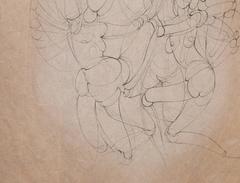
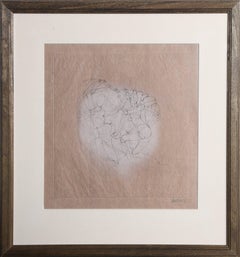
VIII from Les Marionnettes, Surrealist Gouache and Drypoint by Hans Bellmer

VIII from Les Marionnettes, Surrealist Gouache and Drypoint by Hans Bellmer

By Hans Bellmer

Located in Long Island City, NY

Artist: Hans Bellmer, German (1902 - 1975) Title: VIII from Les Marionnettes Year: 1969 Medium: Hand-colored Drypoint Etching on Rice Paper, signed in pencil Image Size: 12 x 11 inch...

Category

1960s Surrealist Utagawa Toyokuni Art

Materials

Gouache, Rice Paper, Drypoint

Walter DuBois Richards, The Lobster Float

Walter DuBois Richards, The Lobster Float

By Walter DuBois Richards

Located in New York, NY

Ohio-born Walter DuBois Richards (1907-2006) was educated at the Cleveland School of Art. He re-located to New York around 1933 where he had a successful career as a commercial artis...

Category

1930s American Modern Utagawa Toyokuni Art

Materials

Woodcut

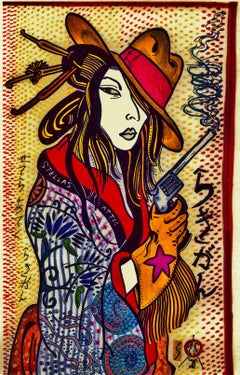
Lucky Gun

Zane FixLucky Gun, 2016

$550

H 17 in W 11 in

Lucky Gun

By Zane Fix

Located in East Hampton, NY

Unframed World-renowned guru of Jap Pop Art - Zane Fix, is an American artist, born in Brooklyn, New York. The art of Zane Fix blends both the intensity and simplicity of Japanese ...

Category

2010s Pop Art Utagawa Toyokuni Art

Materials

Rice Paper, Archival Pigment

16thCentury German Northern Renaissance Woodcut Print Adam & Eve Baron Von Lanna

16thCentury German Northern Renaissance Woodcut Print Adam & Eve Baron Von Lanna

Located in Portland, OR

A rare and important monumental woodcut on paper, Adam and Eve by Hans Burgkmair the Elder ( 1473-1531 Augsburg, Germany ), circa 1525. From the collection of Baron Adalbert von Lann...

Category

16th Century Northern Renaissance Utagawa Toyokuni Art

Materials

Handmade Paper, Woodcut
Previously Available Items
Actor Iwai Hanshiro as a Samurai by Utagawa Toyokuni I - Early 19th Century

Actor Iwai Hanshiro as a Samurai by Utagawa Toyokuni I - Early 19th Century

By Utagawa Toyokuni

Located in Roma, IT

Actor Iwai Hanshiro as a Samurai is an artwork realized by Utagawa Toyokuni (1769-1825), in the early 19th Century Color woodcut, signed or inscribed in the top right and bottom lef...

Category

Early 19th Century Modern Utagawa Toyokuni Art

Materials

Woodcut
Ichikawa Danjuro VII

Ichikawa Danjuro VII

By Utagawa Toyokuni

Located in Austin, TX

Artist: Utagawa Toyokuni I Title: Ichikawa Danjuro VII Medium: Color woodblock print Origin: Japan Date: 1786 Dimensions: 8.5 inches height x 7.5 in width T...

Category

Late 18th Century Edo Utagawa Toyokuni Art

Materials

Woodcut
Three Beauties by a River Japanese Woodblock Print

Three Beauties by a River Japanese Woodblock Print

By Utagawa Toyokuni

Located in Houston, TX

Japanese woodblock print of three beauties by a river. The work has some age to it. it is stamped by the artist. The woodblock print is printed on rice paper. The print is not framed. Artist Biography: The son of a puppet sculptor, Toyokuni was born and worked in Edo. Entering the studio of Toyoharu at the age of 14, Toyokuni drew inspiration from the famous contemporary artists around him, particularly from the great Utamaro. Toyokuni produced elegant courtesans, fine actor prints...

Category

Late 18th Century Edo Utagawa Toyokuni Art

Materials

Woodcut
Utagawa Toyokuni art for sale on 1stDibs.

Find a wide variety of authentic Utagawa Toyokuni art available for sale on 1stDibs. You can also browse by medium to find art by Utagawa Toyokuni in woodcut print and more. Much of the original work by this artist or collective was created during the 19th century and is mostly associated with the modern style. Not every interior allows for large Utagawa Toyokuni art, so small editions measuring 9 inches across are available. Customers who are interested in this artist might also find the work of Lucien Métivet, Robert De Launay, and Frank Kleinholz. Utagawa Toyokuni art prices can differ depending upon medium, time period and other attributes. On 1stDibs, the price for these items starts at $627 and tops out at $719, while the average work can sell for $627.
Artists Similar to Utagawa Toyokuni