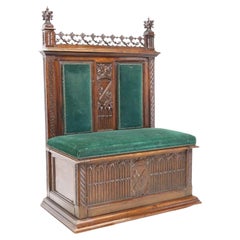
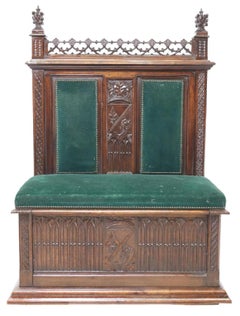
The Gothic Revival movement (also called Victorian Gothic or Neo-Gothic) emerged in Britain in the 1740s, and reached its height in the late-19th century. Gothic Revival furniture's characteristics include such decorative flourishes as pointed arches, floral details, finials, heraldic motifs and linenfold carving.
The movement was rooted in religious and social conservatism. Gothic Revival's proponents, who included Charles Barry and A.W.N. Pugin, the architects of London’s Houses of Parliament (designed in 1840), believed that the art and architecture of the Middle Ages were authentically spiritual and inherently moral.
In the United States, the Gothic Revival movement shaped both public buildings and private houses. Numerous American schools were built in the early-19th century in a style now called Collegiate Gothic. Many builders and craftsmen were inspired by Andrew Jackson Downing’s widely read 1850 book Architecture for Country Houses, which posited that a family’s home should exemplify their values — and that the Gothic Revival style was particularly well-suited to scholars and clergymen. Furniture with detailing that mirrored that of Gothic Revival buildings appeared in the same period. Such pieces typically feature dark, intricately carved wood, and upholstery in velvet or leather.
Much like the castles or cathedrals that inspired them, Gothic Revival chairs, bookcases and beds make a bold design statement. And while you probably don’t have to cross a moat or raise a portcullis to get through your front door, a Gothic Revival piece will declare that your home is indeed your castle.
Don’t underestimate a good bench — antique and vintage benches are storage pieces, stylish accents and statement-making additional seating.
Today, benches are a great option to maximize seating in your house and outdoor space. The perfect option to create a warm, welcoming atmosphere in foyers and entryways, benches can also transform dining areas, making it possible to host a hungry family with limited space. Whether you’re sprucing up your entertaining with upholstered Empire-style benches or adding more options to a dining room that’s seen a farmhouse makeover, this humble furnishing has only become more versatile over the years. Designers have recognized the demand for a good bench, crafting the convenient seating alternative from a range of materials, including wood, iron and even concrete.
Mid-century modern benches from George Nakashima, Charlotte Perriand and the pared-down Platform bench by George Nelson for Herman Miller are classics of innovation, but maybe you’re looking for an unconventional design approach to your home's seating. Opt for something totally outside the box — an antique pine church-pew bench paired with a vintage wool throw and stationed under the mounted coatrack in your mudroom is a distinctive touch.
For your outdoor oasis, a wrought-iron patio bench is the obvious choice but not the only option. An enclosed back patio would do well to inherit a rattan bench with cushions, but it can be susceptible to weathering and should be covered or moved indoors when not in use.
Whatever your seating arrangement needs are, find vintage, new and antique benches for every space on 1stDibs.