(after) Auguste Rodin
Posthumous cast
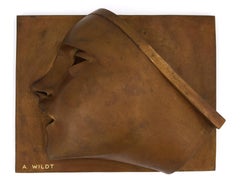
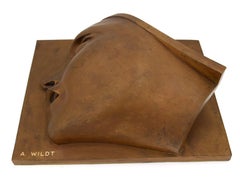
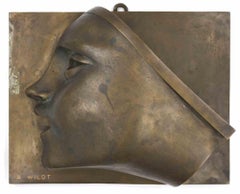
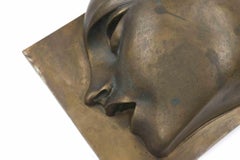
"Petite tete au nez retroussé"
Featuring a bust of a woman.
Limited edition bronze is mounted on a marble base and is signed on the lower right. Great detail.
Dimensions: approx. 7-1/4" tall x 5" across x 5" deep with base
Foundry mark on the reverse, #13 of 299 produced.
François Auguste René Rodin (1840 – 1917) was a French sculptor generally considered the founder of modern sculpture. Rodin possessed a unique ability to model a complex, turbulent, and deeply pocketed surface in clay. He is known for such sculptures as The Thinker, Monument to Balzac, The Kiss, The Burghers of Calais, and The Gates of Hell. He modeled the human body with naturalism, and his sculptures celebrate individual character and physicality. Although Rodin was sensitive to the controversy surrounding his work, he refused to change his style, and his continued output brought increasing favor from the government and the artistic community.
Rodin became the preeminent French sculptor of his time. By 1900, he was a world-renowned artist. Wealthy private clients sought Rodin's work after his World's Fair exhibit, and he kept company with a variety of high-profile intellectuals and artists. His student, Camille Claudel, became his associate, lover, and creative rival. Rodin's other students included Antoine Bourdelle, Constantin Brancusi, and Charles Despiau.
Rodin entered the studio of Albert-Ernest Carrier-Belleuse, a successful mass producer of objets d'art. Rodin worked as Carrier-Belleuse' chief assistant until 1870, designing roof decorations and staircase and doorway embellishments. With the arrival of the Franco-Prussian War, Rodin was called to serve in the French National Guard, but his service was brief due to his near-sightedness. Rodin took classes with animal sculptor Antoine-Louis Barye. The teacher's attention to detail and his finely rendered musculature of animals in motion significantly influenced Rodin. Rodin won the 1880 commission to create a portal for a planned museum of decorative arts. Rodin dedicated much of the next four decades to his elaborate Gates of Hell, an unfinished portal for a museum that was never built. Many of the portal's figures became sculptures in themselves, including Rodin's most famous, The Thinker and The Kiss. With the museum commission came a free studio, granting Rodin a new level of artistic freedom.
By 1900, Rodin's artistic reputation was established. Gaining exposure from a pavilion of his artwork set up near the 1900 World's Fair (Exposition Universelle) in Paris, he received requests to make busts of prominent people internationally, As Rodin's fame grew, he attracted many followers, including the German poet Rainer Maria Rilke, and authors Octave Mirbeau, Joris-Karl Huysmans, and Oscar Wilde.
Rodin and Beuret's modest country estate in Meudon, purchased in 1897, was a host to such guests as King Edward, dancer Isadora Duncan, and harpsichordist Wanda Landowska. He left Beuret in Meudon and began an affair with the American-born Duchesse de Choiseul. From 1910, he mentored the Russian sculptor,
Moissey Kogan...