After Edward Detmold Art

to
5
5
1
1
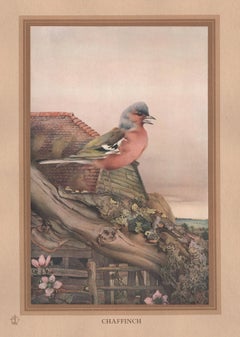
'Chaffinch', English bird print after Edward Detmold, circa 1919

'Chaffinch', English bird print after Edward Detmold, circa 1919

By After Edward Detmold

Located in Melbourne, Victoria

'Chaffinch' Colour plate mounted on card with a printed border from 'The Detmold Nature Pictures', published circa 1919. Edward J Detmold (1883-1957) was an important early 20th century illustrator...

Category

Early 20th Century Naturalistic After Edward Detmold Art
Materials

Color

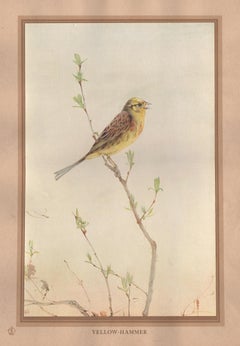
'Yellow-Hammer', English bird print after Edward Detmold, circa 1919

'Yellow-Hammer', English bird print after Edward Detmold, circa 1919

By After Edward Detmold

Located in Melbourne, Victoria

'Yellow-Hammer' Colour plate mounted on card with a printed border from 'The Detmold Nature Pictures', published circa 1919. Edward J Detmold (1883-1957) was an important early 20th century...

Category

Early 20th Century Naturalistic After Edward Detmold Art
Materials

Color

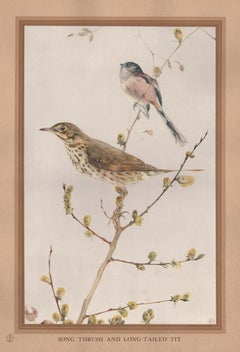
'Song Thrush and Long-Tail Tit', bird print after Edward Detmold, circa 1919

'Song Thrush and Long-Tail Tit', bird print after Edward Detmold, circa 1919

By After Edward Detmold

Located in Melbourne, Victoria

'Song Thrush and Long-Tail Tit' Colour plate mounted on card with a printed border from 'The Detmold Nature Pictures', published circa 1919. Edward J Detmold (1883-1957) was an important early 20th...

Category

Early 20th Century Naturalistic After Edward Detmold Art
Materials

Color

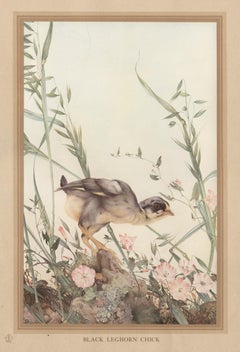
'Black Leghorn Chick', English bird print after Edward Detmold, circa 1919

'Black Leghorn Chick', English bird print after Edward Detmold, circa 1919

By After Edward Detmold

Located in Melbourne, Victoria

'Black Leghorn Chick' Colour plate mounted on card with a printed border from 'The Detmold Nature Pictures', published circa 1919. Edward J Detmold (1883-1957) was an important early 20th century...

Category

Early 20th Century Naturalistic After Edward Detmold Art
Materials

Color

Related Items
Tree with moth, caterpillar..., Plate 39, Metamorphosis Insectorum Surinamensium

Tree with moth, caterpillar..., Plate 39, Metamorphosis Insectorum Surinamensium

By Maria Sibylla Merian

Located in Middletown, NY

Metamorphosis Insectorum Surinamensium, Plate No. 39; Unidentified tree with moth, caterpillar and pupa. The Netherlands: 1705....

Category

Early 18th Century Naturalistic After Edward Detmold Art
Materials

Watercolor, Engraving

Green Painted Sea Shell Lithograph Edition 33 of 34

Green Painted Sea Shell Lithograph Edition 33 of 34

By Frances Nail

Located in Houston, TX

Green shell lithograph of a cone shell. Print is edition 33 of 34. Signed and dated by the artist along with titled. Print is framed in a golden frame...

Category

1970s Naturalistic After Edward Detmold Art
Materials

Lithograph

4 plates from The Wondrous Transformation of Caterpillars & their Strange Diet..

4 plates from The Wondrous Transformation of Caterpillars & their Strange Diet..

By Maria Sibylla Merian

Located in Middletown, NY

Four plates from The Wondrous Transformation of Caterpillars and their Strange Diet of Flowers. “Wolfsmelk Rupsen;" “Wolfsmilch, Raupe und Schmetterling" Amsterdam: J F Bernard, 1730. Each an engraving with hand coloring in watercolor and gouache printed on one sheet of watermarked Honig cream laid paper, each measures 6 1/4 x 5 inches (157 x 121 mm), sheet measures 20 5/8 x 14 inches (522 x 355 mm), full margins. With handling creases in the lower right sheet quadrant, as well as minor, loose cockling, otherwise in very good condition. The colors are superb with exceptionally fresh and bright saturation. Engraved between 1679 and 1683, printed 1730. Plates included: No.1:I; No. 2:1; II & III. MARIA SIBYLLA MERIAN was one of the most highly respected entomologists of the 17th century, and remains today one of the field's most significant figures. A German-born naturalist and scientific illustrator, she reared herself on the study of caterpillars, and made tremendous contributions to the knowledge of the life cycles of numerous species. Until her detailed and careful study of the process of metamorphosis it was thought that insects were "born of mud," through spontaneous generation. Trained as a miniature painter by her stepfather, she published her first book of illustrations in 1675, at the age of 28. In 1679, Merian published the first volume of the two-volume series on caterpillars, The Wondrous Transformation of Caterpillars and their Strange Diet of Flowers; the second volume followed in 1683. Each volume contained 50 plates that she engraved and etched. In 1699, Merian traveled to Dutch Guiana...

Category

Early 18th Century Naturalistic After Edward Detmold Art
Materials

Watercolor, Engraving

Gunner Riding - Original Etching by Giovanni Fattori - 1900 ca.

Gunner Riding - Original Etching by Giovanni Fattori - 1900 ca.

By Giovanni Fattori

Located in Roma, IT

Image dimensions: 16.5x10 cm Signed on plate by the artist. Bibliography: A.Baboni, L’Ottocento: le incisioni di Giovanni Fattori, Museo Civico “Giovanni Fattori”, Livorno 2001, p. 7...

Category

Early 1900s Naturalistic After Edward Detmold Art
Materials

Etching

The Fox Terrier, Smooth and Rough

The Fox Terrier, Smooth and Rough

By Baker

Located in Columbia, MO

The Fox Terrier, Smooth and Rough 1887 Etching

Category

Late 19th Century Naturalistic After Edward Detmold Art
Materials

Etching

A Lying Animal - Original Lithograph by F. Specht - 1880

A Lying Animal - Original Lithograph by F. Specht - 1880

By Friedrich Specht 1

Located in Roma, IT

A Lying Animal is a black and white print realized by Friedrich Specht in 1880. Lithograph on dark paper. Original Title: Derendet. Dated 1880, p.24. Signed by the artist on the r...

Category

1870s Naturalistic After Edward Detmold Art
Materials

Lithograph

Cangaroos in Danger - Lithograph by F. Specht - 1879

Cangaroos in Danger - Lithograph by F. Specht - 1879

By Friedrich Specht 1

Located in Roma, IT

Cangaroos in Danger is a black and white lithograph realized by Friedrich Specht in 1879. Image dimensions: 19,7 x 13,7 cm. Original Title: Am Auftralifchen "Bufch". Dated 1879 an...

Category

1870s Naturalistic After Edward Detmold Art
Materials

Lithograph

Naturalistic Modern Texas Bobcat Black and White Animal Wildlife Print

Naturalistic Modern Texas Bobcat Black and White Animal Wildlife Print

By Charles Beckendorf

Located in Houston, TX

A signed and numbered print of a bobcat from Texas artist Charles Beckendorf. Charles did the original in pencil for this series. The print is displayed in a chrome frame and white m...

Category

1960s Naturalistic After Edward Detmold Art
Materials

Paper, Black and White

Japan Australia's Overseas Airline Qantas original vintage travel poster

Japan Australia's Overseas Airline Qantas original vintage travel poster

By Harry Rogers

Located in Spokane, WA

Original large format Qantas Japan Australia's Overseas Airline vintage travel poster. This antique poster is archival linen backed and in very fine condition. This image was al...

Category

1950s Naturalistic After Edward Detmold Art
Materials

Lithograph

Nasiterna Pygmae
Nasiterna Pygmae

Nasiterna Pygmae

By John Gould

Located in Missouri, MO

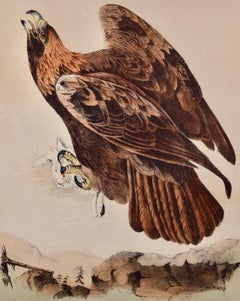
John Gould (British, 1804-1881) Nasiterna Pygmae c. 1849-1861 Hand Colored Lithograph Image Size: approx 19.5 x 13.5 inches Framed Size: 27 3/8 x 21 1/2 inches John Gould was an English ornithologist and bird artist. The Gould League in Australia was named after him. His identification of the birds now nicknamed "Darwin's finches" played a role in the inception of Darwin's theory of evolution by natural selection. Gould's work is referenced in Charles Darwin's book, On the Origin of Species. Gould was born in Lyme Regis, Dorset, the son of a gardener, and the boy probably had a scanty education. Shortly afterwards his father obtained a position on an estate near Guildford, Surrey, and then in 1818 became foreman in the Royal Gardens of Windsor. He was for some time under the care of J T Aiton, of the Royal Gardens of Windsor. The young Gould started training as a gardener, being employed under his father at Windsor from 1818 to 1824, and he was subsequently a gardener at Ripley Castle in Yorkshire. He became an expert in the art of taxidermy, and in 1824 he set himself up in business in London as a taxidermist, and his skill led to him becoming the first Curator and Preserver at the museum of the Zoological Society of London in 1827. Gould's position brought him into contact with the country's leading naturalists, and also meant that he was often the first to see new collections of birds given to the Society. In 1830 a collection of birds arrived from the Himalayas, many not previously described. Gould published these birds in A Century of Birds from the Himalaya Mountains (1830-1832). The text was by Nicholas Aylward Vigors, and the illustrations were lithographed by Gould's wife Elizabeth, daughter of Nicholas Coxen of Kent. This work was followed by four more in the next seven years including Birds of Europe in five volumes - completed in 1837, with the text written by Gould himself, edited by his clerk Edwin Prince. Some of the illustrations were made by Edward Lear as part of his Illustrations of the Family of Psittacidae in 1832. Lear however was in financial difficulty, and he sold the entire set of lithographs to Gould. The books were published in a very large size, imperial folio, with magnificent coloured plates. Eventually 41 of these volumes were published with about 3000 plates. They appeared in parts at £3 3s. a number, subscribed for in advance, and in spite of the heavy expense of preparing the plates, Gould succeeded in making his ventures pay and in realizing a fortune. In 1838 he and his wife moved to Australia to work on the Birds of Australia and shortly after his return to England, his wife died in 1841. When Charles Darwin presented his mammal and bird specimens collected during the second voyage of HMS Beagle to the Geological Society of London at their meeting on 4 January 1837, the bird specimens were given to Gould for identification. He set aside his paying work and at the next meeting on 10 January reported that birds from the Galápagos Islands, which Darwin had thought were blackbirds, "gross-bills" and finches were in fact "a series of ground Finches which are so peculiar" as to form "an entirely new group, containing 12 species." This story made the newspapers. In March, Darwin met Gould again, learning that his Galápagos "wren" was another species of finch and the mockingbirds he had labeled by island were separate species rather than just varieties, with relatives on the South American mainland. Subsequently Gould advised that the smaller southern Rhea specimen that had been rescued from a Christmas dinner...

Category

Mid-19th Century Naturalistic After Edward Detmold Art
Materials

Lithograph

After Edward Detmold art for sale on 1stDibs.

Find a wide variety of authentic After Edward Detmold art available for sale on 1stDibs. Not every interior allows for large After Edward Detmold art, so small editions measuring 9 inches across are available. After Edward Detmold art prices can differ depending upon medium, time period and other attributes. On 1stDibs, the price for these items starts at $350 and tops out at $350, while the average work can sell for $350.
Questions About After Edward Detmold Art
  • 1stDibs ExpertApril 5, 2022
    Famed American photographer Edward Weston was based in California, where he moved when he was 21 from his native Illinois. From there, he developed his trailblazing career that has won him dedicated fans worldwide. Shop a collection of expertly-vetted Edward Weston photography from some of the world’s top sellers on 1stDibs.
  • 1stDibs ExpertApril 5, 2022
    Edward Weston (1886 - 1958) is best known for his photographs of nudes, natural forms and landscapes, which are largely focused on the American West. His highly detailed photographs have a captivating, dark tone. Weston the first photographer to earn a Guggenheim Fellowship and was best known for using an 8×10 view camera, primarily for his black and white "landscape-like." Shop a selection of Edward West pieces from some of the world's top art dealers on 1stDibs.
  • 1stDibs ExpertApril 5, 2022
    Edward Hopper is a realist painter known for his oil paintings. One of his most recognizable pieces is ‘Nighthawks’, a moody scene that portrays four people in a downtown diner late at night. Shop a selection of Fernando Botero pieces from some of the world’s top art dealers on 1stDibs.
  • 1stDibs ExpertApril 5, 2022
    Famed painter Edward Hopper passed away in 1967, his wife, heir to his works, bequeathed their joint collections to the Whitney Museum of American Art. While the Whitney has most of his work, you can still see important paintings by Hopper at the Museum of Modern Art in New York, the Des Moines Art Center and the Art Institute of Chicago. On 1stDibs, find a variety of original artwork from top artists.
  • 1stDibs ExpertJanuary 10, 2025
    Edward Gorey is famous for his art and writing. He possessed a distinctive style, using pen and ink to produce macabre, darkly humorous drawings. In addition to appearing in publications such as the New Yorker and the New York Times, he illustrated his own books, such as The Unstrung Harp. On 1stDibs, find a diverse assortment of illustrations.
  • 1stDibs ExpertOctober 24, 2024
    What an Edward Hopper painting is worth depends on its size, condition, historical significance and other factors. In 2018, his painting Chop Suey fetched more than $91.8 million at a New York auction. Depicting two women chatting face-to-face in a restaurant, the oil painting is an excellent example of Hopper's interest in capturing the everyday lives of people living in New York City during the first half of the 20th century. In Hopper’s vision, the people inhabiting his city and suburban scenes are often lonely, anonymous, temporary inhabitants of sometimes inhospitable environments. When there is no human element, he transfers these qualities to the architecture or even to the landscape itself, using intense light to infuse emotion. If you own a Hopper painting, a certified appraiser or knowledgeable art dealer can assist you with the valuation process. Shop an assortment of Edward Hopper art on 1stDibs.
  • 1stDibs ExpertApril 5, 2022
    Photographer Edward Weston was best-known for his photos of natural forms, landscapes and nudes. His approach was to take a large-format camera and create sharply focused black and white photographs with no effects used to change the images. His art is known as straight photography and helped change the way photographers of that era expressed their vision. On 1stDibs, find a variety of original artwork from top artists.
  • 1stDibs ExpertMarch 25, 2024
    Edward Hopper used a variety of materials to produce his art. His most famous works, including the iconic Nighthawks, are oil paintings on canvas. However, Hopper also experimented with watercolors and etchings. Find a selection of Edward Hopper art from some of the world's top galleries and dealers on 1stDibs.
  • 1stDibs ExpertSeptember 23, 2024
    To identify Ken Edwards pottery, look at the bottom, where you will usually find maker's markings. Artists working for the maker often hand-paint the Ken Edwards brand name or the initials “KE” on the pieces they produce. A painted animal frequently accompanies the brand signature and identifies the specific artist who produced it. You can find images of all the pieces in the Traditional and Collection series on the official Ken Edwards website; these pictures can be helpful in the identification process. A certified appraiser or knowledgeable dealer can also aid you in making an identification. Shop a range of Ken Edwards pottery on 1stDibs.
  • 1stDibs ExpertAugust 8, 2024
    Edward Wormley used a variety of materials over the course of his career. Among them were laminated wood, brass, marble and silk. Not an axiomatic modernist, Wormley deeply appreciated traditional design, and consequently, his vintage seating, storage cabinets, bar carts and other work have an understated warmth and a timeless quality that sets them apart from other furnishings of the era. On 1stDibs, explore a diverse assortment of Edward Wormley furniture.
  • 1stDibs ExpertApril 16, 2024
    Edward Hopper's paintings are located in many places. The Whitney Museum of American Art in New York City is home to the largest collection of the artist's work. You'll also find his pieces in other museum collections, such as the Museum of Modern Art in New York City; the Amon Carter Museum of American Art in Fort Worth, Texas; Newfields in Indianapolis, Indiana; the National Gallery of Art in Washington, D.C. and the Museum of Fine Arts in Boston, Massachusetts. Explore a variety of Edward Hopper art on 1stDibs.
  • 1stDibs ExpertMarch 22, 2022
    Edward Weston primarily did landscape and nature photography, but he also produced a number of nudes. He is well known for his methodical approach to composition and his use of focus. Shop a collection of Edward Weston photographic art on 1stDibs.
  • 1stDibs ExpertSeptember 4, 2024
    Yes, Holmes & Edwards inlaid silverware and other objects are made with real silver. While the company manufactured many types of tableware, including pieces made of solid silver and silver-plated objects, the American manufacturer's inlaid silverware owed to a unique inlay manufacturing process pioneered by Holmes & Edwards. The process, which was patented by New York inventor William A. Warner and acquired by the firm, involved inserting extra sterling silver into key areas of utensils to reduce wear and tear. Find antique Holmes & Edwards silver and other sterling silver objects for sale on 1stDibs.
  • 1stDibs ExpertApril 5, 2022
    Edward Weston is a 20th-century American photographer. Weston is known for his meticulously composed and focused images of nudes, still life and landscape subjects, and his work inspired a generation of future photographers. Browse a collection of Edward Weston’s work on 1stDibs.