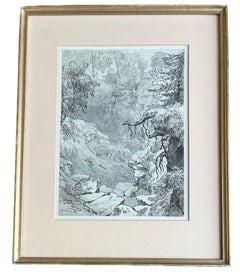
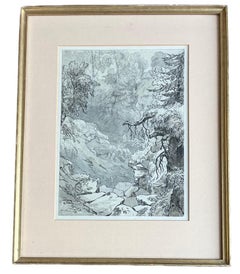
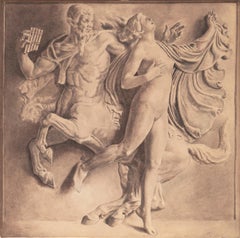
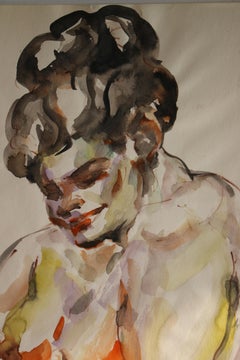
A very attractive and meticulously executed view of a rocky landscape within the woods dating to 1823. This would suit a library or study with its muted tones and skifull draughtsmanship.
William Nicholson (1781-1844)
Near Croxdale Hall
Signed with initials and inscribed with title and date 1823
Pen, ink and grey wash
11 x 8 inches, image only
17 x 13 inches without frame
The portrait-painter and etcher William Nicholson was born in Ovingham-on-Tyne, Northumberland, on Christmas Day 1781. His family transferred to Newcastle when his father was appointed Headmaster of the city's Grammar School. At an early age, though, Nicholson appears to have moved to Hull where he made his artistic debut, painting miniatures of officers garrisoned there. He was almost entirely self-taught, learning his craft through the close study of artworks in private and public galleries. He subsequently returned to Newcastle where he received many commissions to paint portraits of the old families of Northumberland. In 1808, he began to exhibit at the Royal Academy, continuing to do so until 1822. By 1814, Nicholson, whose mother was a Scot, had moved to Edinburgh where he set up as a miniaturist and painter in oils. Soon, however, he began to specialize in watercolour portraits. Early subjects included the actor Daniel Terry and the poet and novelist James Hogg. In 1818 he began to publish a series of Portraits of Eminent Scotsmen, etched from his own portraits and those of other painters. Besides Scott and Hogg, the subjects included the writers Robert Burns, John Wilson ('Christopher North'), and Lord Jeffrey, the painters Sir Henry Raeburn, the divines Alexander Carlyle and Alexander Cameron, the engineer James Watt, the architect John Playfair, and the song-collector and composer George Thomson...
Category
Early 19th Century Academic Alan Farrell Art
MaterialsPaper, Watercolor, Ink, Pen