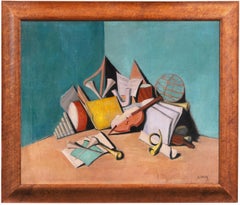
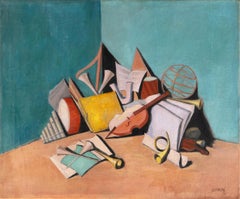
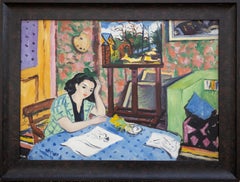
“Still Life, 1936” by Katharine "Kitty" Duff Church (British, 1910-1999).
This large, early painting by Katherine Church is among her finest canvases of the period. Characterized by its bold color palette, simplified forms, and expressive brushwork, this composition centers around a tabletop adorned with various objects: potted plants, a ceramic dish, bottles, and what appear to be books or papers.
The two potted plants provide contrasting elements: on the left, what appears to be a cyclamen with red blossoms and delicate leaves, and on the right, a lush green plant with darker foliage. These plants, painted with loose, textured strokes, add an organic quality to the otherwise structured arrangement.
The tabletop is cluttered yet thoughtfully composed, featuring additional objects like a clear, faceted glass bowl, a small bottle, and books or pads in striking red and green. The dynamic use of color blocks and the juxtaposition of shapes (round pots against rectangular books) create a sense of rhythm and harmony.
The background is darker and less defined, emphasizing the brightly lit tabletop. Church's brushwork is gestural and modernist, leaning toward abstraction, challenging traditional still life conventions.
This painting reflects Church’s interest in balancing everyday objects with bold artistic expression. It conveys both the simplicity and complexity of daily life, transforming an ordinary moment into a vibrant and engaging work of art.
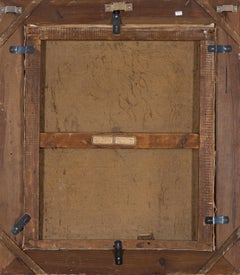
This work is oil on canvas and is signed and dated in the lower right. It is housed in its original gessoed frame and retains various labels and inscriptions on the reverse.
Size:
28.25 inches tall by 36 inches wide (painting)
34 inches tall by 42 inches wide by 2 inches deep (frame)
Provenance:
Private collection, NY;
Acquired from the above
About the artist:
Born in Highgate, north London, Katharine Church, known as ‘Kitty’ amongst friends and family, always wanted to paint. She trained at the Royal Academy of Arts between 1930-1933 and at the Slade between 1933 and 1934. In her early years Kitty exhibited regularly at the Royal Academy. Her first solo exhibition was in 1933 at the Wertheim Gallery. Other artists who exhibited there included Christopher Wood, Victor Pasmore and Cedric Morris. Kitty also showed with the New English Art Club, the London Group and between 1937-1947 her work was exhibited at the influential Lefevre Gallery, which supported avant-garde artists such as Henry Moore, Ben Nicholson and Barbara Hepworth. In 1954 the artist was invited to take part in the Figures in their setting exhibition held at the Tate Gallery.
Henry Tonks and Philip Wilson Steer had a strong influence on Kitty’s early work, but it was her friendship with Ivon Hitchens that liberated her painting technique.
In 1936 Kitty married Anthony West, the son of writers Rebecca West and H.G. Wells. The couple initially lived in London before moving to Quarry Farm, Chicksgrove, Tisbury, near Salisbury, where they brought up their children Caroline and Edmund. There they hosted many of their friends, including the New Zealand painter Frances Hodgkins. Other regular visitors before the War included John and Mywafany Piper, Ralph and Frances Partridge, Noel and Catharine Carrington, Julian Trevelyan and Mary Fedden. For many of those who visited Kitty would organise painting expeditions. After the war Kitty and Anthony separated, with Anthony moving to the United States.
Anthony West moved to the United States to work as a journalist for The New Yorker. In the early years after their parting Kitty visited most years with the children.
In the 1960s Kitty purchased Sutton House and ran the Hambledon Gallery at Blandford Forum. There she promoted the work of her early art-school friends Mary Fedden and Julian Trevelyan, alongside work by the Pipers,
John Craxton...