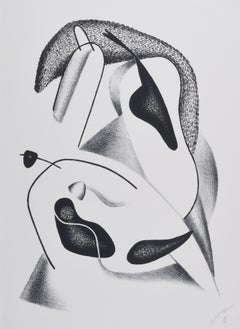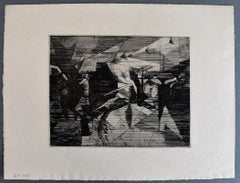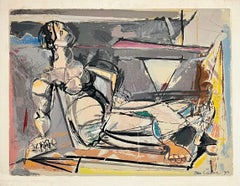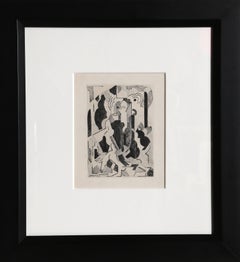
'Descente de Croix' (Descent from the Cross) — 1920s French Cubism
By Albert Gleizes
Located in Myrtle Beach, SC
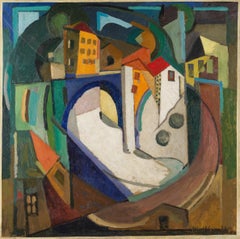
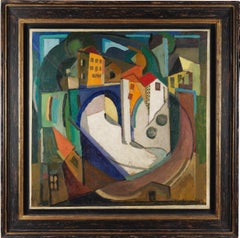
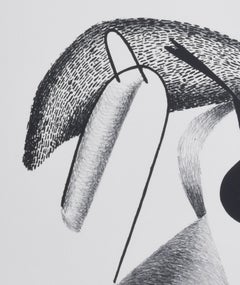
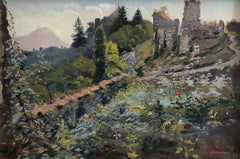
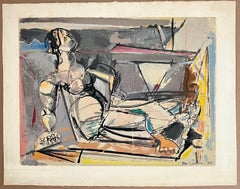
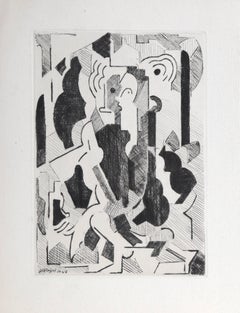
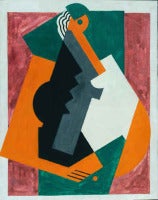
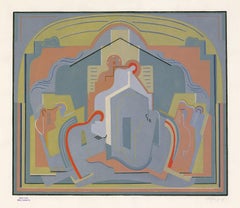
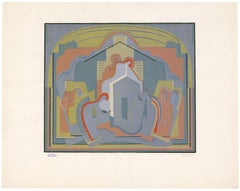
Albert Gleizes, 'Descente de Croix', color pochoir, 1928, edition c. 50. Signed and dated in pencil. A fine, painterly impression, with fresh colors, on heavy, cream wove paper; the full sheet with margins (3 to 4 inches), in very good condition. The publisher's ink stamp 'EDITIONS MOLY-SABATA' beneath the image, lower left. Matted to museum standards, unframed. Image size 12 x 14 inches (305 x 356 mm); sheet size 18 x 22 inches (457 x 559 mm). ABOUT THE IMAGE After the 1927 painting 'Descente de Croix', one of three religious-themed works that Gleizes developed as preliminaries for murals at the church at Serrières, France, the project was terminated at its final phase, and Gleizes commissioned master printer Robert Pouyaud to create prints of the paintings, closely overseeing the production. ABOUT THE MEDIUM Pochoir is a refined stencil-based technique employed to create multiples or to add color to prints produced in other mediums. Characterized by its crisp lines and rich color, the print-making process was most popular from the late 19th century through the 1930s, with its center of activity in Paris. The pochoir process began with the analysis of an image’s composition, including color tones and densities. The numerous stencils (made of aluminum, copper, or zinc) necessary to create a complete image were then designed and hand-cut by the 'découpeur.' The 'coloristes' applied watercolor or gouache pigments through the stencils, skillfully employing a variety of different brushes and methods of paint application to achieve the desired depth of color and textural and tonal nuance. The pochoir process, by its handcrafted methodology, resulted in the finished work producing the effect of an original painting, and in fact, each print was unique. ABOUT THE ARTIST Albert Gleizes (1881-1953), born in Paris, France, was a pioneering figure in the development of abstract art and one of the leading proponents of Cubism. His contributions to the art world extended beyond his paintings; he was also a prolific writer and theoretician, advocating for a new approach to art that emphasized the geometric abstraction of form and a departure from representational traditions. Gleizes initially studied painting at the Académie Julian and the École des Beaux-Arts in Paris, where he was exposed to the academic conventions of the time. However, his artistic vision was profoundly influenced by encounters with avant-garde movements, including Fauvism and the work of Paul Cézanne. These influences led Gleizes to experiment with form and color, gradually moving away from traditional representation toward a more abstract and geometric style. After completing his secondary schooling, Gleizes spent four years in the French army and then began pursuing a career as a painter, primarily doing landscapes. Initially influenced by the Impressionists, he was only twenty-one years of age when his work titled ‘La Seine à Asnières’ was exhibited at the Société Nationale des Beaux-Arts in 1902. The following year, he was part of the first Salon d'Automne and soon came under the influence of Fernand Léger, Robert Delaunay, Jean Metzinger, and Henri Le Fauconnier. In 1907, Gleizes and some of his friends pursued the idea of creating a self-supporting community of artists that would allow them to develop their art free of any commercial concerns. For nearly a year, Gleizes , with other painters, poets, musicians, and writers, lived at a large house in Créteil, but a lack of funds forced them to give up their facility in early 1908, and Gleizes moved temporarily into La Ruche, the artist commune in the Montparnasse Quarter of Paris. In the early 1910s, Gleizes became associated with the Cubist movement, which was spearheaded by artists such as Pablo Picasso and Georges Braque...
1920s Cubist Albert Gleizes Art
Stencil