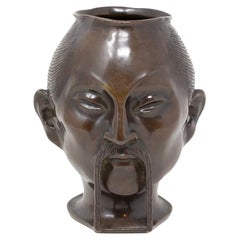
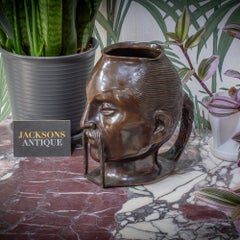
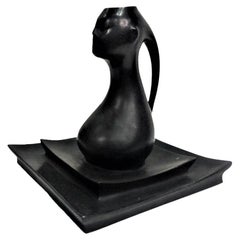
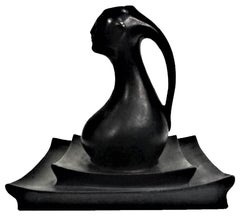
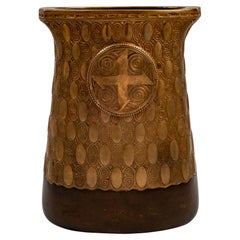
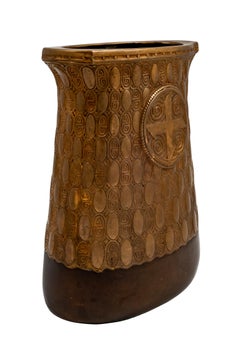
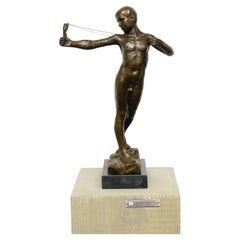
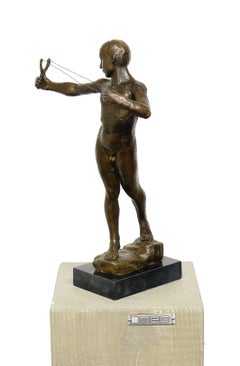
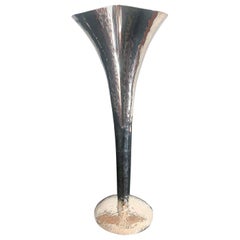
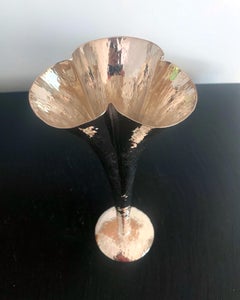
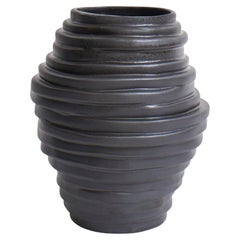
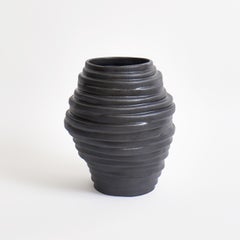
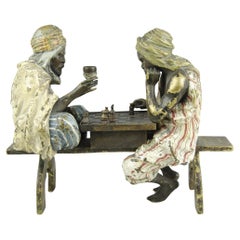
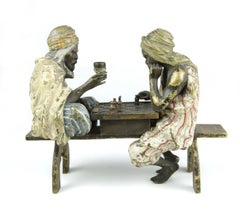
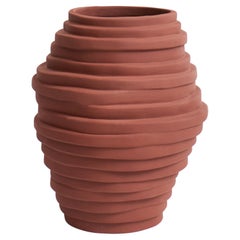
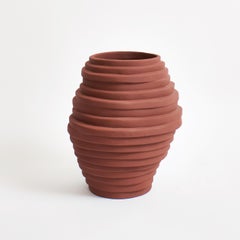
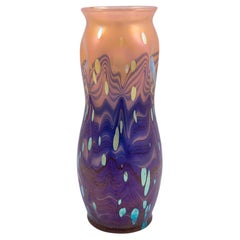
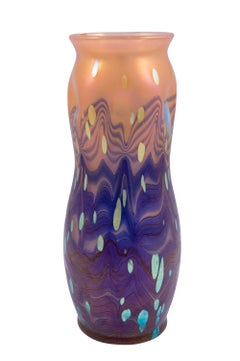
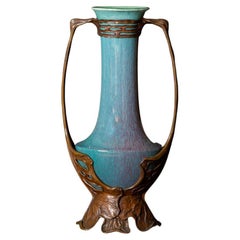
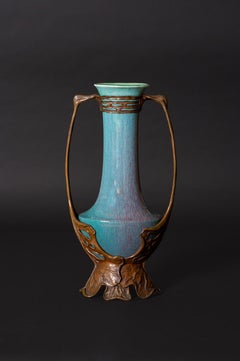
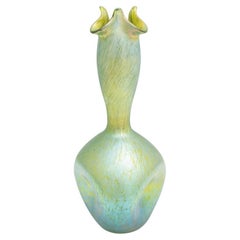
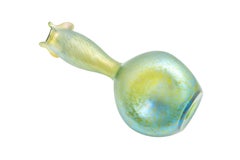
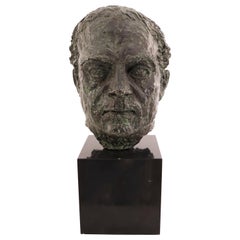
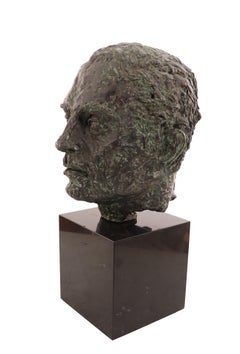
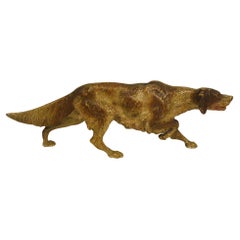
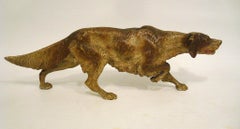
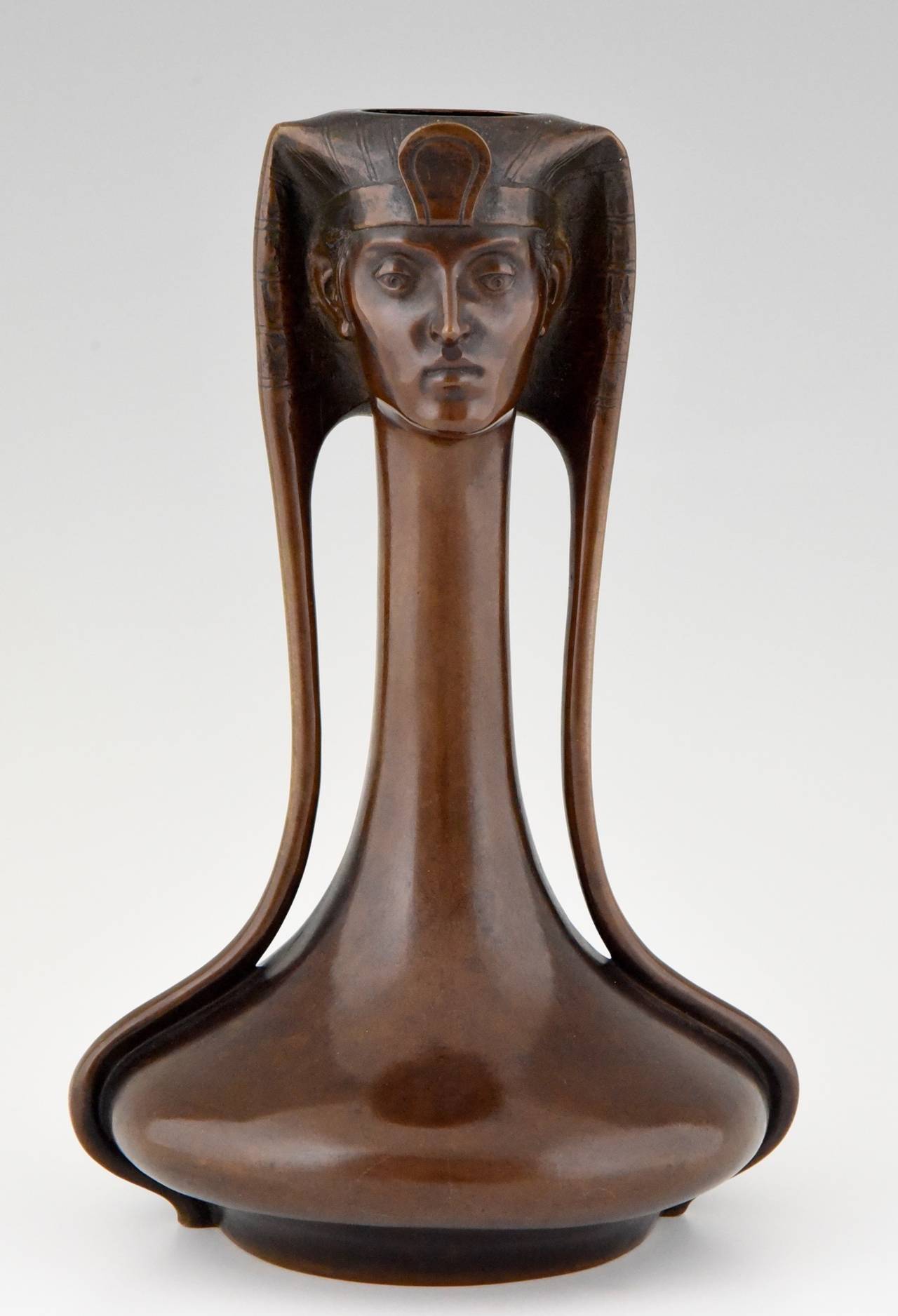
Alfonso Canciani, Viennese Secession Orientalist Bronze Vase, c. 1910
By Alfonso Canciani
Located in New York, NY
Alfonso Canciani (Italian-Austrian, 1863-1955) was a famous Italian-Austrian sculptor of the period of accession to the Viennese Secession. Son of a stonemason, after a realist period he managed to establish himself as a leading sculptor of the Viennese Secession. In fact, he worked in Vienna, where he had enrolled in 1886 at the Academy of Fine Arts, then at the Higher School of Sculpture and finally at the Special School, where he obtained the Rome prize for the sketch for Dante's Monument.
He developed a notable business obtaining important prizes and numerous commissions. First among the sculptors of the Viennese capital, he was invited to join the Association of the Viennese Secession, of which Klimt was magna pars, after the exhibition of Dante's group in 1900 at the Secession exhibition, and obtained the most important Austrian artistic prize, the Kunstlerlpreis.
This same work, presented in 1910 in Berlin, at the Great Art Exhibition, also received an important recognition here. He obtained the Rome prize in 1896, exhibited successfully in Munich and in 1899 at the III International Art Exhibition in Venice.
In that period he made some statues of saints for the cathedral of Santo Stefano in Vienna, the monument to Wagner, the bust of Nietzsche for the University, the scepter and the gold chain of the University Rector, figures of Italian poets ( Petrarch, Boccaccio, Tasso, Ariosto).
He submitted a sketch for the official monument to Empress Elizabeth, which was then built in Austrisn Gföhl and Pula. At the time of his accession to the Secession, he dedicated himself to decorating the facade of the Artaria house in Vienna in collaboration with the architect Max Fabiani.
He later abandoned the symbolist decorativism of the Jugendstil for a more concentrated and vigorous style, approaching the Belgian sculptor Constantin Meunier for the theme of work, and preferring to exhibit at the Künstlerhaus.
In Vienna, he was generous with advice and help with the Italians and in particular with his fellow citizens (such as the Brazzanese Luigi Visintin, then a university student).
After the First World War, he returned to Italy and lived in Friuli, penalized by the fact that the Habsburg Empire had by now disappeared. Instead of large-scale public monuments, he then devoted himself to engraving medals (e.g. for Benedict XV and for the Italian mission in Vienna in 1919) and to designing funeral monuments (examples in Mali Lošinj and Trieste) and portrait busts (of Generals Carlo Caneva and Antonio Baldissera in Udine, sculptures of the War Memorial of Corno di Rosazzo). After all, he had already executed the Bab grave monument in the Döblinger cemetery in Vienna in 1909.
He taught in Trieste from 1920 until 1935, at the local school of industrial art, where he had Marcello Mascherini...
Category
1910s Austrian Jugendstil Vintage Alfonso Canciani Decorative Objects