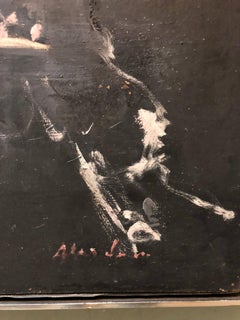
Alfred Aberdam Art

to
1
Overall Width
to
Overall Height
to
1
1
1
1
1
1
1
1
10,537
2,815
2,500
1,412
1
Artist: Alfred Aberdam
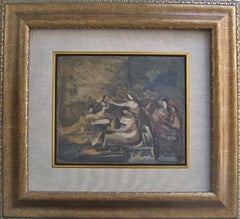
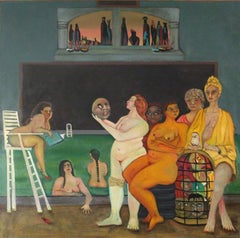
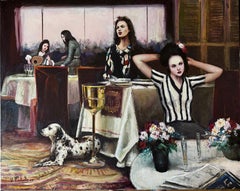
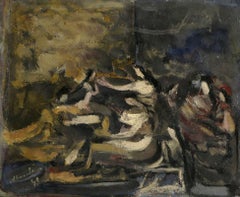
Women in an Interior

Women in an Interior

By Alfred Aberdam

Located in London, GB

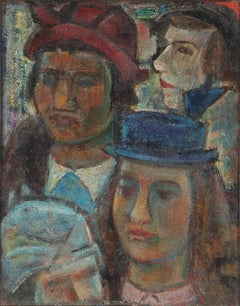
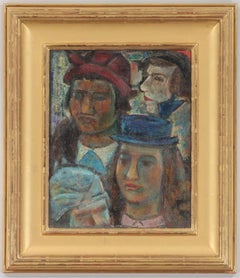
ALFRED ABERDAM 1894-1963 Lviv 1894-1963 Paris (Polish/French) Title: Women in an Interior, 1948 Technique: Original Signed Oil Painting on panel size: 32.5 x 26.5 cm / 12.8 x 10.4...

Category

1940s Modern Alfred Aberdam Art

Materials

Oil

Related Items
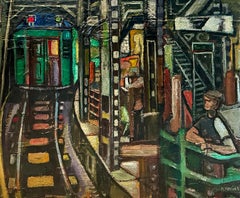
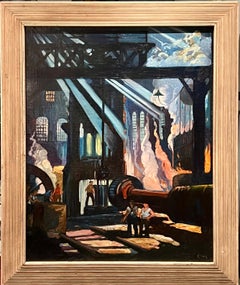
"Paper Making" WPA Industrial Mid-Century American Scene Social Realism Workers

"Paper Making" WPA Industrial Mid-Century American Scene Social Realism Workers

Located in New York, NY

"Paper Making" WPA Industrial Mid-Century American Scene Social Realism Workers Douglas Crockwell (1904-1968) "Paper Making" 19 x 39 inches Oil on board, c. 1936 Signed verso Framed: 28 x 47 Provenance: Estate of the Artist BIO Spencer Douglass Crockwell was born into a comfortable middle class household on April 29, 1904 in Columbus, Ohio. His father, Charles Roland Crockwell, was a mining engineer; his mother, Cora, was the daughter of an Iowa attorney. He became a commercial artist and experimental filmmaker who spent a good part of his career creating illustrations and advertisements for the Saturday Evening Post. In 1907 the Crockwell family moved to St. Louis, Missouri, where he graduated from high school and then attended from Washington University. Initially he studied engineering, but soon switched to business. While still an undergraduate, Crockwell took courses at the St. Louis School of Fine Arts and quickly realized that he wanted to be an artist. After graduating from Washington University in 1926, Crockwell continued to study at the St. Louis School of Fine Arts until 1929. The following year he relocated to Chicago and continued his studies at the American Academy of Art. In 1930 and 1931 he studied in Europe on a Traveling Fellowship. In 1932 Douglass Crockwell moved to Glens Falls, New York, which was to be his home for the remainder of his life. The following year he married Margaret Braman. They had three children, a son Douglass and two daughters, Johanna and Margaret. During the depression he created murals and posters for the Works Progress Administration including Post Office murals in White River junction, Vermont; Endicott, New York; and Macon, Mississippi. In 1934 he painted Paper Workers, Finch Pruyn & Co. (the leading Glens Falls, New York company) for the WPA. In the 1930s Crockwell developed an interest in experimental animated films that occupied him for the rest of his life. In 1936 and 1937, he collaborated with David Smith, a sculptor, to create surrealist films. Because of his interest in experimental films, his output of paintings was limited to just twenty to forty illustrations a year during this time. Crockwell painted his first of many Saturday Evening Post cover in 1933. He also worked for Life, Look, and Esquire, and numerous national advertisers including Friskies dog food, Welch’s Grape Juice, Republic Steel...

Category

1930s American Modern Alfred Aberdam Art

Materials

Oil, Board

Seated Woman in Blue Oil on Canvas, Modern Volumetric Style, Signed

Seated Woman in Blue Oil on Canvas, Modern Volumetric Style, Signed

By Fernando Botero

Located in Sitges, Barcelona

Artist: Sanz Title: Seated Woman in Blue Date: Late 20th Century Medium: Oil on canvas Dimensions: 91 × 61 cm (35.8 × 24 in) Frame: Unframed Signature: Signed Sanz lower left Conditi...

Category

21st Century and Contemporary Modern Alfred Aberdam Art

Materials

Oil

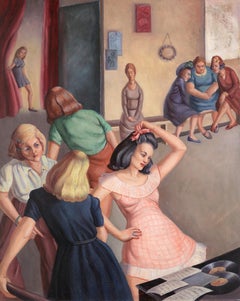
"Sock Hop" Mid-Century American Modernism WPA Female Artist 20th Century Realism

"Sock Hop" Mid-Century American Modernism WPA Female Artist 20th Century Realism

By Kyra Markham

Located in New York, NY

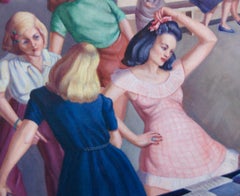
"Sock Hop" Mid-Century American Modernism WPA Female Artist 20th Century Realism. 30 x 24 inches. Oil on canvas. Signed on stretcher, c. 1940s. Frame is likely original to the painting. Realist painter-printmaker Kyra Markham...

Category

1940s American Modern Alfred Aberdam Art

Materials

Canvas, Oil

1970s Abstract Italian Signed Titled and Dated Painting

1970s Abstract Italian Signed Titled and Dated Painting

Located in Roma, IT

Wonderful abstract 20th-century painting by the important Venetian post-war artist Roberto Ferruzzi (VENICE 1927 - 2010) "Interno con Helene R Ferruzzi 1978" “Interior with Helene”,...

Category

1970s Modern Alfred Aberdam Art

Materials

Canvas, Oil

Neon Lighting WPA Mid 20th Century Social Realism American Scene Modern Figures

Neon Lighting WPA Mid 20th Century Social Realism American Scene Modern Figures

By Maurice Becker

Located in New York, NY

Neon Lighting WPA Mid 20th Century Social Realism American Scene Modern Figures MAURICE BECKER (1889-1975) 'Neon Lighting 17 1/4 x 13 3/4 inches Oil on masonite Signed, dated 1936 and titled on verso BIO Maurice Becker, painter, political cartoonist and social reformer, was born in 1889 either in Gorky or Niznij Novgorod, in Russia. His family came to the United States in 1892, to New York City. After high school, Becker worked in a clothing factory. He studied with Ash Can School artist Robert Henri in 1908, and exhibited in the famous 1913 Armory Show in New York City when he was only twenty-four years of age. At the Armory show, Becker showed a drawing of a dog's head...

Category

1930s American Modern Alfred Aberdam Art

Materials

Masonite, Oil

“Still Life, 1936” by Katharine "Kitty" Duff Church British Modern Oil Signed

“Still Life, 1936” by Katharine "Kitty" Duff Church British Modern Oil Signed

Located in Yardley, PA

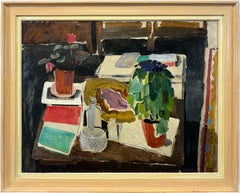
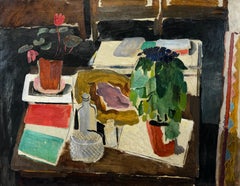
“Still Life, 1936” by Katharine "Kitty" Duff Church (British, 1910-1999). This large, early painting by Katherine Church is among her finest canvases of the period. Characterized by its bold color palette, simplified forms, and expressive brushwork, this composition centers around a tabletop adorned with various objects: potted plants, a ceramic dish, bottles, and what appear to be books or papers. The two potted plants provide contrasting elements: on the left, what appears to be a cyclamen with red blossoms and delicate leaves, and on the right, a lush green plant with darker foliage. These plants, painted with loose, textured strokes, add an organic quality to the otherwise structured arrangement. The tabletop is cluttered yet thoughtfully composed, featuring additional objects like a clear, faceted glass bowl, a small bottle, and books or pads in striking red and green. The dynamic use of color blocks and the juxtaposition of shapes (round pots against rectangular books) create a sense of rhythm and harmony. The background is darker and less defined, emphasizing the brightly lit tabletop. Church's brushwork is gestural and modernist, leaning toward abstraction, challenging traditional still life conventions. This painting reflects Church’s interest in balancing everyday objects with bold artistic expression. It conveys both the simplicity and complexity of daily life, transforming an ordinary moment into a vibrant and engaging work of art. This work is oil on canvas and is signed and dated in the lower right. It is housed in its original gessoed frame and retains various labels and inscriptions on the reverse. Size: 28.25 inches tall by 36 inches wide (painting) 34 inches tall by 42 inches wide by 2 inches deep (frame) Provenance: Private collection, NY; Acquired from the above About the artist: Born in Highgate, north London, Katharine Church, known as ‘Kitty’ amongst friends and family, always wanted to paint. She trained at the Royal Academy of Arts between 1930-1933 and at the Slade between 1933 and 1934. In her early years Kitty exhibited regularly at the Royal Academy. Her first solo exhibition was in 1933 at the Wertheim Gallery. Other artists who exhibited there included Christopher Wood, Victor Pasmore and Cedric Morris. Kitty also showed with the New English Art Club, the London Group and between 1937-1947 her work was exhibited at the influential Lefevre Gallery, which supported avant-garde artists such as Henry Moore, Ben Nicholson and Barbara Hepworth. In 1954 the artist was invited to take part in the Figures in their setting exhibition held at the Tate Gallery. Henry Tonks and Philip Wilson Steer had a strong influence on Kitty’s early work, but it was her friendship with Ivon Hitchens that liberated her painting technique. In 1936 Kitty married Anthony West, the son of writers Rebecca West and H.G. Wells. The couple initially lived in London before moving to Quarry Farm, Chicksgrove, Tisbury, near Salisbury, where they brought up their children Caroline and Edmund. There they hosted many of their friends, including the New Zealand painter Frances Hodgkins. Other regular visitors before the War included John and Mywafany Piper, Ralph and Frances Partridge, Noel and Catharine Carrington, Julian Trevelyan and Mary Fedden. For many of those who visited Kitty would organise painting expeditions. After the war Kitty and Anthony separated, with Anthony moving to the United States. Anthony West moved to the United States to work as a journalist for The New Yorker. In the early years after their parting Kitty visited most years with the children. In the 1960s Kitty purchased Sutton House and ran the Hambledon Gallery at Blandford Forum. There she promoted the work of her early art-school friends Mary Fedden and Julian Trevelyan, alongside work by the Pipers, John Craxton...

Category

1930s Modern Alfred Aberdam Art
Materials

Canvas, Oil

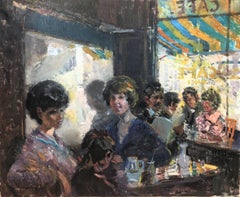
Paris Café Terrace Scene Oil Painting European Post-Impressionist Figurative Art

Paris Café Terrace Scene Oil Painting European Post-Impressionist Figurative Art

By ANGEL BADIA CAMPS

Located in Sitges, Barcelona

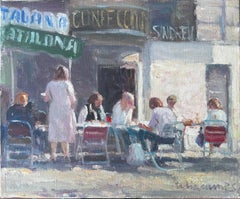
Title: Paris Café Terrace Scene Medium: Oil on canvas Dimensions: 38 × 46 cm (14.96 × 18.11 in) Framing: Unframed Signature: Hand-signed lower right Period: Second half of the 20th century Condition: Very good. Firm canvas, stable paint layer, visible impasto, no apparent restorations. Origin: Spain Original oil painting depicting a lively Parisian café terrace scene, rendered with a luminous and expressive brushstroke. The composition captures a moment of everyday urban life: seated figures, soft conversation, café signage and filtered daylight dissolving into architectural shadows. The artist prioritizes atmosphere over strict detail, allowing the scene to breathe through fluid impasto and subtle tonal transitions. The chromatic palette balances cool bluish greys and whites with warmer accents, creating depth and visual rhythm. The treatment of figures and light evokes European post-impressionist tradition, combining figurative clarity with painterly spontaneity. A refined decorative piece with strong interior presence, ideal for collectors of European figurative art, lovers of Parisian imagery, or elegant contemporary interiors seeking warmth and narrative. Àngel Badia i Camps (Puig-reig, Barcelona, 1929 – Barcelona, 2019) was a Catalan painter, illustrator and comic artist trained at the Barcelona School of Fine Arts. During the 1950s and 1960s he worked extensively as an illustrator for European and British publishers, developing a strong command of the human figure and narrative composition. From the 1970s onward he focused primarily on fine art painting, producing figurative works centered on urban scenes, landscapes and everyday life. His work was exhibited in Spanish and international galleries, consolidating his position within the Catalan figurative tradition of the second half of the 20th century. Paris café painting...

Category

1970s Modern Alfred Aberdam Art
Materials

Oil

Large Mediterranean Fruit Still Life Oil Painting Classic Spanish Kitchen Dining

Large Mediterranean Fruit Still Life Oil Painting Classic Spanish Kitchen Dining

Located in Sitges, Barcelona

Vintage Spanish Fruit Still Life Oil Painting Large Kitchen Wall Art Mediterranean Tabletop Interior Decor Canvas Painting Artist: Antonio Tarraso (Spanish, born 1946) Title: Bodegón de frutas Date: circa 1990 Medium: Oil on canvas Dimensions (image): Height: 65 cm (25.6 in); Width: 81 cm (31.89 in) Dimensions (framed): Height: 77 cm (30.31 in); Width: 93 cm (36.61 in) Signature: Signed lower right Condition: Good overall condition with minor age-related surface marks visible Frame: Frame included Origin: Spain Style: Traditional Mediterranean still life painting Period: 1990–1999 Subject: Fruit still life composition with melon grapes apples ceramic bowl Elegant Mediterranean still life composition featuring grapes, melon and apples arranged around a traditional ceramic bowl and tableware elements. The painting combines classical studio arrangement with warm tonal harmony typical of late 20th century Spanish still life painting, creating a strong decorative presence suitable for dining room, kitchen or hospitality interiors. Its large horizontal format and original frame make the piece immediately display-ready and particularly effective as a focal wall artwork. Traditional fruit still life paintings remain among the most versatile interior artworks for collectors seeking warm European atmosphere pieces. This composition follows the long European still life tradition shaped by Spanish masters such as Luis Meléndez and later Mediterranean studio painters working with structured tabletop arrangements and luminous fruit surfaces. The balanced grouping of ceramics and fruit echoes the decorative realism widely developed in Spanish studio painting during the late 20th century. Antonio Tarraso is a Spanish painter known for traditional Mediterranean still life compositions and decorative interior-oriented oil paintings. His work reflects the continuity of the classical fruit still life genre within modern Spanish studio painting. fruit still life painting kitchen wall art painting dining room wall art painting large still life painting spanish still life painting mediterranean still life painting vintage fruit painting...

Category

1990s Modern Alfred Aberdam Art
Materials

Oil, Canvas

The Sculptress

The Sculptress

By William Robert Shulgold

Located in West Hollywood, CA

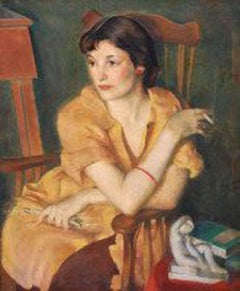
William Robert Shulgold (1897-1989), studied under Arthur Watson Sparks, head of Carnegie?€™s art department. He specialized in figurative genre subjects, displaying within his paintings a quality and understanding akin to 19th century impressionism...

Category

1930s American Modern Alfred Aberdam Art
Materials

Oil

Breakfast Interior Scene, Vintage Oil Painting, Framed, 1970s

Breakfast Interior Scene, Vintage Oil Painting, Framed, 1970s

Located in Portland, OR

Rolf Pettersson (Swedish, 20th Century) Breakfast, ca. 1970s Oil on canvas Framed dimensions 25 5/8” H x 31 9/16” W Signed verso A charming original Swedish interior scene from the ...

Category

1970s Modern Alfred Aberdam Art
Materials

Oil, Graphite

Previously Available Items
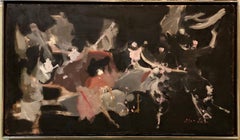
Polish Ecole De Paris Modernist Oil Painting Abstract Dancers

Polish Ecole De Paris Modernist Oil Painting Abstract Dancers

By Alfred Aberdam

Located in Surfside, FL

Alfred Aberdam (1894–1963) painter and graphic artist was a painter of School of Paris, born in Lvov, capital of Galicia, Austro-Hungarian Empire. Born in Lviv, Krystonopol, East Galicia (now Chervonograd, Ukraine) and received a traditional Jewish education in a Heder while studying Hebrew with private teachers. In 1905–12 he lived in Lvov, where he finished high school. He decided to become an artist at the age of 14. At this time he came into contact with young Yiddish Judaic writers (Melech Ravitch, Abraham Moshe Fuks, and others) and with Zionist youth groups in Lvov. He attended their meetings and their lectures on Jewish Judaica artists. After graduating high school, he organized several conferences in his hometown on Italian and Flemish masters and on the first Jewish painters, including Josef Israels (1824-1911). In 1911 he started to study art at the Munich Royal Academy of Fine Arts, Akademie der Bildenden Künste München. Lemberg/Lwów (today Lviv), studies under Gabriel von Hackl (1843-1926). During World War I he was imprisoned by the Russians and stayed in the camp for prisoners of war in Siberia where he became acquainted with David Burliuk and other Russian futurists. In 1917, Aberdam was appointed People’s Commissar of the Department of Fine Arts by the local soviet, which assigned him the task of reorganizing artistic teaching. A year later, in Moscow, he befriended the poet Vladimir Mayakovski. In 1921 in Poland, he began his studies at Kraków's Academy of Fine Arts under Professor Teodora Axentowicz, then lived in Paris. There he participated in numerous exhibitions, and in a Poland exhibition in the Gallery of Modern Art Editions in 1929. In the latter he organized the exhibition in 1931. In 1932 he exhibited in Warsaw and Lviv. From 1933 he belonged to a group of visual artists known as "Nowocześni". In 1923, while he was staying in Berlin, he met Menkes and Weingart in sculptor Alexander Archipenko’s studio. In 1924, he settled in Paris in the Montparnasse area. In the end of 1925, Jan Sliwinski held an exhibition in his gallery Au Sacre du Printemps, at 5 rue du Cherche-Midi, Paris. His work was exhibited alongside paintings by his Galician friends Leon Weissberg, Sigmund Menkes and Joachim Weingart...

Category

Mid-20th Century Modern Alfred Aberdam Art
Materials

Oil

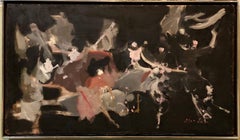
Polish Ecole De Paris Modernist Oil Painting Abstract Dancers

Polish Ecole De Paris Modernist Oil Painting Abstract Dancers

By Alfred Aberdam

Located in Surfside, FL

Alfred Aberdam (1894–1963) painter and graphic artist was a painter of School of Paris, born in Lvov, capital of Galicia, Austro-Hungarian Empire. Born in Lviv, Krystonopol, East Galicia (now Chervonograd, Ukraine) and received a traditional Jewish education in a Heder while studying Hebrew with private teachers. In 1905–12 he lived in Lvov, where he finished high school. He decided to become an artist at the age of 14. At this time he came into contact with young Yiddish Judaic writers (Melech Ravitch, Abraham Moshe Fuks, and others) and with Zionist youth groups in Lvov. He attended their meetings and their lectures on Jewish Judaica artists. After graduating high school, he organized several conferences in his hometown on Italian and Flemish masters and on the first Jewish painters, including Josef Israels (1824-1911). In 1911 he started to study art at the Munich Royal Academy of Fine Arts, Akademie der Bildenden Künste München. Lemberg/Lwów (today Lviv), studies under Gabriel von Hackl (1843-1926). During World War I he was imprisoned by the Russians and stayed in the camp for prisoners of war in Siberia where he became acquainted with David Burliuk and other Russian futurists. In 1917, Aberdam was appointed People’s Commissar of the Department of Fine Arts by the local soviet, which assigned him the task of reorganizing artistic teaching. A year later, in Moscow, he befriended the poet Vladimir Mayakovski. In 1921 in Poland, he began his studies at Kraków's Academy of Fine Arts under Professor Teodora Axentowicz, then lived in Paris. There he participated in numerous exhibitions, and in a Poland exhibition in the Gallery of Modern Art Editions in 1929. In the latter he organized the exhibition in 1931. In 1932 he exhibited in Warsaw and Lviv. From 1933 he belonged to a group of visual artists known as "Nowocześni". In 1923, while he was staying in Berlin, he met Menkes and Weingart in sculptor Alexander Archipenko’s studio. In 1924, he settled in Paris in the Montparnasse area. In the end of 1925, Jan Sliwinski held an exhibition in his gallery Au Sacre du Printemps, at 5 rue du Cherche-Midi, Paris. His work was exhibited alongside paintings by his Galician friends Leon Weissberg, Sigmund Menkes and Joachim Weingart. The Group of Four was born. In 1935 he took part in the exhibition of Polish artists in the Paris Galerie des Beaux-Arts. He maintained connections with Poland, showed his works in Polish exhibitions, and was a member of the Plastycy Nowocześni ("Contemporary Plastic Artists") group. In 1944, he participated in the creation of the Jewish Artists Society in Paris, whose president was sculptor Léon Indenbaum. Aberdam became secretary of this association and Marc Sterling...

Category

Mid-20th Century Modern Alfred Aberdam Art
Materials

Oil

Alfred Aberdam art for sale on 1stDibs.

Find a wide variety of authentic Alfred Aberdam art available for sale on 1stDibs. You can also browse by medium to find art by Alfred Aberdam in oil paint, paint and more. Much of the original work by this artist or collective was created during the 20th century and is mostly associated with the modern style. Not every interior allows for large Alfred Aberdam art, so small editions measuring 11 inches across are available. Customers who are interested in this artist might also find the work of Abram Krol, Ben Benn, and Pawel Kontny. Alfred Aberdam art prices can differ depending upon medium, time period and other attributes. On 1stDibs, the price for these items starts at $2,000 and tops out at $4,000, while the average work can sell for $3,000.

Artists Similar to Alfred Aberdam