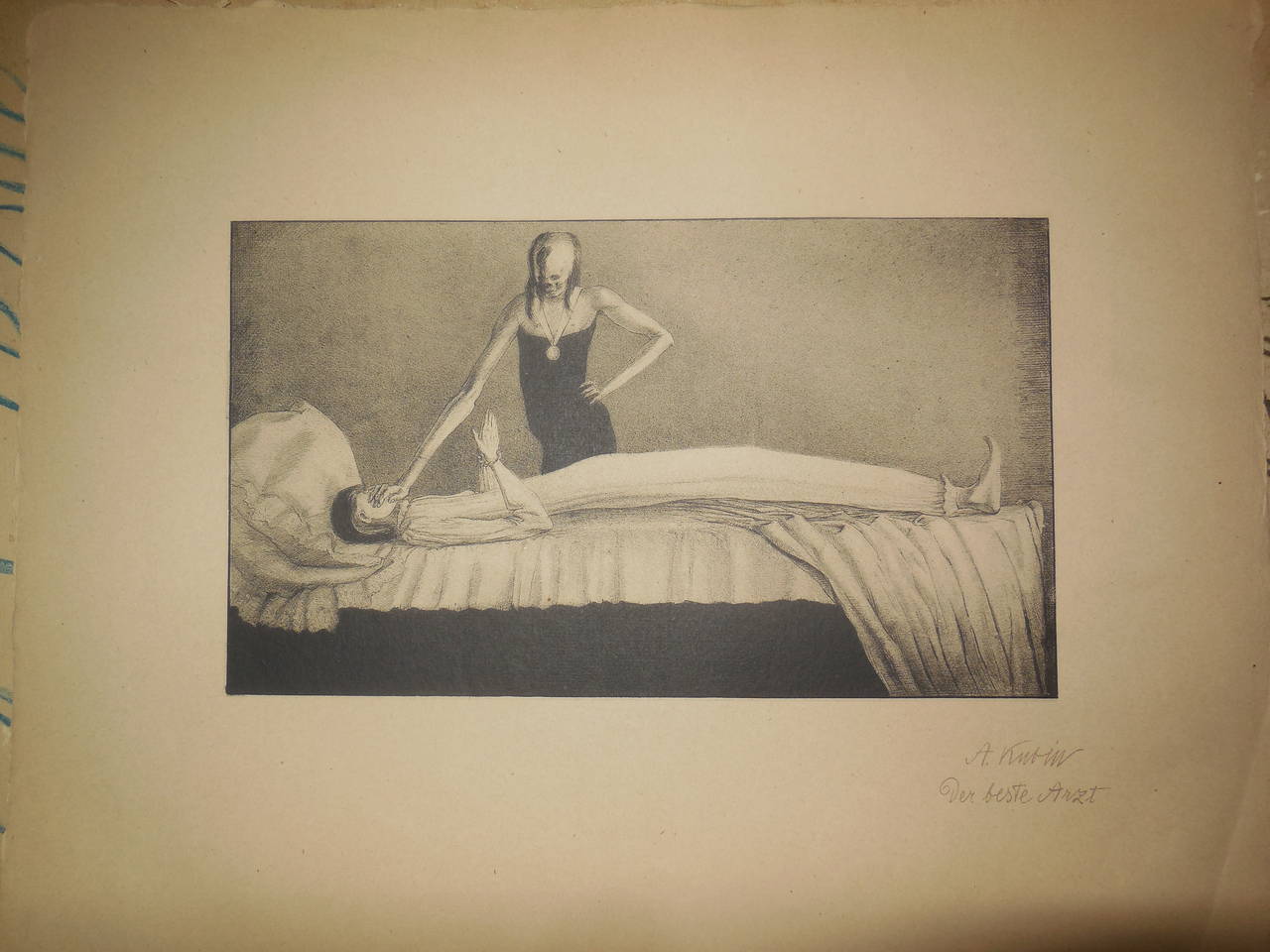
By Alfred Kubin
Located in Surfside, FL
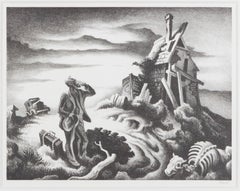
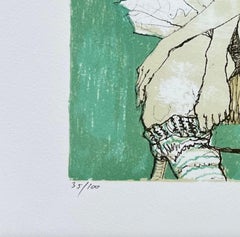
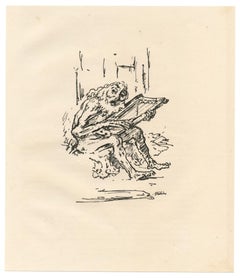
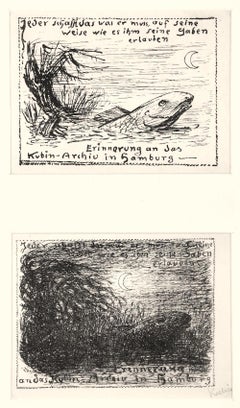
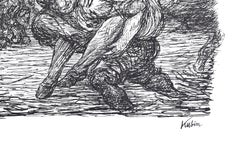
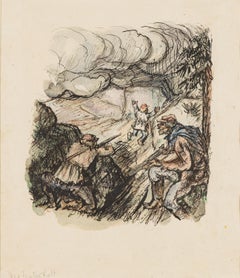
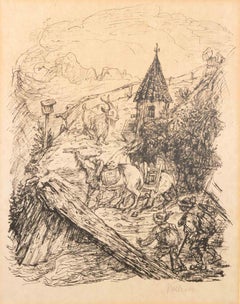
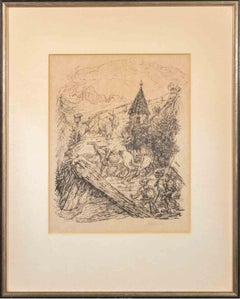
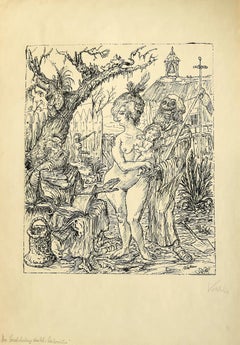
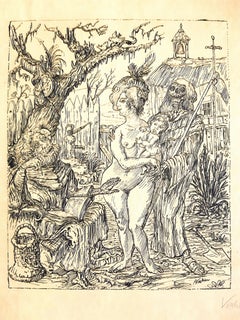
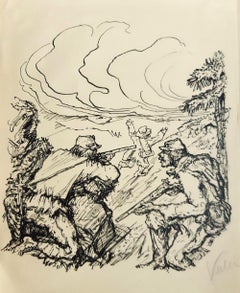
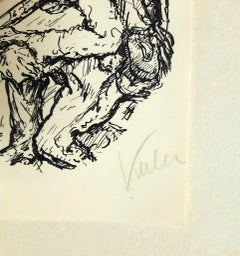
This is a plate signed lithograph from 1903 on fine wove paper. 35X44 cm total sheet size. minor creasing to margins. Czech/Austrian Expressionist Illustrator, 1877-1959
An apprentice photographer at Klagenfurt. During a state of depression in 18967, he attempted suicide on the tomb of his mother. In 1897 he attended Schmidt Rottluff's course at the Academy of Fine Arts. In 1901 he discovered the engravings of Klinger and, with them, his own vocation. In 1905 he visited Odilon Redon in Paris. In 1906 he acquired Zwickeldt Castle, to which he retired. In 1908, after the death of his father, he wrote a novel of the fantastic, The Other Side. He illustrated the works of Nerval, Poe, Strindberg and Wilde. He was a friend of Paul Klee and Franz Marc and member of the New Association of Young Artists and of (the Blue Rider) circle of artists. Der Blauer Reiter. He illustrated numerous books by Edgar allan poe, Gerald
Nerval, Strinberg and Oscar Wilde . By the 1920s, Kubin was well established professionally. In Germany, he showed with such major dealers as Hans Goltz, Fritz Gurlitt and J.B. Neumann, and in Vienna he was
represented by Otto Kallir's Neue Galerie. In 1927, the Staatliche Graphische Sammlung in Munich mounted a 50th birthday exhibition, and a group of prominent Austrian artists and writers published a commemorative
Festschrift. Kubin had also launched a lucrative career as a printmaker and book illustrator; in addition to occasional portfolios accompanying his own writings, Kubin illustrated over 140 books by other authors. Kubin led an essentially reclusive existence, with outside contacts pruned to suit his own agenda. When the Nazis marched into Austria in 1938, Kubin was taken completely by surprise: for he neither owned a radio nor read newspapers.
Kubin lived out the Nazi years relatively undisturbed in Zwickledt. Unlike some banned German colleagues, he did not have to go into "inner exile," because he was already there. And in fact, Kubin was not banned; he
could exhibit, so long as the works were judiciously edited. Still, he refused to do propaganda and found that there was little demand for his quirky drawings in Hitler's Reich. Following World War II, however, Austria
attempted to reclaim her prewar heritage and hailed Kubin as a national treasure. In 1947, on the occasion of his 70th birthday, he was lauded with a retrospective at the Graphische Sammlung Albertina in Vienna and
the establishment of a "Kubin Kabinett" at the Neue Galerie in Linz.
Neue Galerie, Vienna Modern Austrian Art, June 13, 1936
L. H. Jungnickel, O. Kokoschka, A. Kubin, O. Laske, F. Lerch, G. Merkel, F Wotruba and others. Held at the Lothringerstrasse Branch Small, Good Art Works from the 19th and 20th Centuries, January 27, 1949
J. Alt, T. Blau, P. Flora, G. Klimt, A. Kubin, E. Schiele and others
Galerie St. Etienne, New York Watercolors and Drawings by Austrian Artists from the Dial Collection, May 2,
1960
G. Klimt, O. Kokoschka, A. Kubin, E. Schiele and others. Lent by the Worcester Art Museum Gustav Klimt, Egon Schiele, Oskar Kokoschka and Alfred Kubin,
Galerie St Etienne. The "Black-and-White" Show. Expressionist Graphics in Austria & Germany. September 20, 2001 - November 10, 2001
Ernst Barlach, Max Beckmann, Alfred Kubin, Lovis Corinth, Otto Dix, Lyonel Feininger, Erich Heckel, Ernst Ludwig Kirchner, Oskar Kokoschka, Käthe Kollwitz, Paula Modersohn Becker...
Category
Early 1900s Expressionist Alfred Kubin Art
![Le Fondeur Paris [Steel Worker]](https://a.1stdibscdn.com/eugene-carriere-prints-works-on-paper-le-fondeur-paris-steel-worker-for-sale/a_2922/1610896410669/Carriere_E_master.jpg?width=240)