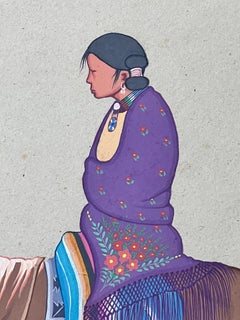
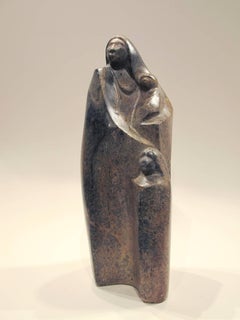
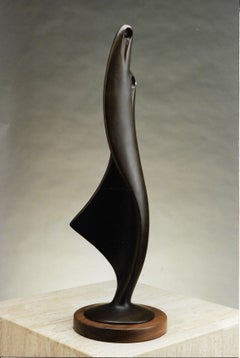
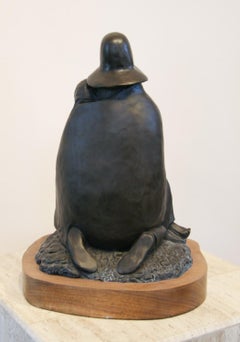
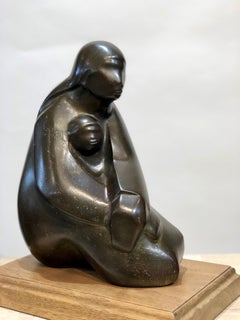
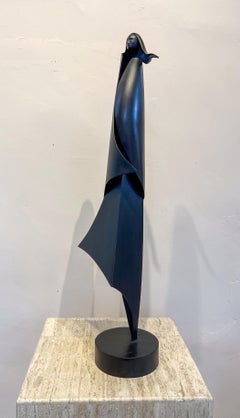
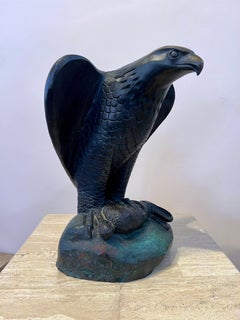
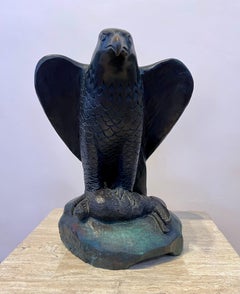
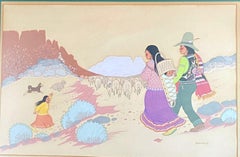
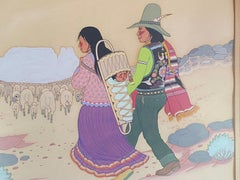
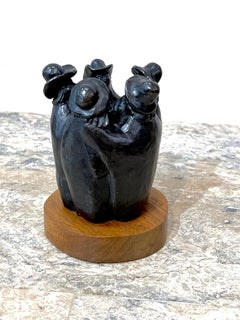
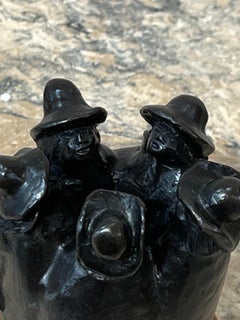
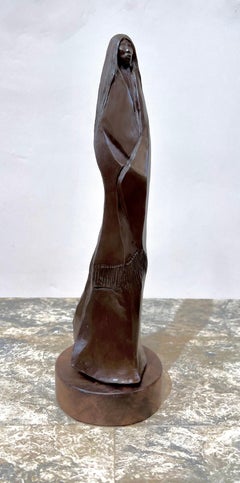
Allan Houser Art

Native American, Apache, 1914-1994

Allan Houser was represented by Glenn Green Galleries (formerly known as The Gallery Wall, Inc.) from 1973 until his death in 1994.

Sandy Green first saw this master sculptor’s work at the Heard Museum in Phoenix and immediately brought her husband Glenn to see the exhibit. The Greens responded enthusiastically to the abstraction and creativity in Houser’s work. They were impressed, not only with his versatility and talent, but with the number of mediums he employed. His subject matter was portrayed in styles ranging from realism, stylized form to abstraction. Throughout their association they noted this artist’s drive and strong commitment to his art.

With encouragement from the Greens, Houser retired from his post as the head of the sculpture department at the Institute of American Indian Arts in Santa Fe, New Mexico, in 1975 to begin working full-time creating his art. The next 20-year period was an exciting time for Allan, the gallery and for the Green family. He created a large body of sculpture in stone, wood and bronze. For many years Glenn Green Galleries co-sponsored many editions of his bronzes and acted as quality control according to Houser’s wishes. As both agents and gallery representatives, the Greens promoted and sold his art in their galleries in Phoenix and Scottsdale, Arizona and in Santa Fe, New Mexico. They had bi-annual exhibits in their galleries to feature Houser’s newest work and sponsored and arranged international museum shows in America, Europe and Asia. They travelled together for these events and went to Carrara, Italy to the famed quarries of Michelangelo and together purchased 20 tons of marble.

Glenn Green Galleries published the definitive book Allan Houser (Haozous) by Barbara H. Perlman. The author interviewed Allan Houser and his family extensively and it includes images of his family and artwork. The second printing is available in the gallery. A long-term project of the gallery for Allan Houser culminated in his receiving the National Medal of Arts in 1992 from President George H. W. Bush, America’s highest arts award. 

Find authentic Allan Houser sculptures, prints and other art on 1stDibs.

(Biography provided by Glenn Green Galleries)

to
13
6
4
1
Overall Width
to
Overall Height
to
24
1
11
6
4
20
1
2
1
1
10
7
6
5
5
4
4
2
1
1
1
1
1
1
1
1
1
1
17
17
4
3
3
24
11,587
2,878
2,492
1,587
1
24
Artist: Allan Houser
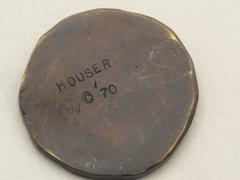
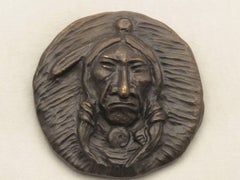
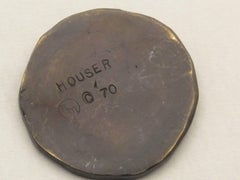
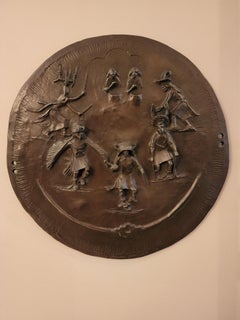
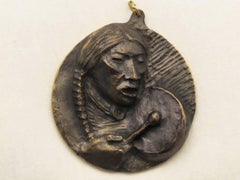
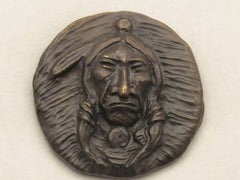
Plains Indian Medallion, bronze, Nambe, Allan Houser, small life-time casting

Plains Indian Medallion, bronze, Nambe, Allan Houser, small life-time casting

By Allan Houser

Located in Santa Fe, NM

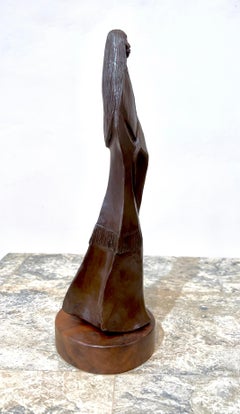
Plains Indian Medallion, bronze, Nambe, Allan Houser, small life-time casting Allan Houser (Haozous), Chiricahua Apache 1914-1994 recipient of the National Medal of Arts in 1992. Allan Houser's father Sam, was part of the small band of Apaches who traveled with Geronimo and surrendered in southern Arizona in 1886. Allan's parents were imprisoned with that group in Ft. Sill, Oklahoma. He was the first child to be born in freedom to those Apaches and a fluent speaker of the Chiricahua language. Allan Houser is an important artist in that he is of the culture he depicts in his artwork. Allan's parents would tell stories and sing songs recalling the experiences on the war path. This bronze edition is a life-time casting. Our gallery represented Allan Houser from 1974 until his passing in 1994 and were investors and provided quality control in the foundry process. Allan Houser's work is many international collections including the Georges Pomidou Centre, The Smithsonian National Portrait Gallery, The Dahlem Museum among others. Allan’s first bronze sculptures were started in the late 1960’s and were cast at Nambe Foundry. At the time the foundry was producing both Nambeware and was doing some sculptural foundry work. There was a fire at Nambe and they lost many of the molds for sculpture as well as their records. We acquired these works directly from Allan Houser. Allan Houser (Haozous), Chiricahua Apache (1914-1994) Selected Collections Centre Georges Pompidou, Paris, France * “They’re Coming”, bronze Dahlem Museum, Berlin, Germany Japanese Royal Collection, Tokyo, Japan “The Eagle”, black marble commissioned by President William J. Clinton United States Mission to the United Nations, New York City, NY *"Offering of the Sacred Pipe”, monumental bronze by Allan Houser © 1979 Presented to the United States Mission to the United Nations as a symbol of World Peace honoring the native people of all tribes in these United States of America on February 27, 1985 by the families of Allan and Anna Marie Houser, George and Thelma Green and Glenn and Sandy Green in New York City. National Portrait Gallery, Smithsonian, Washington, DC * Portrait of Geronimo, bronze National Museum of American Art, Smithsonian, Washington, D.C. * “Buffalo Dance Relief”, Indiana limestone National Museum of the American Indian, Smithsonian, Washington, D.C. *Sacred Rain Arrow, (Originally dedicated at the US Senate Committee on Indian Affairs, US Senate Building) “Goat”, “To The Great Spirit” - dedicated in 1994 at the Vice President’s Residence in Washington, D.C.. Ceremony officiated by Hillary Rodham Clinton and Tipper Gore. Oklahoma State Capitol, Oklahoma City, Ok * “As Long As the Waters Flow”, bronze Gilcrease Museum, Tulsa, OK *Sacred Rain Arrow, bronze Fort Sill, Oklahoma *”Chiricahua Apache Family”, bronze Donated and dedicated to Allan Houser’s parents Sam and Blossom Haozous by Allan Houser and Glenn and Sandy Green The Heard Museum, Phoenix, Arizona *Earth Song, marble donated by Glenn and Sandy Green   The Clinton Presidential Library, Arkansas * “May We Have Peace”, bronze The George H.W. Bush Presidential Library, College Station, Texas *"Offering to the Great Spirit", bronze The British Royal Collection, London, England *Princess Anne received "Proud Mother", bronze in Santa Fe Allan Houser’s father Sam Haozous, surrendered at the age of 14 with Geronimo and his band of Warm Springs Chiricahua Apache people in 1886 in Southern Arizona. This was the last active war party in the United States. This group of Apache people was imprisoned for 27 years starting in Fort Marion, Florida and finally living in captivity in Fort Sill, Oklahoma. Allan Houser was born in 1914. His artwork is an ongoing testimony to Native life in America – its beauty, strength and poignancy. Allan Houser is from the culture and portrayed his people in an insightful and authentic way. Because of the era in which he lived, he had a rare understanding of American Indian life. Allan was the first child born after the Chiricahua Apaches were released from 27 years of captivity. Allan grew up speaking the Chiricahua dialect. Allan heard his father’s stories of being on the warpath with Geronimo and almost nightly heard his parents singing traditional Apache music. Allan’s father knew all of Geronimo’s medicine songs. Allan had an early inclination to be artistic. He was exposed to many Apache ceremonial art forms: music, musical instruments, special dress, beadwork, body painting and dynamic dance that are integral aspects of his culture. His neighbors were members of many different tribes who lived in Oklahoma. Allan eagerly gained information about them and their cultures. Allan gathered this information and mentally stored images until he brought them back to life, years later, as a mature artist. Allan Houser was represented by Glenn Green Galleries (formerly known as The Gallery Wall, Inc.) from 1973 until his death in 1994. The gallery served as agents, advocates, and investors during this time. In 1973 the Greens responded enthusiastically to the abstraction and creativity in Houser’s work. They were impressed, not only with his versatility and talent but with the number of mediums he employed. His subject matter was portrayed in styles ranging from realism, stylized form to abstraction. With encouragement from the Greens, Houser at the age of 61, retired from his post as the head of the sculpture department at the Institute of American Indian Arts in Santa Fe, New Mexico in 1975 to begin working full-time creating his art. The next 20-year period was an exciting time for Allan, the gallery, and for the Green family. He created a large body of sculpture in stone, wood and bronze. For many years Glenn Green Galleries co-sponsored many editions of his bronzes and acted as quality control for the bronze sculptures according to Houser’s wishes. As both agents and gallery representatives, the Greens promoted and sold his art in their galleries in Phoenix and Scottsdale, Arizona and in Santa Fe, New Mexico. They had bi-annual exhibits in their galleries to feature Houser’s newest work and sponsored and arranged international museum shows in America, Europe and Asia. They travelled for these events including a trip to Carrara, Italy to the famed quarries of Michelangelo and together co-financed and arranged the purchase of 20 tons of marble. A watershed event for Allan Houser’s career occurred in the early 1980’s when Glenn Green Galleries arranged with the US Information Agency a touring exhibit of his sculpture through Europe. This series of exhibits drew record attendance for these museums and exposed Houser’s work to an enthusiastic art audience. This resulted in changing the perception of contemporary Native art in the United States where Houser and Glenn Green Galleries initially faced resistance from institutions who wanted to categorize him in a regional way. The credits from the European exhibits helped open doors and minds of the mainstream art community in the United States and beyond. Senator Daniel Inouye of Hawaii was a supporter of Allan Houser’s artwork. We worked with Senator Inouye on many occasions hosting events at our gallery and in Washington D.C in support of the formation of the Smithsonian’s National Museum of the American Indian in Washington, D.C. and other causes supporting Native Americans. Allan Houser is shown below presenting his sculpture “Swift Messenger” to Senator Inouye in Washington, D.C.. This sculpture was eventually given to the National Museum of the American Indian, Smithsonian’s permanent collection. It is now currently on loan and on display in the Oval Office. President Biden’s selection of artwork continues our gallery’s and Allan’s connection to the White House from our time working with Allan Houser from 1974 until his passing in 1994. “It was important for President Biden to walk into an Oval that looked like America and started to show the landscape of who he is going to be as president,” Ashley Williams...

Category

1970s Contemporary Allan Houser Art
Materials

Bronze

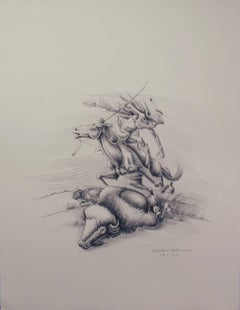
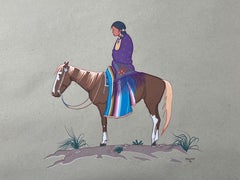
Apache Hunter, limited edition lithograph by Allan Houser, horseback hunter

Apache Hunter, limited edition lithograph by Allan Houser, horseback hunter

By Allan Houser

Located in Santa Fe, NM

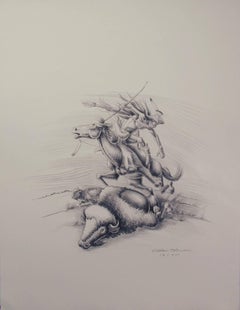
Apache Hunter, limited edition lithograph by Allan Houser, horseback hunter hand-pulled black and white lithograph printed in Santa Fe, New Mexico unframed edition of 75 Allan Houser (Haozous), Chiricahua Apache (1914-1994) Selected Collections Centre Georges Pompidou, Paris, France * “They’re Coming”, bronze Dahlem Museum, Berlin, Germany Japanese Royal Collection, Tokyo, Japan “The Eagle”, black marble commissioned by President William J. Clinton United States Mission to the United Nations, New York City, NY *"Offering of the Sacred Pipe”, monumental bronze by Allan Houser © 1979 Presented to the United States Mission to the United Nations as a symbol of World Peace honoring the native people of all tribes in these United States of America on February 27, 1985 by the families of Allan and Anna Marie Houser, George and Thelma Green and Glenn and Sandy Green in New York City. National Portrait Gallery, Smithsonian, Washington, DC * Portrait of Geronimo, bronze National Museum of American Art, Smithsonian, Washington, D.C. * “Buffalo Dance Relief”, Indiana limestone National Museum of the American Indian, Smithsonian, Washington, D.C. *Sacred Rain Arrow, (Originally dedicated at the US Senate Committee on Indian Affairs, US Senate Building) “Goat”, “To The Great Spirit” - dedicated in 1994 at the Vice President’s Residence in Washington, D.C.. Ceremony officiated by Hillary Rodham Clinton and Tipper Gore. Oklahoma State Capitol, Oklahoma City, Ok * “As Long As the Waters Flow”, bronze Gilcrease Museum, Tulsa, OK *Sacred Rain Arrow, bronze Fort Sill, Oklahoma *”Chiricahua Apache Family”, bronze Donated and dedicated to Allan Houser’s parents Sam and Blossom Haozous by Allan Houser and Glenn and Sandy Green The Heard Museum, Phoenix, Arizona *Earth Song, marble donated by Glenn and Sandy Green   The Clinton Presidential Library, Arkansas * “May We Have Peace”, bronze The George H.W. Bush Presidential Library, College Station, Texas *"Offering to the Great Spirit", bronze The British Royal Collection, London, England *Princess Anne received "Proud Mother", bronze in Santa Fe Allan Houser’s father Sam Haozous, surrendered at the age of 14 with Geronimo and his band of Warm Springs Chiricahua Apache people in 1886 in Southern Arizona. This was the last active war party in the United States. This group of Apache people was imprisoned for 27 years starting in Fort Marion, Florida and finally living in captivity in Fort Sill, Oklahoma. Allan Houser was born in 1914. His artwork is an ongoing testimony to Native life in America – its beauty, strength and poignancy. Allan Houser is from the culture and portrayed his people in an insightful and authentic way. Because of the era in which he lived, he had a rare understanding of American Indian life. Allan was the first child born after the Chiricahua Apaches were released from 27 years of captivity. Allan grew up speaking the Chiricahua dialect. Allan heard his father’s stories of being on the warpath with Geronimo and almost nightly heard his parents singing traditional Apache music. Allan’s father knew all of Geronimo’s medicine songs. Allan had an early inclination to be artistic. He was exposed to many Apache ceremonial art forms: music, musical instruments, special dress, beadwork, body painting and dynamic dance that are integral aspects of his culture. His neighbors were members of many different tribes who lived in Oklahoma. Allan eagerly gained information about them and their cultures. Allan gathered this information and mentally stored images until he brought them back to life, years later, as a mature artist. Allan Houser was represented by Glenn Green Galleries (formerly known as The Gallery Wall, Inc.) from 1973 until his death in 1994. The gallery served as agents, advocates, and investors during this time. In 1973 the Greens responded enthusiastically to the abstraction and creativity in Houser’s work. They were impressed, not only with his versatility and talent but with the number of mediums he employed. His subject matter was portrayed in styles ranging from realism, stylized form to abstraction. With encouragement from the Greens, Houser at the age of 61, retired from his post as the head of the sculpture department at the Institute of American Indian Arts in Santa Fe, New Mexico in 1975 to begin working full-time creating his art. The next 20-year period was an exciting time for Allan, the gallery, and for the Green family. He created a large body of sculpture in stone, wood and bronze. For many years Glenn Green Galleries co-sponsored many editions of his bronzes and acted as quality control for the bronze sculptures according to Houser’s wishes. As both agents and gallery representatives, the Greens promoted and sold his art in their galleries in Phoenix and Scottsdale, Arizona and in Santa Fe, New Mexico. They had bi-annual exhibits in their galleries to feature Houser’s newest work and sponsored and arranged international museum shows in America, Europe and Asia. They travelled for these events including a trip to Carrara, Italy to the famed quarries of Michelangelo and together co-financed and arranged the purchase of 20 tons of marble. A watershed event for Allan Houser’s career occurred in the early 1980’s when Glenn Green Galleries arranged with the US Information Agency a touring exhibit of his sculpture through Europe. This series of exhibits drew record attendance for these museums and exposed Houser’s work to an enthusiastic art audience. This resulted in changing the perception of contemporary Native art in the United States where Houser and Glenn Green Galleries initially faced resistance from institutions who wanted to categorize him in a regional way. The credits from the European exhibits helped open doors and minds of the mainstream art community in the United States and beyond. Senator Daniel Inouye of Hawaii was a supporter of Allan Houser’s artwork. We worked with Senator Inouye on many occasions hosting events at our gallery and in Washington D.C in support of the formation of the Smithsonian’s National Museum of the American Indian in Washington, D.C. and other causes supporting Native Americans. Allan Houser is shown below presenting his sculpture “Swift Messenger” to Senator Inouye in Washington, D.C.. This sculpture was eventually given to the National Museum of the American Indian, Smithsonian’s permanent collection. It is now currently on loan and on display in the Oval Office. President Biden’s selection of artwork continues our gallery’s and Allan’s connection to the White House from our time working with Allan Houser from 1974 until his passing in 1994. “It was important for President Biden to walk into an Oval that looked like America and started to show the landscape of who he is going to be as president,” Ashley Williams...

Category

1970s Contemporary Allan Houser Art
Materials

Lithograph

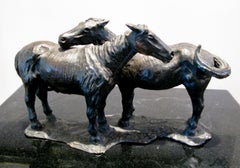
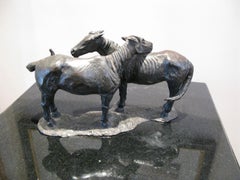
Indian Ponies, realistic bronze sculpture, dark brown patina, horses, Nambe

Indian Ponies, realistic bronze sculpture, dark brown patina, horses, Nambe

By Allan Houser

Located in Santa Fe, NM

Indian Ponies, realistic bronze sculpture, dark brown patina, horses, Nambe Foundry limited edition bronze solid casting Allan Houser (Haozous), Chiricahua Apache (1914-1994) Selec...

Category

1970s Contemporary Allan Houser Art

Materials

Bronze

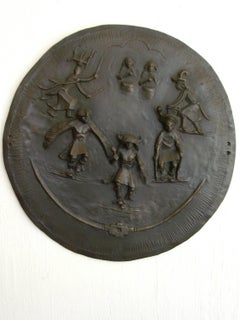
Plains Indian Medallion, bronze, Nambe, Allan Houser, small life-time casting

Plains Indian Medallion, bronze, Nambe, Allan Houser, small life-time casting

By Allan Houser

Located in Santa Fe, NM

Plains Indian Medallion, bronze, Nambe, Allan Houser, small life-time casting Allan Houser (Haozous), Chiricahua Apache 1914-1994 recipient of the National Medal of Arts in 1992. Allan Houser's father Sam, was part of the small band of Apaches who traveled with Geronimo and surrendered in southern Arizona in 1886. Allan's parents were imprisoned with that group in Ft. Sill, Oklahoma. He was the first child to be born in freedom to those Apaches and a fluent speaker of the Chiricahua language. Allan Houser is an important artist in that he is of the culture he depicts in his artwork. Allan's parents would tell stories and sing songs recalling the experiences on the war path. This bronze edition is a life-time casting. Our gallery represented Allan Houser from 1974 until his passing in 1994 and were investors and provided quality control in the foundry process. Allan Houser's work is many international collections including the Georges Pomidou Centre, The Smithsonian National Portrait Gallery, The Dahlem Museum among others. Allan’s first bronze sculptures were started in the late 1960’s and were cast at Nambe Foundry. At the time the foundry was producing both Nambeware and was doing some sculptural foundry work. There was a fire at Nambe and they lost many of the molds for sculpture as well as their records. We acquired these works directly from Allan Houser. Allan Houser (Haozous), Chiricahua Apache (1914-1994) Selected Collections Centre Georges Pompidou, Paris, France * “They’re Coming”, bronze Dahlem Museum, Berlin, Germany Japanese Royal Collection, Tokyo, Japan “The Eagle”, black marble commissioned by President William J. Clinton United States Mission to the United Nations, New York City, NY *"Offering of the Sacred Pipe”, monumental bronze by Allan Houser © 1979 Presented to the United States Mission to the United Nations as a symbol of World Peace honoring the native people of all tribes in these United States of America on February 27, 1985 by the families of Allan and Anna Marie Houser, George and Thelma Green and Glenn and Sandy Green in New York City. National Portrait Gallery, Smithsonian, Washington, DC * Portrait of Geronimo, bronze National Museum of American Art, Smithsonian, Washington, D.C. * “Buffalo Dance Relief”, Indiana limestone National Museum of the American Indian, Smithsonian, Washington, D.C. *Sacred Rain Arrow...

Category

1970s Contemporary Allan Houser Art

Materials

Bronze

Allan Houser Native American Modernist Bronze Sculpture, 1989, "Watching"

Allan Houser Native American Modernist Bronze Sculpture, 1989, "Watching"

By Allan Houser

Located in Phoenix, AZ

Beautiful, large Allan Houser bronze titled "Watching." The piece is signed "Allan Houser" and numbered 11 of the edition of 12. The bronze measures 23"h (including the 1" wooden pli...

Category

Late 20th Century Allan Houser Art

Materials

Bronze

Standing Apache Drummer, bronze sculpture, Allan Houser, solid cast, Nambe

Standing Apache Drummer, bronze sculpture, Allan Houser, solid cast, Nambe

By Allan Houser

Located in Santa Fe, NM

Allan Houser (Haozous), Chiricahua Apache 1914-1994 recipient of the National Medal of Arts in 1992. Allan Houser's father Sam, was part of the small band of Apaches who traveled wit...

Category

1970s Contemporary Allan Houser Art

Materials

Bronze

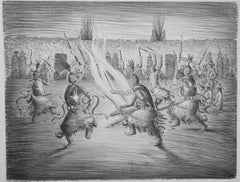
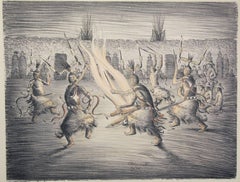
Apache Mountain Spirit Dancers, lithograph, Apache, Allan Houser Haozous black

Apache Mountain Spirit Dancers, lithograph, Apache, Allan Houser Haozous black

By Allan Houser

Located in Santa Fe, NM

Apache Mountain Spirit Dancers, lithograph, Apache, Allan Houser Haozous black Hand colored original lithograph edition by Allan Houser hand printed in Santa Fe, New Mexico Allan Houser (Haozous), Chiricahua Apache (1914-1994) Selected Collections Centre Georges Pompidou, Paris, France * “They’re Coming”, bronze Dahlem Museum, Berlin, Germany Japanese Royal Collection, Tokyo, Japan “The Eagle”, black marble commissioned by President William J. Clinton United States Mission to the United Nations, New York City, NY *"Offering of the Sacred Pipe”, monumental bronze by Allan Houser © 1979 Presented to the United States Mission to the United Nations as a symbol of World Peace honoring the native people of all tribes in these United States of America on February 27, 1985 by the families of Allan and Anna Marie Houser, George and Thelma Green and Glenn and Sandy Green in New York City. National Portrait Gallery, Smithsonian, Washington, DC * Portrait of Geronimo, bronze National Museum of American Art, Smithsonian, Washington, D.C. * “Buffalo Dance Relief”, Indiana limestone...

Category

1970s Contemporary Allan Houser Art

Materials

Color Pencil, Lithograph

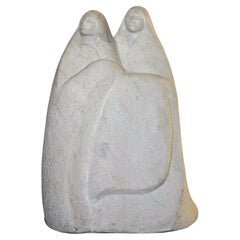
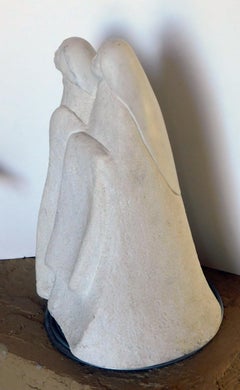
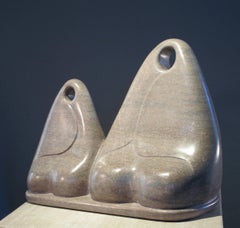
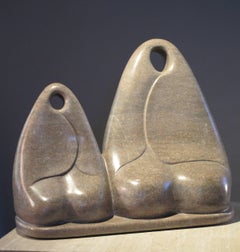
Allan Houser Marble Sculpture - Two Figures

Allan Houser Marble Sculpture - Two Figures

By Allan Houser

Located in Phoenix, AZ

Wonderful sculpture of two figures by Native American artist Allan Houser (1914-1994). The work is in excellent condition and measures 19 1/2"h x 12"w x 9"deep. His signature is seen...

Category

Late 20th Century Allan Houser Art

Materials

Marble

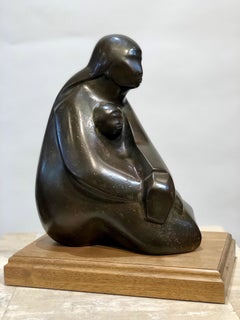
The Shy One, bronze, sculpture, by Allan Houser, mother, child, Apache, Native

The Shy One, bronze, sculpture, by Allan Houser, mother, child, Apache, Native

By Allan Houser

Located in Santa Fe, NM

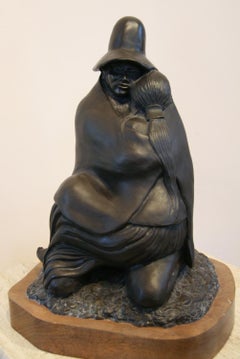
The Shy One, bronze, sculpture, by Allan Houser, mother, child, Apache, Native limited edition bronze casting lifetime casting wood base GLENN GREEN GALLERIES' LONG ASSOCIATION WIT...

Category

1990s Contemporary Allan Houser Art

Materials

Bronze

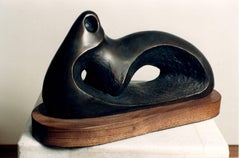
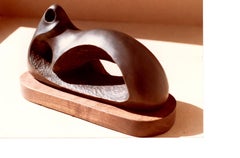
Reclining Figure II, by Allan Houser, Apache, abstract, figurative, bronze

Reclining Figure II, by Allan Houser, Apache, abstract, figurative, bronze

By Allan Houser

Located in Santa Fe, NM

Reclining Figure II, by Allan Houser, Apache, abstract, figurative, bronze Allan Houser was born in 1914. His artwork is an ongoing testimony to Native life in America – its beauty...

Category

1980s Contemporary Allan Houser Art

Materials

Bronze

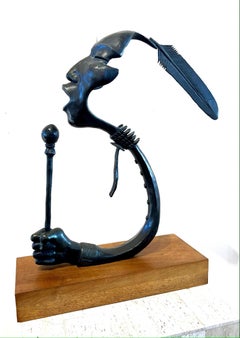
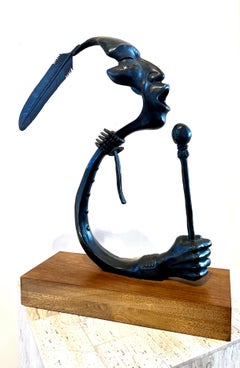
Lead Singer, bronze, sculpture, Allan Houser, Native American, Drummer, Apache

Lead Singer, bronze, sculpture, Allan Houser, Native American, Drummer, Apache

By Allan Houser

Located in Santa Fe, NM

Lead Singer, bronze, sculpture, Allan Houser, Native American, Drummer, Apache Allan Houser Haozous Warm Springs Chiricahua Apache 1914-1994 National Medal of Arts awardee Allan Houser (Haozous), Chiricahua Apache (1914-1994) Selected Collections Centre Georges Pompidou, Paris, France * “They’re Coming”, bronze Dahlem Museum, Berlin, Germany Japanese Royal Collection, Tokyo, Japan “The Eagle”, black marble commissioned by President William J. Clinton United States Mission to the United Nations, New York City, NY *"Offering of the Sacred Pipe”, monumental bronze by Allan Houser © 1979 Presented to the United States Mission to the United Nations as a symbol of World Peace honoring the native people of all tribes in these United States of America on February 27, 1985 by the families of Allan and Anna Marie Houser, George and Thelma Green and Glenn and Sandy Green in New York City. National Portrait Gallery, Smithsonian, Washington, DC * Portrait of Geronimo, bronze National Museum of American Art, Smithsonian, Washington, D.C. * “Buffalo Dance Relief”, Indiana limestone National Museum of the American Indian, Smithsonian, Washington, D.C. *Sacred Rain Arrow, (Originally dedicated at the US Senate Committee on Indian Affairs, US Senate Building) “Goat”, “To The Great Spirit” - dedicated in 1994 at the Vice President’s Residence in Washington, D.C.. Ceremony officiated by Hillary Rodham Clinton and Tipper Gore. Oklahoma State Capitol, Oklahoma City, Ok * “As Long As the Waters Flow”, bronze Gilcrease Museum, Tulsa, OK *Sacred Rain Arrow, bronze Fort Sill, Oklahoma *”Chiricahua Apache Family”, bronze Donated and dedicated to Allan Houser’s parents Sam and Blossom Haozous by Allan Houser and Glenn and Sandy Green The Heard Museum, Phoenix, Arizona *Earth Song, marble donated by Glenn and Sandy Green The Clinton Presidential Library, Arkansas * “May We Have Peace”, bronze The George H.W. Bush Presidential Library, College Station, Texas *"Offering to the Great Spirit", bronze The British Royal Collection, London, England *Princess Anne received "Proud Mother", bronze in Santa Fe Allan Houser’s father Sam Haozous, surrendered at the age of 14 with Geronimo and his band of Warm Springs Chiricahua Apache people in 1886 in Southern Arizona. This was the last active war party in the United States. This group of Apache people was imprisoned for 27 years starting in Fort Marion, Florida and finally living in captivity in Fort Sill, Oklahoma. Allan Houser was born in 1914. His artwork is an ongoing testimony to Native life in America – its beauty, strength and poignancy. Allan Houser is from the culture and portrayed his people in an insightful and authentic way. Because of the era in which he lived, he had a rare understanding of American Indian life. Allan was the first child born after the Chiricahua Apaches were released from 27 years of captivity. Allan grew up speaking the Chiricahua dialect. Allan heard his father’s stories of being on the warpath with Geronimo and almost nightly heard his parents singing traditional Apache music. Allan’s father knew all of Geronimo’s medicine songs. Allan had an early inclination to be artistic. He was exposed to many Apache ceremonial art forms: music, musical instruments, special dress, beadwork, body painting and dynamic dance that are integral aspects of his culture. His neighbors were members of many different tribes who lived in Oklahoma. Allan eagerly gained information about them and their cultures. Allan gathered this information and mentally stored images until he brought them back to life, years later, as a mature artist. Allan Houser was represented by Glenn Green Galleries (formerly known as The Gallery Wall, Inc.) from 1973 until his death in 1994. The gallery served as agents, advocates, and investors during this time. In 1973 the Greens responded enthusiastically to the abstraction and creativity in Houser’s work. They were impressed, not only with his versatility and talent but with the number of mediums he employed. His subject matter was portrayed in styles ranging from realism, stylized form to abstraction. With encouragement from the Greens, Houser at the age of 61, retired from his post as the head of the sculpture department at the Institute of American Indian Arts in Santa Fe, New Mexico in 1975 to begin working full-time creating his art. The next 20-year period was an exciting time for Allan, the gallery, and for the Green family. He created a large body of sculpture in stone, wood and bronze. For many years Glenn Green Galleries co-sponsored many editions of his bronzes and acted as quality control for the bronze sculptures according to Houser’s wishes. As both agents and gallery representatives, the Greens promoted and sold his art in their galleries in Phoenix and Scottsdale, Arizona and in Santa Fe, New Mexico. They had bi-annual exhibits in their galleries to feature Houser’s newest work and sponsored and arranged international museum shows in America, Europe and Asia. They travelled for these events including a trip to Carrara, Italy to the famed quarries of Michelangelo and together co-financed and arranged the purchase of 20 tons of marble. A watershed event for Allan Houser’s career occurred in the early 1980’s when Glenn Green Galleries arranged with the US Information Agency a touring exhibit of his sculpture through Europe. This series of exhibits drew record attendance for these museums and exposed Houser’s work to an enthusiastic art audience. This resulted in changing the perception of contemporary Native art in the United States where Houser and Glenn Green Galleries initially faced resistance from institutions who wanted to categorize him in a regional way. The credits from the European exhibits helped open doors and minds of the mainstream art community in the United States and beyond. Senator Daniel Inouye of Hawaii was a supporter of Allan Houser’s artwork. We worked with Senator Inouye on many occasions hosting events at our gallery and in Washington D.C in support of the formation of the Smithsonian’s National Museum of the American Indian in Washington, D.C. and other causes supporting Native Americans. Allan Houser is shown below presenting his sculpture “Swift Messenger” to Senator Inouye in Washington, D.C.. This sculpture was eventually given to the National Museum of the American Indian, Smithsonian’s permanent collection. It is now currently on loan and on display in the Oval Office. President Biden’s selection of artwork continues our gallery’s and Allan’s connection to the White House from our time working with Allan Houser from 1974 until his passing in 1994. “It was important for President Biden to walk into an Oval that looked like America and started to show the landscape of who he is going to be as president,” Ashley Williams...

Category

1970s Contemporary Allan Houser Art
Materials

Bronze

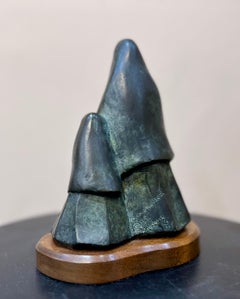
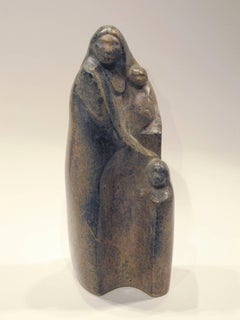
Shared Dreams, stone, sculpture, by Allan Houser, Texas steatite, mother, child

Shared Dreams, stone, sculpture, by Allan Houser, Texas steatite, mother, child

By Allan Houser

Located in Santa Fe, NM

Shared Dreams, stone, sculpture, by Allan Houser, Texas steatite, mother, child signed by the artist at the base of the child's blanket Allan Houser (Haozous), Chiricahua Apache 191...

Category

1980s Contemporary Allan Houser Art

Materials

Stone

After the Dance, bronze sculpture, realism, Native American, Man, Woman, Embrace

After the Dance, bronze sculpture, realism, Native American, Man, Woman, Embrace

By Allan Houser

Located in Santa Fe, NM

After the Dance, bronze sculpture, realism, Native American, Man, Woman, Embrace limited bronze edition, lifetime casting Allan Houser (Haozous), Chiricahua Apache (1914-1994) Selected Collections Centre Georges Pompidou, Paris, France * “They’re Coming”, bronze Dahlem Museum, Berlin, Germany Japanese Royal Collection, Tokyo, Japan “The Eagle”, black marble commissioned by President William J. Clinton United States Mission to the United Nations, New York City, NY *"Offering of the Sacred Pipe”, monumental bronze by Allan Houser © 1979 Presented to the United States Mission to the United Nations as a symbol of World Peace honoring the native people of all tribes in these United States of America on February 27, 1985 by the families of Allan and Anna Marie Houser, George and Thelma Green and Glenn and Sandy Green in New York City. National Portrait Gallery, Smithsonian, Washington, DC * Portrait of Geronimo, bronze National Museum of American Art, Smithsonian, Washington, D.C. * “Buffalo Dance Relief”, Indiana limestone National Museum of the American Indian, Smithsonian, Washington, D.C. *Sacred Rain Arrow, (Originally dedicated at the US Senate Committee on Indian Affairs, US Senate Building) “Goat”, “To The Great Spirit” - dedicated in 1994 at the Vice President’s Residence in Washington, D.C.. Ceremony officiated by Hillary Rodham Clinton and Tipper Gore. Oklahoma State Capitol, Oklahoma City, Ok * “As Long As the Waters Flow”, bronze Gilcrease Museum, Tulsa, OK *Sacred Rain Arrow, bronze Fort Sill, Oklahoma *”Chiricahua Apache Family”, bronze Donated and dedicated to Allan Houser’s parents Sam and Blossom Haozous by Allan Houser and Glenn and Sandy Green The Heard Museum, Phoenix, Arizona *Earth Song, marble donated by Glenn and Sandy Green   The Clinton Presidential Library, Arkansas * “May We Have Peace”, bronze The George H.W. Bush Presidential Library, College Station, Texas *"Offering to the Great Spirit", bronze The British Royal Collection, London, England *Princess Anne received "Proud Mother", bronze in Santa Fe Allan Houser’s father Sam Haozous, surrendered at the age of 14 with Geronimo and his band of Warm Springs Chiricahua Apache people in 1886 in Southern Arizona. This was the last active war party...

Category

1970s Allan Houser Art

Materials

Bronze

Southwest Dance Shield, Allan Houser, relief, bronze, Contemporary Native art

Southwest Dance Shield, Allan Houser, relief, bronze, Contemporary Native art

By Allan Houser

Located in Santa Fe, NM

Southwest Dance Shield, Allan Houser, relief, bronze, Contemporary Native art Allan Houser SOUTHWEST DANCE SHIELD bronze edition 24 ©1976 14.5" x 14.5" x 1.5" Allan Houser (Haozous...

Category

1970s Contemporary Allan Houser Art

Materials

Bronze

Related Items
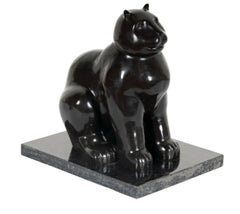
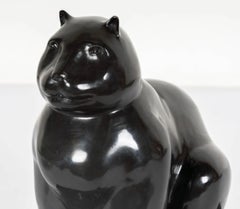
After Fernando Botero "Cat" Bronze Sculpture, Edition of 50

After Fernando Botero "Cat" Bronze Sculpture, Edition of 50

By Fernando Botero

Located in Cuauhtemoc, Ciudad de México

After Fernando Botero – CAT, Bronze, Marble Base, Great for Home or Office Edition of 50 This beautifully executed bronze sculpture is an After Fernando Botero work, created in fai...

Category

20th Century Contemporary Allan Houser Art

Materials

Marble, Bronze

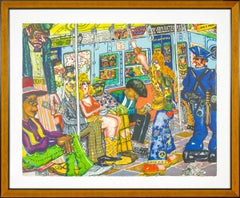
Hand-signed "Local" lithograph by Red Grooms from the 1971  "No Gas" portfolio

Hand-signed "Local" lithograph by Red Grooms from the 1971 "No Gas" portfolio

By Red Grooms

Located in Boca Raton, FL

"Local" lithograph by Red Grooms from the 1971 "No Gas" portfolio. Hand-signed AP Red Grooms in policeman's left shoe in bottom lower right of image. Depicts people on subway.

Category

1970s Contemporary Allan Houser Art

Materials

Lithograph

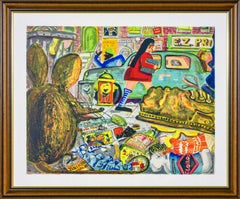
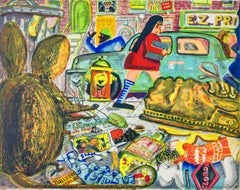
Hand-signed and numbered "Rat" lithograph from "No Gas Portfolio" by Red Grooms

Hand-signed and numbered "Rat" lithograph from "No Gas Portfolio" by Red Grooms

By Red Grooms

Located in Boca Raton, FL

"Rat" lithograph from 1971 "No Gas" portfolio by Red Grooms. Hand-signed AP Red Grooms inside blue of Clorox bottle on front lower right. Image size: 22 x 27 1/2 inches. Depicts a N...

Category

1970s Contemporary Allan Houser Art

Materials

Lithograph

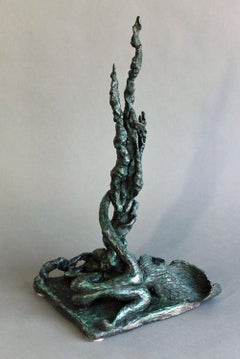
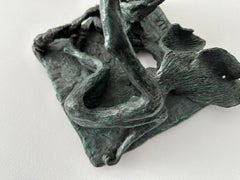
Woman Lying Down & Growing with Tree bronze sculpture by Yulla Lipchitz

Woman Lying Down & Growing with Tree bronze sculpture by Yulla Lipchitz

Located in Hudson, NY

Organic, abstract bronze sculpture by Yulla Lipchitz of a woman lying down with a tree. About this artist: Yulla Lipchitz, née Halberstadt, was born on April 21, 1911 in Berlin, Ge...

Category

1970s Modern Allan Houser Art

Materials

Bronze

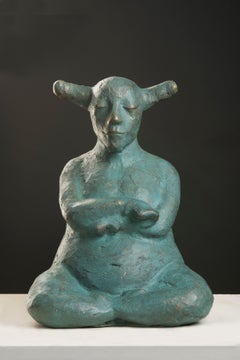
Little Zen (Turquoise Patina) 1/99

Little Zen (Turquoise Patina) 1/99

By Giuseppe Palumbo

Located in Napa, CA

Giuseppe Palumbo’s whimsical, anthropomorphic sculptures delve into the human psyche through irony, wit, and humor. By applying classical techniques to his contemporary subjects, Pal...

Category

2010s Contemporary Allan Houser Art

Materials

Bronze

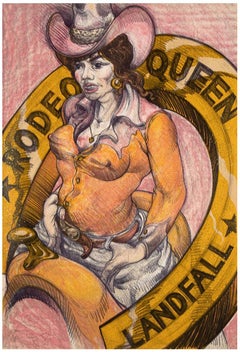
Rodeo Queen by Luis Jimenez

Rodeo Queen by Luis Jimenez

By Luis Alfonso Jimenez

Located in Phoenix, AZ

Rodeo Queen, 1981 Edition 36/50 Signed lower left, Inscribed: for the "Rose" 82. Provenance: Print was a gift to Rozanne Charington, companion and model for "Rodeo Queen", "Rose Tattoo" and "Jimenez at Adeliza's Candy Store". Lithograph on paper 42 ½ × 29 in. (107.3 × 73.7 cm) Luis Alfonso Jimenez Born, 1940, El Paso, Texas, died 2006, Hondo, New Mexico. Statement: Luis Jimenez, in his work, celebrates the vitality of life. . . . Jimenez es un hijo de la frontera; he knows its people and the landscape. It is the transformation of these people into art that is his most important contribution to the art of this vast region which stretches between Mexico and the United States. His subject matter utilizes the popular images of the cultura del norte, and a large part of it is depicted and transformed in the rough and tumble world of la frontera. He is also a son of el norte, and so he uses its materials and explores its emerging, popular myths. The tension and attraction of Jimnez’s work is that he always creates within the space of his two worlds, the Mexicano and the Americano. He constantly shows us the irony of the two forces which repel, while showing us glimpses of the synthesis he seeks. What a gift it has been to us for this talented artist to reflect on the soul of our region. He gives meaning to our existence and history. Rudolfo Anaya (passage chosen by the artist), A View from La Frontera, Man on Fire: Luis Jimenez, pp. 1, 3, 6Biography: Luis Jimenez was born in Texas to parents who had emigrated from Mexico to the United States; he would later dedicate his 1989 sculpture Border Crossing to his father, who had entered the country illegally. The elder Jimenez was a neon sign designer in El Paso, and Luis worked with him as a youth. His experience working in the neon shop and his fascination with U.S. car culture would both become major influences on his art career. Jimenez studied architecture at the University of Texas, Austin (UTA), and also took art courses in which he first created sculptures with wood, steel, and fiberglass, choosing the latter because of its association with U.S. popular culture. He subsequently became one of the artists who made fiberglass an acceptable medium in the 1960s. In 1964 Jimenez received his B.S. in art from UTA, and he continued his studies at the Universidad Nacional Autonoma de Mexico in Mexico City. In 1966 he moved to New York City and worked as an assistant to sculptor Seymour Lipton. Jimenez began to exhibit his art while in New York and in 1972 moved to New Mexico to focus on creating public sculptures, even as he maintained his diverse output of drawings, prints, and lithographs. Drawing on his early experiences, Jimenez creates works that come from a border perspective, one that draws upon the hybridity bred by culture clashes. Often socially and politically informed, his works speak not only in regional terms, those germane to the southwestern United States, but to broader, more global issues as well. They exhibit a profoundly Chicano aesthetic and sensibility, one that is informed by Mexican and Mexican American traditions, North American popular culture, Chicano cultural icons, and images and themes unique to the Southwest. Death, sexuality, and the struggle of the common people are frequent themes. Inspired by authors who write in an autobiographical style, Jimenez creates works that function as personal narrative yet are also able to make statements about culture in more global terms. His use of bold colors and lines, a legacy from his fathers work as a neon sign maker, lends a dynamic sensuality to his work, one that is particularly evident in his monumental fiberglass and acrylic urethane sculptural works Many of Jimenez's works correspond to scholar Toms Ybarra-Fraustos definition of the Chicano aesthetic of rasquachismo, a lowbrow sensibility that appeals to the working class in that it applies to objects that subvert expressions of the mainstream or dominant culture. Creating art that speaks to the people, Jimenez is able to transform regional and culturally specific myths and symbols into globally recognized and relevant icons. Exhibitions: In addition to his personal work, Jimenez has been commissioned for numerous public art projects. In 1999 his sculpture Southwest Piet was designated a National Treasure by First Lady Hillary Clinton. The many exhibitions featuring his work have included Human Concern/Personal Torment (Whitney Museum of American Art, New York, 1969). The First International Motorcycle Art Show (Phoenix Art Museum, Phoenix, AZ, 1973). Three Texas Artists (Centre Cultural Americaine, USIS, Paris, 1977), Recent Trends in Collecting (Smithsonian Institution, Washington, DC, 1982). Committed to Print (Museum of Modern Art, New York, 1989) Printmaking in Texas: The 1980s (Modern Art Museum, Fort Worth, TX. Laguna Gloria Art Museum, Austin, 1990. The Whitney Biennial (Whitney Museum of American Art, New York, 1991) Man On Fire: Luis Jimnez (Albuquerque Museum of Art, NM, 1994-95). 47th Annual Purchase Exhibition (American Academy of Arts and Letters, New York, 1995). Traveling solo exhibition, Working Class Heroes: Images from the Popular Culture (1997-2000). Jiménez Collier Gallery has been in continuous operation for over 40 years. Originally located just off Main Street in downtown Scottsdale, Arizona, we have moved to Phoenix to accommodate and showcase our large inventory including: • Original works by Maynard Dixon, Lon Megargee, Ed Mell, Fritz Scholder, Bill Schenck, Bill Lesch, Luis Jimenez, Greg Singley, Dan Budnik, and other 20th century Western, WPA and Contemporary Southwestern artists. • The Fine Art Estate of Lon Megargee • Vintage rodeo...

Category

1980s Contemporary Allan Houser Art

Materials

Lithograph

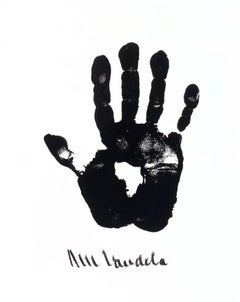
Hand of Africa - Mandela, Former South African President, Signed Artwork, Hand

Hand of Africa - Mandela, Former South African President, Signed Artwork, Hand

By Nelson Mandela

Located in Knowle Lane, Cranleigh

Nelson Mandela, Hand of Africa, Signed Limited Edition Lithograph Many people are unaware that Nelson Mandela turned his hand to art in his 80's as a way of leaving a legacy for his ...

Category

Early 2000s Contemporary Allan Houser Art

Materials

Lithograph

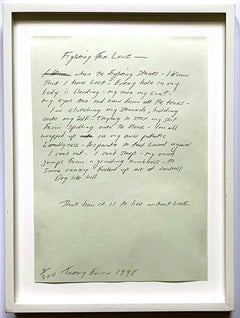
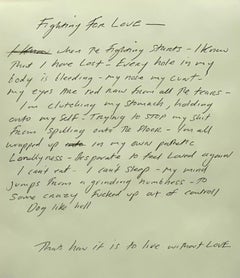
Tracey Emin - Fighting for Love - Offset lithograph mimeograph, Signed/N, Framed

Tracey Emin - Fighting for Love - Offset lithograph mimeograph, Signed/N, Framed

By Tracey Emin

Located in New York, NY

Offset lithograph mimeograph on green apple paper Pencil signed and numbered 9/300 Provenance: Opus Art Limited This work has been elegantly floated and framed in a wood frame under ...

Category

1990s Contemporary Allan Houser Art

Materials

Digital, Lithograph, Offset

After Fernando Botero Standing Woman Bronze Sculpture, Edition of 50

After Fernando Botero Standing Woman Bronze Sculpture, Edition of 50

By Fernando Botero

Located in Cuauhtemoc, Ciudad de México

After Fernando Botero – STANDING WOMAN Bronze Sculpture Edition of 50 This beautifully executed bronze sculpture is an After Fernando Botero work, created in faithful homage to th...

Category

20th Century Contemporary Allan Houser Art

Materials

Marble, Bronze

After Botero - Standing Woman Bronze Sculpture, Contemporary 20th Century

After Botero - Standing Woman Bronze Sculpture, Contemporary 20th Century

By Fernando Botero

Located in Cuauhtemoc, Ciudad de México

This AFTER BOTERO sculpture is a very beautiful, faithful reproduction in the style of BOTERO'S work that has sold very well here on 1st Dibs. The edition is 50 in Roman numerals. ...

Category

20th Century Contemporary Allan Houser Art

Materials

Marble, Bronze

Previously Available Items
Pleasant Memories, bronze, sculpture, Allan Houser, Apache, contemporary, modern

Pleasant Memories, bronze, sculpture, Allan Houser, Apache, contemporary, modern

By Allan Houser

Located in Santa Fe, NM

Pleasant Memories, bronze, sculpture, Allan Houser, Apache, contemporary, modern GLENN GREEN GALLERIES' LONG ASSOCIATION WITH ALLAN HOUSER Allan Houser was represented by Glenn Gree...

Category

1990s Contemporary Allan Houser Art

Materials

Bronze

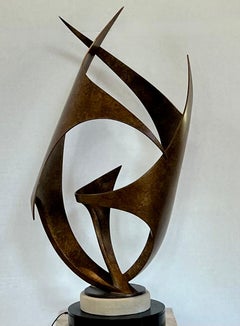
Nature Evolving, bronze, sculpture, by Allan Houser, Apache, abstract, modernism

Nature Evolving, bronze, sculpture, by Allan Houser, Apache, abstract, modernism

By Allan Houser

Located in Santa Fe, NM

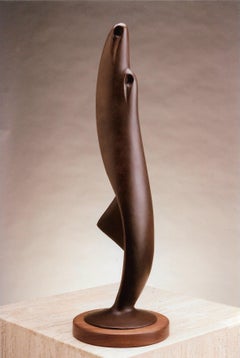
Nature Evolving, bronze, sculpture, by Allan Houser, Apache, abstract, modernism limited edition, lifetime casting, bronze mounted to walnut base GLENN GREEN GALLERIES' LONG ASSOCIA...

Category

1980s Contemporary Allan Houser Art

Materials

Bronze

Night Talk, Allan Houser, bronze, sculpture, limited edition, brown, figurative

Night Talk, Allan Houser, bronze, sculpture, limited edition, brown, figurative

By Allan Houser

Located in Santa Fe, NM

Night Talk, Allan Houser, bronze, sculpture, limited edition, brown, figurative Allan Houser (Haozous), Chiricahua Apache (1914-1994) Selected Collections Centre Georges Pompidou, Paris, France * “They’re Coming”, bronze Dahlem Museum, Berlin, Germany Japanese Royal Collection, Tokyo, Japan “The Eagle”, black marble commissioned by President William J. Clinton United States Mission to the United Nations, New York City, NY *"Offering of the Sacred Pipe”, monumental bronze by Allan Houser © 1979 Presented to the United States Mission to the United Nations as a symbol of World Peace honoring the native people of all tribes in these United States of America on February 27, 1985 by the families of Allan and Anna Marie Houser, George and Thelma Green and Glenn and Sandy Green in New York City. National Portrait Gallery, Smithsonian, Washington, DC * Portrait of Geronimo, bronze National Museum of American Art, Smithsonian, Washington, D.C. * “Buffalo Dance Relief”, Indiana limestone National Museum of the American Indian, Smithsonian, Washington, D.C. *Sacred Rain Arrow, (Originally dedicated at the US Senate Committee on Indian Affairs, US Senate Building) “Goat”, “To The Great Spirit” - dedicated in 1994 at the Vice President’s Residence in Washington, D.C.. Ceremony officiated by Hillary Rodham Clinton and Tipper Gore. Oklahoma State Capitol, Oklahoma City, Ok * “As Long As the Waters Flow”, bronze Gilcrease Museum, Tulsa, OK *Sacred Rain Arrow, bronze Fort Sill, Oklahoma *”Chiricahua Apache Family...

Category

1980s Contemporary Allan Houser Art

Materials

Bronze

End of the Hunt, by Allan Houser, bronze, sculpture, wildlife, eagle, rabbit

End of the Hunt, by Allan Houser, bronze, sculpture, wildlife, eagle, rabbit

By Allan Houser

Located in Santa Fe, NM

End of the Hunt, by Allan Houser, bronze, sculpture, wildlife, eagle, rabbit Allan Houser (Haozous), Chiricahua Apache (1914-1994) Selected Collections Centre Georges Pompidou, Paris, France * “They’re Coming”, bronze Dahlem Museum, Berlin, Germany Japanese Royal Collection, Tokyo, Japan “The Eagle”, black marble commissioned by President William J. Clinton United States Mission to the United Nations, New York City, NY *"Offering of the Sacred Pipe”, monumental bronze by Allan Houser © 1979 Presented to the United States Mission to the United Nations as a symbol of World Peace honoring the native people of all tribes in these United States of America on February 27, 1985 by the families of Allan and Anna Marie Houser, George and Thelma Green and Glenn and Sandy Green in New York City. National Portrait Gallery, Smithsonian, Washington, DC * Portrait of Geronimo, bronze National Museum of American Art, Smithsonian, Washington, D.C. * “Buffalo Dance Relief”, Indiana limestone National Museum of the American Indian, Smithsonian, Washington, D.C. *Sacred Rain Arrow, (Originally dedicated at the US Senate Committee on Indian Affairs, US Senate Building) “Goat”, “To The Great Spirit” - dedicated in 1994 at the Vice President’s Residence in Washington, D.C.. Ceremony officiated by Hillary Rodham Clinton and Tipper Gore. Oklahoma State Capitol, Oklahoma City, Ok * “As Long As the Waters Flow”, bronze Gilcrease Museum, Tulsa, OK *Sacred Rain Arrow, bronze Fort Sill, Oklahoma *”Chiricahua Apache Family”, bronze Donated and dedicated to Allan Houser’s parents Sam and Blossom Haozous by Allan Houser and Glenn and Sandy Green The Heard Museum, Phoenix, Arizona *Earth Song, marble donated by Glenn and Sandy Green The Clinton Presidential Library, Arkansas * “May We Have Peace”, bronze The George H.W. Bush Presidential Library, College Station, Texas *"Offering to the Great Spirit", bronze The British Royal Collection, London, England *Princess Anne received "Proud Mother", bronze in Santa Fe Allan Houser’s father Sam Haozous, surrendered at the age of 14 with Geronimo and his band of Warm Springs Chiricahua Apache people in 1886 in Southern Arizona. This was the last active war party...

Category

1970s Contemporary Allan Houser Art

Materials

Bronze

Somewhere on the Reservation, Bronze, Sculpture, Allan Houser, Apache, Singer

Somewhere on the Reservation, Bronze, Sculpture, Allan Houser, Apache, Singer

By Allan Houser

Located in Santa Fe, NM

Somewhere on the Reservation, Bronze,Sculpture, by Allan Houser, Apache, Singers Allan Houser (Haozous), Chiricahua Apache 1914-1994 recipient of the National Medal of Arts in 1992. Allan Houser's father Sam, was part of the small band of Apaches who traveled with Geronimo and surrendered in southern Arizona in 1886. Allan's parents were imprisoned with that group in Ft. Sill, Oklahoma. He was the first child to be born in freedom to those Apaches and a fluent speaker of the Chiricahua language. Allan Houser is an important artist in that he is of the culture he depicts in his artwork. Allan's parents would tell stories and sing songs recalling the experiences on the warpath. Our gallery represented Allan Houser from 1974 until his passing in 1994 and were investors and provided quality control in the foundry process. Allan Houser's work is many international collections including the Georges Pompidou Centre, The Smithsonian National Portrait Gallery, The Dahlem Museum among others. Allan Houser (Haozous), Chiricahua Apache (1914-1994) Selected Collections Centre Georges Pompidou, Paris, France * “They’re Coming”, bronze Dahlem Museum, Berlin, Germany Japanese Royal Collection, Tokyo, Japan “The Eagle”, black marble commissioned by President William J. Clinton United States Mission to the United Nations, New York City, NY *"Offering of the Sacred Pipe”, monumental bronze by Allan Houser © 1979 Presented to the United States Mission to the United Nations as a symbol of World Peace honoring the native people of all tribes in these United States of America on February 27, 1985 by the families of Allan and Anna Marie Houser, George and Thelma Green and Glenn and Sandy Green in New York City. National Portrait Gallery, Smithsonian, Washington, DC * Portrait of Geronimo, bronze National Museum of American Art, Smithsonian, Washington, D.C. * “Buffalo Dance Relief”, Indiana limestone National Museum of the American Indian, Smithsonian, Washington, D.C. *Sacred Rain Arrow, (Originally dedicated at the US Senate Committee on Indian Affairs, US Senate Building) “Goat”, “To The Great Spirit” - dedicated in 1994 at the Vice President’s Residence in Washington, D.C.. Ceremony officiated by Hillary Rodham Clinton and Tipper Gore. Oklahoma State Capitol, Oklahoma City, Ok * “As Long As the Waters Flow”, bronze Gilcrease Museum, Tulsa, OK *Sacred Rain Arrow, bronze Fort Sill, Oklahoma *”Chiricahua Apache Family”, bronze Donated and dedicated to Allan Houser’s parents Sam and Blossom Haozous by Allan Houser and Glenn and Sandy Green The Heard Museum, Phoenix, Arizona *Earth Song, marble donated by Glenn and Sandy Green The Clinton Presidential Library, Arkansas * “May We Have Peace”, bronze The George H.W. Bush Presidential Library, College Station, Texas *"Offering to the Great Spirit", bronze The British Royal Collection, London, England *Princess Anne received "Proud Mother", bronze in Santa Fe Allan Houser’s father Sam Haozous, surrendered at the age of 14 with Geronimo and his band of Warm Springs Chiricahua Apache people in 1886 in Southern Arizona. This was the last active war party in the United States. This group of Apache people was imprisoned for 27 years starting in Fort Marion, Florida and finally living in captivity in Fort Sill, Oklahoma. Allan Houser was born in 1914. His artwork is an ongoing testimony to Native life in America – its beauty, strength and poignancy. Allan Houser is from the culture and portrayed his people in an insightful and authentic way. Because of the era in which he lived, he had a rare understanding of American Indian life. Allan was the first child born after the Chiricahua Apaches were released from 27 years of captivity. Allan grew up speaking the Chiricahua dialect. Allan heard his father’s stories of being on the warpath with Geronimo and almost nightly heard his parents singing traditional Apache music. Allan’s father knew all of Geronimo’s medicine songs. Allan had an early inclination to be artistic. He was exposed to many Apache ceremonial art forms: music, musical instruments, special dress, beadwork, body painting and dynamic dance that are integral aspects of his culture. His neighbors were members of many different tribes who lived in Oklahoma. Allan eagerly gained information about them and their cultures. Allan gathered this information and mentally stored images until he brought them back to life, years later, as a mature artist. Allan Houser was represented by Glenn Green Galleries (formerly known as The Gallery Wall, Inc.) from 1973 until his death in 1994. The gallery served as agents, advocates, and investors during this time. In 1973 the Greens responded enthusiastically to the abstraction and creativity in Houser’s work. They were impressed, not only with his versatility and talent but with the number of mediums he employed. His subject matter was portrayed in styles ranging from realism, stylized form to abstraction. With encouragement from the Greens, Houser at the age of 61, retired from his post as the head of the sculpture department at the Institute of American Indian Arts in Santa Fe, New Mexico in 1975 to begin working full-time creating his art. The next 20-year period was an exciting time for Allan, the gallery, and for the Green family. He created a large body of sculpture in stone, wood and bronze. For many years Glenn Green Galleries co-sponsored many editions of his bronzes and acted as quality control for the bronze sculptures according to Houser’s wishes. As both agents and gallery representatives, the Greens promoted and sold his art in their galleries in Phoenix and Scottsdale, Arizona and in Santa Fe, New Mexico. They had bi-annual exhibits in their galleries to feature Houser’s newest work and sponsored and arranged international museum shows in America, Europe and Asia. They travelled for these events including a trip to Carrara, Italy to the famed quarries of Michelangelo and together co-financed and arranged the purchase of 20 tons of marble. A watershed event for Allan Houser’s career occurred in the early 1980’s when Glenn Green Galleries arranged with the US Information Agency a touring exhibit of his sculpture through Europe. This series of exhibits drew record attendance for these museums and exposed Houser’s work to an enthusiastic art audience. This resulted in changing the perception of contemporary Native art in the United States where Houser and Glenn Green Galleries initially faced resistance from institutions who wanted to categorize him in a regional way. The credits from the European exhibits helped open doors and minds of the mainstream art community in the United States and beyond. Senator Daniel Inouye of Hawaii was a supporter of Allan Houser’s artwork. We worked with Senator Inouye on many occasions hosting events at our gallery and in Washington D.C in support of the formation of the Smithsonian’s National Museum of the American Indian in Washington, D.C. and other causes supporting Native Americans. Allan Houser is shown below presenting his sculpture “Swift Messenger” to Senator Inouye in Washington, D.C.. This sculpture was eventually given to the National Museum of the American Indian, Smithsonian’s permanent collection. It is now currently on loan and on display in the Oval Office. President Biden’s selection of artwork continues our gallery’s and Allan’s connection to the White House from our time working with Allan Houser from 1974 until his passing in 1994. “It was important for President Biden to walk into an Oval that looked like America and started to show the landscape of who he is going to be as president,” Ashley Williams...

Category

1970s Contemporary Allan Houser Art
Materials

Bronze

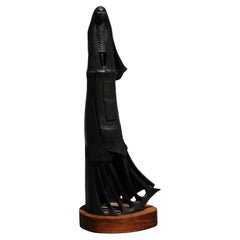
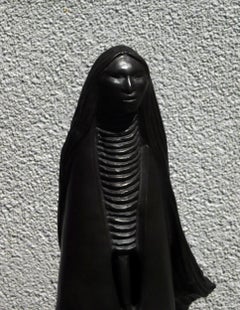
San Carlos Girl, bronze, sculpture, by Allan Houser, Apache, woman, brown

San Carlos Girl, bronze, sculpture, by Allan Houser, Apache, woman, brown

By Allan Houser

Located in Santa Fe, NM

San Carlos Girl, bronze, sculpture, by Allan Houser, Apache, woman, brown lifetime casting limited edition Allan Houser (Haozous), Chiricahua Apache 1914-1994 recipient of the National Medal of Arts in 1992. Allan Houser's father Sam, was part of the small band of Apaches who traveled with Geronimo and surrendered in southern Arizona in 1886. Allan's parents were imprisoned with that group in Ft. Sill, Oklahoma. He was the first child to be born in freedom to those Apaches and a fluent speaker of the Chiricahua language. Allan Houser is an important artist because he is of the culture he depicts in his artwork. Allan's parents would tell stories and sing songs recalling the experiences on the warpath. Our gallery represented Allan Houser from 1974 until his passing in 1994 and were investors and provided quality control in the foundry process. Allan Houser's work is in many international collections including the Georges Pompidou Centre, The Smithsonian National Portrait Gallery, and The Dahlem Museum among others. Allan Houser (Haozous), Chiricahua Apache (1914-1994) Selected Collections Centre Georges Pompidou, Paris, France * “They’re Coming”, bronze Dahlem Museum, Berlin, Germany Japanese Royal Collection, Tokyo, Japan “The Eagle”, black marble commissioned by President William J. Clinton United States Mission to the United Nations, New York City, NY *"Offering of the Sacred Pipe”, monumental bronze by Allan Houser © 1979 Presented to the United States Mission to the United Nations as a symbol of World Peace honoring the native people of all tribes in these United States of America on February 27, 1985 by the families of Allan and Anna Marie Houser, George and Thelma Green and Glenn and Sandy Green in New York City. National Portrait Gallery, Smithsonian, Washington, DC * Portrait of Geronimo, bronze National Museum of American Art, Smithsonian, Washington, D.C. * “Buffalo Dance Relief”, Indiana limestone National Museum of the American Indian, Smithsonian, Washington, D.C. *Sacred Rain Arrow, (Originally dedicated at the US Senate Committee on Indian Affairs, US Senate Building) “Goat”, “To The Great Spirit” - dedicated in 1994 at the Vice President’s Residence in Washington, D.C.. The ceremony officiated by Hillary Rodham Clinton and Tipper Gore. Oklahoma State Capitol, Oklahoma City, Ok * “As Long As the Waters Flow”, bronze Gilcrease Museum, Tulsa, OK *Sacred Rain Arrow, bronze Fort Sill, Oklahoma *” Chiricahua Apache Family”, bronze Donated and dedicated to Allan Houser’s parents Sam and Blossom Haozous by Allan Houser and Glenn and Sandy Green The Heard Museum, Phoenix, Arizona *Earth Song, marble donated by Glenn and Sandy Green The Clinton Presidential Library, Arkansas * “May We Have Peace”, bronze The George H.W. Bush Presidential Library, College Station, Texas *"Offering to the Great Spirit", bronze The British Royal Collection, London, England *Princess Anne received "Proud Mother", bronze in Santa Fe Allan Houser’s father Sam Haozous, surrendered at the age of 14 with Geronimo and his band of Warm Springs Chiricahua Apache people in 1886 in Southern Arizona. This was the last active war party in the United States. This group of Apache people was imprisoned for 27 years starting in Fort Marion, Florida and finally living in captivity in Fort Sill, Oklahoma. Allan Houser was born in 1914. His artwork is an ongoing testimony to Native life in America – its beauty, strength and poignancy. Allan Houser is from the culture and portrayed his people in an insightful and authentic way. Because of the era in which he lived, he had a rare understanding of American Indian life. Allan was the first child born after the Chiricahua Apaches were released from 27 years of captivity. Allan grew up speaking the Chiricahua dialect. Allan heard his father’s stories of being on the warpath with Geronimo and almost nightly heard his parents singing traditional Apache music. Allan’s father knew all of Geronimo’s medicine songs. Allan had an early inclination to be artistic. He was exposed to many Apache ceremonial art forms: music, musical instruments, special dress, beadwork, body painting and dynamic dance that are integral aspects of his culture. His neighbors were members of many different tribes who lived in Oklahoma. Allan eagerly gained information about them and their cultures. Allan gathered this information and mentally stored images until he brought them back to life, years later, as a mature artist. Allan Houser was represented by Glenn Green Galleries (formerly known as The Gallery Wall, Inc.) from 1973 until his death in 1994. The gallery served as agents, advocates, and investors during this time. In 1973 the Greens responded enthusiastically to the abstraction and creativity in Houser’s work. They were impressed, not only with his versatility and talent but with the number of mediums he employed. His subject matter was portrayed in styles ranging from realism, stylized form to abstraction. With encouragement from the Greens, Houser at the age of 61, retired from his post as the head of the sculpture department at the Institute of American Indian Arts in Santa Fe, New Mexico in 1975 to begin working full-time creating his art. The next 20-year period was an exciting time for Allan, the gallery, and for the Green family. He created a large body of sculpture in stone, wood and bronze. For many years Glenn Green Galleries co-sponsored many editions of his bronzes and acted as quality control for the bronze sculptures according to Houser’s wishes. As both agents and gallery representatives, the Greens promoted and sold his art in their galleries in Phoenix and Scottsdale, Arizona and in Santa Fe, New Mexico. They had bi-annual exhibits in their galleries to feature Houser’s newest work and sponsored and arranged international museum shows in America, Europe and Asia. They travelled for these events including a trip to Carrara, Italy to the famed quarries of Michelangelo and together co-financed and arranged the purchase of 20 tons of marble. A watershed event for Allan Houser’s career occurred in the early 1980’s when Glenn Green Galleries arranged with the US Information Agency a touring exhibit of his sculpture through Europe. This series of exhibits drew record attendance for these museums and exposed Houser’s work to an enthusiastic art audience. This resulted in changing the perception of contemporary Native art in the United States where Houser and Glenn Green Galleries initially faced resistance from institutions who wanted to categorize him in a regional way. The credits from the European exhibits helped open doors and minds of the mainstream art community in the United States and beyond. Senator Daniel Inouye of Hawaii was a supporter of Allan Houser’s artwork. We worked with Senator Inouye on many occasions hosting events at our gallery and in Washington D.C in support of the formation of the Smithsonian’s National Museum of the American Indian in Washington, D.C. and other causes supporting Native Americans. Allan Houser is shown below presenting his sculpture “Swift Messenger” to Senator Inouye in Washington, D.C.. This sculpture was eventually given to the National Museum of the American Indian, Smithsonian’s permanent collection. It is now currently on loan and on display in the Oval Office. President Biden’s selection of artwork continues our gallery’s and Allan’s connection to the White House from our time working with Allan Houser from 1974 until his passing in 1994. “It was important for President Biden to walk into an Oval that looked like America and started to show the landscape of who he is going to be as president,” Ashley Williams...

Category

1970s Contemporary Allan Houser Art
Materials

Bronze

Sparrow Hawk, bronze, sculpture, by Allan Houser, bird, limited edition, gold

Sparrow Hawk, bronze, sculpture, by Allan Houser, bird, limited edition, gold

By Allan Houser

Located in Santa Fe, NM

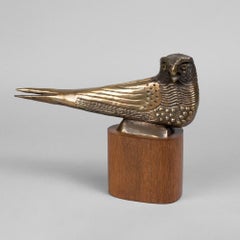
Sparrow Hawk, bronze, sculpture, by Allan Houser, bird, limited edition, gold GLENN GREEN GALLERIES' LONG ASSOCIATION WITH ALLAN HOUSER Allan Houser was represented by Glenn Green ...

Category

1970s Contemporary Allan Houser Art

Materials

Bronze

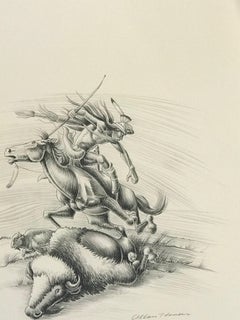
Apache Hunter, limited edition lithograph by Allan Houser, horseback hunter

Apache Hunter, limited edition lithograph by Allan Houser, horseback hunter

By Allan Houser

Located in Santa Fe, NM

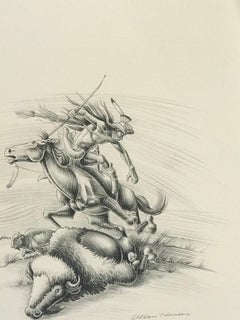
Apache Hunter, limited edition lithograph by Allan Houser, horseback hunter hand pulled black and white lithograph edition printed in Santa Fe, New Mexico Allan Houser (Haozous), Chiricahua Apache (1914-1994) Selected Collections Centre Georges Pompidou, Paris, France * “They’re Coming”, bronze Dahlem Museum, Berlin, Germany Japanese Royal Collection, Tokyo, Japan “The Eagle”, black marble commissioned by President William J. Clinton United States Mission to the United Nations, New York City, NY *"Offering of the Sacred Pipe”, monumental bronze by Allan Houser © 1979 Presented to the United States Mission to the United Nations as a symbol of World Peace honoring the native people of all tribes in these United States of America on February 27, 1985 by the families of Allan and Anna Marie Houser, George and Thelma Green and Glenn and Sandy Green in New York City. National Portrait Gallery, Smithsonian, Washington, DC * Portrait of Geronimo, bronze National Museum of American Art, Smithsonian, Washington, D.C. * “Buffalo Dance Relief”, Indiana limestone National Museum of the American Indian, Smithsonian, Washington, D.C. *Sacred Rain Arrow, (Originally dedicated at the US Senate Committee on Indian Affairs, US Senate Building) “Goat”, “To The Great Spirit” - dedicated in 1994 at the Vice President’s Residence in Washington, D.C.. Ceremony officiated by Hillary Rodham Clinton and Tipper Gore. Oklahoma State Capitol, Oklahoma City, Ok * “As Long As the Waters Flow”, bronze Gilcrease Museum, Tulsa, OK *Sacred Rain Arrow, bronze Fort Sill, Oklahoma *”Chiricahua Apache Family”, bronze Donated and dedicated to Allan Houser’s parents Sam and Blossom Haozous by Allan Houser and Glenn and Sandy Green The Heard Museum, Phoenix, Arizona *Earth Song, marble donated by Glenn and Sandy Green   The Clinton Presidential Library, Arkansas * “May We Have Peace”, bronze The George H.W. Bush Presidential Library, College Station, Texas *"Offering to the Great Spirit", bronze The British Royal Collection, London, England *Princess Anne received "Proud Mother", bronze in Santa Fe Allan Houser’s father Sam Haozous, surrendered at the age of 14 with Geronimo and his band of Warm Springs Chiricahua Apache people in 1886 in Southern Arizona. This was the last active war party in the United States. This group of Apache people was imprisoned for 27 years starting in Fort Marion, Florida and finally living in captivity in Fort Sill, Oklahoma. Allan Houser was born in 1914. His artwork is an ongoing testimony to Native life in America – its beauty, strength and poignancy. Allan Houser is from the culture and portrayed his people in an insightful and authentic way. Because of the era in which he lived, he had a rare understanding of American Indian life. Allan was the first child born after the Chiricahua Apaches were released from 27 years of captivity. Allan grew up speaking the Chiricahua dialect. Allan heard his father’s stories of being on the warpath with Geronimo and almost nightly heard his parents singing traditional Apache music. Allan’s father knew all of Geronimo’s medicine songs. Allan had an early inclination to be artistic. He was exposed to many Apache ceremonial art forms: music, musical instruments, special dress, beadwork, body painting and dynamic dance that are integral aspects of his culture. His neighbors were members of many different tribes who lived in Oklahoma. Allan eagerly gained information about them and their cultures. Allan gathered this information and mentally stored images until he brought them back to life, years later, as a mature artist. Allan Houser was represented by Glenn Green Galleries (formerly known as The Gallery Wall, Inc.) from 1973 until his death in 1994. The gallery served as agents, advocates, and investors during this time. In 1973 the Greens responded enthusiastically to the abstraction and creativity in Houser’s work. They were impressed, not only with his versatility and talent but with the number of mediums he employed. His subject matter was portrayed in styles ranging from realism, stylized form to abstraction. With encouragement from the Greens, Houser at the age of 61, retired from his post as the head of the sculpture department at the Institute of American Indian Arts in Santa Fe, New Mexico in 1975 to begin working full-time creating his art. The next 20-year period was an exciting time for Allan, the gallery, and for the Green family. He created a large body of sculpture in stone, wood and bronze. For many years Glenn Green Galleries co-sponsored many editions of his bronzes and acted as quality control for the bronze sculptures according to Houser’s wishes. As both agents and gallery representatives, the Greens promoted and sold his art in their galleries in Phoenix and Scottsdale, Arizona and in Santa Fe, New Mexico. They had bi-annual exhibits in their galleries to feature Houser’s newest work and sponsored and arranged international museum shows in America, Europe and Asia. They travelled for these events including a trip to Carrara, Italy to the famed quarries of Michelangelo and together co-financed and arranged the purchase of 20 tons of marble. A watershed event for Allan Houser’s career occurred in the early 1980’s when Glenn Green Galleries arranged with the US Information Agency a touring exhibit of his sculpture through Europe. This series of exhibits drew record attendance for these museums and exposed Houser’s work to an enthusiastic art audience. This resulted in changing the perception of contemporary Native art in the United States where Houser and Glenn Green Galleries initially faced resistance from institutions who wanted to categorize him in a regional way. The credits from the European exhibits helped open doors and minds of the mainstream art community in the United States and beyond. Senator Daniel Inouye of Hawaii was a supporter of Allan Houser’s artwork. We worked with Senator Inouye on many occasions hosting events at our gallery and in Washington D.C in support of the formation of the Smithsonian’s National Museum of the American Indian in Washington, D.C. and other causes supporting Native Americans. Allan Houser is shown below presenting his sculpture “Swift Messenger” to Senator Inouye in Washington, D.C.. This sculpture was eventually given to the National Museum of the American Indian, Smithsonian’s permanent collection. It is now currently on loan and on display in the Oval Office. President Biden’s selection of artwork continues our gallery’s and Allan’s connection to the White House from our time working with Allan Houser from 1974 until his passing in 1994. “It was important for President Biden to walk into an Oval that looked like America and started to show the landscape of who he is going to be as president,” Ashley Williams...

Category

1970s Contemporary Allan Houser Art
Materials

Lithograph

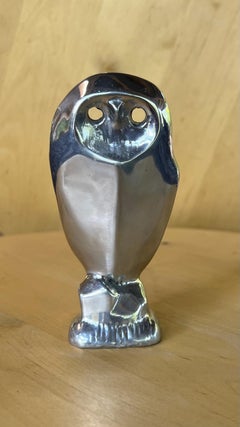
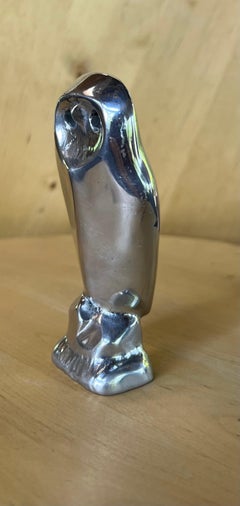
Large Owl sculpture by Allan Houser, Apache, Silver, small, sculpture, Nambe

Large Owl sculpture by Allan Houser, Apache, Silver, small, sculpture, Nambe

By Allan Houser

Located in Santa Fe, NM

Large Owl sculpture by Allan Houser, Apache, Silver, small, sculpture, Nambe Allan Houser (Haozous), Chiricahua Apache 1914-1994 recipient of the National Medal of Arts in 1992. Allan Houser's father Sam, was part of the small band of Apaches who traveled with Geronimo and surrendered in southern Arizona in 1886. Allan's parents were imprisoned with that group in Ft. Sill, Oklahoma. He was the first child to be born in freedom to those Apaches and a fluent speaker of the Chiricahua language. Allan Houser is an important artist in that he is of the culture he depicts in his artwork. Allan's parents would tell stories and sing songs recalling the experiences on the war path. This bronze edition is a life-time casting. Our gallery represented Allan Houser from 1974 until his passing in 1994 and were investors and provided quality control in the foundry process. Allan Houser's work is many international collections including the Georges Pomidou Centre, The Smithsonian National Portrait Gallery, The Dahlem Museum among others. Allan’s first bronze sculptures were started in the late 1960’s and were cast at Nambe Foundry. At the time the foundry was producing both Nambeware and was doing some sculptural foundry work. There was a fire at Nambe and they lost many of the molds for sculpture as well as their records. We acquired these works directly from Allan Houser. Allan Houser (Haozous), Chiricahua Apache (1914-1994) Selected Collections Centre Georges Pompidou, Paris, France * “They’re Coming”, bronze Dahlem Museum, Berlin, Germany Japanese Royal Collection, Tokyo, Japan “The Eagle”, black marble commissioned by President William J. Clinton United States Mission to the United Nations, New York City, NY *"Offering of the Sacred Pipe”, monumental bronze by Allan Houser © 1979 Presented to the United States Mission to the United Nations as a symbol of World Peace honoring the native people of all tribes in these United States of America on February 27, 1985 by the families of Allan and Anna Marie Houser, George and Thelma Green and Glenn and Sandy Green in New York City. National Portrait Gallery, Smithsonian, Washington, DC * Portrait of Geronimo, bronze National Museum of American Art, Smithsonian, Washington, D.C. * “Buffalo Dance Relief”, Indiana limestone National Museum of the American Indian, Smithsonian, Washington, D.C. *Sacred Rain Arrow...

Category

1970s Contemporary Allan Houser Art
Materials

Metal

Allan Houser art for sale on 1stDibs.
Find a wide variety of authentic Allan Houser art available for sale on 1stDibs. You can also browse by medium to find art by Allan Houser in metal, bronze, lithograph and more. Much of the original work by this artist or collective was created during the 20th century and is mostly associated with the contemporary style. Not every interior allows for large Allan Houser art, so small editions measuring 2 inches across are available. Customers who are interested in this artist might also find the work of Eduardo Oropeza, Patrick Brun, and Amancio González Andrés. Allan Houser art prices can differ depending upon medium, time period and other attributes. On 1stDibs, the price for these items starts at $1,800 and tops out at $16,000, while the average work can sell for $3,300.
Artists Similar to Allan Houser