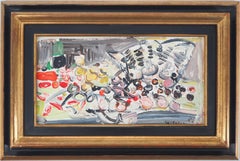
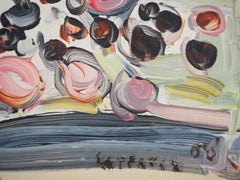
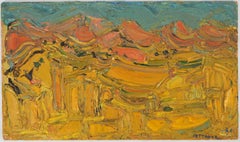
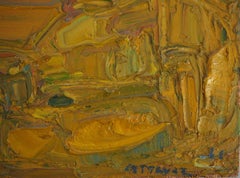
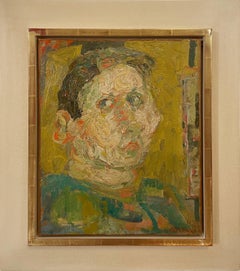
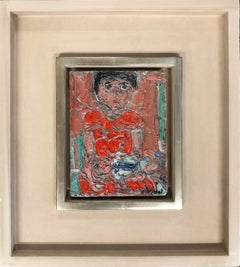
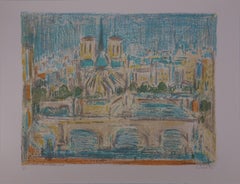
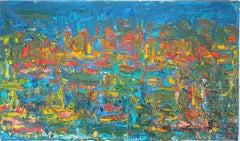
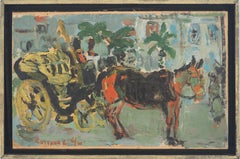
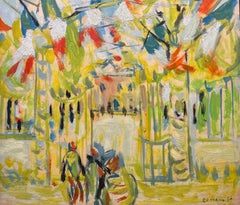
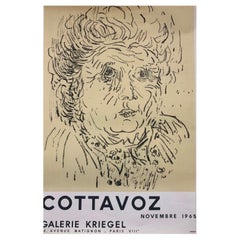
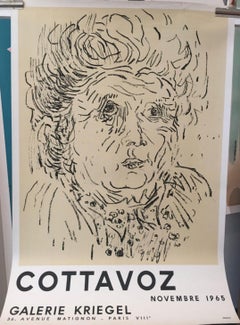
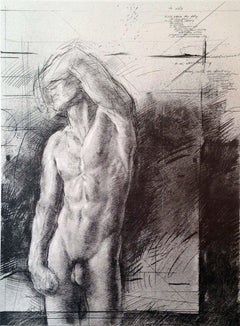
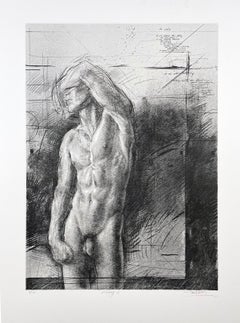
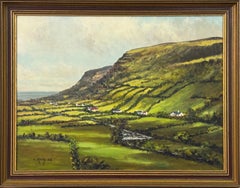
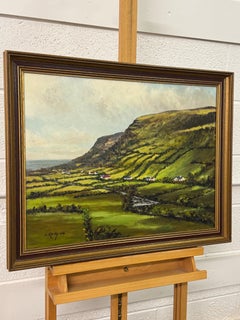
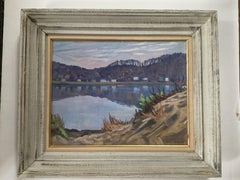
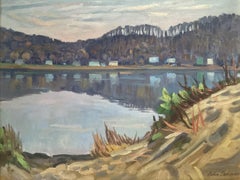
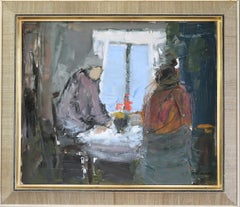
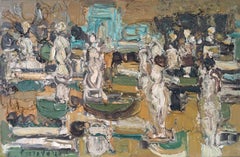
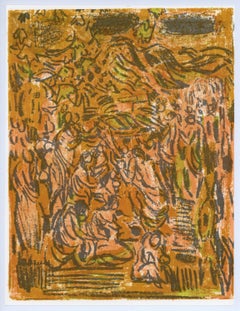
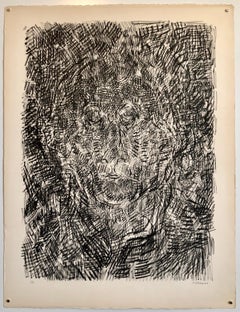
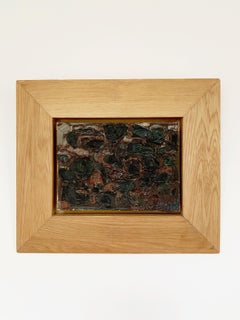
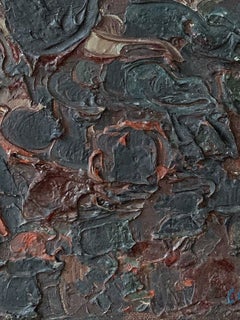
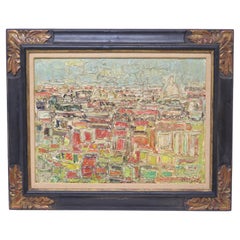
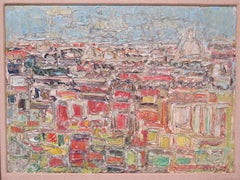
By André Cottavoz
Located in Surfside, FL
Born in 1922 in Saint-Marcellin, in Isère, André Cottavoz studied at the École des Beaux-Arts in Lyon in 1939. In 1942, Cottavoz at 20 years, he is in class 22 and must go to the Compulsory Labor Service. Released and his studies completed, he participated, from 1945, in several exhibitions. In 1953, he was awarded the Fénéon Prize.
André Cottavoz was born on July 22nd, 1922, in Saint Marcellin in Isère, first child of the young Marguerite (she is hardly 18 years old then) and of her husband Paul Cottavoz. André, called Doudou by his grandmother (nickname that he will assume all his life) expresses his passion for painting as soon as he is a teenager. Indeed, he is 14 when his mother surprises him copying a landscape from l'Illustration gazette. Practicing watercolour, she encourages him in this way, buys colors to him and takes him to paint in the nature with her.
He also benefits from Michel Gaudet’s advice, a friend of Renoir living in the area, and regularly works from nature with him, to the great displeasure of his father opposed to a future career as an artist.
At the age of 18, against the advice of his father, but supported by his mother, he enrolled at The Fine Arts School in Lyon to continue his learning. But he is quickly disappointed with academic teaching (it is forbidden to pronounce the name of Cézanne), he does not understand why before painting a nude, he should first have drawn its skeleton, and is excluded from a workshop on the day he arrives, exhibiting a reproduction of Van Gogh in whom he recognizes a Master. In 1942, he is obliged to spend two years in the “STO” (forced labour services) in Austria. There, he carried on painting and drawing. He met a talented young artist, the humorist Paul Philibert Charrin. This latter straight away recognizes him as a master and dedicates him an admiration that, according to Frédéric Dard, will become detrimental to his own career. They organize exhibitions of their works together. These pieces unfortunately will be destroyed or lost because of the war. He travels to Paris to follow the courses of Paris’ Art School, in order to obtain a diploma and a vacation as a drawing teacher. His passionate temperament, on top of his way of conceiving pictorial art closer to the emotion, does not match with the academic requirements of the school, and he does not obtain the diploma which could have ensured him a regular income. At the same time, he attends the courses of the Grande Chaumière.
In 1946, he exhibits a sight of Paris at the « salon of the young painting », La place d’Ivry which will make him recognized as a rather well known figurative painter in the line of Bonnard.
The same year, is held the first salon of non-figurative painting called « les Réalités Nouvelles ». However, faithful to himself, Cottavoz refuses any fashion influences or labels and is more than ever obstinate by his own way of painting, as close as possible to “his own emotion”, will he entrust to Jacques Zeitoun later on. In 1948, with friends of The Fine Arts School (Fusaro, Truphémus, Adilon, Charrin, and others…), the group organizes at the chapel of the « Ampère high school » in Lyon, a first exhibition of the « sansistes » which means without « istes » (term by which they express their refusal to carry any label, like Impressionism, Fauvism, Cubism, Futurism, etc…). They do not feel really accepted in Lyon, and even if they start to be famous in the area, it is truly Paris’ school which will support the movement (thanks to the meetings resulting from this), and make it possible for the young artists to get in touch with both galleries and art lovers. He is considered a part of the new school of Paris, a group that included Paul Aïzpiri, Roger Bezombes,
Bernard Buffet, James Coignard, Roger Lersy, Bernard Lorjou, Roger Mühl and Gaston Sebire.
In the early 50s, his first stays in Vallauris are at 13 Sicard street where he rents a paintshop. His work is done merely to earn a living with the ceramist Gilbert Valentin, precious moments there when he also meets Picasso and Francoise Gilot.
In 1950, André Cottavoz obtains a price at the Biennale of Menton. Therefrom in 1952, he presents his paintings at the “Art Vivant” gallery, boulevard Raspail in Paris, and becomes friend with Raymond Cogniat and Georges Besson, respectively director of “Art” newspaper, and art critic for several other papers. At last, in 1953, he receives the first price at « Fénéon reward » which reveals him to the general public and contributes to his fame abroad, particularly in the United States and Japan for his engraved work. His relations with painters such as Garbell, Andre Lanskoy, Saboureau and Terechkovitch make easier his introduction in the circle of the Parisian Art galleries. He then signs up his first contract with the gallery of « Art Vivant », ardently supported by the unfailing Jacques Zeitoun
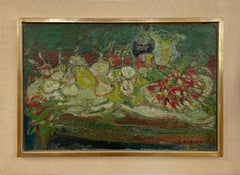
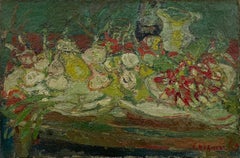
From 1953 to 1961, the landscapes of Lyon area, South of France, Italy (Genoa, Vicchio, Florence), Belgium (Ostend, Antwerp…) alternate his important creativity with his nude works, still lifes, portraits of relatives and friends…
Ever since, his meeting with the Japanese dealer...
Category
1960s Abstract André Cottavoz Art