Arnold Marc Gorter Paintings

Dutch, 1866-1933

Arnold Marc Gorter was born in the rural farming area south of Almelo, a small town in the eastern part of the Netherlands called Twente. He was the youngest of 11 children. His mother, Geertruida ten Cate Hoedemaker, nevertheless found time to be a painter of flowers, mainly in watercolors. She taught Arnold the love of Nature and Art. His father built their (still existing) house called Friso in 1862. As Arnold decided to become a painter himself, his father urged him to obtain a drawing-master degree first. In 1884, Gorter chose to move to Amsterdam, where a new kind of school was founded that was to produce teachers to train artisans and craftsmen, designers and draughtsmen. This drawing master's normal school was located in the newly built Rijksmuseum (National Museum). After passing the final exams in 1887, Gorter indeed became a teacher at the evening classes of such a new school. In 1889, he entered the painting classes of the State-Academy. The landscape of his native countryside Twente remained his favorite, though the south-east of Amsterdam and particularly the banks of the little Gein-river offered themselves as sites for painting studies too.

In 1896, having ended his career as a school teacher, Gorter seems to have taken more time to spend on his career as a painter. He joined the secession-like artist's society Sint Lucas and became vice-president soon. A little later, he was elected president of this then rapidly growing art-club, in which not only painters but also architects, musicians and actors, as well as art-lovers were united. Here, he met Piet Mondrian among the new members. Great success was gained by the 1900 St Lucas exhibition, for which high-ranked older artists were invited. It attracted more attention from the public and the press than ever before. The much older art society Arti et Amicitiae, of which Gorter in 1889 had become a member, gave young artists fewer facilities to exhibit and had higher entry-terms to match. In 1904, he exchanged his presidency of St Lucas for the vice-presidency of Arti, to become its president many times in later years. Important was Gorter's contact with one of Amsterdam's leading art-galleries, Frans Buffa. In 1898, he had his first solo show here. This art-dealer, representing well-known painters like J.H. Weissenbruch, Is. Israëls and J. Toorop became Gorter's main representative too. Gorter's way of working was to go out in the country and make oil-sketches. The little oil-sketches were rarely exhibited, nor for sale; only sometimes given as a present.

Around 1910, Gorter's name was well known as one of the leading and most popular painters in Holland. But also in France and Germany, where he took part in the enormous yearly exhibitions of the Salon des Artistes Francais in Paris and the Internationale Kunstausstellungen in Berlin and Munich. He was successful there and sold the large canvases made just for these huge events. He received many gold medals and other rewards in Paris and Munich. It is still surprising that in France, where Luminism and Fauvism were invented at the time, Gorter's often almost monochromatic pictures of autumn, winter and night, were so highly regarded. The French State bought one of his paintings and later made him a member of the French Academy, an honor he shared with only a few other foreign painters. Reviews in France likewise were much more favorable than those in Holland. English and American art dealers now became interested too. The first exhibition of his work in America was at the 1904 Universal Exhibition in St.Louis. Through the connections, his dealer Buffa had many American galleries showed his work. Sales of his paintings in USA and Canada outnumbered his Dutch sales in the 1920s. Many reproductions were made in USA also. The 1915 “Panama-Pacific” world-fair in San Francisco was another great event. Gorter was a member of the committee organizing the Dutch art-section. Some American collectors, after having bought one of Gorter's paintings at an exhibition like this one, or those in Paris and Munich, sent a request for one, or even several more paintings. The Frye Art Museum in Seattle still has the eight landscapes its founder collected this way. Appreciation in England was less striking, although in 1914 Gorter was invited to exhibit a large painting in the Royal Academy and later in the Scottish Academy. The well known French Gallery in London regularly showed his work. After the war, a successful exhibition of Dutch art was touring England, organized by individual Dutch artists and collectors. For the first time, it included modernist painters like Mondrian and Gestel and showed a good representation of Dutch art at that time. The tour's greatest success was at the Whitechapel Art Gallery in London in 1921.

The Queen of the Netherlands, Wilhelmina, took up painting around 1919 and wanted to invite a real landscapist as a tutor or as a companion painter. Knowing Gorter from her yearly visits to the Arti-exhibitions and having bought one of his paintings already in 1913, she thought of him. In 1921, Gorter was invited to her countryside palace at Apeldoorn to paint the autumn colors together. The next year an invitation followed to accompany Wilhelmina and members of the court on a two-month cruise along Norway's coast, to go painting there. Since 1916, Gorter had acquired land near the village of Vorden in the east of the Netherlands. A country-house was built there in 1926. He had painted in Vorden regularly from 1904 on. The Vordense Beek, a little stream passing through woodlands and meadows, became a subject for hundreds of paintings.
to
1
2
Overall Width
to
Overall Height
to
1
2
1
3
3
3
2
2
3
787
758
753
665
3
2
1
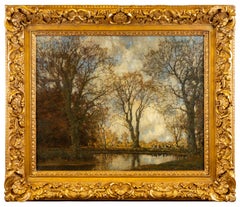
Artist: Arnold Marc Gorter
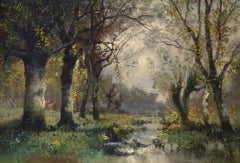
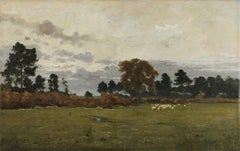
Autumn Landscape
Autumn Landscape

Autumn Landscape

By Arnold Marc Gorter

Located in Douglas, Isle of Man

Arnold Marc Gorter 1866 - 1933, was a Dutch landscape painter who preferred the calm tranquility of the Eastern Netherlands and the change of the seasons, grading light and ambience ...

Category

Early 1900s Arnold Marc Gorter Paintings

Materials

Canvas, Oil

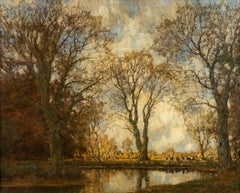
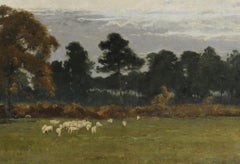
Sheep by the River
Sheep by the River

Sheep by the River

By Arnold Marc Gorter

Located in Sheffield, MA

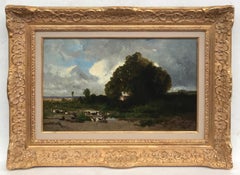
Arnold Marc Gorter Dutch, 1866-1933 Sheep by the River Oil on canvas 26 ¾ by 32 ¾ in, w/ frame 34 ½ by 40 ½ in Signed lower right Arnold Marc Gorter studied at the National Academy...

Category

Early 20th Century Barbizon School Arnold Marc Gorter Paintings

Materials

Oil

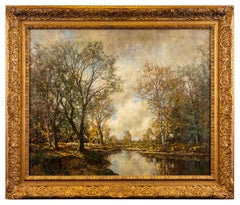
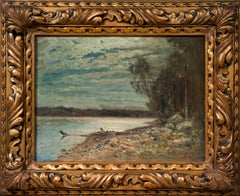
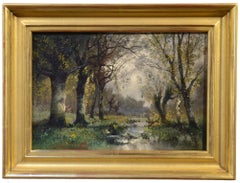
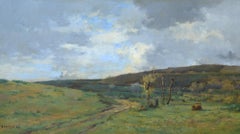
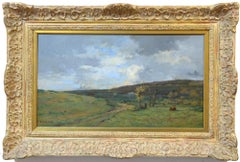
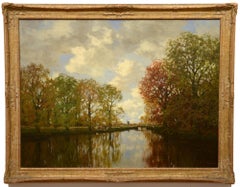
An Autumn Landscape
An Autumn Landscape

An Autumn Landscape

By Arnold Marc Gorter

Located in Sheffield, MA

Arnold Marc Gorter Dutch, 1866-1933 An Autumn Landscape Oil on canvas 26 ¼ by 33 ¾ in, w/ frame 35 ¾ by 43 ¼ in Signed "A.M. Gorter" lower right Inventory Number: 01927 Arnold Mar...

Category

Late 19th Century Romantic Arnold Marc Gorter Paintings

Materials

Canvas, Oil

Related Items
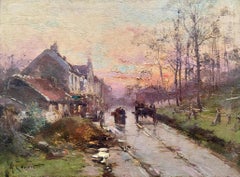
French school Landscape Rural path, signed, school of Barbizon

French school Landscape Rural path, signed, school of Barbizon

Located in Zofingen, AG

➡️ Landscape Forest Path with Figures Anonym school of Barbizon⬅️ ⏩It is signed Colet⏪ ⭐Medium:⭐ Oil on canvas ⭐Technique: ⭐Impasto painting with expressive brushwork. ⭐Size:⭐2...

Category

Early 1900s Barbizon School Arnold Marc Gorter Paintings

Materials

Gesso, Oil, Stretcher Bars, Canvas

"a Fontainebleu, " Charles Francis DeKlyn, Barbizon, Oil, French Countryside

"a Fontainebleu, " Charles Francis DeKlyn, Barbizon, Oil, French Countryside

Located in Wiscasset, ME

Charles Francis De Klyn was born in Westchester County, New York, in 1865. A landscape, marine, portrait and figure painter, De Klyn studied in New York and Paris from 1886 to 1891, then taught at the Cleveland Art Club and the Cleveland School of Art. In 1893, he was one of the founders of the Cleveland Brush and Palette Club, and he exhibited at the National Academy of Design in 1894 and 1895. He was also a member of the Society of Western Artists. "A Fontainebleu" by Charles Francis De Klyn is a beautifully rendered Barbizon oil...

Category

Late 19th Century Barbizon School Arnold Marc Gorter Paintings

Materials

Oil, Panel

Seascape at Sunset, Romantic Oil on Canvas, 19th Century, Signed

Seascape at Sunset, Romantic Oil on Canvas, 19th Century, Signed

Located in Genève, GE

Signed "G. Goldberg" This atmospheric seascape captures a tranquil coastal scene at sunset, where the fading light reflects delicately across the surface of the water. The compositi...

Category

19th Century Romantic Arnold Marc Gorter Paintings

Materials

Canvas, Oil

Evening Landscape with River and Farmhouses, 1898

Evening Landscape with River and Farmhouses, 1898

Located in Stockholm, SE

Evening Landscape with River and Farmhouses by August Alvén captures a moment of profound quiet in the Swedish countryside just after sunset. The glowing sky transitions from warm ap...

Category

1890s Romantic Arnold Marc Gorter Paintings

Materials

Canvas, Oil

Village Afternoon, French Countryside, Barbizon School, 19th Century, Oil

Village Afternoon, French Countryside, Barbizon School, 19th Century, Oil

Located in Wiscasset, ME

Alfred Howland was born in Wadpole, New Hampshire in 1838, the son of a builder. He began his artistic training as a lithographer in Boston in 1857, moved to New York a year later an...

Category

Mid-19th Century Barbizon School Arnold Marc Gorter Paintings

Materials

Canvas, Oil

French Barbizon rural landscape: young girls chatting by the village gates

French Barbizon rural landscape: young girls chatting by the village gates

Located in Norwich, GB

Godefroy de Hagemann (1820-1877) was a member of the Hanover dynasty, of German Princes. His full name was Godefroy Auguste Christian Volfgann baron de Hagemann, or Godefroy de Hagem...

Category

Mid-19th Century Barbizon School Arnold Marc Gorter Paintings

Materials

Canvas, Oil

Barbizon School Landscape, The Poplar Trees, Late 19th Century Oil on Wood Panel

Barbizon School Landscape, The Poplar Trees, Late 19th Century Oil on Wood Panel

Located in Cotignac, FR

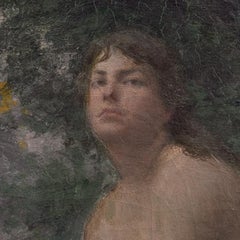
Late 19th Century French Barbizon School oil on wood panel of poplar trees in a landscape by Richard. The painting is signed bottom left. The painting is on a quality chamfered panel. A very charming, almost impressionist, rendition of a line of iconic French trees in a landscape. Before them an earth drive has been ploughed up by the wheels of passing carts and horses. Richard has created a wonderful perspective that draws us in to the painting and he has created a contrast between the strong greens of the trees and fields against the whites and blues of the sky. The painting is reminiscent of the works of Monet from the 1890s. to whom the poplar trees were a continuing inspiration. The Barbizon school of painters was part of an art movement towards Realism in art, which arose in the context of the dominant Romantic Movement of the time. The Barbizon school was active roughly from 1830 through 1870. It takes its name from the village of Barbizon, France, on the edge of the Forest of Fontainebleau, where many of the artists gathered. Most of their works were landscape paintings, but several of them also painted landscapes with farmworkers, and genre scenes of village life. Some of the most prominent features of this school are its tonal qualities, colour, loose brushwork, and softness of form. The leaders of the Barbizon school were: Théodore Rousseau, Charles-François Daubigny, Jules Dupré, Constant Troyon, Charles Jacque, and Narcisse Virgilio Díaz. Jean-François Millet lived in Barbizon from 1849, but his interest in figures with a landscape backdrop sets him rather apart from the others. Jean-Baptiste-Camille Corot was the earliest on the scene, first painting in the forest in 1829, but his work has a poetic and literary quality which sets him somewhat apart. Other artists associated with the school, often pupils of the main group, include: Henri Harpignies, Albert Charpin, François-Louis Français and Émile van Marcke. In 1824 the Salon de Paris exhibited works of John Constable, an English painter. His rural scenes influenced some of the younger artists of the time, moving them to abandon formalism and to draw inspiration directly from nature. Natural scenes became the subjects of their paintings rather than mere backdrops to dramatic events. During the Revolutions of 1848 artists gathered at Barbizon to follow Constable's ideas, making nature the subject of their paintings. The French landscape became a major theme of the Barbizon painters. Millet extended the idea from landscape to figures — peasant figures, scenes of peasant life, and work in the fields. In The Gleaners (1857), for example, Millet portrays three peasant women working at the harvest. Gleaners are poor people who are permitted to gather the remains after the owners of the field complete the main harvest. The owners (portrayed as wealthy) and their laborers are seen in the back of the painting. Millet shifted the focus and the subject matter from the rich and prominent to those at the bottom of the social ladders. To emphasize their anonymity and marginalized position, he hid their faces. The women's bowed bodies represent their everyday hard work. In the spring of 1829, Jean-Baptiste-Camille Corot came to Barbizon to paint in the Forest of Fontainebleau, he had first painted in the forest at Chailly in 1822. He returned to Barbizon in the autumn of 1830 and in the summer of 1831, where he made drawings and oil studies, from which he made a painting intended for the Salon of 1830; "View of the Forest of Fontainebleau'" (now in the National Gallery in Washington) and, for the salon of 1831, another "View of the Forest of Fontainebleau"'. While there he met the members of the Barbizon school: Théodore Rousseau, Paul Huet, Constant Troyon, Jean-François Millet, and the young Charles-François Daubigny. During the late 1860s, the Barbizon painters attracted the attention of a younger generation of French artists studying in Paris. Several of those artists visited Fontainebleau Forest to paint the landscape, including Claude Monet, Pierre-Auguste Renoir, Alfred Sisley and Frédéric Bazille. In the 1870s those artists, among others, developed the art movement called Impressionism and practiced 'plein air' painting. In contrast, the main members of the school made drawings and sketches on the spot, but painted back in their studios. The Post-Impressionist painter Vincent Van Gogh studied and copied several of the Barbizon painters as well, including 21 copies of paintings by Millet. He copied Millet more than any other artist. He also did three paintings in Daubigny's Garden. The Barbizon painters also had a profound impact on landscape painting in the United States. This included the development of the American Barbizon school by William Morris Hunt. Several artists who were also in, or contemporary to, the Hudson River School studied Barbizon paintings for their loose brushwork and emotional impact. A notable example is George Inness, who sought to emulate the works of Rousseau. Paintings from the Barbizon school also influenced landscape painting in California. The artist Percy Gray...
Category

Late 19th Century Barbizon School Arnold Marc Gorter Paintings

Materials

Oil, Wood Panel

Animated Cottage House in Normandy, Landscape Painting, Oil on Canvas

Animated Cottage House in Normandy, Landscape Painting, Oil on Canvas

By Hippolyte Camille Delpy

Located in PARIS, FR

Conditions : Excellent overall Conditions.. Unframed. Certificate from Michel Rodrigue Complementary shipping worlwide by DHL, FEDEX. Returning customers : 25% OFF listed price on al...

Category

19th Century Barbizon School Arnold Marc Gorter Paintings

Materials

Oil

Landscape by the Pond

HIS René CharlesLandscape by the Pond, Circa 1920

$10,483

H 26.38 in W 31.89 in D 1.97 in

Landscape by the Pond

Located in Saint-Ouen, FR

René Charles Edmond His (1877-1960) Lanscape by the Pond Oil on canvas signed low left Old frame gilded with leaves Size canvas : 51 X 65 cm Size frame : 67 X 81 cm René Charles ...

Category

Early 20th Century Barbizon School Arnold Marc Gorter Paintings

Materials

Oil

"Moontide", Alexander Volkov, 24x48, Oil on Canvas, Photorealism, Landscape

"Moontide", Alexander Volkov, 24x48, Oil on Canvas, Photorealism, Landscape

By Alexander Volkov

Located in Dallas, TX

"Moontide" by Alexander Volkov is an original oil on canvas. This painting is a photorealistic view of the moonlight reflecting on the waters surface. The moon is hidden behind the c...

Category

2010s Photorealist Arnold Marc Gorter Paintings

Materials

Canvas, Oil

Twilight Landscape with Windmill and Church, 1891

Twilight Landscape with Windmill and Church, 1891

Located in Stockholm, SE

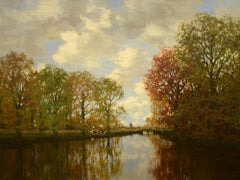
"Twilight Landscape with Windmill and Church" is a captivating work by Swedish artist Albert Larsson, painted in 1891 when Larsson was 22 years old. The painting captures a landscape steeped in the quietude of dusk, with a sky ablaze in hues of red and orange, signalling the end of the day. The silhouettes of trees are rendered with astonishing detail against the twilight sky, showcasing Larsson's early mastery of light and shadow. Dominating the pastoral scene is a traditional windmill, its blades stilled against the sky, alongside the spire of a church that pierces the horizon. These structures, together with the meticulously painted trees, are testaments to the human presence within the natural world, suggesting a harmony between the two. A notable feature is the small water-filled furrow in the field, which catches the fading light of the sky, creating a pathway of reflection leading the eye through the composition. This detail highlights Larsson's skill in using light to draw attention to elements within his paintings. Albert Larsson, born on November 4, 1869, in Malmö and passing on August 31, 1952, in Lund, was an artist deeply influenced by his education in Copenhagen at the Art Academy and later at Peder Severin Krøyer...
Category

1890s Romantic Arnold Marc Gorter Paintings

Materials

Canvas, Oil

Previously Available Items
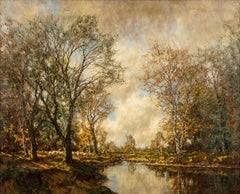
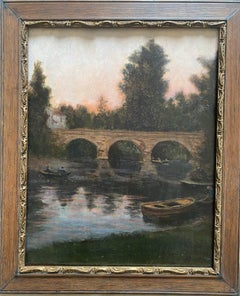
Autumn Reflections
Autumn Reflections

Arnold Marc GorterAutumn Reflections

Sold

H 29.5 in W 39.25 in

Autumn Reflections

By Arnold Marc Gorter

Located in Wiscasset, ME

An artist of the Dutch School, Arnold Marc Gorter became known for both his oil paintings and drawings of the landscapes with which he was so familiar. A student of the National Acad...

Category

Early 1900s Impressionist Arnold Marc Gorter Paintings

Materials

Canvas, Oil

Arnold Marc Gorter paintings for sale on 1stDibs.

Find a wide variety of authentic Arnold Marc Gorter paintings available for sale on 1stDibs. Customers who are interested in this artist might also find the work of Theo Mackaay, Frank Dekkers, and Luuk de Haan.