Arthur Devis Paintings

to
1
Overall Width
to
Overall Height
to
1
1
1
1
1
1
1
1
1
1
1
1
788
753
752
663
1
1
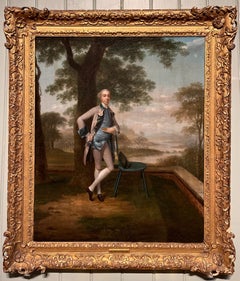
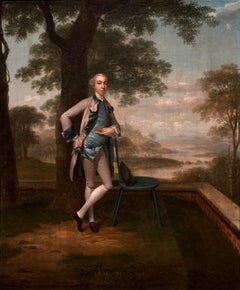
Artist: Arthur Devis
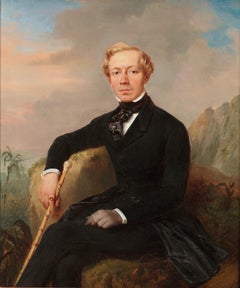
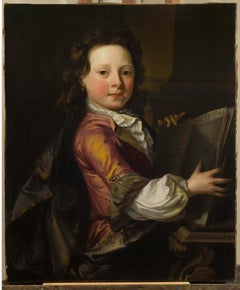
Portrait of a Gentleman

Portrait of a Gentleman

By Arthur Devis

Located in London, GB

Oil on canvas, signed and dated 'Art Devis/fe 1755' lower left Image size: 29 1/2 x 24 1/4 inches (75 x 62 cm) Original ornate gilt wood frame Provenance: Ian Douglas Leonard Cochra...

Category

1750s Arthur Devis Paintings

Materials

Canvas, Oil

Related Items
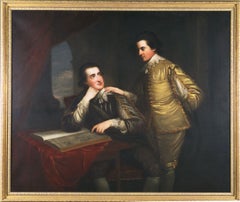
Portrait of George and Edward Finch-Hatton in Van Dyck Dress

Portrait of George and Edward Finch-Hatton in Van Dyck Dress

By David Martin

Located in New York, NY

Appointed Portrait Painter to the Prince of Wales in Scotland in 1785, David Martin was the leading Scottish portrait painter of his generation. The artist is best known in the United States for his portrait of Benjamin Franklin, which is in the White House collection, Washington, D.C. The sitters depicted in this double portrait were the sons of the British diplomat Edward Finch-Hatton. George (1747-1823), later of Eastwell Park, Kent, is shown seated, reading an ancient charter or medieval manuscript...

Category

18th Century and Earlier Arthur Devis Paintings

Materials

Canvas, Oil

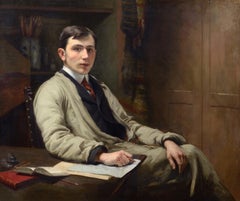
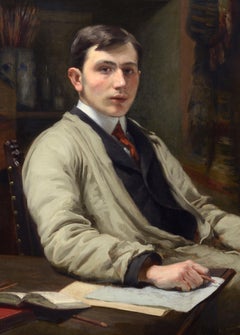
Portrait of young man - The artist's son

Portrait of young man - The artist's son

Located in BELEYMAS, FR

Auguste-Joseph Delécluse (Roubaix 1855 - Paris 1928) Portrait of the artist's son, Eugène Delécluse Oil on canvas H. 98 cm; W. 116 cm Signed lower right 1903 Exhibition: 1903, Salon...

Category

Early 1900s French School Arthur Devis Paintings

Materials

Canvas, Oil

Portrait of a man in armor

Portrait of a man in armor

Located in BELEYMAS, FR

Attributed to Jacques DUMONT aka DUMONT LE ROMAIN (Paris 1701 - 1781) Presumed portrait of Louis-Joseph de Formanoir (?-1732) Oil on canvas H. 91.5 cm; L. 73 cm Signed on the helmet:...

Category

1750s French School Arthur Devis Paintings

Materials

Canvas, Oil

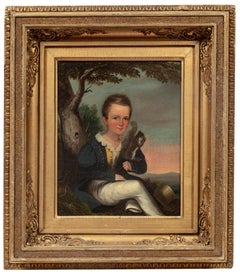
Portrait of a Boy with a Squirrel

Portrait of a Boy with a Squirrel

Located in New York, NY

Provenance: Lewis J. Ruskin, Arizona, 1958–1981; thence by descent to the present owner. This charming portrait of a young boy with his pet squirrel is a newly-discovered work by G...

Category

Mid-19th Century Arthur Devis Paintings

Materials

Canvas, Oil

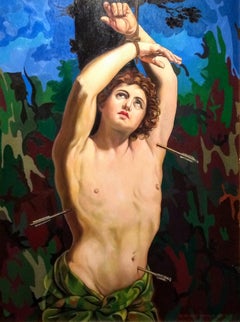
Neoclassical, renaissance, Biblical, St Sebastian "Martyrdom" (After Guido Reni)

Neoclassical, renaissance, Biblical, St Sebastian "Martyrdom" (After Guido Reni)

By Giancarlo Impiglia

Located in Bridgehampton, NY

Part of Giancarlo Impiglia's iconic "camouflage" series in which, deviating from his signature style, he expresses his classical education, flawless technique, and concerns about the...

Category

2010s Arthur Devis Paintings

Materials

Canvas, Oil

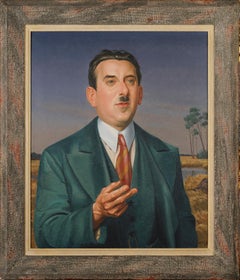
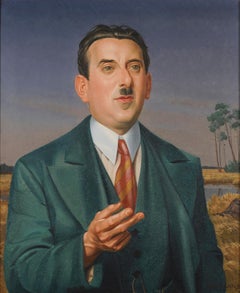
Portrait of a French man

Portrait of a French man

By Jean Despujols

Located in BELEYMAS, FR

Jean DESPUJOLS (Salles 1886 – Shreveport 1965) Portrait of a Henri Martin, mayor of Saint Médard en Jalles (Gironde) Oil on canvas H. 75 cm; L. 60 cm Signed lower right around 1920/2...

Category

1920s French School Arthur Devis Paintings

Materials

Canvas, Oil

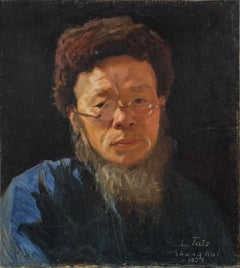
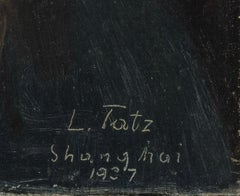
Portrait of a Chinese Man

Laszlo TatzPortrait of a Chinese Man

$6,850

H 19.69 in W 17.52 in D 1.19 in

Portrait of a Chinese Man

Located in Amsterdam, NL

Lazlo Tatz (Hungary 1888 - Philippines 1951) Portrait of a Chinese man Oil on canvas, H. 50 x W. 44.5 cm Tatz studied in Budapest and Paris, and in 1931 h...

Category

Early 20th Century Arthur Devis Paintings

Materials

Canvas, Oil

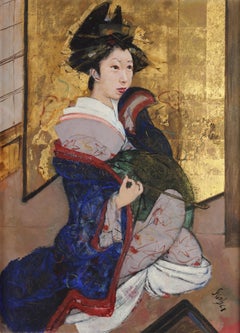
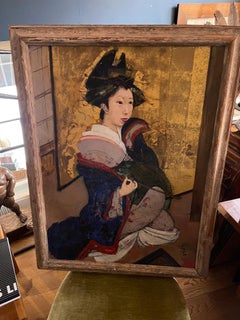
Portrait of a Geisha

Roland StrasserPortrait of a Geisha

$50,014

H 29.93 in W 18.51 in D 1.58 in

Portrait of a Geisha

By Roland Strasser

Located in Amsterdam, NL

Roland Strasser (1895-1974) "Japanese Geisha" Signed lower right Oil and gold leaf on canvas, measures: 76 x 46 cm In fine white-wash wood frame. ...

Category

1930s Expressionist Arthur Devis Paintings

Materials

Gold Leaf

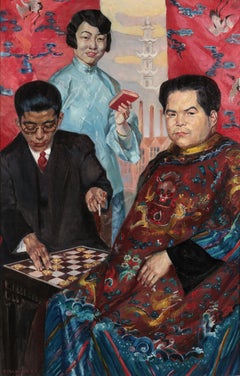
A Chinese Company playing Droughts

Erwin BindewaldA Chinese Company playing Droughts, 1927

$12,944

H 55.32 in W 35.63 in D 1.58 in

A Chinese Company playing Droughts

Located in Amsterdam, NL

ERWIN BINDEWALD (1897-1950) Two men playing draughts, a girl with the red book standing behind them Signed and dated E. Bindewald d.j., 27 Oil on canvas, 140.5 x 90.5 cm In black and gilt gesso frame. Note: Bindewald was born in Charlottenburg. He moved to Berlin in 1914 where he studied till 1924 at the Berliner Kunst Akademie. Bindewald travelled in Europe, but mainly stayed in Germany and certainly never was in China. This painting was made in Europe, presumably in the China Town of Berlin. Bindewald received several commisions in Germany from factory owners who wanted their factories painted inside, usually with workers, as well as outside. In the present painting the sitter on the right seems to be a man with a Manchurian background, wearing the brown coat reserved for the highest aristocracy in China. In China the black sleeve-ends completely cover the hands, indicating that the high aristocracy does not have to do any manuel labour. This man clearly is not a factory worker but he possibly is the (co)- owner of the factory in the background and as such might need his hands to do at least some writing. The man on the left in the modern Western suit...

Category

1920s Art Deco Arthur Devis Paintings

Materials

Canvas, Oil

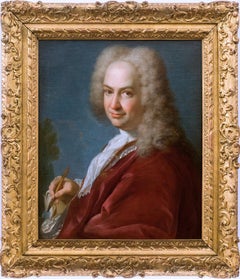
Presumed artist self-portrait

Presumed artist self-portrait

Located in BELEYMAS, FR

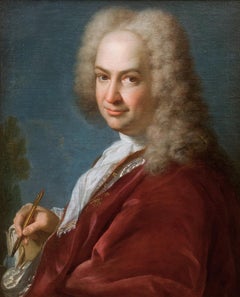
Louis-Gabriel BLANCHET (Versailles, 1701 – Rome, 1772) Presumed self-portrait of the artist Oil on canvas H. 73 cm; W. 60 cm Circa 1730 Originally presented in a Restoration period frame with a "Mignard" cartouche, this beautiful painting initially appeared to us as a work from northern Italy. However, it exuded a rather French form of refinement, suggesting that its artist may have assimilated a dual influence from both sides of the Alps. We thank our colleague and friend Philippe Mendès for spontaneously and judiciously "bringing out" the name of Louis-Gabriel Blanchet, a Romanized French portraitist, whose spirit and stylistic characteristics we clearly recognize here. Blanchet's "French" years, before his final departure for Rome in 1728, following his winning of the second Grand Prix for painting after Subleyras in 1727, are extremely poorly documented. His father, Gabriel, was valet to Blouin, himself Louis XIV's first valet at the time. According to Thierry Lefrançois, Blanchet was one of the few students of Nicolas Bertin (1667-1736), whose studio he is said to have joined in the early 1720s. At a baptism on March 24, 1724, where he was godfather, he is mentioned as a painter in the picture store of the Duke of Antin, the director of buildings between 1708 and 1736. At this time, he was probably already married to Jeanne Quément, with whom he had a daughter also named Jeanne, who would marry Nicolas Aviet, the son of a valet in the queen's wardrobe, in Versailles in 1738. When Blanchet arrived in Rome in October 1728, he was accompanied by Subleyras, Trémolières, and Slodtz. He enjoyed the goodwill of Vleughels, the director of the Académie de France, which had been based at the Palazzo Mancini since 1725, even though the latter was not always kind to our resident. From 1732, he was under the protection of the Duke of Saint-Aignan when he took up his post as ambassador to Rome. Along with Slodtz and Subleyras, they formed a trio of friends, joined by Joseph Vernet shortly after his arrival in Rome in 1734. Slodtz and Blanchet, on the occasion of Subleyras's marriage in 1739, were there to attest that their friend was not bound by any marital commitment, and Blanchet was a witness at Vernet's wedding in 1745. It is most likely from these early years in Rome that our portrait of the artist dates, the expression and turn of his face irresistibly reminiscent of a self-portrait. The still relatively youthful features may correspond to Blanchet's thirty-something years, and the fluffy wig was still fashionable at this time. The painting fits well with the depiction of a young painter wanting to display both the beginnings of success and a certain simplicity or restraint. A slight smile expresses a form of assurance in this man with a gentle, sincere gaze and a face radiating a keen sense of wit. We find here the air of intimacy present in almost all of Blanchet's portraits, even those from the 1750s and 1760s, as well as an almost complicity with the viewer. The spirit of the painting is quite close to that of the presumed portrait of Bouchardon (painted around 1730) and the portrait of Pannini, painted in 1736, but it possesses a more natural quality, notably thanks to the absence of decorum. Our work exhibits the characteristics of Blanchet's paintings: elegance, luminosity (especially in the whites), vibrant and refined colors (here, the harmony of the garnet of the garment and the slate blue of the background, whose uniformity is tempered by a very sketched landscape and a grove of greenery), light complexions, rather rosy cheekbones, often full lips, and rather tight framing. According to the Academy's rules, Blanchet's stay should have ended in the spring of 1732, but, for reasons unknown, he remained in the Eternal City until his death, as did his friend Subleyras, with whom he shared accommodation until the late 1730s. The latter regularly called upon him to collaborate on his paintings, such as The Meal at Simon's. Through Saint-Aignan's intervention, Blanchet was employed in the late 1730s by the Stuart princely family, then exiled in Italy. He notably produced copies (now lost) after Liotard of the portraits of Charles Edward and Henry Benedict, the sons of James III Stuart. The latter also commissioned three other portraits (now in the National Portrait Gallery in London), whose more formal character contrasts with the intimate spirit of Blanchet's portraits. Blanchet frequented English painters, such as the landscape painter Richard Wilson, and studied with the Scottish portraitist Katherine Read...

Category

1730s French School Arthur Devis Paintings
Materials

Oil, Canvas

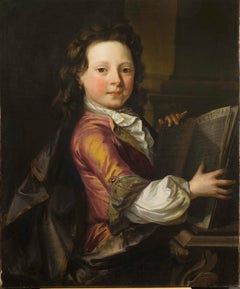
Portrait of a Boy, John Closterman, Large English Portrait Art, Old Master

Portrait of a Boy, John Closterman, Large English Portrait Art, Old Master

By John Closterman

Located in Greven, DE

John Clostermann (Osnabrück 1660 - 1711 London) Portrait of a boy, maybe Charles Hinde Oil on canvas, 61 x 74,6 cm John Closterman (also Klosterman) was a portrait painter of the late 17th and early 18th centuries. He primarily portrayed English noblemen and European aristocratic families. His father was already an artist and he trained his son. In 1679 he went to Paris and studied with Francois de Troy. In 1681 he was in London and worked for the artist John Riley, whose studio he took over after his death. In 1696 he was invited to the Spanish court...

Category

17th Century Baroque Arthur Devis Paintings
Materials

Canvas, Oil

Previously Available Items
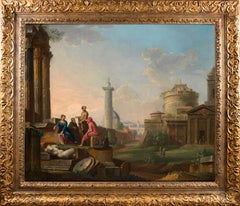
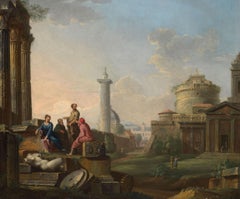
18th century oil capriccio of Rome

18th century oil capriccio of Rome

By Arthur Devis

Located in London, GB

Collections: Probably Anthony Devis, half-brother of Arthur Devis; Ellin Devis, Arthur Devis’s daughter, a gift from the above; Ellin Devis Marris, adopted daughter of the above, by bequest in 1820; Arthur Tooth & Sons Ltd (as by Panini); Private collection, UK, 1987; The Leger Galleries, 1987; The Hon. Simon Sainsbury, acquired from the above in 1987; Sainsbury sale, Christie’s, 18th June 2008, lot 205 [the literature cited incorrectly in Christie’s catalogue entry applies to the painting listed by D’Oench (1979) as no. 272]; Private collection, 2013. Literature: Ellen Gates D’Oench, Arthur Devis (1712-1787); Master of the Georgian Conversation Piece, A Dissertation Presented to the Faculty of the Graduate School of Yale University in Candidacy for the Degree of Doctor of Philosophy, 1979, cat. no. 272. Signed and dated ADevis 1736, lower centre Framed dimensions: 31.5 x 36 inches Arthur Devis is best known as a master of conversation pieces and full-length portraits in small scale, described by Sacheverell Sitwell as ‘the perfect small master of the school.’ His work as a painter of landscapes and architectural capriccios is less well known. This previously unpublished ruinscape, made in the manner Giovanni Paolo Panini, sheds important light on his early career and crucially, his working methods. Signed and dated 1736, Devis evidently retained an affection for the painting, incorporating it into at least two of his interior conversation pieces. This catalogue entry contains important new information on Devis’s early career and art training in the north-west of Britain in the 1730s, as well as reproducing extracts from the unpublished will of Devis’s daughter. Born in Preston, Lancashire in 1712 Devis’s early training took place in the north-west where he worked with the Flemish painter Peter Tillemans. Tillemans seems to have spent time at Knowsley Hall in Lancashire in 1728-9, completing a number of spectacular landscapes depicting the house, park and James Stanley, 10th Earl of Derby’s racecourse. It is clear from the surviving correspondence of the 10th Earl that Knowsley, with its substantial collection of old master paintings, became an important site for artists in the region. We know at least one other of Tillemans’s pupils, one Edward Coppock, stayed at Knowsley learning to draw, and in 1736 George Stubbs arrived to copy paintings, supervised by his master, Hamlet Winstanley. According to Stubbs’s earliest biographer, Ozias Humphry, the first picture he attempted to copy at Knowsley was a ruinscape by Giovanni Paolo Panini. It is highly suggestive that at the same date Devis was also completing a work strongly influenced by the Italian painter Panini. Further investigation reveals that the present painting, which is not a copy of any existing Panini design, but is in fact a composition directly derived from a drawing by Hamlet Winstanley and contained in a sketchbook now in the Warrington Museum and Art Gallery. Winstanley had visited Italy in 1723–1725 and filled a sketchbook with topographical landscape drawings and subsequently produced a number of capriccio studies derived from these accurate drawings. One such sheet depicts the Castel Sant’Angelo behind a classical church and campanile identical to the buildings on the right hand side of Devis’s painting. Devis’s use of such an idiosyncratic set of structures seems certain to have derived from Winstanley’s drawing adding further to the supposition that Devis trained at Knowsley and continued to have contact there throughout his early years in Preston. Turning to the painting itself, it appears to be a conventional digest of classic Roman monuments, arranged to form a fanciful ruinscape. On the far left of the composition are the three columns of the Temple of Castor and Pollux from the Forum in Rome; in the left foreground is the remains of a torso of Venus; prominently in the background is Trajan’s Column and behind it the dome of Santa Maria di Loreto; to the right a profile of the Capitoline and on the far right the group of buildings borrowed from Winstanley’s drawing. Standing amongst the ruins are a group of figures, in vaguely classical costume, in discussion. The works of Giovanni Paolo Panini were extremely fashionable amongst British collectors from the mid-1730s onwards, Devis’s painting and more importantly his conduit, in the form of Winstanley’s Italian drawings, were a very early instance of British artists imitating this format. In the following generation countless British painters would replicate Panini’s designs as decorative additions to interiors as new Palladian designs demanded painted overmantels and overdoors, but Devis’s signed and dated composition was absolutely at the forefront of this fashion. Given the squareish format of the present painting it seems likely that it was designed as an overdoor. This is confirmed by Devis’s inclusion of the present composition in at least two of his earliest conversation pieces. The profile of the three columns from the Temple of Castor and Pollux, Venus’s torso...

Category

18th Century Old Masters Arthur Devis Paintings
Materials

Oil, Canvas

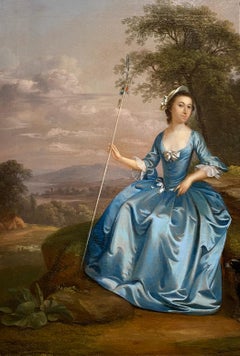
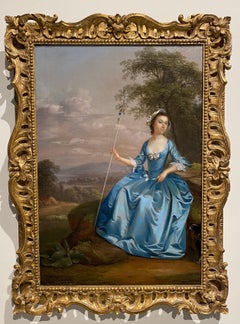
Portrait of Mrs Bates as a shepherdess, seated in a landscape

Portrait of Mrs Bates as a shepherdess, seated in a landscape

By Arthur Devis

Located in Stoke, Hampshire

Arthur Devis (1712-1787) Portrait of Mrs Bates as a shepherdess, seated, in a blue dress Oil on canvas Signed lower centre canvas size 24 x 16 1/2 in frame size 28 x 21 in Provenanc...

Category

18th Century Old Masters Arthur Devis Paintings
Materials

Canvas, Oil

Arthur Devis paintings for sale on 1stDibs.

Find a wide variety of authentic Arthur Devis paintings available for sale on 1stDibs.