Avraham Binder Paintings

to
1
Overall Width
to
Overall Height
to
1
1
1
1
1
1
1
1
754
754
747
672
1
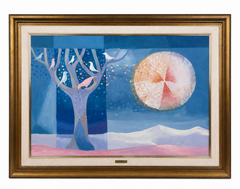
Artist: Avraham Binder
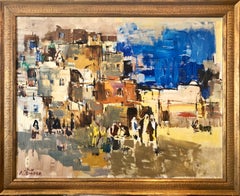
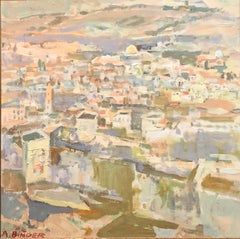
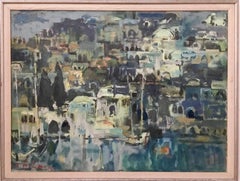
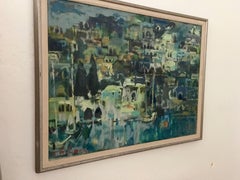
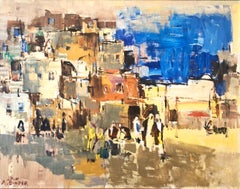
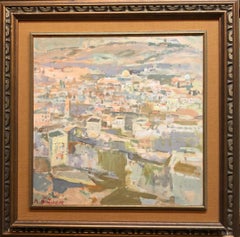
Large Abstract landscape of Jerusalem Israeli Oil Painting Judaica

Large Abstract landscape of Jerusalem Israeli Oil Painting Judaica

By Avraham Binder

Located in Surfside, FL

Avraham Binder was born in 1906 in Vilnius (or Vilna), now part of Lithuania. He began painting at an early age and completed the prescribed studies in painting at the academy of art...

Category

20th Century Modern Avraham Binder Paintings

Materials

Canvas, Oil

Related Items
Jerusalem Wall 1985 Oil Painting, Catalan Modernist Urban Landscape Holy City

Jerusalem Wall 1985 Oil Painting, Catalan Modernist Urban Landscape Holy City

By Manuel Capdevila Massana

Located in Sitges, Barcelona

Artist: Manuel Capdevila Massana (Barcelona, 1910 – 2006) Title: La Muralla (Jerusalem Wall) Date: 1985 Medium: Oil on canvas Dimensions: 60 × 73 cm (23.6 × 28.7 in) Signature: Signe...

Category

1980s Modern Avraham Binder Paintings

Materials

Canvas, Oil

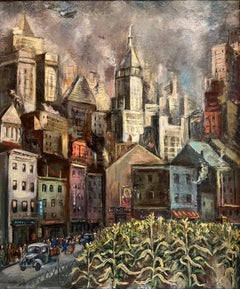
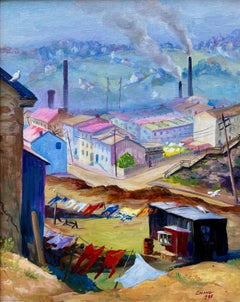
NYC Cityscape American Scene WPA Modern Realism Mid 20th Century Architectural

NYC Cityscape American Scene WPA Modern Realism Mid 20th Century Architectural

By Ernest Fiene

Located in New York, NY

NYC Cityscape American Scene WPA Modern Realism Mid 20th Century Architectural Ernest Fiene (1894-1965) Cityscape 36 x 30 inches Oil on canvas Signed and dated 1930. lower right Provenance Estate of the artist. ACA Galleries, New York Exhibited New York, Frank Rehn Gallery, Changing Old New York, 1931. New York, ACA Galleries, Ernest Fiene: Art of the City, 1925-1955, May 2-23, 1981, n.p., no. 5. BIO Ernest Fiene was born in Elberfeld, Germany in 1894. As a teenager, Fiene immigrated to the United States in 1912. He studied art at the National Academy of Design in New York City from 1914 to 1918, taking day classes with Thomas Maynard and evening classes with Leon Kroll. Fiene continued his studies at the Beaux-Arts Institute of Design in New York from 1916 to 1918, adding classes in printmaking at the Art Students League in 1923. Fiene began his career as an artist in 1919 with his first exhibition of watercolors at the MacDowell Club arranged by his mentor Robert Henri. In 1923 the Whitney Studio Club mounted a large exhibition of his works. The following year he had an exhibition at the New Gallery in New York, which completely sold out all fifty-two works, including paintings, watercolors, drawings, and etchings. With the proceeds of sales from the New Gallery exhibition, Ernest Fiene and his younger brother Paul, a sculptor, built studios in Woodstock, New York in 1925. In the early Twenties Ernest Fiene painted mostly landscapes of Woodstock and both the Ramapo and Hudson River Valleys. The first monograph from the Younger Artists Series was published on Fiene in 1922. Published in Woodstock, the series went on to include Alexander Brook, Peggy Bacon, and Yasuo Kuniyoshi. The book reproduced 1 illustration in color and another 27 reproductions in black and white. Around 1925 Fiene became fascinated with the intensity, excitement, and opportunities for color harmonies New York City offered as a subject. His paintings shifted to urban and industrial themes with architecture, industry, and transportation becoming his subjects. By 1926 Fiene had attracted the dealer Frank K.M. Rehn, who gave him a one-man exhibition that year, which travelled to the Boston Arts Club. C.W. Kraushaar Galleries gave Fiene a one-man exhibition of urban, landscape, portrait, and still life paintings in 1927. Julianna Force, the director of the Whitney Studio Club and first director of the Whitney Museum of American Art, included two of Fiene’s paintings in a fall exhibition in 1928. The Whitney Studio Club showed Fiene’s paintings in a two-man exhibition with Glenn O. Coleman that year and acquired three of Fiene’s paintings. Also in 1928 Fiene became affiliated with Edith Halpert’s Downtown Gallery where he had an exhibition of 20 lithographs in the spring. Fiene sold his house in Woodstock in 1928 to spend more of his time in New York City. With so many successful exhibitions, Fiene returned to Paris in 1928-29 where he rented Jules Pascin's studio and studied at the Académie de la Grande Chaumière. In France, Fiene painted both landscape and urban subjects developed from ideas influenced by Cubist geometry and the use of flat areas of broad color. Upon returning to New York in 1930, Fiene used this new approach to continue to paint New York skyscraper and waterfront subjects, as well as to begin a series of paintings on changing old New York based on the excavations for Radio City Music Hall and the construction of the Empire State Building. Frank K.M. Rehn Galleries exhibited this series, titled “Changing Old New York,” in 1931. Fiene also has solo exhibitions at Rehn Galleries in 1930 and 1932. Fiene’s oil paintings are exhibited at the Chicago Arts Club in 1930 as well. Fiene was included in the Museum of Modern Art’s exhibition Painting and Sculpture by Living Americans in December of 1931. Visiting New York, Henri Matisse saw the exhibition and called Fiene’s Razing Buildings, West 49th Street the finest painting he had seen in New York. Fiene had two mural studies from his Mechanical Progress series exhibited at the Museum of Modern Art’s exhibition Murals by American Painters and Photographers in 1932. Fiene sent View from my Window which depicts Fiene working on a lithograph stone while looking out his window to the newly completed Empire State Building to the Carnegie International in 1931. In 1932 Fiene participated in the first Biennial of American Painting at the Whitney Museum and his prints were included in exhibitions at the Downtown Gallery and the Wehye Gallery. In the same year, Fiene was awarded a Guggenheim fellowship to further study mural painting in Florence, Italy. On his return from Italy in 1933 Fiene re-engaged himself in New York City life and won several public and private mural projects. Fiene resumed his active exhibition schedule, participating in two group exhibitions at the Whitney Museum and a one-man exhibition of recent paintings at the Downtown Gallery in January 1934. In 1933 he purchased a farm in Southbury, Connecticut, which added Connecticut scenes to his landscape subjects. This was also the year Fiene began to spend summers on Monhegan Island, Maine, where he painted seascapes, harbor scenes, and still lifes. Fiene’s landscape paintings attracted numerous commissions as part of the American Scene movement. Through the fall and winter of 1935-36, Fiene took an extended sketching trip through the urban, industrial, and farming areas of Pennsylvania and West Virginia. Most of the twenty-four Pennsylvania urban and rural paintings...

Category

1930s American Modern Avraham Binder Paintings

Materials

Canvas, Oil

Till the Clouds Roll By 1945 Frank Sinatra Mid Century Modern Hollywood Film WPA

Till the Clouds Roll By 1945 Frank Sinatra Mid Century Modern Hollywood Film WPA

By Richard Whorf

Located in New York, NY

Till the Clouds Roll By 1945 Frank Sinatra Mid Century Modern Hollywood Film WPA TILL THE COULDS ROLL BY (Film Set), oil on canvas, 20 x 24 inches signed “Richard Whorf” lower right and signed and dated on the verso “R. Whorf/ Dec. 21, 1945. Frame by Hendenryk. ABOUT THE PAINTING This painting is from the collection of Barbara and Frank Sinatra, dated December 21, 1945 (just nine days after Frank Sinatra’s 30th birthday), and depicts the Metro-Goldwyn-Mayer Culver City backlot during the filming of Till the Clouds Roll By, the direction of the film having been taking over by Richard Whorf in December 1945. It is not presently clear if Whorf gave the Sinatras this painting as a gift, as the presence of the Dalzell Hatfield Galleries label on the verso indicates the painting may have been sourced there. Frank and Nancy Sinatra acquired a number of works from Dalzell Hatfield Galleries during the 1940’s, or perhaps they framed it for the couple. Sinatra performed “Old Man River’ in the film. Sinatra and June Allyson are depicted in the center of the painting. PROVENANCE From the Estate of Mrs. Nancy Sinatra; Dalzell Hatfield Galleries, Ambassador Hotel, Los Angeles. An image of the Dalzell Hatfield label and the back of the original frame (which we replaced with a stunning Heydenrk frame) are attached. Nancy Sinatra was Fran's first wife. Nancy Rose Barbato was 17 years old when she met Frank Sinatra, an 18-year-old singer from Hoboken, on the Jersey Shore in the summer of 1934. They married in 1939 at Our Lady of Sorrows Church in Jersey City where Frank gave Nancy a recording of a song dedicated to her titled "Our Love" as a wedding present. The young newlyweds lived and worked in New Jersey, where Frank worked as an unknown singing waiter and master of ceremonies at the Rustic Cabin while Nancy worked as a secretary at the American Type Founders. His musical career took off after singing with big band leaders Harry James and Tommy Dorsey...

Category

1940s American Modern Avraham Binder Paintings

Materials

Canvas, Oil

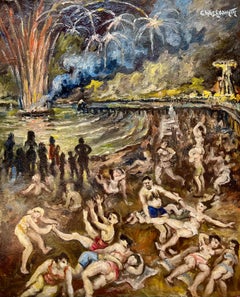
John Haymson "Brooklyn Bridge" Oil Painting of New York Skyline, circa 1955

John Haymson "Brooklyn Bridge" Oil Painting of New York Skyline, circa 1955

By John Haymson

Located in Miami, FL

JOHN HAYMSON – "BROOKLYN BRIDGE" ⚜ Oil on Canvas ⚜ Hand Signed ⚜ Conservation Frame NEW YORK ICON IN VIVID DETAIL This atmospheric oil painting by John Haymson captures the enduring...

Category

1950s Modern Avraham Binder Paintings

Materials

Canvas, Oil

Mother and Child Ibiza Beach Mediterranean art Oil Painting Ignacio Gil Spain

Mother and Child Ibiza Beach Mediterranean art Oil Painting Ignacio Gil Spain

By Ignacio Gil Sala

Located in Sitges, Barcelona

Artist Ignacio Gil Sala (1913–2003) Title Motherhood on the Beach of Ibiza Date c.1990 Medium Oil on canvas Dimensions 38 × 46 cm (14.97 × 18.12 in) Signature Signed “I. Gil Sala” in the lower right corner. Framing Unframed Condition Good condition. Canvas firm and well stretched with stable paint surface. Description Luminous Mediterranean scene by Spanish painter Ignacio Gil Sala depicting a mother holding her daughter on the rocky shore of Ibiza. The composition combines figure painting and coastal landscape through a vibrant, expressive brushstroke typical of late 20th-century Spanish post-Impressionism. The intense blues of the sea contrast with the warm tones of the rocks and figures, creating a bright and atmospheric Mediterranean setting. Works depicting Ibiza and family scenes by the sea are especially appreciated by collectors of Spanish figurative painting and Mediterranean coastal art. Biography Ignacio Gil Sala (1913–2003) was a Spanish painter known for his Mediterranean landscapes and figurative scenes. Trained at the School of Fine Arts in Barcelona, he developed a post-Impressionist style characterized by vibrant color, dynamic brushwork and a strong sensitivity to Mediterranean light. Throughout his career he exhibited widely in Spain and abroad, dedicating much of his production to coastal landscapes, Mediterranean villages and scenes inspired by Ibiza. Ibiza Mediterranean painting Mother and child Spanish figurative painting Beach scene Mediterranean coast Spanish oil painting Post Impressionist Ibiza art...

Category

1990s Modern Avraham Binder Paintings

Materials

Canvas, Oil

Brooklyn Transfer East River Crossing, Oil on Canvas Painting Frederick Reimers

Brooklyn Transfer East River Crossing, Oil on Canvas Painting Frederick Reimers

Located in Atlanta, GA

"Bklyn Transfer, East River Crossing" by Frederick Reimers (1911–1994) This unique, captivating cityscape painting by Frederick Reimers (USA, 1911–1994) offers a dynamic view of the ...

Category

20th Century Modern Avraham Binder Paintings

Materials

Canvas, Oil, Acrylic

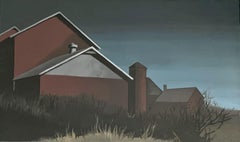
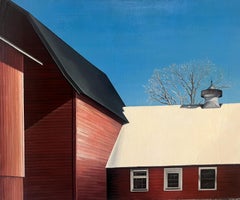
“Middleton Place II, 1974” Wolf Kahn, West Brattleboro, Vermont Barn Oil Canvas

“Middleton Place II, 1974” Wolf Kahn, West Brattleboro, Vermont Barn Oil Canvas

By Wolf Kahn

Located in Yardley, PA

A fantastic early painting from Kahn’s iconic barn series depicting Dr. Middleton’s property in West Brattleboro, VT. Here, Kahn turns a familiar rural motif into something hovering ...

Category

1970s American Modern Avraham Binder Paintings

Materials

Canvas, Oil

"London" Cityscape Oil Painting on Canvas by Denis Paul Noyer, Framed

"London" Cityscape Oil Painting on Canvas by Denis Paul Noyer, Framed

By Denis Paul Noyer

Located in Encino, CA

"London," an original oil on canvas by Denis Paul Noyer, is a piece for the true collector. Noyer's capture of the architectural details of the surrounding buildings projects from th...

Category

1970s Modern Avraham Binder Paintings

Materials

Oil, Canvas

Barcelona Las Ramblas Flower Market Oil Painting Impressionist Street Scene

Barcelona Las Ramblas Flower Market Oil Painting Impressionist Street Scene

Located in Sitges, Barcelona

Artist: Francisco Carbonell Massabé (Barcelona, 1928) Title: Las Ramblas de las Flores, Barcelona Medium: Oil on canvas Dimensions Height: 60 cm Width: 73 cm (23.62 × 28.74 in) Signature: Signed lower right; signed and titled on the reverse Frame: Unframed Condition: Very good condition. Firm canvas and stable paint layer Charming impressionist street scene depicting the famous Las Ramblas flower market in Barcelona, one of the city’s most iconic and vibrant locations. The composition captures the lively atmosphere of the historic boulevard, where flower stalls filled with colorful bouquets line the promenade while pedestrians stroll beneath the trees. The artist organizes the scene through a dynamic interplay of figures, market stands and architecture, creating a sense of movement and urban life. Executed with a loose and expressive impressionist brushwork, the painting emphasizes light, color and atmosphere. The rich palette of warm earth tones, greens and floral colors gives the scene a vivid Mediterranean character while maintaining an elegant pictorial balance. Paintings representing Barcelona and Las Ramblas are highly sought after by collectors and interior designers, as they evoke the cultural identity and vibrant lifestyle of the city. The subject matter, combined with the decorative strength of the composition, makes this work particularly appealing for display in both classic and contemporary interiors. An attractive and lively cityscape painting capturing the spirit of Barcelona’s most famous avenue. Francisco Carbonell Massabé (Barcelona, 1928) is a Spanish painter trained at the Schools of Fine Arts and at La Llotja in Barcelona. His artistic career has focused primarily on landscape and urban scenes, strongly influenced by Mediterranean impressionism. His work is characterized by loose brushwork, luminous color and a vibrant treatment of everyday life. He exhibited in various Spanish and European cities, developing a body of work appreciated for its evocative depictions of Mediterranean cities and landscapes. His scenes of Barcelona remain among his most recognizable and collectible subjects. Barcelona painting Las Ramblas painting Barcelona street scene Flower market painting...

Category

1990s Modern Avraham Binder Paintings

Materials

Canvas, Oil

Irish Modernist Oil on Canvas Painting "Young Bathers" Children on the Beach

Irish Modernist Oil on Canvas Painting "Young Bathers" Children on the Beach

Located in Portland, OR

An important Irish Modernist oil on canvas painting by Henry Robertson Craig (1816-1984), titled "Young Bathers", circa 1960. This very beautiful painting of children seated on the...

Category

1960s Modern Avraham Binder Paintings

Materials

Oil, Canvas

Spanish Mediterranean Hill Town Landscape Oil Painting Post-Impressionist Style

Spanish Mediterranean Hill Town Landscape Oil Painting Post-Impressionist Style

By Josep Moscardo

Located in Sitges, Barcelona

Medium: Oil on canvas Dimensions: 61 × 46 cm (24.02 × 18.11 in) Signature: Signed lower area Date: 1977 Condition: Very good. Stable canvas and well-preserved paint layer. Framed: No. The painting is currently unframed. Style: Post-Impressionist Subject: Mediterranean hill town landscape Expressive Mediterranean landscape depicting a historic Spanish hill town crowned by a fortified structure overlooking clustered white and terracotta buildings. The composition is constructed through energetic, visible brushwork and a vibrant palette of warm earth tones contrasted with an intense blue sky. The artist organizes the architecture in rhythmic planes that guide the viewer’s eye upward toward the monumental structure dominating the skyline. The painting reflects the Mediterranean post-impressionist tradition, where color and structure take precedence over strict realism, resulting in a lively and decorative interpretation of the landscape. Works of this kind are particularly sought after for interior design projects thanks to their warm palette, architectural subject matter and timeless Mediterranean atmosphere. An attractive original painting combining decorative strength with the charm of mid-20th-century Spanish landscape painting. Josep Moscardó (Barcelona, 1953) is a Spanish painter, sculptor and draftsman associated with the Mediterranean post-impressionist tradition. His work is characterized by vibrant color, spontaneous brushwork and a strong interest in landscape and architectural subjects. Throughout his career he has portrayed scenes from Catalonia, the Balearic Islands and other European locations, developing a style that balances expressive color with structural composition. Alongside his painting practice, he has also explored sculpture and drawing, expanding his artistic language into three-dimensional forms. His paintings appear regularly in galleries and private collections and are appreciated for their decorative strength and Mediterranean character. Spanish landscape Mediterranean landscape Spanish village painting...

Category

1970s Modern Avraham Binder Paintings

Materials

Canvas, Oil

19th Century Maestro View of Venice with the Island of San Giorgio Maggiore

19th Century Maestro View of Venice with the Island of San Giorgio Maggiore

Located in Milano, Lombardia

Maestro active in Venice in the 19th Century Title: View of Venice with the Island of San Giorgio Maggiore and the Basilica Medium: Oil on canvas Dimensions: without frame 29 × 41 c...

Category

Late 19th Century Modern Avraham Binder Paintings

Materials

Oil, Canvas

Previously Available Items
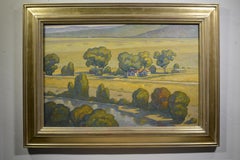
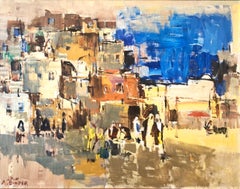
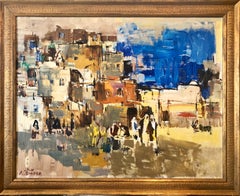
Large Abstract landscape of Jerusalem Israeli Oil Painting Judaica

Large Abstract landscape of Jerusalem Israeli Oil Painting Judaica

By Avraham Binder

Located in Surfside, FL

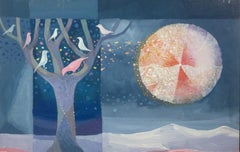
Large gilt framed abstract modernist landscape of Jerusalem. Framed it measures 33.25 X 41.25 inches. Canvas measures 28 x 36 inches. Bold Blue sky. Avraham Binder was born in 1906 in Vilnius (or Vilna), now part of Lithuania. He began painting at an early age and completed the prescribed studies in painting at the academy of arts in his native city. Upon graduation, at the commencement exhibition of works submitted by the graduates, he was awarded a prize in recognition of his talents. Artistic talent had deep roots in the Binder family. Avraham's father and grandfather were both artistically inclined, as was his sister Zila Binder and daughter Yael. In fact, he came from a long line of master artistic bookbinders, hence the family surname. The Binder family emigrated to Palestine in 1920. There, his father established a bookbinding workshop in Tel-Aviv while Avraham pursued painting. Binder has not identified with any particular modern school nor narrow artistic doctrine. He struggles to verbally explain his personal conception. Instead, he derives inspiration from emotions, resulting in a great variety of artistic treatments. Particularly memorable are his urban landscapes with their predominance of blues and aquamarines, composed of a profusion of squares and rectangles, crowding one another and covering nearly the entire canvas. The angular shapes are interspersed with radiant dots of red, gold and yellow, like the lights of the big city. Those squares and rectangles reflect, perhaps, impressions of a childhood spent among books which were scattered about the home and workshop of his father, the bookbinder. These shapes, no doubt, had their influence upon the artist whose first youthful impressions were – books. Traces of these shapes are discernible in Binder’s work to this day, in the angularity of splashes of color which, no longer crowded together, are now well separated to create an airy spaciousness. Not only the splashes of color – the inventing space, too – creates figurative effects in the artist’s treatment. Avraham Binder is not a “cerebral” painter. Neither identified with any particular modern school, nor preaching any narrow artistic doctrine, he is an emotional artist: his inspiration, derived from the heart, leads him on to the most varied range of treatments in his artistic work. In vain might one try to persuade him to define his personal conception of painting. He is not one to indulge in verbal explanation. But his sheer artistic skill, his virtuosity with the paint brush, did impel him to experiment widely with the artistic techniques of the modern age. And his exceptional talent stood him in good stead in all this experimentation. Binders large-scale urban landscapes are not mere constructs to represent our present-day architecture with its pervasive angularity. Made up as they are of color, Binder’s unique color composition qualifies these canvases to be ranked among the foremost artistic works in Israeli painting. They are uniquely Binder, very different from what we see in the work of his contemporaries. Here and there, Binder also introduces the human element into these paintings. He lives and breathes the atmosphere of his surroundings, deeply experiencing the sea and the shore of Tel-Aviv that confront him day after day, and which he has transferred to his canvases, as metaphors in paint, throughout the life. More recently, he has created a new series of shore-and-seascapes, in tones ranging from brown to blue. ochre, violet and pale yellow – marvelous views of the sea and of figures enlivening its shore. In yet another series, featuring nearly the same range of hues, he lets us view, through his eyes, the Carmel Market in Tel-Aviv, or the city’s coffee houses with their crowds of people, heads bunched together as if in search of human closeness, with the windows looking in upon them. He has also done large paintings of Jerusalem – not the Jerusalem of gloom and holiness, but a Jerusalem in contrast to the flat topography of Tel-Aviv; it is this different topography which here provides the challenge for him as a painter. And the colors – the colors are bright, full of light, an inner illumination which seems to emanate from the artist himself, rather than from the sun beating down from above. So many great artists have built their life’s work upon watercolors. Binder’s watercolors are in no way inferior in their artistic worth to many of those, what with their spontaneity, their translucent quality, their color combinations, and the artist’s ability to say so much with an economy of brush strokes. We have here a painter who, until the end of his life, was still in his full creative powers, and who continued to add to his impressive storehouse of artistic works. Hundreds of his paintings grace the homes of collectors in Israel and throughout the world, or hang in his private collection; they include Israel landscapes and, most importantly, cityscapes; an exquisite series of wild flowers; many portrait paintings; experimental wood sculptures; murals painted on wood panels; reliefs…, etc. All these are testimony to an artist who refuses to rest on his laurels, who forever reaches out to try his hand at new challenges, strikes out in novel directions, discovers innovative techniques, and experiments in all the dimensions of the plastic arts. On the Israel Museum website they have listed an exhibition of his Artists in Israel for the Defense, Tel Aviv Museum of Art, Helena Rubinstein Pavilion, Tel Aviv 1967 Artists: Avraham Binder, Motke Blum, (Mordechai) Samuel Bak, Yosl Bergner, Nahum Gilboa, Jean David, Marcel Janco, Lea Nikel, Jacob Pins, Esther Peretz Arad, Dani Karavan, Reuven Rubin, Zvi Raphaely, Yossi Stern...

Category

20th Century Modern Avraham Binder Paintings
Materials

Canvas, Oil

Port of Old Jaffa (Tel Aviv)

Port of Old Jaffa (Tel Aviv)

By Avraham Binder

Located in Surfside, FL

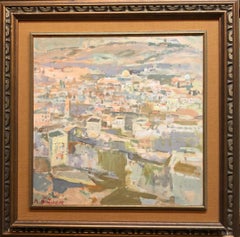
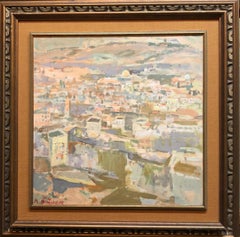
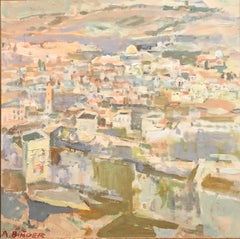
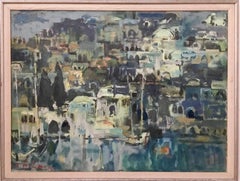
Avraham Binder was born in 1906 in Vilnius (or Vilna), now part of Lithuania. He began painting at an early age and completed the prescribed studies in painting at the academy of arts in his native city. Upon graduation, at the commencement exhibition of works submitted by the graduates, he was awarded a prize in recognition of his talents. Artistic talent had deep roots in the Binder family. Avraham's father and grandfather were both artistically inclined, as was his sister Zila Binder and daughter Yael. In fact, he came from a long line of master artistic bookbinders, hence the family surname. The Binder family emigrated to Palestine in 1920. There, his father established a bookbinding workshop in Tel-Aviv while Avraham pursued painting. Binder has not identified with any particular modern school nor narrow artistic doctrine. He struggles to verbally explain his personal conception. Instead, he derives inspiration from emotions, resulting in a great variety of artistic treatments. Particularly memorable are his urban landscapes with their predominance of blues and aquamarines, composed of a profusion of squares and rectangles, crowding one another and covering nearly the entire canvas. The angular shapes are interspersed with radiant dots of red, gold and yellow, like the lights of the big city. Those squares and rectangles reflect, perhaps, impressions of a childhood spent among books which were scattered about the home and workshop of his father, the bookbinder. These shapes, no doubt, had their influence upon the artist whose first youthful impressions were – books. Traces of these shapes are discernible in Binder’s work to this day, in the angularity of splashes of color which, no longer crowded together, are now well separated to create an airy spaciousness. Not only the splashes of color – the inventing space, too – creates figurative effects in the artist’s treatment. Avraham Binder is not a “cerebral” painter. Neither identified with any particular modern school, nor preaching any narrow artistic doctrine, he is an emotional artist: his inspiration, derived from the heart, leads him on to the most varied range of treatments in his artistic work. In vain might one try to persuade him to define his personal conception of painting. He is not one to indulge in verbal explanation. But his sheer artistic skill, his virtuosity with the paint brush, did impel him to experiment widely with the artistic techniques of the modern age. And his exceptional talent stood him in good stead in all this experimentation. Binders large-scale urban landscapes are not mere constructs to represent our present-day architecture with its pervasive angularity. Made up as they are of color, Binder’s unique color composition qualifies these canvases to be ranked among the foremost artistic works in Israeli painting. They are uniquely Binder, very different from what we see in the work of his contemporaries. Here and there, Binder also introduces the human element into these paintings. He lives and breathes the atmosphere of his surroundings, deeply experiencing the sea and the shore of Tel-Aviv that confront him day after day, and which he has transferred to his canvases, as metaphors in paint, throughout the life. More recently, he has created a new series of shore-and-seascapes, in tones ranging from brown to blue. ochre, violet and pale yellow – marvelous views of the sea and of figures enlivening its shore. In yet another series, featuring nearly the same range of hues, he lets us view, through his eyes, the Carmel Market in Tel-Aviv, or the city’s coffee houses with their crowds of people, heads bunched together as if in search of human closeness, with the windows looking in upon them. He has also done large paintings of Jerusalem...

Category

20th Century Modern Avraham Binder Paintings
Materials

Oil

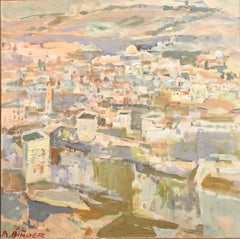
Large Abstract landscape of Jerusalem Israeli Oil Painting Judaica

Large Abstract landscape of Jerusalem Israeli Oil Painting Judaica

By Avraham Binder

Located in Surfside, FL

Large gilt framed abstract modernist landscape of Jerusalem. Framed it measures 33.25 X 41.25 inches. Canvas measures 28 x 36 inches. Bold Blue sky. Avraham Binder was born in 1906 in Vilnius (or Vilna), now part of Lithuania. He began painting at an early age and completed the prescribed studies in painting at the academy of arts in his native city. Upon graduation, at the commencement exhibition of works submitted by the graduates, he was awarded a prize in recognition of his talents. Artistic talent had deep roots in the Binder family. Avraham's father and grandfather were both artistically inclined, as was his sister Zila Binder and daughter Yael. In fact, he came from a long line of master artistic bookbinders, hence the family surname. The Binder family emigrated to Palestine in 1920. There, his father established a bookbinding workshop in Tel-Aviv while Avraham pursued painting. Binder has not identified with any particular modern school nor narrow artistic doctrine. He struggles to verbally explain his personal conception. Instead, he derives inspiration from emotions, resulting in a great variety of artistic treatments. Particularly memorable are his urban landscapes with their predominance of blues and aquamarines, composed of a profusion of squares and rectangles, crowding one another and covering nearly the entire canvas. The angular shapes are interspersed with radiant dots of red, gold and yellow, like the lights of the big city. Those squares and rectangles reflect, perhaps, impressions of a childhood spent among books which were scattered about the home and workshop of his father, the bookbinder. These shapes, no doubt, had their influence upon the artist whose first youthful impressions were – books. Traces of these shapes are discernible in Binder’s work to this day, in the angularity of splashes of color which, no longer crowded together, are now well separated to create an airy spaciousness. Not only the splashes of color – the inventing space, too – creates figurative effects in the artist’s treatment. Avraham Binder is not a “cerebral” painter. Neither identified with any particular modern school, nor preaching any narrow artistic doctrine, he is an emotional artist: his inspiration, derived from the heart, leads him on to the most varied range of treatments in his artistic work. In vain might one try to persuade him to define his personal conception of painting. He is not one to indulge in verbal explanation. But his sheer artistic skill, his virtuosity with the paint brush, did impel him to experiment widely with the artistic techniques of the modern age. And his exceptional talent stood him in good stead in all this experimentation. Binders large-scale urban landscapes are not mere constructs to represent our present-day architecture with its pervasive angularity. Made up as they are of color, Binder’s unique color composition qualifies these canvases to be ranked among the foremost artistic works in Israeli painting. They are uniquely Binder, very different from what we see in the work of his contemporaries. Here and there, Binder also introduces the human element into these paintings. He lives and breathes the atmosphere of his surroundings, deeply experiencing the sea and the shore of Tel-Aviv that confront him day after day, and which he has transferred to his canvases, as metaphors in paint, throughout the life. More recently, he has created a new series of shore-and-seascapes, in tones ranging from brown to blue. ochre, violet and pale yellow – marvelous views of the sea and of figures enlivening its shore. In yet another series, featuring nearly the same range of hues, he lets us view, through his eyes, the Carmel Market in Tel-Aviv, or the city’s coffee houses with their crowds of people, heads bunched together as if in search of human closeness, with the windows looking in upon them. He has also done large paintings of Jerusalem...

Category

20th Century Modern Avraham Binder Paintings
Materials

Canvas, Oil

Large Abstract landscape of Jerusalem Israeli Oil Painting Judaica

Large Abstract landscape of Jerusalem Israeli Oil Painting Judaica

By Avraham Binder

Located in Surfside, FL

Avraham Binder was born in 1906 in Vilnius (or Vilna), now part of Lithuania. He began painting at an early age and completed the prescribed studies in painting at the academy of arts in his native city. Upon graduation, at the commencement exhibition of works submitted by the graduates, he was awarded a prize in recognition of his talents. Artistic talent had deep roots in the Binder family. Avraham's father and grandfather were both artistically inclined, as was his sister Zila Binder and daughter Yael. In fact, he came from a long line of master artistic bookbinders, hence the family surname. The Binder family emigrated to Palestine in 1920. There, his father established a bookbinding workshop in Tel-Aviv while Avraham pursued painting. Binder has not identified with any particular modern school nor narrow artistic doctrine. He struggles to verbally explain his personal conception. Instead, he derives inspiration from emotions, resulting in a great variety of artistic treatments. Particularly memorable are his urban landscapes with their predominance of blues and aquamarines, composed of a profusion of squares and rectangles, crowding one another and covering nearly the entire canvas. The angular shapes are interspersed with radiant dots of red, gold and yellow, like the lights of the big city. Those squares and rectangles reflect, perhaps, impressions of a childhood spent among books which were scattered about the home and workshop of his father, the bookbinder. These shapes, no doubt, had their influence upon the artist whose first youthful impressions were – books. Traces of these shapes are discernible in Binder’s work to this day, in the angularity of splashes of color which, no longer crowded together, are now well separated to create an airy spaciousness. Not only the splashes of color – the inventing space, too – creates figurative effects in the artist’s treatment. Avraham Binder is not a “cerebral” painter. Neither identified with any particular modern school, nor preaching any narrow artistic doctrine, he is an emotional artist: his inspiration, derived from the heart, leads him on to the most varied range of treatments in his artistic work. In vain might one try to persuade him to define his personal conception of painting. He is not one to indulge in verbal explanation. But his sheer artistic skill, his virtuosity with the paint brush, did impel him to experiment widely with the artistic techniques of the modern age. And his exceptional talent stood him in good stead in all this experimentation. Binders large-scale urban landscapes are not mere constructs to represent our present-day architecture with its pervasive angularity. Made up as they are of color, Binder’s unique color composition qualifies these canvases to be ranked among the foremost artistic works in Israeli painting. They are uniquely Binder, very different from what we see in the work of his contemporaries. Here and there, Binder also introduces the human element into these paintings. He lives and breathes the atmosphere of his surroundings, deeply experiencing the sea and the shore of Tel-Aviv that confront him day after day, and which he has transferred to his canvases, as metaphors in paint, throughout the life. More recently, he has created a new series of shore-and-seascapes, in tones ranging from brown to blue. ochre, violet and pale yellow – marvelous views of the sea and of figures enlivening its shore. In yet another series, featuring nearly the same range of hues, he lets us view, through his eyes, the Carmel Market in Tel-Aviv, or the city’s coffee houses with their crowds of people, heads bunched together as if in search of human closeness, with the windows looking in upon them. He has also done large paintings of Jerusalem...

Category

20th Century Modern Avraham Binder Paintings
Materials

Canvas, Oil

Port of Old Jaffa (Tel Aviv)

Port of Old Jaffa (Tel Aviv)

By Avraham Binder

Located in Surfside, FL

Avraham Binder was born in 1906 in Vilnius (or Vilna), now part of Lithuania. He began painting at an early age and completed the prescribed studies in painting at the academy of arts in his native city. Upon graduation, at the commencement exhibition of works submitted by the graduates, he was awarded a prize in recognition of his talents. Artistic talent had deep roots in the Binder family. Avraham's father and grandfather were both artistically inclined, as was his sister Zila Binder and daughter Yael. In fact, he came from a long line of master artistic bookbinders, hence the family surname. The Binder family emigrated to Palestine in 1920. There, his father established a bookbinding workshop in Tel-Aviv while Avraham pursued painting. Binder has not identified with any particular modern school nor narrow artistic doctrine. He struggles to verbally explain his personal conception. Instead, he derives inspiration from emotions, resulting in a great variety of artistic treatments. Particularly memorable are his urban landscapes with their predominance of blues and aquamarines, composed of a profusion of squares and rectangles, crowding one another and covering nearly the entire canvas. The angular shapes are interspersed with radiant dots of red, gold and yellow, like the lights of the big city. Those squares and rectangles reflect, perhaps, impressions of a childhood spent among books which were scattered about the home and workshop of his father, the bookbinder. These shapes, no doubt, had their influence upon the artist whose first youthful impressions were – books. Traces of these shapes are discernible in Binder’s work to this day, in the angularity of splashes of color which, no longer crowded together, are now well separated to create an airy spaciousness. Not only the splashes of color – the inventing space, too – creates figurative effects in the artist’s treatment. Avraham Binder is not a “cerebral” painter. Neither identified with any particular modern school, nor preaching any narrow artistic doctrine, he is an emotional artist: his inspiration, derived from the heart, leads him on to the most varied range of treatments in his artistic work. In vain might one try to persuade him to define his personal conception of painting. He is not one to indulge in verbal explanation. But his sheer artistic skill, his virtuosity with the paint brush, did impel him to experiment widely with the artistic techniques of the modern age. And his exceptional talent stood him in good stead in all this experimentation. Binders large-scale urban landscapes are not mere constructs to represent our present-day architecture with its pervasive angularity. Made up as they are of color, Binder’s unique color composition qualifies these canvases to be ranked among the foremost artistic works in Israeli painting. They are uniquely Binder, very different from what we see in the work of his contemporaries. Here and there, Binder also introduces the human element into these paintings. He lives and breathes the atmosphere of his surroundings, deeply experiencing the sea and the shore of Tel-Aviv that confront him day after day, and which he has transferred to his canvases, as metaphors in paint, throughout the life. More recently, he has created a new series of shore-and-seascapes, in tones ranging from brown to blue. ochre, violet and pale yellow – marvelous views of the sea and of figures enlivening its shore. In yet another series, featuring nearly the same range of hues, he lets us view, through his eyes, the Carmel Market in Tel-Aviv, or the city’s coffee houses with their crowds of people, heads bunched together as if in search of human closeness, with the windows looking in upon them. He has also done large paintings of Jerusalem...

Category

20th Century Modern Avraham Binder Paintings
Materials

Oil

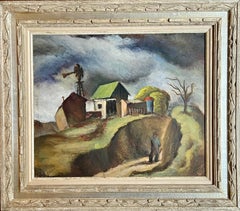
Avraham Binder paintings for sale on 1stDibs.

Find a wide variety of authentic Avraham Binder paintings available for sale on 1stDibs. You can also browse by medium to find art by Avraham Binder in canvas, fabric, oil paint and more. Much of the original work by this artist or collective was created during the 20th century and is mostly associated with the modern style. Not every interior allows for large Avraham Binder paintings, so small editions measuring 36 inches across are available. Customers who are interested in this artist might also find the work of David Azuz, Moshe Katz, and Denis Paul Noyer. Avraham Binder paintings prices can differ depending upon medium, time period and other attributes. On 1stDibs, the price for these items starts at $4,500 and tops out at $4,500, while the average work can sell for $4,500.