By Barry Flanagan
Located in BUNGAY, SUFFOLK
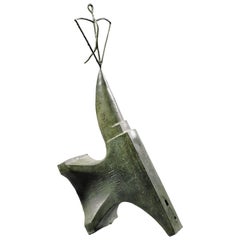
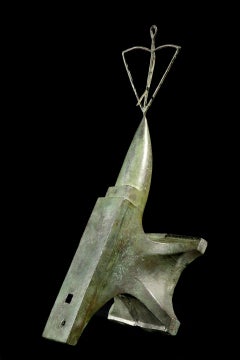
Barry Flanagan (British, 1941-2009): Pilgrim on Anvil
No 5, cast in an edition of 7 plus one artist's cast
Signed, the anvil dated 1951
Bronze
Conceived in 1984
Provenance: Private collection, acquired directly from the artist
Exhibition history: Waddington Galleries, 29th May-22nd June 1985. Catalogue and private view invitation included
Literature: Enrique Juncosa (ed.), Barry Flanagan: Sculpture 1965-2005 (Ireland, 2006) no.89, p.89, illustrated. Ferdinand Ulrich (ed.) Barry Flanagan: Sculpture and Drawing (Kerber Verlag, 2002), illustrated
Related to: No.2 of the same edition included in Recklinghausen Kunsthalle, Barry Flanagan: Plastik und Zeichnung - Sculpture and Drawing, 5 May-14 July 2002, cat no.2, illus color p110, touring to: Nice, Musée d'Art Moderne et d'Art Contemporain, 6 December 2002-25 May 2003
Tate Britain held a retrospective on Barry Flanagan 2011-2012. Barry Flanagan was one of Britain’s most important and original artists, and this exhibition re-evaluated his position as a key figure in the development of British and international sculpture. Focusing on the artists’ studio practice it brought together works from 1965-1982. It highlighted how his sculptures emerged through the interaction of idea, form and process and reflected his interest in and engagement with literature, poetry and 'pataphysics. The show also demonstrated the vital impact these early works had on the development of Flanagan's hare sculptures. This was the first major exhibition of Flanagan’s work in London since 1983.
The sculpture consists of an up-ended bronze anvil with an abstract linear motif balanced on or projecting from the tip, the whole richly patinated.
Measures: Height 34 cm, 13¼in, width 78 cm, 30¾in, breadth 22.5 cm, 9in.
The anvil is a peculiarly appropriate image for a sculptor and it is used knowingly here and in a number other of Flanagan's sculptures. Its apparent solidity lends a physical gravitas to the piece, and as a classical form it also lends the gravitas of thousands of years of history. The anvil is a tool with which otherwise intractable raw materials are manipulated into man-made lines and transformed into useful objects. Its inertia allows the energy with which it is struck to transfer to the object which is being formed, it acts as a medium. It is a craftsman's tool and Flanagan identified with the craftsman; for a while as a younger artist he supplemented his income with work as a builder, frame-maker and then baker, and later he worked at a stone mason's yard. His practice as an artist was 'based on the notion of skill within a particular Craft.' Fuchs, R. (foreword), Barry Flanagan: sculpture 1966-1976 (Eindhoven: Municipal Van Abbemuseum, 1977).
Anvil, 1981 (exhibited at Venice Biennale 1982)
The anvil here is tilted onto one end, giving a sense of movement to an otherwise stabile form. It looks as though it has been knocked over or even tossed aside as if it weighs very little, by a super-human force...
Category
1980s Irish Modern Vintage Furniture