By Yoshitomo Nara
Located in Madrid, Madrid
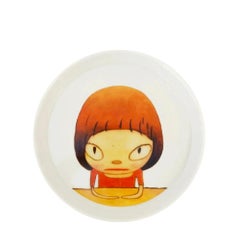
Yoshitomo Nara - Let's talk about "Glory"
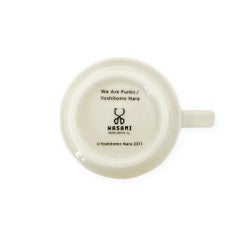
Date of creation: 2011
Medium: Porcelain
Edition: Open
Size: Φ22 mm
Condition: Brand new, inside its custom box
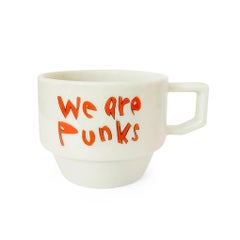
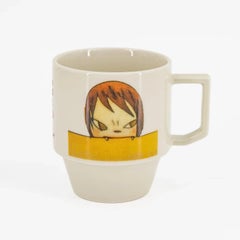
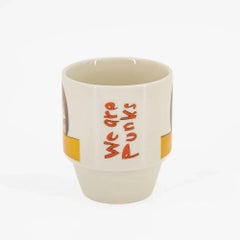
Description: A Hasami ware porcelain plate reproducing Yoshitomo Nara's Let's Talk About "Glory" (2012), an acrylic-on-canvas painting where one of the artist's trademark children stares out with brow slightly furrowed and mouth set in a line that says she has heard what glory is and remains unconvinced.
The original work, measuring roughly life-size, belongs to the period following the 2011 Great East Japan Earthquake, when Nara's palette softened, his paint layers multiplied, and the angry scowls of his earlier figures gave way to a different register: heavy-lidded, searching, charged. "I was so depressed that I couldn't help feeling that what I'd been doing was totally meaningless," he later recalled. When the brushes finally came back out, the defiant scowls had gone. What replaced them was a gaze that holds more weight precisely because it asks for less. No raised fist, no bared fangs — just a pair of eyes that have seen something and are still deciding what to make of it.
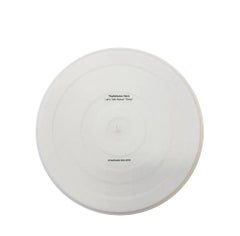
Like the rest of Nara's Hasami porcelain series, this plate is crafted in Nagasaki Prefecture, home to one of Japan's oldest ceramic traditions. Smooth and surprisingly heavy for its size, the body holds a print sharp enough to preserve the layered, almost translucent quality of Nara's post-2011 palette — the soft greens and muted flesh tones that replaced the flat, punchy colours of his earlier work.
ABOUT THE ARTIST
Yoshitomo Nara (奈良美智, b. 1959, Hirosaki) is one of the most influential Japanese artists working today. Round-headed children with piercing gazes populate his canvases and sculptures, images that have gone well beyond the art world to become a broader cultural phenomenon.
Childhood in Aomori: Solitude, Nature, and Radio Waves
Nara grew up in Hirosaki, a small city in Aomori Prefecture at the northern tip of Honshū. Both parents worked long hours, leaving young Yoshitomo to fend for himself after school. The Japanese have a word for children like him, kagikko, latchkey kids who come home to an empty house and learn to keep their own company. That early acquaintance with solitude runs through every painting. Look at any of Nara's figures and you will find a self-contained being who meets your eye with a steadiness that could be courage or could just as easily be vulnerability.
During those solitary years, Western music reached him through the Far East Network (FEN), the U.S. Armed Forces radio station. Rock, folk, and later punk gave him a way to feel before painting ever did. As a young boy he bought his first record, Suzie Q, and has often said that album covers were his earliest art gallery. Later, he would design covers for Shonen Knife, R.E.M., and Bloodthirsty Butchers, and every exhibition he puts on is accompanied by a playlist of his own making.
Education: Aichi and the Kunstakademie Düsseldorf
After earning a BFA (1985) and MFA (1987) at the Aichi Prefectural University of Fine Arts and Music, Nara relocated to Germany to enrol at the Kunstakademie Düsseldorf, the same school that had shaped Joseph Beuys and Gerhard Richter. Under Neo-Expressionist painter A.R. Penck (1991–1993), he received one piece of advice that stuck: "Paint on the canvas as if you are drawing." Bold, pared-back figures, large rounded heads set against bare backgrounds, began to take shape on his canvases.
At the Kunstakademie's annual student show in 1992, visitors saw The Girl with the Knife in Her Hand (1991), a painting that crystallised the tension running through all of Nara's work: an apparently innocent girl holding a tiny knife, a gesture he reads not as aggression but as self-defence against a threatening adult world. Once finished with his studies, Nara settled in Cologne in 1994 and set up in a former cotton mill. Cut off by the language barrier, he turned painting into a conversation with himself, and it was in that solitude that the gaze people remember long after leaving the gallery first appeared.
Return to Japan and International Acclaim
Twelve years later, Nara came back to Japan. I DON'T MIND, IF YOU FORGET ME. opened at the Yokohama Museum of Art in 2001 and toured five Japanese venues, including Hirosaki. MoMA New York acquired 130 of his drawings around the same time, and the travelling retrospective Nothing Ever Happens (2003–2005) cemented his reputation in the United States. Within the Japanese "New Pop" wave, he shared the stage with artists such as Takashi Murakami, Makoto Aida, and Mariko Mori...
Category
2010s Pop Art Chris Reilly Art